Basement waterproofing options and costs in Orléans
In Orléans, basement waterproofing decisions are usually driven by two things: how your water is getting in and how hard it will be to relieve the pressure behind your foundation. With a population of 125,937 (Statistics Canada, 2021 Census), Orléans has a steady mix of older detached homes and newer builds, but the waterproofing work most homeowners notice is often in neighbourhood pockets where original drainage systems have aged out. Many foundations here were built decades ago, when tar-and-paper methods and early weeping tile layouts were more common—if those components fail or clog, water finds alternate paths through mortar joints, cracks, or floor-wall interfaces.
Ottawa’s freeze-thaw cycles also matter for pricing. Repeated winter expansion and spring melt can widen existing cracks and convert “damp” into active seepage. Add Ottawa’s clay-rich soils and a relatively high local water table, and you typically see higher excavation and drainage requirements than you would in better-draining ground. Contractors with proven site-access experience are in especially high demand around Orléans’ family neighbourhoods near Jeanne d’Arc Boulevard, because driveways, landscaped beds, and mature trees often increase labour and disposal costs.
Below are the most common waterproofing approaches and realistic price ranges for a typical detached home, so you can compare quotes before a contractor ever puts numbers on paper.
| Method |
What It Addresses |
Disruption Level |
Durability |
Price Range |
| Exterior excavation + new membrane + drainage tile |
Stops water at the source by replacing failed membrane and weeping tile, reducing hydrostatic pressure |
High (landscaping removal, excavation, backfill) |
Long-term (typically 20–30 years+ with correct backfill and detailing) |
$9,000–$45,000 |
| Interior perimeter drain channel + sump pit |
Intercepts seepage after it enters and discharges it safely away from the foundation |
Medium (floor access; less excavation than exterior) |
Long-term (system longevity depends on pump choice and maintenance) |
$6,000–$20,000 |
| Foundation crack injection (epoxy or polyurethane) |
Seals cracks to prevent seepage; epoxy often targets structural stability while polyurethane targets active leaks |
Low to Medium (minimal disruption; drilling and curing time) |
Good (typically 10–20 years, depending on crack movement and prep) |
$600–$3,000 |
| Sump pump installation (primary + battery backup) |
Manages high water periods during spring melt and heavy rain; backup reduces risk during outages |
Low to Medium (core drilling; sump pit work) |
Reliable if sized and installed correctly (backup adds resilience) |
$2,200–$3,500 |
| Window well drain installation |
Reduces water pooling around egress windows and prevents seepage to window areas |
Low to Medium (localized excavation and grading) |
Good (depends on proper outlet and materials) |
$1,500–$5,000 |
| Lot re-grading / downspout extension |
Stops roof runoff from feeding soil moisture near the foundation; improves shedding away from walls |
Low (typically exterior only) |
Moderate to good (can help for years, but won’t replace failed drainage) |
$800–$4,500 |
Prices are estimates only and vary by project scope, site access and material selection.
What affects the price of waterproofing in Orléans
In Orléans and across the Ottawa economic region, it’s common to see the “same type” of basement waterproofing quote swing by 30–50% when contractors price the site conditions differently. Some bids assume minimal excavation, while others price the full reality: clay-heavy soils that hold water, clogged or missing weeping tile, deeper foundation elevations, and constrained access from fencing, landscaping, and patios. Labour rates and disposal costs also vary by scope—especially where contractors have to cart away heavy clay and bring in properly graded backfill.
Three drivers separate regional costs from the national average: soil type, water table, and freeze-thaw. In clay-heavy ground (common in Ottawa’s broader area), water doesn’t drain freely and the clay can expand and exert lateral pressure during freeze-thaw, worsening cracking over time. A relatively higher local water table increases sump run times and the need for reliable discharge routing. And Ontario’s freeze-thaw cycles widen existing cracks, so an approach that might look “good” in a dry season can fail once spring melt returns.
Two practical examples in Orléans: (1) if your foundation wall is poured concrete with hairline cracking, crack injection may address the symptom without full excavation—often a few thousand dollars instead of an exterior dig. (2) if you have block walls with older weeping tile that’s silted or collapsed, an interior drain channel plus sump system may be the faster first step (commonly within the $6,000–$20,000 band), while a full exterior solution ($9,000–$45,000) becomes the longer-term fix when hydrostatic pressure is consistent.
Because Orléans has a mix of housing ages and many basements that predate modern drainage detailing, “what’s failed underneath” is often the biggest hidden cost variable in the quote you receive.
| Price Factor |
Why It Matters |
Cost Impact |
| Interior vs. exterior approach — interior is less disruptive but addresses symptoms |
Exterior treats the water source; interior primarily intercepts water after entry |
Interior can be notably cheaper; exterior can add significant excavation and membrane labour |
| Foundation type — poured concrete vs. block vs. stone vs. ICF |
Different walls respond differently to cracks and different systems bond best to different substrates |
Poured concrete often pairs well with crack injection; block more often needs drainage complements |
| Soil type — clay expands more than sand, adding pressure |
Clay holds water and expands during freeze-thaw, increasing wall stress and seepage risk |
Clay can raise excavation and waterproofing costs by about 25–50% |
| Crack type and length — hairline vs. structural horizontal cracks |
Hairline cracks may be sealed; movement cracks may require additional assessment or structural steps |
Structural cracks typically increase scope and labour, not just materials |
| Sump pump backup system — battery or water-powered backup needed |
Backup reduces risk during spring flooding or power interruptions |
Costs add to sump projects, but can prevent major losses |
| Access — landscaping, decks, or driveways must be removed for exterior |
Exterior work requires working room and safe excavation depth |
Removal, restoration, and disposal can quickly move a “mid” quote to the high end |
| Weeping tile age — original tile (60+ years) may be completely failed |
Collapsed or silted tile can’t move water effectively |
Replacement often forces exterior pricing or expanded drainage scope |
| Mould or efflorescence remediation required before sealing |
Sealers don’t bond well on active salts/mould without cleaning and drying |
Prep can add days and labour; it also affects product selection |
Permits & regulations in Ontario
In Ontario, some basement waterproofing-related work typically needs a building permit, while other steps often do not. As a homeowner in Orléans, you should expect that foundation excavation, changes to lot drainage, and structural crack repair are the jobs most likely to require permitting because they can affect building performance and how water moves around the structure. If a contractor proposes altering foundation elements in a way that impacts structural integrity, plan for a permit and potentially an engineered review.
Sump pump installations can also require municipal approval depending on where the discharge will go. If the new system connects to the storm system or sanitary infrastructure, you should confirm what approvals are needed before the work starts. For structural crack repair—especially horizontal cracks in block walls or major step cracks that could indicate movement—an assessment from a structural engineer is often required to determine whether underpinning or other structural work is needed.
Here’s how to verify contractor readiness in Ontario, step-by-step:
- Ask for the company’s Ontario licence information and verify it through the relevant online registry for the trades they perform.
- Request a current certificate of liability insurance and confirm it covers the specific waterproofing/foundation scope.
- Verify WSIB/WCB clearance for the workers who will be on-site (ask for the clearance letter or proof of coverage status).
- For structural-level work, ask what engineering support they include and whether they’ll coordinate the engineer’s scope and report.
- Get permit responsibility confirmed in writing: who pulls permits, and what’s included in the quote.
Interior vs exterior waterproofing — what does Orléans need?
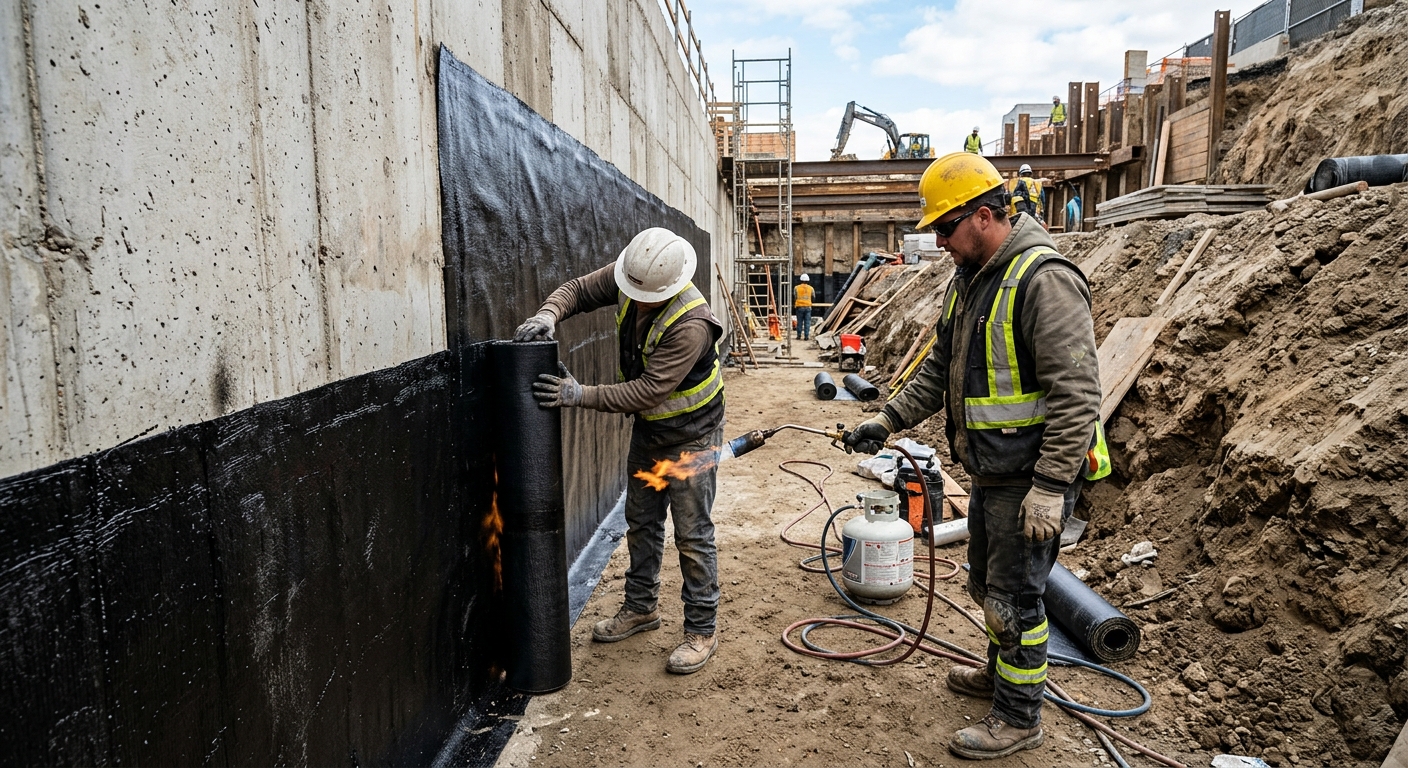
The fundamental difference is where the solution works. Exterior waterproofing—full excavation, new membrane, replacement drainage tile, and careful backfill—addresses water entry at the source. It’s the most permanent option when hydrostatic pressure is persistent, but it’s also the most disruptive because landscaping, walkways, and sometimes driveways must be removed and restored. Interior waterproofing—perimeter drain channel, sump pit, sump pump, and sometimes battery backup—manages water after it enters. In Orléans, that can be a practical first line when exterior access is limited or when you need to stabilize conditions quickly for finishing work.
Given Ottawa-area climate and soil, exterior work often performs best when clay holds moisture against the foundation and freeze-thaw expands existing cracks. That said, not every home needs full excavation. Many poured-concrete foundations respond well to crack injection when cracking is limited and not actively widening; block foundations often benefit from interior drainage as a complement, because mortar joints and block cores can allow seepage pathways that interior drains capture reliably.
Sump pump backup systems are particularly important in Ontario during spring flooding periods, when outages can happen just when meltwater loads are highest. A primary pump alone helps most of the season, but backup helps protect against the “worst-day” scenario.
Example: if you’re seeing localized dampness near one seam or a limited run of hairline cracks, crack injection may keep the cost near the $600–$3,000 band instead of starting at $9,000–$45,000 for exterior excavation. If your basement floods during heavy spring rain and the weeping tile is likely failed, spending the extra on exterior drainage can be justified because interior-only systems can end up running continuously.
| Method |
Best For |
Addresses Source? |
Disruption |
Lifespan |
Price Band |
| Full exterior excavation + membrane |
Ongoing seepage/flooding, failed weeping tile, high hydrostatic pressure, clay backfill issues |
Yes (best match for preventing water entry) |
High |
20–30 years+ with proper detailing |
$9,000–$45,000 |
| Interior French drain + sump system |
Seepage after entry, inaccessible exterior, older weeping tile, damp-to-wet basements |
No (intercepts water after entry) |
Medium |
10–20+ years with correct pump sizing/maintenance |
$6,000–$20,000 |
| Crack injection — epoxy (structural) |
Cracks where structure needs sealing and movement is limited |
Partial (seals pathways; doesn’t replace failed drainage) |
Low to Medium |
10–20 years (depends on crack movement) |
$600–$3,000 |
| Crack injection — polyurethane (active leak) |
Active seepage through cracks with water flow during testing |
Partial (targets the leak pathway) |
Low to Medium |
10–20 years (prep and crack stability matter) |
$800–$3,000 |
| Interior drain channel only (no sump) |
Light moisture, non-flooding conditions where intercepted water can’t pool |
No |
Medium (floor/crawl access) |
5–15 years depending on water load |
$3,500–$10,000 |
| Re-grading + downspout extensions |
Roof runoff issues, minor dampness, improving drainage to slow moisture rise |
No (management of external water) |
Low |
Several years (improves conditions, doesn’t fix failed foundations) |
$800–$4,500 |
How to choose a waterproofing contractor in Orléans
Choosing a waterproofing contractor in Orléans comes down to proof: proof of coverage, proof of scope clarity, and proof they understand Ottawa-area drainage problems. Start by verifying Ontario licensing/authorization for the specific trades they perform, then confirm they carry liability insurance for the job size and site conditions. Next, verify WSIB/WCB coverage: you should be able to receive a clearance letter or proof of coverage status directly from the contractor before work begins.
For pricing, get 2–3 itemised written quotes—not just a lump sum. Ask for a labour-and-materials breakdown so you can see what’s included (excavation depth, membrane type, drainage tile routing, sump pit and pump specs, discharge method, and restoration). Read the exclusions line-by-line: disposal included or not, permit pulling included or not, restoration of landscaping included or not, and what happens if the weeping tile is found to be fully failed.
Warranty should be specific. Confirm the workmanship warranty length, whether it covers system components and labour, and if the product/manufacturer warranty is documented and transferable to the next homeowner. Payment schedules should be conservative—never pay more than 10–15% upfront. Hold back funds until the waterproofing is complete and tested.
Finally, insist on timing in writing. Ask for a start date and completion estimate, and ensure curing/inspection steps are reflected in the schedule so you know when the site can be returned to normal.
- Ask for insurance certificate and confirm the coverage dates match your project timeline.
- Request WSIB/WCB clearance letter before the first day on-site.
- Verify the contractor’s licence/authorization for the work they’re doing (not just the company name).
- Get itemised quote: labour hours, materials, equipment, disposal, and restoration.
- Confirm whether a permit is required for foundation excavation/structural crack repair and who pulls it.
- Specify discharge routing for sump discharge and confirm approvals if connecting to municipal services.
- Ask how they test for active leaks (hose test, crack flow observation) before injection decisions.
- Require pump specs: primary model, piggyback or float controls, and backup type.
- Confirm warranty terms in writing (workmanship + product), and ask if it transfers.
- Ensure the scope includes proper backfill/granular drainage and protection of the membrane.
- Clarify exclusions: mould remediation, concrete replacement, re-framing/drywall, and electrical work.
- Agree on payment milestones tied to deliverables, with a maximum 10–15% upfront payment.
Red flags I commonly see with problematic waterproofing contractors in Orléans include: (1) quotes that don’t mention discharge routing for sump pumps, (2) no written scope for disposal and restoration after excavation, (3) warranties that cover “materials only” with no labour component, (4) refusing to provide WSIB/WCB proof or insurance documentation, and (5) vague language like “seal the basement” without specifying membrane, drainage, or crack injection type.
Frequently asked questions — waterproofing in Orléans
What causes foundation cracks in Orléans?
Foundation cracks in Orléans are usually a mix of movement and water pressure. Clay-rich soil that expands and contracts through freeze-thaw can push laterally against foundation walls, slowly widening cracks over multiple winters. If weeping tile or exterior drainage is clogged or missing, water backs up against the foundation and increases hydrostatic pressure, which can turn hairline cracks into active seepage pathways. In older Orléans homes, original weeping tile systems are often silted or collapsed, and spring melt can create long periods of saturated soil. In many cases, the crack pattern—horizontal cracks in block walls versus narrow vertical or stair-step cracks—helps determine whether you need crack injection alone or a bigger drainage plan. (Statistics Canada, 2021 Census)
How do I compare waterproofing quotes?
Compare quotes by scope, not by the final number. In Ontario (including Orléans), make sure each proposal lists the same work items: which membrane is specified (if exterior), whether weeping tile will be replaced, how drainage is routed, and how sump discharge will be handled. Ask for itemised labour + materials so you can see what’s included in excavation, disposal, and restoration. For example, interior perimeter drainage and sump work typically aligns with the $6,000–$20,000 band, while full exterior excavation generally starts much higher, commonly within the $9,000–$45,000 band. If one quote is far lower, check what they excluded: disposal, permit pulling, backup sump pump, or engineering support for structural crack repair. Lastly, verify warranty wording and whether it covers workmanship and any product limitations.
How long does basement waterproofing take in Orléans?
Typical timelines in Orléans depend on the approach and site access. Interior perimeter drains and sump systems often take about 3–7 working days once site prep is done, not counting drying/curing time for patching or coatings. Crack injection is usually faster—often 1–3 working days—but delays can occur if cracks are actively leaking and need confirmation after testing. Full exterior excavation is the longest: many projects take 2–4 weeks, mainly because excavation, membrane and drainage installation, inspections, curing/backfill, and landscaping restoration all take time. Clay soils can slow backfill and compaction steps, and Ontario freeze-thaw can affect when a contractor wants to pour/grade certain sections. Ask for a written start date, finish estimate, and schedule assumptions (including permit lead times if required).
What is a weeping tile and does my Orléans home have one?
Weeping tile is the older drainage system around or near the foundation designed to collect groundwater and direct it away from the footing, usually into a sump or discharge area. Many Orléans detached homes built decades ago have some version of it, but it may be silted, collapsed, or missing sections. You can often identify clues in the basement: a visible drain line near the footing, historical records, or signs of past repairs where a system was partially replaced. During a waterproofing assessment, contractors typically inspect for evidence of older tile connections and check how the basement behaves during spring melt and heavy rain. If your home has basement dampness, efflorescence, or recurrent damp corners, it may indicate a failed weeping tile system—especially when clay-heavy soil holds water against the foundation. (Statistics Canada, 2021 Census)
Can I waterproof my basement in winter in Orléans?
In winter, you can often address certain waterproofing tasks, but full exterior projects may be delayed depending on conditions. Interior work—like sump pit installation, perimeter drain channels, and crack injection—can sometimes proceed if the contractor can access the foundation and keep materials within workable temperature ranges. However, exterior excavation and membrane work are commonly restricted because frozen ground makes excavation, drainage line installation, and proper backfill/compaction difficult. Ontario’s freeze-thaw cycles are a reason to plan carefully: sealing over active moisture or doing poor backfill while the surrounding soil is frozen can lead to premature failures. If you’re dealing with active leaks, the best winter strategy is usually to stabilize the basement with interior interception (sump + drainage) and then plan exterior correction when conditions improve. Ask your contractor for a temperature plan and curing timelines in writing.
What is the difference between waterproofing and damp-proofing?
Waterproofing is aimed at controlling water movement through foundation assemblies—especially when there’s active seepage, recurring dampness after heavy rain, or flooding risk. Damp-proofing generally refers to limiting moisture penetration to keep surfaces dry enough for comfort, often through coatings or patching that may not handle hydrostatic pressure. In Orléans and the Ottawa economic region, clay-rich soils, higher seasonal saturation, and freeze-thaw mean many basements aren’t just “damp”—they may experience water entry under pressure. That’s why approaches like exterior excavation with new drainage tile and membrane, or interior perimeter drains tied to a sump pump, are often required. As a cost signal, interior systems typically sit around the $6,000–$20,000 band when a sump/drain channel is needed, while exterior excavation that treats the source commonly falls into the $9,000–$45,000 band. The right choice depends on whether you have active seepage versus minor moisture.