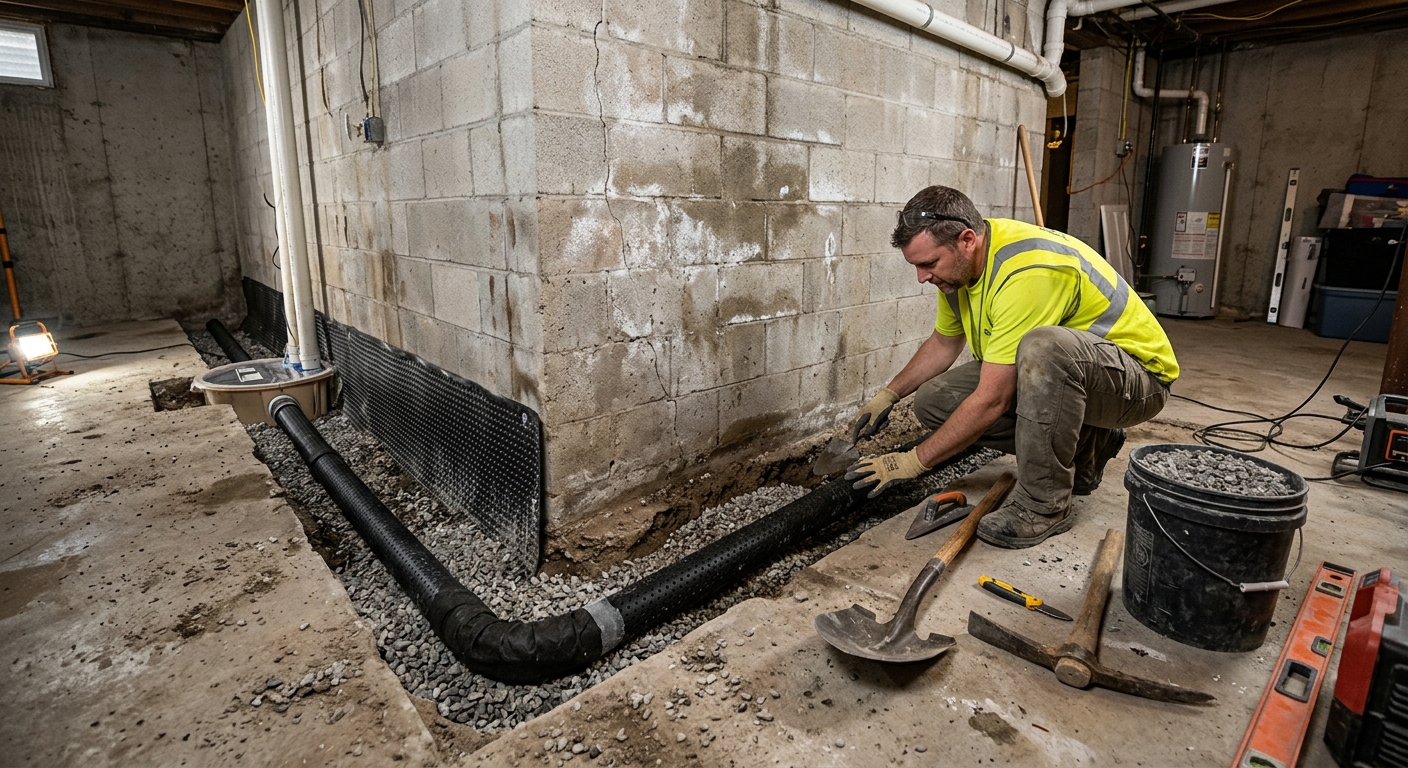
Basement waterproofing options and costs in Weston
In Weston, basement waterproofing is often a matter of managing water pressure and flow paths—not just patching a leak. With a population of 17,992 (Statistics Canada, 2021 Census), Weston’s tight-knit neighbourhoods and established housing stock mean many basements were built before modern membrane standards became common. Those older systems—tar-and-paper approaches and early weeping tile—are far more likely to have partially failed by now, especially where clay soils hold water and winter freeze–thaw widens movement at joints and cracks.
Toronto-area climate and market dynamics shape pricing. Freeze–thaw cycles in the Greater Toronto Area can turn hairline cracks into active seepage within a few winters, while glacial till and dense clay add lateral pressure on foundation walls when saturated. Many Weston lots also have constrained access near additions, decks, and shared driveways, which can raise excavation labour and disposal time. That’s why local contractors in Weston are busiest around the older residential corridors and infill edges—where weeping tile replacement, targeted excavation, and interior drainage are requested most often.
To help you compare solutions apples-to-apples, use the table below as a realistic starting point for planning. If you’re deciding between exterior and interior systems, the “disruption” column is usually the fastest way to spot which option matches your budget and your site conditions.
| Method |
What It Addresses |
Disruption Level |
Durability |
Price Range |
| Exterior excavation + new membrane + drainage tile |
Primary source of seepage by managing hydrostatic pressure at the foundation perimeter; restores drainage path with new tile and membrane |
High (excavation, landscaping restoration, backfill) |
Long-term when installed on a sound footing line and properly backfilled |
$7,000–$25,000 |
| Interior perimeter drain channel + sump pit |
Water after it enters; captures seepage and reduces hydrostatic pressure from the inside |
Medium (interior cutting, plumbing, limited demolition) |
Very good for chronic seepage and failing weepers when paired correctly |
$3,500–$15,000 |
| Foundation crack injection (epoxy or polyurethane) |
Localized leaks; seals cracks and cold joints when the movement pattern is understood |
Low to Medium (minimal demo; surface prep required) |
High for stable cracks; effectiveness depends on whether crack is actively leaking |
$600–$3,000 |
| Sump pump installation (primary + battery backup) |
Maintains dryness during heavy inflow; battery backup helps during outages |
Low to Medium (pit installation, electrical work, discharge routing) |
High when discharge and check valves are installed correctly |
$800–$3,500 |
| Window well drain installation |
Localized exterior water intrusion around egress/vent windows |
Medium (excavation around window area) |
Good for targeted wet spots when grading and daylighting are correct |
$1,200–$4,500 |
| Lot re-grading / downspout extension |
Reduces surface runoff against the foundation; improves flow to proper discharge |
Low (or Medium if excavation is needed) |
Good as a maintenance/control step; not a full cure if drainage tile is failing |
$1,000–$6,000 |
Prices are estimates only and vary by project scope, site access and material selection.
What affects the price of waterproofing in Weston
In Weston, the same “basement leak” can produce quotes that vary by 30–50% across the Toronto market because contractors are pricing different root causes, not just similar-looking symptoms. Two homes can both have damp corners, yet one has a failing original weeping tile (or clogged gravity drain) and the other has a localized crack or window well intrusion. When you add access constraints and foundation age, the labour and material quantities can change quickly.
The three drivers that most separate local costs from a national average are soil type, water table behaviour, and freeze–thaw. Toronto-area ground is frequently a mix of glacial till and dense clay pockets that expand when saturated, increasing lateral pressure on foundations and worsening cracks over time. In many Weston basements, high water levels mean sump pumps (if installed) run more often, and the drainage system needs adequate capacity and properly routed discharge. Freeze–thaw cycles also widen small defects in poured concrete or block foundations; that’s why contractors may recommend crack injection only as a piece of a bigger drainage strategy.
Concrete examples from Weston: (1) If the downspouts dump near the foundation, a re-grading and extension fix may be closer to a “control” job; if not addressed, it can drive more flow into interior drains and increase overall system scope. (2) If your foundation wall is block and the leak pattern follows mortar joints or cold joints, you’ll often need interior perimeter drainage even if you add sealing. (3) In a home where exterior excavation can’t be done without removing a deck or landscaping, interior perimeter drains plus sump may become the most cost-effective option, even though exterior can be the more permanent source-of-water correction. That’s where local price bands like interior waterproofing at $3,500–$15,000 versus exterior at $7,000–$25,000 often show up in homeowner-friendly planning.
Age of drainage matters too: older original weeping tile (commonly 60+ years) may be fully failed, partially collapsed, or clogged—so the cost can shift from “small fix” to “system replacement” once a camera assessment confirms the condition.
| Price Factor |
Why It Matters |
Cost Impact |
| Interior vs. exterior approach — interior is less disruptive but addresses symptoms |
Exterior can stop water at the source; interior controls water after it enters |
Interior often comes in lower, but may require ongoing pump operation; exterior commonly costs more upfront due to excavation |
| Foundation type — poured concrete vs. block vs. stone vs. ICF |
Different walls move differently and seal differently; block often needs drainage complements |
Poured concrete may respond better to targeted crack work; block can increase labour for interior drainage and sealing |
| Soil type — clay expands more than sand, adding pressure |
Clay saturation increases lateral pressure and leak activity during spring |
More robust drainage and membrane detailing is often required in clay-heavy pockets |
| Crack type and length — hairline vs. structural horizontal cracks |
Active leaking cracks need flexible sealing; structural movement may require engineered repair |
Stable, hairline cracks can be cheaper; longer or structural cracks increase scope and permit/engineer involvement |
| Sump pump backup system — battery or water-powered backup needed |
Power interruptions during spring flooding can cause rapid overflow if only a primary pump is used |
Backup adds cost, but can prevent major cleanup losses during outages |
| Access — landscaping, decks, or driveways must be removed for exterior |
Tight lots add excavation time, restoration costs, and safety controls |
Exterior work can rise significantly when removal/disposal/restoration is required |
| Weeping tile age — original tile (60+ years) may be completely failed |
Failing drains force more water toward foundation points |
If tile is failed, scope can shift from minor sealing to full drainage replacement |
| Mould or efflorescence remediation required before sealing |
Moisture must be controlled before coatings and sealants will hold |
More prep steps add cost; also requires proper cleaning and drying time |
Permits & regulations in Ontario
In Ontario, foundation excavation, structural crack repair, and changes to lot drainage typically require a building permit. If your contractor is modifying discharge routing, altering how roof or footing drainage leaves the lot, or working near foundation structural elements, ask whether permits will be pulled before work begins. Sump pump installations that connect to the storm or sanitary sewer generally need municipal approval—so the “we’ll just tie it in” approach should be clarified early. For structural crack repair (particularly horizontal cracks in block walls, major step cracks, or anything that suggests ongoing movement), a structural engineer’s assessment is often required to confirm whether underpinning or other structural actions are needed.
To protect yourself in Weston, verify three things: (1) licensing/registration where applicable, (2) liability insurance, and (3) WSIB/WCB coverage. Start by requesting the contractor’s proof of insurance (certificate of insurance) showing they carry sufficient general liability and name you/your property as an applicable insured party where required by contract. Next, ask for WSIB clearance or WCB proof (the specific document depends on the coverage they hold). Then check engineering support: for structural repairs, confirm they include engineered plans or can coordinate an engineer assessment.
Step-by-step: request their permit plan in writing, collect insurance and WSIB/WCB documents before signing, confirm the discharge location and connection method, and ensure the written scope references any permit responsibilities. Don’t rely on verbal assurance—Ontario’s approvals are project- and municipality-dependent, and waterproofing costs can climb quickly if you have to redo unapproved connections.
Interior vs exterior waterproofing — what does Weston need?
The fundamental difference between interior and exterior waterproofing is where the water problem is controlled. Exterior waterproofing—full excavation, new membrane, and new drainage tile—addresses the source of water entry by managing hydrostatic pressure around the foundation. It’s the more permanent fix, but it’s also the most disruptive because excavation can require removing landscaping, deck sections, or portions of hardscape for regrading and backfill. Interior waterproofing—perimeter drain channel, sump pit, sump pump, and related plumbing—manages water after it enters and reduces pressure inside the basement, but it doesn’t stop saturated soil from pushing against the wall itself.
In Weston’s Toronto climate, freeze–thaw cycles make small defects worse over time, especially where dense clay expands when saturated. For that reason, exterior solutions are commonly recommended when the original weeping tile is failed, when seepage tracks across multiple wall segments, or when the water table is consistently high. Interior solutions are often the better fit when excavation access is limited or when the leak is chronic but localized and can be captured. Poured concrete walls often respond well to crack injection when cracks are stable; block foundations more frequently require interior drainage as a practical complement because mortar joints and cold joints can invite seepage paths.
Sump pump backups matter in Ontario because power outages can occur during heavy spring weather and localized storms. A battery backup helps keep water managed during short outages, reducing cleanup risk when clay is saturated and water inflow increases.
Where the price difference is justified: if exterior excavation is feasible and the drainage tile is confirmed failed, homeowners can spend at $7,000–$25,000 to reduce repeated water intrusions long-term. However, if access makes exterior impractical, an interior system at $3,500–$15,000 may be the sensible first step, especially when the source is already close to the inside (like chronic seepage along a footing line or past flooding patterns).
| Method |
Best For |
Addresses Source? |
Disruption |
Lifespan |
Price Band |
| Full exterior excavation + membrane |
Widespread seepage, failed weeping tile, consistent high inflow, exterior wall issues |
Yes |
High |
Long-term when properly backfilled and protected from settlement |
$7,000–$25,000 |
| Interior French drain + sump system |
Chronic seepage, homes where excavation is constrained, recurring basement dampness |
Partial (manages water after entry) |
Medium |
Very good with correct discharge routing and backup |
$3,500–$15,000 |
| Crack injection — epoxy (structural) |
Stable cracks in poured concrete; when the crack is not actively moving |
Partial (seals pathways) |
Low to Medium |
High for stable, properly prepared cracks |
$600–$3,000 |
| Crack injection — polyurethane (active leak) |
Active leaks, flowing cracks, water-driven seepage points |
Partial (seals pathways) |
Low to Medium |
High when crack movement is active but addressed with flexible material |
$600–$3,000 |
| Interior drain channel only (no sump) |
Light seepage or areas where intermittent water can be managed without pump capacity |
No (manages entry locally) |
Medium |
Limited in high water table situations |
$2,000–$8,000 |
| Re-grading + downspout extensions |
Surface runoff driving water toward foundation; early-stage dampness |
No (controls external water) |
Low to Medium |
Good as a control step; depends on drainage condition |
$1,000–$6,000 |
How to choose a waterproofing contractor in Weston
Choosing a contractor in Weston is mainly about verifying proof and clarity before money changes hands. For Ontario work, ask for: (1) liability insurance (a certificate of insurance with your job details and adequate coverage), (2) WSIB/WCB clearance or proof of coverage, and (3) whether they coordinate engineering for structural crack repairs. You can check the contractor’s registration/eligibility through the appropriate Ontario channels if they claim regulated work—then verify insurance directly via the certificate, not just a brochure. For WSIB/WCB, request the clearance document in writing and confirm it’s current for the work timeline.
Get 2–3 itemised quotes rather than a lump sum. A good estimate lists labour and materials separately: excavation (if exterior), membrane system components, drainage tile and piping, sump pit and pump model, check valves, discharge line routing, and disposal/restoration. Ask what’s included and what’s excluded: permit pull included or not, demolition depth, concrete patching scope, and whether mould/efflorescence remediation is part of pre-seal work. Also clarify warranty terms—workmanship warranty length, product/manufacturer warranty (and conditions), and whether the warranty transfers to future owners.
On payment schedule, never pay more than 10–15% upfront. Use progress draws only after defined milestones (for example, after excavation and membrane install, or after interior rough-in and rough plumbing). Hold back the final portion until the job is complete, cleaned up, and tested. Finally, require a written start date and a completion estimate so spring-related rush timelines don’t blur accountability.
- Request proof of liability insurance (certificate) before you sign anything.
- Request WSIB/WCB clearance and confirm dates cover the work period.
- Ask who pulls permits and confirm it in the contract for any required permit/approval work.
- Get an itemised breakdown: labour vs materials, plus disposal and restoration.
- Confirm the drainage discharge plan (where the water goes) and whether tie-ins require municipal approval.
- Ask for pump specs: model, discharge line size, check valves, and basin/pit dimensions.
- If using backup, confirm battery type and activation logic (not just “we add backup”).
- Ensure crack injection type is matched to the leak behaviour (epoxy for stable vs polyurethane for active).
- Confirm surface prep and curing requirements (this is where failures often start).
- Ask how they handle mould/efflorescence before sealing or coating.
- Review warranty: workmanship, product warranty terms, and transferability to new homeowners.
- Hold back 10–20% until punch-list items are finished and the system is demonstrated.
Red flags to watch for in Weston: “one-size-fits-all” waterproofing quotes with no site inspection; refusing to provide proof of WSIB/WCB clearance or current insurance; promising to “seal everything” without addressing drainage tile age or discharge routing; high-pressure payment requests early in the job; and vague warranty language (no specific workmanship duration or exclusions).
Frequently asked questions — waterproofing in Weston
What drainage issues are most common in Weston homes?
In Weston and the wider Toronto area, the most common drainage issues start with how foundation water is managed—or not managed—before it reaches the basement. Many homes built in earlier periods depend on older weeping tile or gravity drainage that can become clogged or partially failed over decades, especially in clay-heavy pockets. That shows up as interior dampness, efflorescence on concrete or block, or recurring seepage along cold joints. Freeze–thaw can also widen small cracks, making what used to be “surface damp” become an active leak after spring rains. Where downspouts discharge near foundations, runoff adds to the load and increases sump run times if a pump is installed. (Statistics Canada, 2021 Census; population context for Weston: 17,992.)
How do I choose a waterproofing contractor in Weston?
Choose a Weston contractor by verifying documentation first and scope clarity second. Ask for liability insurance (certificate of insurance) and WSIB/WCB clearance—then confirm the dates match your job timeline. Next, require 2–3 itemised quotes with labour and materials broken out, not just a lump sum. For waterproofing, the scope should state exactly what’s included: excavation limits (if exterior), membrane system components, drainage tile routing, sump discharge method, and disposal/restoration responsibilities. If you have structural crack indicators, confirm engineering support is included because Ontario may require permits and an assessment for structural work. Finally, check warranty terms: workmanship length, manufacturer/product warranty conditions, and whether it’s transferable. For budget planning, you’ll often see interior projects in the $3,500–$15,000 band and exterior in the $7,000–$25,000 band.
What is a battery backup sump pump and do I need one in Weston?
A battery backup sump pump is a secondary power system that keeps pumping during short outages. In Weston, it’s most valuable when spring flooding coincides with severe weather or when power interruptions occur during heavy rain. Standard sump pumps rely on electricity; if your primary pump loses power while clay soil is saturated, the basin can overflow quickly and turn a managed leak into a cleanup problem. Battery backup solutions add cost, but they reduce that risk—especially for homes with chronic seepage or sump installations that run during spring melt. Whether you “need” one depends on your inflow history, how fast water collects, and how critical basement dryness is for your household. If your leak is recurring after storms, discuss backup options early. Many homeowners budget sump work including primary and backup in the $800–$3,500 range.
How much does basement waterproofing cost in Weston?
Basement waterproofing in Weston typically falls into a few common bands depending on whether the work is exterior or interior, and whether you’re sealing isolated cracks or replacing drainage. Exterior excavation plus new membrane and drainage tile is commonly estimated in the $7,000–$25,000 range due to excavation labour, membrane materials, and landscaping restoration. Interior waterproofing involving perimeter drain channels and a sump pit often lands in the $3,500–$15,000 range, especially when discharge routing and plumbing are included. For isolated leaks, foundation crack repair via epoxy or polyurethane injection is usually less, often around $600–$3,000, depending on crack length and preparation needs. If you’re adding or upgrading sump equipment (including battery backup), homeowners commonly see $800–$3,500. Actual pricing can move based on access constraints, foundation type, and whether permit/approval work is needed for discharge.
Interior vs exterior waterproofing — which is better?
Exterior waterproofing is usually “better” at stopping water at the source because it replaces/creates a drainage path and membrane around the foundation perimeter. In Weston’s clay and freeze–thaw environment, that can be the most reliable long-term approach—especially when the original weeping tile has failed. But exterior work is also more disruptive because it requires excavation and backfill, and many Weston properties have access constraints (decks, landscaping, and driveways). Interior waterproofing is often the practical choice when excavation is limited or when the primary goal is to manage chronic seepage that already enters the basement. For poured concrete walls, crack injection can complement interior systems when cracks are stable; for block foundations, interior drainage is frequently a better pairing because seepage pathways can persist through joints. A common decision rule: if you can excavate and the drainage tile is failing, interior-plus-sump may turn into a recurring fix, while exterior may prevent future events. Budget-wise, exterior projects typically start in the $7,000–$25,000 band versus interior at $3,500–$15,000.
Why is my basement leaking in Weston?
Basement leaks in Weston are usually caused by water pressure and flow paths, not a single “bad spot.” Dense clay and mixed till soils can hold water, and when freeze–thaw cycles occur, small defects in concrete or block foundations expand and become active. A failed or clogged weeping tile system is also a frequent driver—older tile may be partially collapsed, blocked, or simply no longer moving water away effectively. Leaks can then show up at cold joints, tie holes, or cracks; you may notice dampness that increases during spring rainfall and melt. If your basement is also showing efflorescence or a musty odour, it often points to recurring moisture infiltration rather than one-time drainage. Finally, surface runoff issues—like downspouts that discharge too close to the foundation—can push extra water toward the wall, increasing the load on any interior drainage system. In Ontario, clarifying the discharge method and any required approvals is part of the fix, not an afterthought.