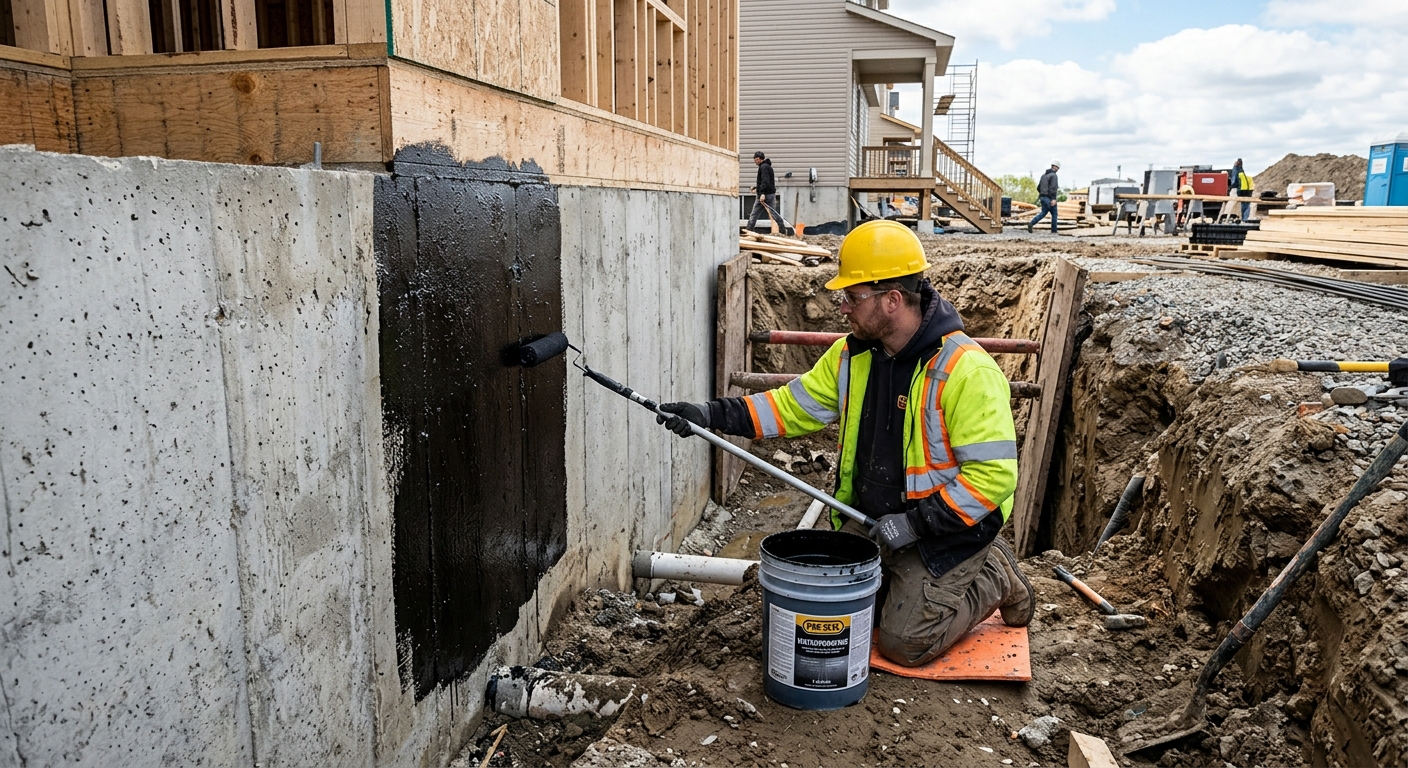
Basement waterproofing options and costs in Amherstburg
Amherstburg homeowners typically face basement leaks through the walls, slab edges, or through older openings like weeping-tile tie-ins—especially in the Windsor–Sarnia corridor where moisture pressure can stay against the foundation. With 50.5% of local homes built before 1981 (Statistics Canada, 2021 Census), many basements are retrofitted from earlier damp-proofing systems, and that means we often see aged or clogged weeping tile, compromised mortar joints, and crack pathways in concrete block and poured walls. In Amherstburg, the timing of winter freeze–thaw and the seasonal swing in groundwater can also push water through hairline cracks that used to “weigh in” only in wet weeks.
Costs in Windsor–Sarnia are shaped by the same three realities we see on site: fine-textured, poorly drained soils in parts of Essex/Lambton that can hold water near the foundation, compact subsoils that limit outward drying, and expanding freeze–thaw cycles that widen joints. That’s why contractors in demand often cluster around actively built-out neighbourhoods like the South Amherstburg area (and older pockets closer to waterfront and established lots), where access constraints make exterior excavation more expensive and interior drainage retrofits are common.
If you’re comparing bids, the cleanest way is to start with the method that matches how water is getting in—then match it to the expected disruption and lifespan. The table below summarizes the most common options we see for Amherstburg basements.
| Method |
What It Addresses |
Disruption Level |
Durability |
Price Range |
| Exterior excavation + new membrane + drainage tile |
Water entry at the foundation face; hydrostatic pressure control with proper footing drains and drainage layer |
High (excavation, landscaping repair) |
Long-term (typically 20+ years when installed to specification) |
$12,000–$25,000 |
| Interior perimeter drain channel + sump pit |
Water after it enters; controls seepage and reduces hydrostatic pooling against the foundation interior |
Medium (floor/finish disruption around perimeter) |
Long-term (typically 15+ years with quality pump and maintenance) |
$8,000–$18,000 |
| Foundation crack injection (epoxy or polyurethane) |
Crack pathways—epoxy for sealing non-moving cracks; polyurethane for active leaks |
Low (minimal invasive work) |
Medium to long-term (depends on crack type and wall movement) |
$600–$2,500 |
| Sump pump installation (primary + battery backup) |
Reliably lifts collected water away from the foundation; backup reduces risk during outages in spring conditions |
Medium (small pit/coring, discharge line work) |
Long-term (15+ years depending on pump selection and power protection) |
$1,800–$4,500 |
| Window well drain installation |
Bulk water intrusion at window wells and pooling from downspouts/grade issues |
Low to medium (excavation around window opening) |
Medium to long-term (10–20 years with proper gravel and discharge) |
$1,200–$3,200 |
| Lot re-grading / downspout extension |
Stops surface water from reaching foundation; improves shed of roof runoff and reduces saturation |
Low (minor landscaping disruption) |
Medium (can last years, but needs correct drainage outlets) |
$900–$2,800 |
Prices are estimates only and vary by project scope, site access and material selection.
What affects the price of waterproofing in Amherstburg
In Amherstburg (and the wider Windsor–Sarnia corridor), you can see the same “type” of waterproofing project priced 30–50% differently across Ontario because site conditions drive labour time and how much excavation/disposal is required. Nationally, contractors may average costs assuming easier drainage and more forgiving soil. Locally, three drivers separate Windsor–Sarnia pricing from the national average: soil type, water table behaviour, and freeze–thaw. Fine, clay-heavy soils expand during freeze–thaw and can push laterally against foundation walls, worsening cracks and joints over time—so a bid that only “patches” the symptom often costs more later. High or seasonally elevated water tables in this region increase sump run times and the size/robustness of drainage components, which affects both materials and installation detail.
Practical examples we see in Amherstburg include: (1) two houses on similar streets where one has accessible exterior walls for excavation and the other has a deck, mature shrubs, or a tight driveway—access alone can shift the job from an exterior range closer to $12,000–$25,000 toward the upper end due to removal/rebuild work; (2) older weeping tile that’s original or partially collapsed—when we open a trench, the “simple” interior plan can turn into interior drainage plus a sump retrofit in order to protect finishes; (3) basements with efflorescence and active dampness near mortar joints—before any sealing, we usually need drying and cleaning, which affects scheduling and sometimes adds time-sensitive labour.
Homes built before 1981 (Statistics Canada, 2021 Census) are also more likely to have foundation details that aren’t compatible with modern membranes without system upgrades, so bids often reflect whether the contractor is building a full water-management pathway (drainage + discharge) versus a localized repair.
| Price Factor |
Why It Matters |
Cost Impact |
| Interior vs. exterior approach — interior is less disruptive but addresses symptoms |
Exterior targets water entry at the foundation face; interior controls after entry |
Interior often fits closer to $8,000–$18,000, while exterior excavation commonly aligns with $12,000–$25,000 |
| Foundation type — poured concrete vs. block vs. stone vs. ICF |
Crack behaviour and sealing methods differ by wall material and jointing |
Block/older masonry frequently increases drainage scope and crack assessment time |
| Soil type — clay expands more than sand, adding pressure |
Clay soils can exert lateral pressure during freeze–thaw |
More robust drainage layers and backfill detailing can increase labour/materials |
| Crack type and length — hairline vs. structural horizontal cracks |
Non-moving cracks may be sealed; moving cracks often require broader solutions |
Sealing a few linear hairlines may stay near $600–$2,500; structural-related cracks usually cost more due to investigation and remediation |
| Sump pump backup system — battery or water-powered backup needed |
Prevents flooding risk during spring power interruptions |
Backup adds cost but reduces catastrophic loss risk; often pushes sump scope toward the upper side of $1,800–$4,500 |
| Access — landscaping, decks, or driveways must be removed for exterior |
Excavation productivity depends on how much can be moved quickly and safely |
Restricted access can increase excavation hours and restoration |
| Weeping tile age — original tile (60+ years) may be completely failed |
Failed tile can mean groundwater isn’t being collected/discharged properly |
Often requires re-tie-in, replacement, or full drainage redesign |
| Mould or efflorescence remediation required before sealing |
Sealing over active moisture/salts leads to repeating symptoms |
Extra remediation steps add labour and schedule management |
Permits & regulations in Ontario
In Ontario, foundation excavation, structural crack repair, and changes to lot drainage typically require a building permit. Where we’re modifying drainage connections or adding discharge lines, sump pump installations that connect to municipal storm or sanitary services also require municipal approval. For structural crack repair—particularly horizontal cracks in block walls, major step cracking, or signs of movement—an assessment by a structural engineer is often required to confirm whether underpinning, tie-back, or other structural work is necessary before waterproofing proceeds. A good waterproofing contractor should tell you up front what will be permitted and coordinate inspections where required.
To verify an Amherstburg contractor, start with the licence/credentials check using the Ontario registry listings that relate to the trades they perform, then confirm insurance with a current certificate of liability insurance naming you as applicable. Next, ask for proof of WSIB/WCB clearance or coverage status (whichever applies to the contractor’s workforce). Request documentation before you sign, and confirm the scope aligns with what they’re insured to do—especially for excavation and any structural repair work.
Step-by-step: (1) request the written scope and permit responsibility in the contract; (2) verify licensing through the appropriate online listing; (3) ask for WSIB/WCB clearance (or equivalent status proof); (4) obtain the certificate of insurance; (5) for structural items, ask whether they include engineering support or use an engineer you approve.
Interior vs exterior waterproofing — what does Amherstburg need?
The fundamental difference is simple: exterior waterproofing treats the water at its source by excavating to the foundation, applying a continuous membrane, installing/renewing drainage tile, and backfilling with proper drainage material. Interior waterproofing—perimeter drain channel, sump pit, and sump pump—manages water after it enters the basement. In the Amherstburg context, exterior solutions are often the most permanent because Windsor–Sarnia soils can stay wet near the foundation and seasonal groundwater can build hydrostatic pressure against walls.
That said, exterior isn’t always justified. In older Amherstburg neighbourhood pockets where landscaping, driveways, or additions limit excavation, interior drainage is frequently the practical best value. For poured concrete walls, we more often see crack injection or interior sealing paired with proper interior drainage because the wall tends to respond well to sealing non-moving defects; for block foundations, interior drainage is commonly necessary because seepage paths through joints and capillaries can keep reappearing unless the perimeter is managed. Freeze–thaw also matters: foundation movement can make “seal-only” solutions fail, so crack type and history decide whether exterior membrane or interior drainage is the stronger play.
Power reliability is another reason to consider backup. During spring wet periods, if the sump pump is your active line of defence, a battery backup or equivalent can prevent a basement flood when electricity is lost.
For a dollar example: if your contractor offers an exterior plan in the $12,000–$25,000 band but your site access is tight and the water entry is mostly through a known interior seep point, you might see better value in a combined interior perimeter drain and sump approach in the $8,000–$18,000 band—provided the system is designed around the water table behaviour and discharge pathway.
| Method |
Best For |
Addresses Source? |
Disruption |
Lifespan |
Price Band |
| Full exterior excavation + membrane |
Widespread seepage, high water table behaviour, and when you can access exterior walls |
Yes |
High |
20+ years |
$12,000–$25,000 |
| Interior French drain + sump system |
Constrained exterior access; seepage after it enters; retrofits that protect finished basements |
No (manages water after entry) |
Medium |
15+ years |
$8,000–$18,000 |
| Crack injection — epoxy (structural) |
Non-moving cracks with a stable crack profile where sealing is appropriate |
Sometimes (crack pathway) |
Low |
Medium to long-term |
$600–$2,500 |
| Crack injection — polyurethane (active leak) |
Active leaks or damp, flexible crack movement where flexible sealing is required |
Sometimes (crack pathway) |
Low |
Medium to long-term |
$700–$2,700 |
| Interior drain channel only (no sump) |
Light seepage where gravity discharge can work and backup risk is low |
No |
Medium to low |
10–15 years |
$5,500–$10,500 |
| Re-grading + downspout extensions |
Surface-water problems (roof runoff and grading directing water toward the foundation) |
No (prevents additional entry) |
Low |
5–10+ years (depends on maintenance) |
$900–$2,800 |
How to choose a waterproofing contractor in Amherstburg
Start by confirming the contractor’s Ontario standing and basic financial/worker protection. Ask for a current certificate of liability insurance and confirm the coverage is active for the project’s scope. Next, verify WSIB/WCB coverage status: request documentation showing clearance/coverage for the company and ask how they handle subcontractors. For excavation and structural crack work, you want a team that can show competence with the methods they’re proposing—not just a generic waterproofing “package.”
Then get 2–3 itemised written quotes. Insist on a breakdown that shows labour and materials separately (membrane/drain tile, backfill and disposal, sump and pump components, discharge line work, and any restoration). Watch for exclusions: debris removal, permit pull responsibility, concrete coring, drywall/floor patching, and whether grading repairs or landscaping restoration are included. Also confirm warranty terms. A workmanship warranty should be clearly stated by scope (for example, drain installation and membrane system application) and supported by the manufacturer warranty for products used—plus whether the warranty is transferable if you sell the house.
Payment schedule matters. Never pay more than 10–15% upfront. Use holdback until the work is complete and final clean-up is done. Finally, ensure your timeline includes a start date and a completion estimate in writing, and ask how they handle wet-weather delays during spring conditions common to the Windsor–Sarnia corridor.
- Verify WSIB/WCB status documentation before work begins.
- Confirm current liability insurance and whether it includes your address as applicable.
- Get itemised labour vs materials pricing (not one lump sum).
- Ask what’s excluded: permit fees, disposal, restoration, concrete patching, and drywall/floor refinishing.
- Confirm disposal/recycling and trucking is included if excavation is required.
- Request product names and system details (membrane type, drainage board, pipe size, discharge plan).
- Ask how they’ll test or confirm discharge is working (especially with sump setups).
- Ensure warranty is written: workmanship length, product/manufacturer warranty, and transferability.
- Request proof of prior similar Amherstburg projects (with photos) relevant to your foundation type.
- Confirm payment schedule: small deposit, then milestone payments, holdback to completion.
- Get start date and estimated completion time in writing, including weather contingencies.
- For structural cracks, ask whether they coordinate engineering assessment when required.
Red flags in Amherstburg: (1) contractors who refuse to put the scope and warranty in writing; (2) bids that promise to “stop all leaks” without diagnosing crack type, drainage capacity, and discharge; (3) quoting exterior work without acknowledging access constraints or restoration responsibilities; (4) skipping permit/approval discussion for sump ties or lot drainage changes; (5) asking for large upfront deposits (well beyond 10–15%).
Frequently asked questions — waterproofing in Amherstburg
Interior vs exterior waterproofing — which is better?
For Amherstburg homes, exterior waterproofing is usually the “best” long-term solution because it addresses water entry: excavation, membrane coverage, proper drainage tile, and drainage backfill. Interior waterproofing is typically the best choice when you can’t excavate exterior walls due to driveways, decks, tight lot lines, or occupied homes where disruption must be limited. The Windsor–Sarnia soil and seasonal groundwater behaviour often means hydrostatic pressure keeps finding paths at the foundation face, which is why exterior can outperform when access allows. In costs, you’ll often see exterior ranges around $12,000–$25,000, while interior drainage and sump projects often fall closer to $8,000–$18,000. The better answer depends on your crack type, where water appears first (walls vs floor edges), and whether regrading alone would actually solve the problem.
Why is my basement leaking in Amherstburg?
In Amherstburg, basement leaks commonly happen because groundwater and surface water combine to create persistent moisture against the foundation. When fine-textured soils hold water and the water table rises seasonally, seepage can push through cracks, joints, and mortar areas—especially in housing built before 1981 (Statistics Canada, 2021 Census). Freeze–thaw can also widen existing pathways: small cracks and seal failures grow over multiple winter cycles. Often, older homes have aging or clogged weeping tile, so interior symptoms show up even when exterior damp-proofing looks “fine.” Another frequent cause is surface runoff: if downspouts discharge close to the foundation or grading slopes toward the house, water saturates the backfill and reaches the wall faster. The most accurate way to confirm the cause is a site inspection with crack mapping and review of drainage/discharge conditions.
How do I know if a foundation crack is serious?
A crack is more concerning when it suggests movement or structural behaviour, rather than simple shrinkage. In Amherstburg, pay attention to horizontal cracks in block walls, major step cracks that climb and shift between courses, cracks that widen seasonally, or evidence of bowing at wall corners. Also take note of “active leak” signs: dampness around the crack, water seepage during spring thaws, and mineral staining or efflorescence that keeps returning. Hairline cracks that remain dry and stable for years can sometimes be sealed after proper assessment. But the safest approach is to document the crack (measure width, take photos, note timing with rain/snow melt) and have a contractor classify it. If it appears structural, an engineer assessment may be required before any waterproofing strategy—because stopping water without addressing movement can lead to repeat failures.
How much does foundation crack repair cost in Amherstburg?
For Amherstburg, foundation crack repair pricing usually depends on crack type, length, and whether there’s active leakage. Typical local ranges for crack injection are about $600–$2,500. Epoxy injection is commonly used for non-moving cracks (often cheaper because it’s straightforward), while polyurethane injection is used when there’s active leakage or flexible movement and can run toward the upper end due to prep and material handling. Costs also rise if we must address more than one crack line, drill additional ports, or prepare the surface with cleaning/etching so the product bonds properly. If the crack indicates structural movement or there are multiple failure modes (for example, water pressure plus joint failure), you should expect that waterproofing may involve drainage upgrades as well, not just injection.
Do I need a sump pump in Amherstburg?
You may need a sump pump in Amherstburg when seepage consistently reaches a level where interior drainage alone can’t manage it, or when the foundation experiences seasonal groundwater pressure. Interior perimeter drains often work with a sump pit to collect seepage and keep the basement drier. If your basement is affected during spring flooding periods or you’ve seen water accumulate near the wall line or floor perimeter, a sump system becomes a practical control. Because power outages can occur, adding a backup (battery or equivalent) is often worth considering when a sump is the main line of defence. Sump installation commonly falls around $1,800–$4,500, depending on pump selection and whether backup is included. That said, if your leak is primarily from surface water, re-grading/downspouts may be the better starting point—so it’s important to match the system to the root cause.
How does Amherstburg's soil affect my foundation?
In Amherstburg and the Windsor–Sarnia corridor, soil type is a major determinant of waterproofing performance. Many areas feature fine-textured, poorly drained soils that can retain moisture and keep the backfill saturated near the foundation. That means hydrostatic pressure can build against basement walls, pushing water through cracks and joints. Clay-heavy soils also expand during freeze–thaw cycles, which can widen gaps over time and turn previously minor seepage pathways into active leaks. Even in sandier pockets, seasonal groundwater movement can still transmit moisture toward basements when the water table rises. Homes built earlier (Statistics Canada, 2021 Census) often rely on older drainage systems that are prone to failure, such as clogged weeping tile or inadequate exterior drainage. The practical takeaway: your soil conditions influence whether exterior drainage/membrane is the primary solution or whether interior drainage and sump controls are the right fit.