Basement waterproofing options and costs in Kitchener
Kitchener homeowners typically face waterproofing decisions that start with the foundation wall and the ground around it. With 256,885 people in the city (Statistics Canada, 2021 Census), you’ll see a busy mix of older homes and expanding neighbourhoods, and that directly affects contractor availability and pricing. Nearly half of local dwellings were built before 1981, which matters because older tar-and-paper membranes and original weeping tile systems can fail after decades in freeze-thaw conditions. In Kitchener, many basements also show signs of seepage during spring melt, when hydrostatic pressure builds against foundation walls and any drainage weakness becomes noticeable.
In the Kitchener–Waterloo–Barrie corridor, costs are shaped by soil and water movement. Clay-heavy ground tends to hold water, expand during freeze-thaw, and increase lateral pressure on the foundation—so “repairs only” solutions can be more expensive over time. Access and excavation depth also drive labour: gardens, mature trees, driveways, and older lots in areas like Doon South and Laurentian Hills often require careful scheduling and disposal planning. Contractor pricing commonly reflects whether excavation is needed, whether a sump system will run frequently, and whether you need crack repairs or a full drainage rebuild.
Below are the most common approaches, what they address, typical disruption, and realistic Kitchener price bands—so you can compare quotes side by side before deciding what to tackle first.
| Method |
What It Addresses |
Disruption Level |
Durability |
Price Range |
| Exterior excavation + new membrane + drainage tile |
Active and recurring seepage by replacing the drainage path and wall protection |
High (yard excavation, backfill, landscaping restoration) |
Long-term, most complete solution |
$7,000–$15,000 |
| Interior perimeter drain channel + sump pit |
Water that enters the basement by collecting it after entry |
Medium (interior floor/feature adjustments) |
High when drainage is properly sized |
$6,000–$14,000 |
| Foundation crack injection (epoxy or polyurethane) |
Cracks as the entry route (epoxy for sealed/structural; polyurethane for active leaks) |
Low to medium (surface prep, crack routing, patching) |
Good for targeted crack systems |
$1,200–$3,000 |
| Sump pump installation (primary + battery backup) |
Manages collected water during spring melt and heavy runoff |
Low to medium (pit, discharge line, electrical tie-in) |
Very good with backup and correct discharge |
$900–$3,600 |
| Window well drain installation |
Water coming in around egress wells and during rain/melt |
Low to medium (well excavation and rework) |
Good for problem areas |
$1,200–$4,800 |
| Lot re-grading / downspout extension |
Reduces water reaching foundation by directing roof and surface runoff away |
Low to medium (spot excavation, grading, landscaping) |
Variable (best when paired with drainage) |
$800–$4,000 |
Prices are estimates only and vary by project scope, site access and material selection.
What affects the price of waterproofing in Kitchener
In Kitchener–Waterloo–Barrie, quotes for the “same” basement can vary by 30–50% because waterproofing is never just a product—it’s excavation depth, site access, and how much water is actually getting in. A small change in drainage design, the length of foundation wall addressed, or whether we need to replace failed weeping tile can move your total cost quickly. That same difference is why your contractor may cite different labour hours even when you’re both looking at the same wall stains.
Three drivers most strongly separate Kitchener pricing from many national averages: soil type, water table, and freeze-thaw. Clay-heavy ground (common in parts of Ontario) expands during freeze-thaw and can exert higher lateral pressure on foundation walls, which can turn a hairline crack into a recurring leak—so crack work may become part of the system rather than a “nice-to-have.” When local drainage is poor or the effective water level is high, sump pump run times increase and discharge logistics become more complex. Freeze-thaw also adds risk to older systems: Homes built before 1981 are more likely to have original drainage components that are fully or partially failed, meaning excavation or interior upgrades often have to address the underlying cause, not just the symptom.
Two practical examples from Kitchener: if a basement leak is localized at a stair-step area and tests suggest an active crack, polyurethane injection may reduce labour versus full wall excavation. On the other hand, if you have extensive interior dampness along multiple walls plus old, collapsed weeping tile, interior perimeter drainage can still run into higher costs, and exterior waterproofing (often in the $7,000–$15,000 band) becomes the more durable comparison. With older housing stock—nearly 48.6% built before 1981—expect more frequent failures in weeping tile and compromised drainage around foundations.
| Price Factor |
Why It Matters |
Cost Impact |
| Interior vs. exterior approach — interior is less disruptive but addresses symptoms |
Exterior targets the water before it enters; interior manages water after entry |
Can swing totals by thousands (exterior commonly lands in the higher band) |
| Foundation type — poured concrete vs. block vs. stone vs. ICF |
Crack behaviour and sealing methods differ by wall system |
Poured concrete often benefits from crack systems; block often needs complementary drainage |
| Soil type — clay expands more than sand, adding pressure |
Clay holds water and increases lateral pressure during freeze-thaw |
More water control required; can push you toward exterior or upgraded drainage sizing |
| Crack type and length — hairline vs. structural horizontal cracks |
Structural or horizontal cracks may require engineering assessment and more extensive repair |
May add engineer review and longer crack repair scope |
| Sump pump backup system — battery or water-powered backup needed |
Power resilience matters during spring storm events and outage risk |
Adds cost but protects against expensive cleanup and damage |
| Access — landscaping, decks, or driveways must be removed for exterior |
Excavation footprint and restoration requirements change labour and disposal |
Exterior projects can increase significantly where removal/replacement is extensive |
| Weeping tile age — original tile (60+ years) may be completely failed |
Old tile often collapses or clogs, stopping the drainage pathway |
May require replacement rather than patching, raising exterior scope |
| Mould or efflorescence remediation required before sealing |
Sealers and membranes can fail if moisture and contaminants aren’t addressed |
Can add prep time and additional products before waterproofing |
Permits & regulations in Ontario
In Ontario, permit requirements usually depend on how the work changes structure or drainage. Foundation excavation, structural crack repair that addresses a potential structural concern, and changes to lot drainage commonly trigger a building permit pathway. Also, sump pump installations that tie into municipal sewer infrastructure (storm or sanitary), or work that alters how discharge is handled, typically requires municipal approvals. Because requirements can vary by scope and municipality, your contractor should be clear on whether they will pull permits and whether the work affects supporting elements or drainage systems.
For structural crack repair—especially horizontal cracks in block walls, significant step cracking, or anything suggesting the foundation has shifted—an engineer’s assessment is often required to determine if underpinning or structural remediation is needed. That’s why reputable Kitchener waterproofing contractors typically coordinate with engineering when they see patterns beyond surface seepage.
How to verify a contractor in steps:
- Check the contractor’s Ontario registration/licensing information through the appropriate online provincial tools (search the contractor’s legal business name).
- Request a current certificate of liability insurance and confirm it’s in the contractor’s name and active for the project dates.
- Ask for WSIB/WCB coverage proof (or the appropriate status documentation) before work begins.
- For structural work, confirm they include engineering support and identify whether an engineer report will be issued for the scope.
- Get the written scope stating which permits will be pulled, and list any permit costs as a line item (or clearly marked “included”).
Interior vs exterior waterproofing — what does Kitchener need?
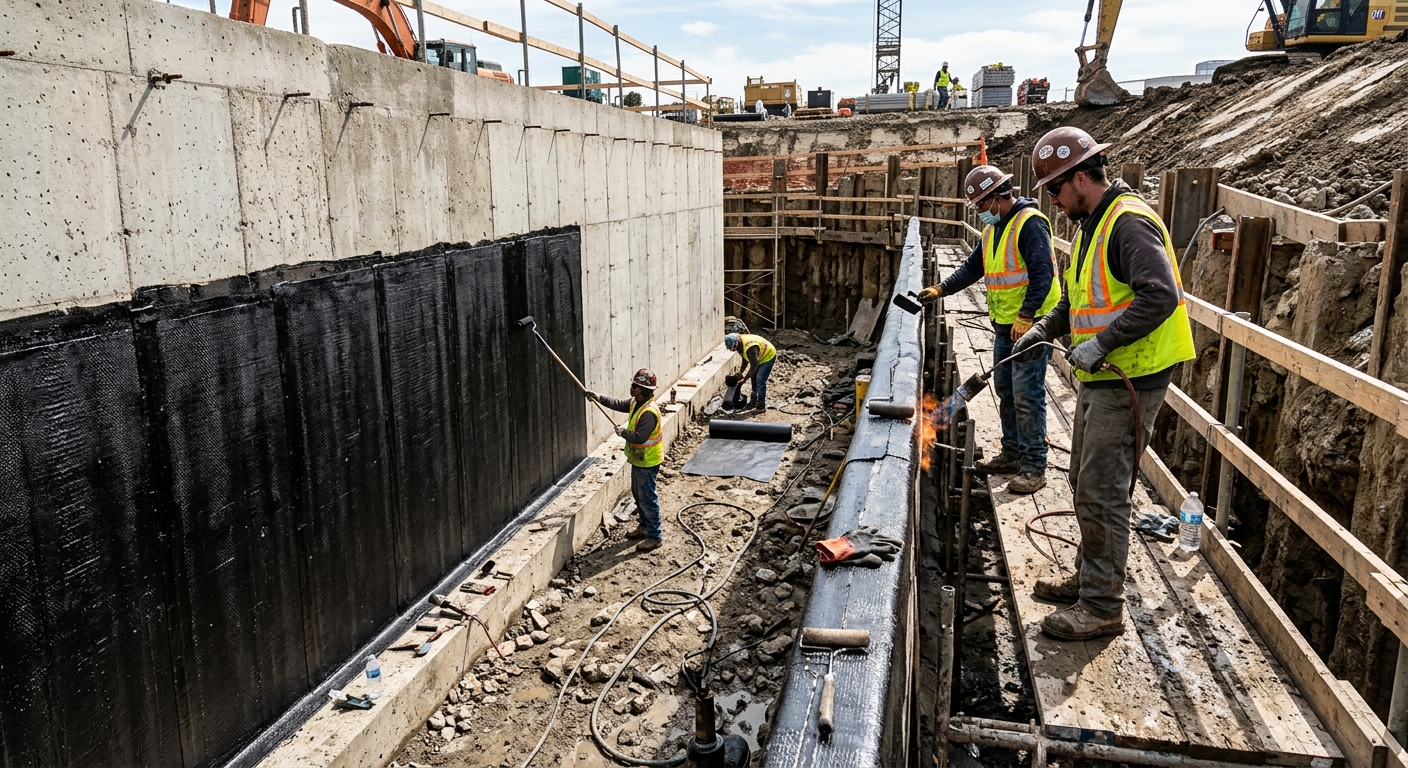
The fundamental difference is whether you prevent water at the foundation or manage water after it enters. Exterior waterproofing—full excavation, a new membrane, new drainage tile, and backfill—targets the source. It’s usually the most durable approach in Kitchener’s freeze-thaw climate because it restores the drainage pathway and reduces hydrostatic pressure against the wall. The trade-off is cost and disruption: you’re working in the yard around the perimeter, which can impact landscaping and require disposal planning.
Interior waterproofing—typically an interior French drain channel, sump pit, and sump pump—collects water after it enters the basement. It can be a strong fit when excavation is limited, when the main problem is repeated seepage during spring melt, or when you’re working with constrained driveways and patios. But interior systems do not eliminate hydrostatic pressure on the wall; they manage it by capturing water, so long-term performance depends on correct grading, proper pipe routing, and adequate pump sizing.
In Kitchener, poured concrete walls often respond well to targeted crack injection combined with drainage, because the crack system can be sealed effectively. Block foundations, on the other hand, frequently benefit from interior drainage as a practical complement, especially when multiple areas show dampness. For many homeowners, a realistic “value” comparison looks like this: if you’re seeing localized cracking and low volumes, crack injection plus a properly designed sump system may stay closer to the $1,200–$3,000 range for cracks and $900–$3,600 for pump upgrades. But if you have wide perimeter dampness and older, likely-failed weeping tile, choosing exterior waterproofing—often $7,000–$15,000—can be justified because you’re rebuilding the drainage strategy rather than only controlling symptoms.
| Method |
Best For |
Addresses Source? |
Disruption |
Lifespan |
Price Band |
| Full exterior excavation + membrane |
Recurring seepage, suspected failed weeping tile, broad wall dampness |
Yes (before entry) |
High |
Long-term |
$7,000–$15,000 |
| Interior French drain + sump system |
Limited excavation access, spring melt water management |
No (after entry) |
Medium |
Good to very good with proper pump design |
$6,000–$20,000 |
| Crack injection — epoxy (structural) |
Non-moving or stable cracks in poured concrete where sealing is needed |
Yes (by sealing the entry route) |
Low to medium |
Good when the crack is truly stable |
$1,200–$3,000 |
| Crack injection — polyurethane (active leak) |
Active seepage where water flow is present through the crack |
Yes (seals the active leak path) |
Low to medium |
Good to very good when paired with drainage |
$1,200–$3,000 |
| Interior drain channel only (no sump) |
Very minor seepage or where water can be gravity-managed |
No (after entry) |
Low to medium |
Moderate (depends on conditions) |
$4,000–$10,000 |
| Re-grading + downspout extensions |
Surface water and roof runoff issues |
Sometimes (reduces water reaching foundation) |
Low to medium |
Variable; best with drainage verification |
$800–$4,000 |
How to choose a waterproofing contractor in Kitchener
Start with verification. In Ontario, ask your contractor for their current Ontario business registration/licence details (and confirm the name matches your contract), plus a certificate of liability insurance showing coverage effective for your job dates. Request proof of WSIB/WCB coverage as well—don’t rely on verbal assurances. If the contractor proposes structural crack work, ensure they either have engineering support in-house or clearly explain how an engineer assessment will be arranged, since structural crack patterns may change what’s required.
Next, get 2–3 itemised written quotes. You want a breakdown that separates labour and materials (membrane, drainage pipe, geotextile, pumps, battery backup, discharge piping, prep work, disposal), not a single lump sum. Read the exclusions line by line: is disposal included? Is permit pulling included or billed separately? Are repairs to concrete floors/steps included or limited to waterproofing areas? Ask how they confirm where the water is coming from—sometimes a simple “we’ll add a sump” pitch misses the broader drainage failure.
Warranty matters. Confirm the workmanship warranty length and whether it covers labour only or also product-related labour and reinstatement. Ask if the warranty is transferable if you sell. Payment schedule should protect you: never pay more than 10–15% upfront, and use a holdback until the job is complete and cleaned up. Finally, get a start date and completion estimate in writing, along with conditions that could extend timelines (weather, curing times, inspection hold-ups).
- Licence/registration details match the legal name on your contract
- Current certificate of liability insurance (valid dates, correct contractor)
- WSIB/WCB proof provided before work starts
- Engineering support included for any structural crack concern
- Itemised quote with labour vs materials vs disposal clearly separated
- Explicit scope of what’s included/excluded (permits, discharge routing, reinstatement)
- Written warranty terms: workmanship duration, what it covers, and transferability
- Payment schedule with a defined holdback until final completion
- Discharge plan described (where water goes and how it’s protected)
- Pump specs and backup approach listed (battery or water-powered backup)
- Moisture testing or inspection steps described before sealing surfaces
- Schedule and curing/restoration steps shown on paper
Red flags in Kitchener include: “one-price-fits-all” exterior excavation without assessing weeping tile condition; refusing to put exclusions in writing (especially disposal, landscaping reinstatement, or discharge compliance); skipping engineering discussion when crack patterns suggest movement; warranties that only cover materials or are vague about labour; and asking for large upfront payments beyond about 10–15%.
Frequently asked questions — waterproofing in Kitchener
Do I need a permit for foundation work in Ontario?
In Ontario, permit requirements commonly apply when foundation excavation is planned, when you’re doing structural crack repair that may affect support, or when you change how lot drainage works near the foundation. Sump pump work can also require municipal approvals when discharge is connected to municipal sewer infrastructure (storm or sanitary). For Kitchener homeowners, the key is to confirm what your scope includes: excavation, discharge routing, and whether the work is purely waterproofing vs structural in nature. A solid contractor will list in writing whether permits are included, and they should explain who pulls them. If the contractor recommends work for horizontal or step cracks that suggest structural movement, you should expect an engineer assessment as part of the process.
How long does waterproofing last?
How long waterproofing lasts depends on whether the system addresses the water source or just captures water after entry. Exterior waterproofing—membrane plus new drainage tile—typically performs the longest because it reduces hydrostatic pressure at the foundation. Interior systems (French drain/channel plus sump) can last many years, but performance relies on correct pump sizing, discharge routing, and the condition of the drainage pathway. In Kitchener, freeze-thaw increases stress on both the soil and the wall, so cracking and drainage failures can show up sooner if the original weeping tile is beyond its service life. As a cost reality check, homeowners often compare crack injection in the $1,200–$3,000 range versus broader drainage work in the $6,000–$20,000 band; the wider the underlying drainage correction, the longer the typical expected service life.
Can I waterproof my basement from the inside only?
Yes, you can often waterproof from the inside only in Kitchener, especially when excavation is constrained by driveways, decks, or limited side-yard access. Interior perimeter drains and sump systems are designed to collect water after it enters and move it away before it damages finishes. However, interior-only approaches don’t stop hydrostatic pressure against the foundation wall itself, which means they work best when the main issue is water entry that can be captured consistently. If your basement shows widespread perimeter dampness and the home likely has original drainage components (homes built before 1981 are far more common in Kitchener’s housing stock—Statistics Canada, 2021 Census), interior-only might still help but may not be the most durable long-term fix. Many homeowners end up using interior drainage plus targeted crack injection when the source is localized.
What causes foundation cracks in Kitchener?
In Kitchener, foundation cracks are commonly driven by freeze-thaw cycles and soil movement, especially with clay-heavy soils that expand and contract. Over time, lateral pressure can widen existing cracks, turning a small seepage path into an active leak during spring melt. Older foundation walls can also show more cracking because earlier waterproofing methods and weeping tile systems were not designed for today’s drainage expectations. Improper grading and downspouts can worsen the issue by keeping water concentrated near the foundation. If cracks are horizontal or step patterns are significant, that can indicate a structural concern—not just cosmetic shrinkage—so an engineer assessment may be required before sealing. That’s why the “crack injection type” (epoxy for stable cracks vs polyurethane for active leaks) needs to match what’s actually happening.
How do I compare waterproofing quotes?
To compare quotes in Kitchener, insist on itemised written scopes with labour and materials separated. Look for what’s included: excavation depth (if exterior), replacement vs repair of drainage tile, interior drain configuration, sump pump specifications (including whether battery backup is included), and how discharge is handled. Confirm whether disposal and landscaping reinstatement are included, and whether permit costs are included or listed separately. Don’t compare only price—compare approach to the likely source: if multiple walls are damp and moisture patterns suggest failed exterior drainage, a cheaper interior-only quote may end up costing more later. As a reference point, exterior waterproofing often falls around the $7,000–$15,000 band, while interior systems commonly land in the $6,000–$20,000 range depending on scope. A good quote will explain why the method chosen fits your foundation and water conditions.
How long does basement waterproofing take in Kitchener?
Timing varies by method and site constraints. Interior perimeter drains and sump installations are typically faster than full exterior excavation because there’s no yard dig-and-rebuild cycle; some jobs can be completed in days to a couple of weeks depending on how much floor/finish work is involved and cure times for patching and sealing. Full exterior waterproofing usually takes longer due to excavation, membrane and drainage installation, backfill, and landscaping restoration. Kitchener weather can also affect scheduling, especially for exterior work where soil moisture and freeze risk matter. A contractor should provide a start date and completion estimate in writing and clarify what could extend timelines (cure times, material availability, access restrictions). If you’re also doing crack injection, that can sometimes be scheduled alongside drainage upgrades, but active leak conditions may require additional steps for proper sealing.