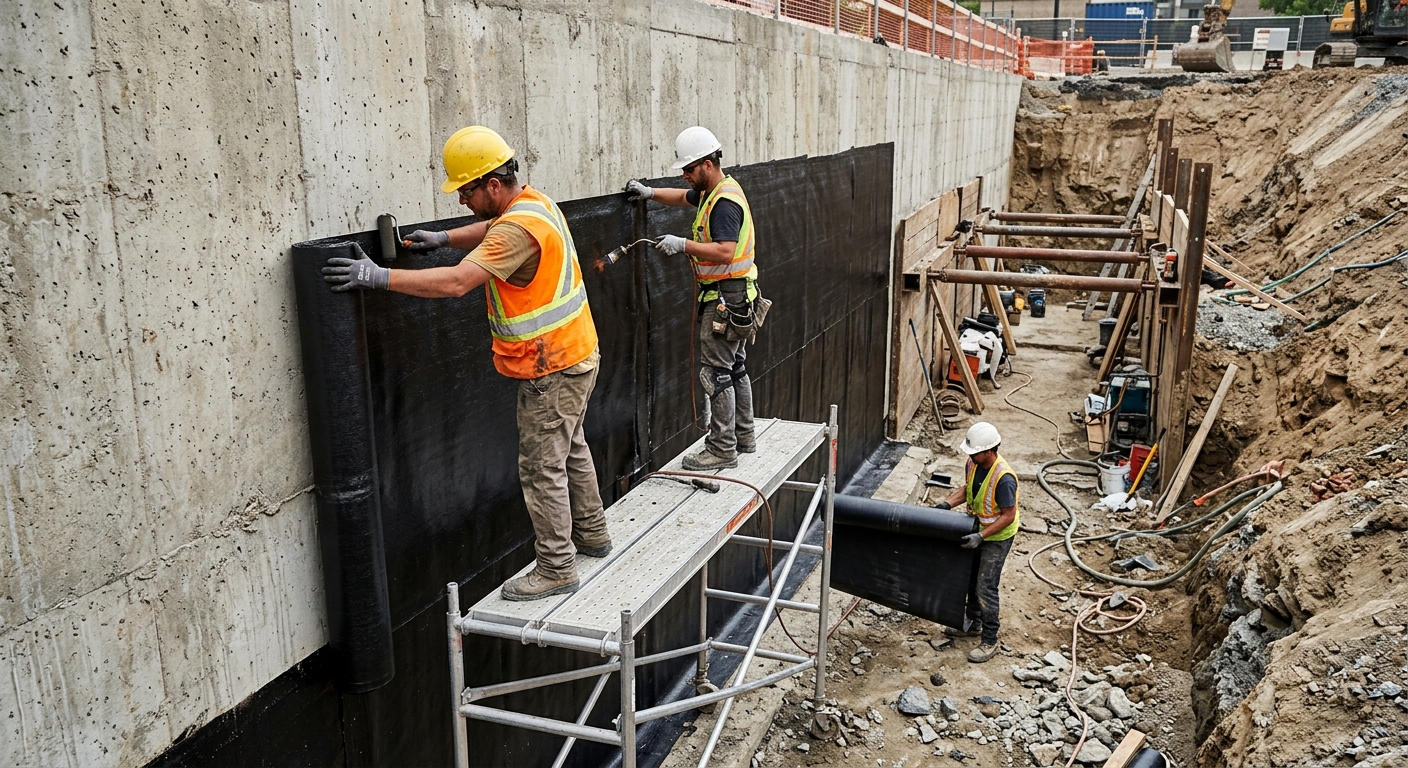
Basement waterproofing options and costs in Essex
Essex homeowners usually start shopping for basement waterproofing because water shows up around the slab edge, through a joint between foundation walls, or as musty odours after snowmelt. In Essex (population 21,216), a large portion of housing is older—about 63.1% of homes were built before 1981 (Statistics Canada, 2021 Census). That matters because early damp-proofing systems, older tar-and-paper membranes, and aging weeping tile commonly lose their ability to handle seasonal groundwater. In practical terms, many basements in this area need systems designed for elevated seepage risk and freeze–thaw movement that widens hairline cracks and joints.
In the Windsor–Sarnia corridor, waterproofing costs tend to run higher than a “typical” national basement job when the soil holds water. Much of Lambton and Essex counties has fine-textured, poorly drained soils where moisture stays against foundation walls, increasing seepage and hydrostatic pressure. Contractors in places like Kingsville Road/CR roadsides and the larger-lot pockets around Colchester Township often see recurring spring wetness, which affects labour planning and the need for robust footing drains, pump retrofits, or comprehensive exterior excavation. Access also plays a role: tight frontage and mature landscaping can push projects into the higher end of the exterior excavation range.
Because the “right” approach depends on where water is entering (outside water vs. inside drainage), the comparison below will help you map options to budget and disruption.
| Method |
What It Addresses |
Disruption Level |
Durability |
Price Range |
| Exterior excavation + new membrane + drainage tile |
Stops water entry by rebuilding the exterior waterproofing system and replacing failing footing drains |
High (full dig-out, backfill, landscaping restoration) |
High (system-level fix with modern materials) |
$12,000–$25,000 |
| Interior perimeter drain channel + sump pit |
Collects seepage after it enters and directs it to a sump |
Medium (limited floor/sump opening) |
Medium to High (depends on crack sealing and weeping tile condition) |
$8,000–$18,000 |
| Foundation crack injection (epoxy or polyurethane) |
Seals cracks/joints to reduce leakage pathways (epoxy for non-moving cracks; polyurethane for active leaks) |
Low to Medium (surface prep, localized drilling) |
Medium to High (best when hydrostatic pressure is controlled) |
$600–$2,500 |
| Sump pump installation (primary + battery backup) |
Moves collected water away during peak seepage and short power outages |
Low to Medium (sump pit + discharge lines) |
High (with backup power and proper check valves) |
$1,800–$4,500 |
| Window well drain installation |
Prevents surface runoff from saturating near egress windows |
Low to Medium (excavate around window well) |
Medium (depends on grading and flow paths) |
$2,000–$6,000 |
| Lot re-grading / downspout extension |
Reduces roof water and surface water reaching foundation |
Low (grading, small excavations) |
Low to Medium (helps, but may not stop groundwater pressure) |
$1,500–$4,500 |
Prices are estimates only and vary by project scope, site access and material selection.
What affects the price of waterproofing in Essex
Two Essex basements can look identical when you first see them—same wall height, similar cracking—but quotes can still swing by 30–50% once contractors factor in site conditions and the actual water source. In the Windsor–Sarnia corridor, the three biggest budget drivers that separate local costs from the national average are soil type, water table behaviour, and freeze–thaw. Clay-heavy, poorly drained soils (common across parts of Lambton and Essex) expand during freeze–thaw and can exert lateral pressure, worsening cracks over time. Meanwhile, higher groundwater levels increase sump run times and the capacity needed for effective drainage.
In older housing stock—particularly homes built before 1981 in Essex—contractors often find original weeping tile that has failed or become clogged. That forces a change in plan: instead of “collecting a little seepage,” the system has to handle sustained inflow during spring melt. When moisture stays trapped against foundation walls, interior-only solutions may still work, but they usually require upgraded perimeter drains and a reliable sump pump strategy. Where exterior excavation is feasible, rebuilding the drainage tile and membrane is closer to a permanent fix; where access is constrained, interior drainage becomes the practical route.
Concrete cost examples we see locally: (1) A poured-concrete wall with manageable hairline cracking may be addressed with crack repair plus interior drainage in the lower end of the $8,000–$18,000 interior band. (2) A block foundation with multiple open joints on a clay lot often pushes projects into the upper interior range because more of the wall needs drainage support and sometimes injection points. (3) If downspouts discharge toward the foundation and re-grading plus extensions can redirect water, the job may start near the lower band of $12,000–$25,000 only when excavation is required; otherwise, surface corrections alone can be far cheaper but won’t solve high groundwater pressure.
| Price Factor |
Why It Matters |
Cost Impact |
| Interior vs. exterior approach — interior is less disruptive but addresses symptoms |
Exterior rebuilds the exterior water barrier; interior manages water after entry |
Interior often costs less upfront; exterior costs more but addresses the source |
| Foundation type — poured concrete vs. block vs. stone vs. ICF |
Different wall behaviour and crack patterns change prep, sealing, and drainage strategy |
Block and stone typically require more targeted drainage work |
| Soil type — clay expands more than sand, adding pressure |
Clay holds moisture against the wall and increases lateral stress during freeze–thaw |
Higher inflow can mean more drain capacity and stronger pump requirements |
| Crack type and length — hairline vs. structural horizontal cracks |
Active or structural cracks need different repairs and sometimes engineering |
Structural conditions increase scope, testing, and potential underpinning contingency |
| Sump pump backup system — battery or water-powered backup needed |
Backup prevents failure during power interruptions during spring wet periods |
Adds equipment cost and wiring/plumbing work |
| Access — landscaping, decks, or driveways must be removed for exterior |
More removal/restoration increases labour and disposal |
Can move a job toward the upper end of the exterior excavation range |
| Weeping tile age — original tile (60+ years) may be completely failed |
Failed tile shifts the plan toward full replacement or added interior capture |
Replacement and tie-ins increase material and labour time |
| Mould or efflorescence remediation required before sealing |
Sealing over active moisture contamination can reduce system performance |
Surface removal, drying time, and remediation add schedule and labour |
Permits & regulations in Ontario
In Ontario, foundation-related work often triggers permit requirements, especially when you’re changing the building envelope, altering structural components, or modifying how water is managed at the lot line. In most Essex projects, foundation excavation and any structural crack repair tied to stability (for example, major horizontal cracks in block walls or step cracking that suggests movement) typically require a permit. Installing or upgrading drainage systems can also fall under permit rules when it involves connecting to municipal storm or sanitary infrastructure—your contractor should confirm the exact approval path before work starts.
Step-by-step, a homeowner in Essex can verify contractor compliance: first, ask the contractor for their Ontario licence/registration details and confirm whether they are the party pulling the permit (if required). Next, request a current certificate of insurance (general liability) that lists you as the certificate holder if appropriate, and provide WSIB/WCB coverage proof for workers on site. If structural work is involved, confirm they have engineering support: a structural engineer assessment may be required to determine whether underpinning, wall reinforcement, or other stabilization is needed before sealing.
Finally, check the written scope for what’s included: permit pull, drawings, excavation restoration, disposal of soils, and inspection scheduling. A reputable contractor will also be upfront about what does not require a permit—minor downspout extensions, surface re-grading, or typical window well drain work are sometimes treated as low-risk improvements, but the final call depends on how the system ties into drainage and any structural or excavation depth changes.
Interior vs exterior waterproofing — what does Essex need?
The fundamental difference is simple: exterior waterproofing (full excavation, new membrane, new drainage tile, then backfill) targets water before it reaches the foundation. It’s the most “source control” approach, but it’s also the most disruptive and costly because contractors must dig down to the footing and rebuild the exterior system. Interior waterproofing (perimeter drain channel, sump pit, sump pump) manages water after it enters; it typically involves less landscaping disruption, but it does not stop hydrostatic pressure on the wall itself. In Essex, where many homes sit on poorly drained, fine-textured soils that keep moisture against foundations and where freeze–thaw stresses joints, interior systems often succeed best when paired with proper crack sealing and sump pump capacity.
Given the local housing mix—many older homes and a large share of single-detached dwellings—contractors commonly see poured concrete and block foundations behaving differently. Poured-concrete walls often respond well to crack injection plus an interior drainage plan because the wall tends to seal more uniformly. Block foundations, by contrast, may have more complex mortar joint seepage and localized pathways; interior drainage is often the practical complement, even when some exterior work is possible.
For power-outage risk, especially during spring flooding and wet weather, consider a backup system. If you only install a primary sump and the power fails, seepage can quickly overwhelm a shallow perimeter drain setup.
Dollar-wise, the justification is typically straightforward: if an interior-only plan is offered around $8,000–$18,000, but your inspection shows exterior drainage tile is failed and water is entering from the footing area consistently, a move toward the exterior band of $12,000–$25,000 can be worth it to reduce the chance of ongoing seepage and rework. If your issue is primarily surface runoff from roof downspouts, re-grading and extensions may solve it without excavation; however, that won’t address high groundwater pressure.
| Method |
Best For |
Addresses Source? |
Disruption |
Lifespan |
Price Band |
| Full exterior excavation + membrane |
Homes with failing exterior drainage, consistent seepage at the footing, or high groundwater influence |
Yes (water entry control) |
High |
Long (system-level rebuild) |
$12,000–$25,000 |
| Interior French drain + sump system |
Constrained lots, partial access, or when interior capture is the practical solution |
No (manages water after entry) |
Medium |
Medium to Long (depends on sealing + pump reliability) |
$8,000–$18,000 |
| Crack injection — epoxy (structural) |
Cracks that are stable and not actively leaking, especially in poured concrete |
Partial (seals pathways) |
Low |
Medium to Long (with controlled moisture) |
$600–$2,500 |
| Crack injection — polyurethane (active leak) |
Active seepage through joints/cracks, common in freeze–thaw widened paths |
Partial (seals active leakage routes) |
Low |
Medium to Long (best with drainage/pump) |
$800–$3,000 |
| Interior drain channel only (no sump) |
Very mild seepage where gravity discharge or very low inflow is confirmed |
No |
Low to Medium |
Shorter (risk increases during high water events) |
$5,000–$10,000 |
| Re-grading + downspout extensions |
Surface water issues tied to roof runoff and poor grading |
Yes for surface water only |
Low |
Short to Medium (depends on continued maintenance) |
$1,500–$4,500 |
How to choose a waterproofing contractor in Essex
Start by verifying the contractor’s Ontario compliance, because basement waterproofing is equal parts waterproofing design and safe field work. Ask for a certificate of general liability insurance and confirm coverage limits are appropriate for your property. Next, request WSIB/WCB documentation for workers who will be on site. To check the licence/registration, use the appropriate online registry access where the contractor’s business information can be verified, and confirm the company name and address match the quote paperwork you receive. If the scope includes structural crack repairs, ask whether they can coordinate or provide an engineer assessment; don’t rely on “we’ll inject and see” for major horizontal or step cracks.
Then get 2–3 itemised written quotes. You want a labour + materials breakdown (membrane type, drain tile, sump pump model, discharge method, and restoration scope), not a single lump sum. Review what’s excluded: disposal of excavated soil, permits (if required), restoration of landscaping/sod, and drying time allowances. Warranty matters—ask for the workmanship warranty length, whether it’s backed by the contractor (not only the product), and whether the warranty is transferable if you sell your home.
On payment terms, never agree to more than 10–15% upfront. Hold back a portion until the job is complete, inspected, and you’ve received as-built notes (pump discharge location, tie-in points, and drainage flow direction). Finally, ask for a written start date and a completion timeline that includes cure/dry time for membranes and crack injection products.
- Ask what the “water source” is (surface runoff vs. groundwater) and how they confirmed it.
- Request an inspection report: photos, crack mapping, and grading notes.
- Confirm whether they’re proposing interior only, exterior, or a hybrid for Essex’s soil conditions.
- Get itemised labour/materials and a clear scope for disposal and restoration.
- Verify permit responsibility and whether inspections are included in the schedule.
- Confirm sump pump discharge route (and check valves) to reduce backflow risk.
- Ask about backup power: battery backup option and how it’s integrated.
- Ensure they include proper backfill specification suitable for freeze–thaw durability.
- Check the product/manufacturer warranty and workmanship warranty separately.
- Ask whether warranty is transferable to a new homeowner.
- Use a conservative payment schedule; keep a holdback until completion.
- Require a completion checklist and final walk-through before release of remaining funds.
Red flags we see in Essex include: quotes that ignore soil/water-table behaviour and assume “one injection fixes all”; no discussion of sump pump discharge/check valves or backup power despite spring wetness; missing permit responsibility when excavation or structural crack repair is involved; vague warranty language (“warranty applies to materials only” or unclear duration); and payment schedules that ask for most of the cost up front without a clear milestones plan.
Frequently asked questions — waterproofing in Essex
What is a weeping tile and does my Essex home have one?
Weeping tile (often called a footing drain) is the underground drainage system installed around or near the foundation’s footing to collect groundwater and seepage. In many older Essex homes—especially those built before 1981—original weeping tile may exist but can be clogged, broken, or disconnected after decades of freeze–thaw movement and sediment buildup (Statistics Canada, 2021 Census). You can’t always “see” it from inside the basement, but clues include a history of dampness that worsens during spring melt, evidence of older drain lines at floor penetrations, or an older sump setup. A contractor can confirm using an inspection camera or by locating discharge/tie-in points where accessible. If your home doesn’t have it, you may still be able to install a new perimeter drain and sump, but the design will depend on soil and water levels.
Can I waterproof my basement in winter in Essex?
You can sometimes waterproof in winter in Essex, but feasibility depends on conditions—especially soil temperature and access. Exterior excavation is usually difficult when ground is frozen, and backfill handling and compaction can be compromised if contractors can’t work to the proper depth with workable materials. Interior waterproofing is more commonly scheduled because contractors can open floors, install perimeter drains, and place sump pits without relying on deep exterior dig-outs. If your quote includes crack injection, that’s also often practical in cold weather because it’s a localized work sequence—though the basement needs to be clean and dry enough for prep and curing. Budget-wise, interior solutions generally align with the $8,000–$18,000 band depending on drain length and whether a sump is required. For exterior membrane rebuilds, many homeowners plan for spring/summer when excavation and backfill quality can be controlled.
What is the difference between waterproofing and damp-proofing?
Damp-proofing is designed to resist minor moisture and condensation through a basement wall, but it isn’t intended to manage sustained hydrostatic pressure. Waterproofing, by contrast, aims to prevent or control water entry and seepage under real wet-season conditions—common in Essex where soils can keep moisture against foundations and freeze–thaw can widen cracks. In practical terms, “damp-proofing” might be older coating work that doesn’t include a functioning drainage tile and doesn’t create a full water-collection pathway. Modern waterproofing usually involves a system: exterior membrane and drainage tile, or an interior perimeter drain and sump with reliable discharge. If your basement only feels slightly humid, damp-proofing might be part of the solution. But if you’re seeing recurring wet walls after snowmelt or during high groundwater, waterproofing systems are typically the more appropriate fix—even if it means a project closer to the $12,000–$25,000 exterior band or $8,000–$18,000 interior drainage scope.
Will basement waterproofing affect my property value in Essex?
In most Essex neighbourhoods, waterproofing can help protect property value by reducing moisture damage and giving buyers confidence that the basement is designed to handle spring wetness and freeze–thaw. While waterfront views aren’t the issue here, groundwater seepage is a real concern in parts of the Windsor–Sarnia corridor, and older housing stock increases the likelihood of failing drainage systems. The value impact is strongest when the work includes a clear system-level fix (documented sump discharge, updated drainage, and crack sealing) and when you can provide warranties and receipts. Buyers generally prefer projects with measurable outcomes rather than “we dried it out once.” If a full exterior rebuild is done, it may be easier to explain as a source-control solution, often within the $12,000–$25,000 range. Interior drainage can also preserve value and habitability when designed correctly within the $8,000–$18,000 band. The key is documentation and proper installation—not just visible cosmetic dryness.
What drainage issues are most common in Essex homes?
Common drainage issues in Essex include wetness after spring melt, seepage around foundation joints, and damp areas that correlate with heavy rain or snowmelt. Many older basements experience water tracking along mortar lines in block foundations or along cracks widened by freeze–thaw. Another frequent issue is that roof leaders and downspouts discharge too close to the foundation, adding surface water that eventually migrates toward the walls. Weeping tile failure is also common where original drains are decades old—clogged or collapsed lines can stop collection and shift the problem inward. Window wells are another repeat offender because they collect surface runoff and can become saturated. In response, local contractors often recommend perimeter drains and sump pits, sometimes with backup power. In lighter cases, downspout extensions and re-grading can help, but when the problem is groundwater, surface fixes alone won’t fully stop seepage.
How do I choose a waterproofing contractor in Essex?
Choose a waterproofing contractor in Essex by starting with compliance and transparency. Ask for proof of general liability insurance and WSIB/WCB coverage, and confirm who is responsible for permits if your project includes foundation excavation or structural crack repair. Next, get 2–3 itemised written quotes with clear labour and materials breakdowns (drain type, membrane system, sump pump model, discharge method, and restoration). Don’t accept vague scopes that omit disposal, permit pulls, or site restoration—those gaps often lead to change orders. Verify warranty terms: workmanship warranty length, product/manufacturer warranty coverage, and whether the warranty is transferable if you sell. For payment, keep it conservative: never more than 10–15% upfront and use holdback until completion. Finally, require a written timeline and start date. If one contractor’s price is far below the $8,000–$18,000 interior range or the $12,000–$25,000 exterior range without explaining scope differences, treat it as a question—not a bargain.