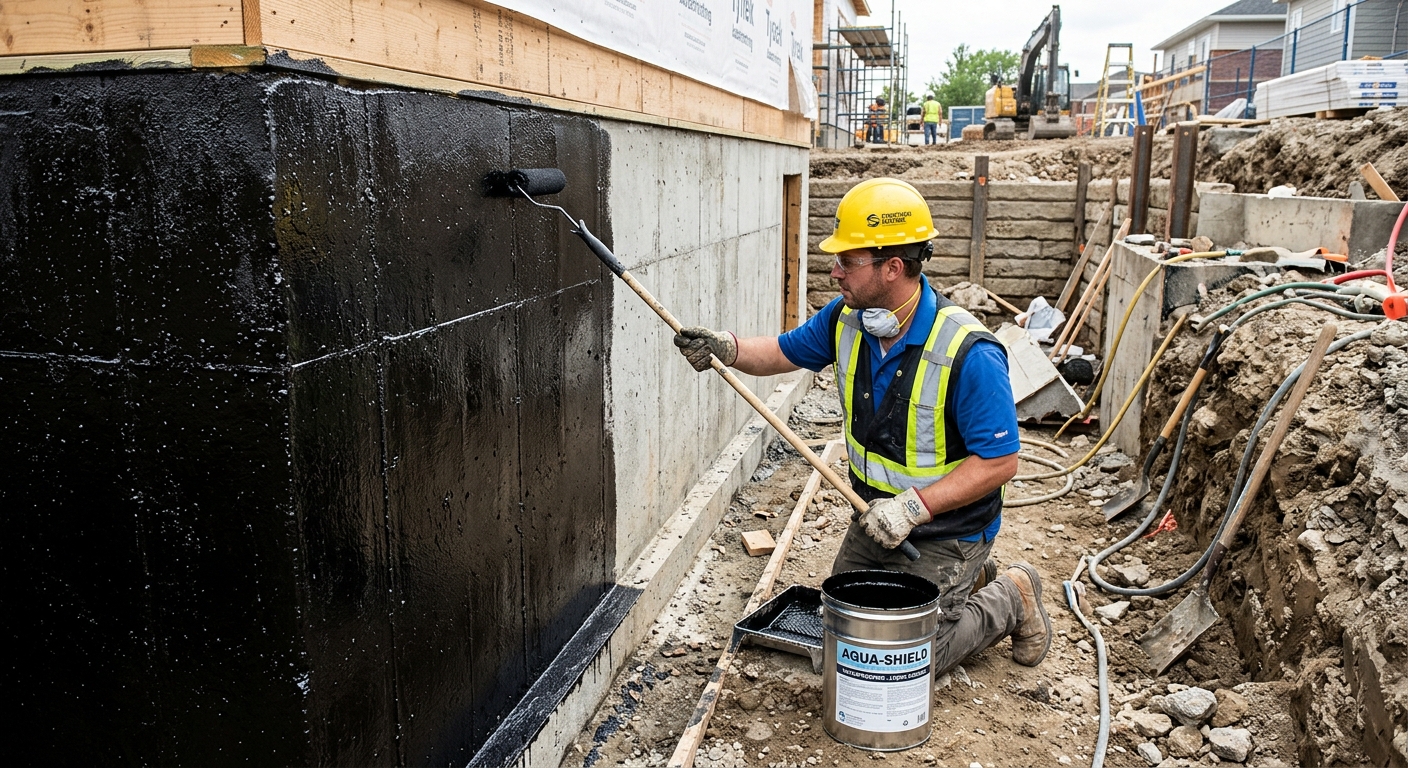
Basement waterproofing options and costs in St. Catharines
Basement waterproofing in St. Catharines usually comes down to one key question: is the water getting in from the outside (hydrostatic pressure through the foundation wall and floor), or is it showing up after it has already found a pathway inside? Homeowners in St. Catharines often ask for a “quick fix,” but the right choice depends on how your lot drains, the condition of older weeping tile, and how your foundation wall reacts to Ontario’s freeze–thaw cycles. With 71.0% of homes in the area built before 1981, many basements are dealing with legacy waterproofing details—failed weeping tile, old tar-and-paper systems, and drains that have been bypassed by time and settling. In a market where single-detached houses make up 55.6% of dwellings, excavation work is common, and so is demand for exterior solutions in established neighbourhoods.
In the Hamilton–Niagara Peninsula region, costs can rise because we see clay and silty clay subsoils that hold moisture and can expand. That increases lateral pressure on foundation walls and makes cracking worse over time. Groundwater can also sit roughly 2–4 m below grade, and perched water in shallow fill layers can raise seepage risk in deeper basements or areas with poor drainage. This combination often pushes projects beyond “patch and seal,” adding labour for deeper excavation, more robust drainage stone, and membrane systems, especially where contractors need to work around landscaping and older services.
Trades see particularly high demand around older streets and mature lots in areas like the north-end near Port Dalhousie and parts of the West Lincoln Road corridor, where grades and drainage patterns are less consistent. Use the table below as a practical starting point to compare methods and disruption before you request itemised quotes.
| Method |
What It Addresses |
Disruption Level |
Durability |
Price Range |
| Exterior excavation + new membrane + drainage tile |
Primary water entry; replaces perimeter drainage and barrier protection |
High (landscaping/steps/driveway may be disturbed) |
High (targeted source control) |
$12,000–$25,000 |
| Interior perimeter drain channel + sump pit |
Water after it enters; reduces hydrostatic pressure |
Medium (floor/footing work inside) |
Medium to high (depends on crack conditions) |
$8,000–$18,000 |
| Foundation crack injection (epoxy or polyurethane) |
Crack sealing to stop seepage paths or stabilise minor structural movement |
Low to medium (drilling/patching) |
Medium to high (epoxy: better for stable cracks; polyurethane: active leaks) |
$600–$1,800 |
| Sump pump installation (primary + battery backup) |
Manages collected water during high water events |
Low to medium (pit excavation/coring) |
Medium to high (backup reduces outage risk) |
$1,800–$4,200 |
| Window well drain installation |
Stops water pooling around basement window openings |
Low (localized excavation) |
Medium (best with proper grading and weep management) |
$1,200–$3,000 |
| Lot re-grading / downspout extension |
Reduces water around foundation and directs it away |
Low to medium (topsoil/stone changes) |
Low to medium (surface-control measure) |
$900–$2,500 |
Prices are estimates only and vary by project scope, site access and material selection.
What affects the price of waterproofing in St. Catharines
In St. Catharines, two contractors can price the “same” waterproofing problem with a difference of 30–50%, and it’s usually justified by how much water control is actually built into the scope. The Hamilton–Niagara Peninsula area differs from the national average mainly because the combination of clay-heavy soils, groundwater conditions, and repeated freeze–thaw tends to create more real hydrostatic pressure and more movement in the foundation over time. Even if the symptom looks similar (damp walls, efflorescence, a musty smell), the underlying water pathway may not be the same—so the labour intensity and material build-up changes.
Three drivers separate local costs from the national average. First, soil type: clay and silty clay can expand during freeze–thaw and exert lateral pressure that worsens cracks. This can turn a simple crack seal into a more involved crack injection plus drainage upgrade, where the difference might be several thousand dollars. Second, the water table: in Ontario, groundwater can commonly sit roughly 2–4 m below grade, and perched water in shallow fill layers increases seepage risk. That can push the need for a sump system with a robust discharge plan and (in many basements) a backup unit—moving a project from a basic sump to a higher tier system. Third, freeze–thaw: Ontario winters accelerate failure of weak exterior drainage details, so contractors often price for longer-term resilience, including membrane and proper stone/grading.
Concrete examples you’ll see in St. Catharines: (1) a basement with active seepage through a poured-concrete wall often needs targeted crack injection plus interior drainage—commonly landing in the combined band where interior waterproofing is closer to $8,000–$18,000; (2) an exterior project on a mature lot with established shrubs and a finished driveway usually costs closer to $12,000–$25,000 because of excavation depth, disposal, and reinstatement; (3) if your weeping tile is original (often 60+ years), contractors frequently plan for more robust replacement or bypassing—rather than patching around a failing system.
| Price Factor |
Why It Matters |
Cost Impact |
| Interior vs. exterior approach — interior is less disruptive but addresses symptoms |
Interior works after water enters; exterior reduces source water entry |
Exterior often adds excavation and reinstatement, raising total cost by thousands |
| Foundation type — poured concrete vs. block vs. stone vs. ICF |
Different walls respond differently to pressure and crack behaviour |
Poured walls may suit injection + drainage; block often needs interior drainage complement |
| Soil type — clay expands more than sand, adding pressure |
Clay can increase lateral load during freeze–thaw |
More robust drainage/membrane and deeper work can increase excavation time |
| Crack type and length — hairline vs. structural horizontal cracks |
Not all cracks behave the same; structural cracks may signal movement |
Structural repairs can require engineering review and additional scope |
| Sump pump backup system — battery or water-powered backup needed |
Power outages during spring melt can leave basements vulnerable |
Backup adds equipment and install time; often increases total by a meaningful margin |
| Access — landscaping, decks, or driveways must be removed for exterior |
Exterior requires safe excavation space and controlled reinstatement |
Removal/disposal and replacement materials can materially change the quote |
| Weeping tile age — original tile (60+ years) may be completely failed |
Old systems can collapse, clog, or bypass |
Replacement or comprehensive drainage work increases labour and material quantities |
| Mould or efflorescence remediation required before sealing |
Sealers won’t bond reliably on active salts/mould |
Extra prep steps (cleaning, drying, vapour-safe treatments) add cost and time |
Permits & regulations in Ontario
In Ontario, foundation-related work can trigger permit requirements depending on what you’re changing and how invasive the work is. In general, excavation near a foundation, structural crack repair (especially for horizontal cracks in block walls or step cracking that suggests movement), and changes to lot drainage often require a building permit. If the plan includes re-routing or connecting drainage discharge (for example, sump pump discharge tied into a municipal sewer system), municipal approval may also be required. A sump pump connection to storm or sanitary services is not something you should assume is “standard”—it typically needs to be handled to the municipality’s direction.
For structural crack repair, a structural engineer’s assessment is often required to determine whether underpinning or other structural remediation is needed. A reputable waterproofing contractor in St. Catharines should be able to explain how they handle engineered assessments and ensure the scope stays within the proper approvals. Confirm the contractor carries liability insurance and WSIB/WCB coverage for workers on site, not just a company address and a promise.
Step-by-step, here’s how a homeowner should verify before signing: (1) request the company’s Ontario licensing information and name of the licence holder; (2) ask for an up-to-date certificate of insurance and verify the coverage applies to your job’s scope; (3) request WSIB/WCB clearance (or the proof that coverage is in place) and check that the certificate is current; (4) ask who pulls the permit if your scope requires one, and confirm what documentation is needed for the permit application. If they can’t provide clear paperwork up front, that’s a red flag.
Interior vs exterior waterproofing — what does St. Catharines need?
The fundamental difference is what each method does to the water source. Exterior waterproofing—full excavation, new membrane, perimeter drainage tile, and proper backfill—aims to stop water entry before it reaches your foundation. That’s the most permanent approach, but it’s also the most disruptive. Interior waterproofing (perimeter drain channel, sump pit, sump pump) manages water after it enters by collecting it and reducing hydrostatic pressure. It’s typically less invasive, but it doesn’t fully remove the root cause of hydrostatic loading on the wall itself.
In St. Catharines, the decision often hinges on soil moisture retention, freeze–thaw movement, and foundation type. Clay-heavy pockets and higher seasonal moisture mean hydrostatic pressure can persist longer in the wall and around the footing. Where poured-concrete walls show cracks, crack injection combined with interior drainage can be a strong practical pairing—especially when you need a solution without full excavation. Where block foundations are involved, interior drainage is commonly necessary because block systems can experience more water migration patterns and the wall may not respond the same way to sealing alone.
Sump pump backup also matters locally. In Ontario, spring flooding and heavy melt periods can coincide with power interruptions, so a backup system (often battery-based or water-powered depending on site plan) can keep the basement dry during critical windows.
To put it in dollars: if an exterior solution would be $12,000–$25,000 but your basement’s seepage is mainly local to a crack line with manageable interior excavation, you may justify an interior-first plan closer to $8,000–$18,000. On the other hand, if the weeping tile is failing and water is saturating the perimeter for months, exterior source control usually costs more—but it’s often the difference between “drying” and “stopping.”
| Method |
Best For |
Addresses Source? |
Disruption |
Lifespan |
Price Band |
| Full exterior excavation + membrane |
Active seepage with ongoing hydrostatic pressure and failed perimeter drainage |
Yes |
High |
Long (often 15+ years with correct installation) |
$12,000–$25,000 |
| Interior French drain + sump system |
Damp walls/floors where full excavation is impractical or budget-limited |
No (manages after entry) |
Medium |
Medium to long (depends on drainage capacity and maintenance) |
$8,000–$18,000 |
| Crack injection — epoxy (structural) |
Stable cracks where water is limited and crack movement is minimal |
Partially (seals a path, assumes crack stability) |
Low |
Medium to long if the crack remains stable |
$600–$1,800 |
| Crack injection — polyurethane (active leak) |
Active weeping or trickle leaks where the crack may be non-stable |
Partially (stops seepage paths; drainage still matters) |
Low |
Medium to long (best when paired with proper drainage) |
$900–$1,900 |
| Interior drain channel only (no sump) |
Very minor dampness where gravity discharge is feasible |
No |
Low to medium |
Shorter than sump systems if water levels rise |
$6,000–$12,000 |
| Re-grading + downspout extensions |
Surface water issues and early-stage dampness |
No (addresses runoff) |
Low to medium |
Short to medium (depends on maintenance and site drainage) |
$900–$2,500 |
How to choose a waterproofing contractor in St. Catharines
Start by verifying the contractor’s Ontario licensing status, liability insurance, and WSIB/WCB coverage—because waterproofing work often involves excavation, coring, and labour that can’t be treated as “DIY-adjacent.” How to check: (1) ask for their Ontario licence details and the licence holder name; (2) request a current certificate of insurance and confirm it covers the scope (excavation, concrete cutting, sump installation, and any structural crack work); (3) ask for WSIB/WCB clearance or confirmation of coverage for workers; don’t accept a verbal “yes.” If they won’t provide proof, you don’t want them on a site near your foundation.
Next, get 2–3 itemised written quotes. You want a breakdown of labour and materials (membrane type, drainage stone, pipe specs, sump pump model, discharge method, crack injection materials, and disposal). Avoid lump-sum quotes that don’t specify what’s included. Read the exclusions: will they remove and replace landscaping? Is permit pulling included if required? Is disposal included? If mould remediation is needed before sealing, is it in the plan? Also ask about the warranty: workmanship warranty length, product/manufacturer warranty, and whether it transfers if you sell your home.
For payment, never pay more than 10–15% upfront. Hold back enough to protect you until the job is complete and conditions are verified (pumps tested, discharge confirmed, clean-up done). Finally, get a start date and completion estimate in writing, along with how they handle rain delays and winter restrictions.
- Provide licence details and the name of the licensed business/individual
- Show up-to-date liability insurance certificate (scope-matched)
- Provide WSIB/WCB clearance or proof of coverage
- Use a site visit and moisture/crack assessment—not just a photo-based guess
- Include a written scope with measurements (linear feet of membrane/drain, crack length)
- Spell out what happens to discharge (where sump water goes)
- State disposal and reinstatement inclusions for excavation
- List materials specs (membrane, pipe size, stone gradation, pump model)
- Include warranty terms: workmanship length and product warranty details
- Show payment schedule and holdback plan in writing
- Confirm permitting responsibility if your work triggers approvals
- Provide a start/completion timeline and rain/wet-weather contingency
Concrete red flags to watch for in St. Catharines: (1) “one size fits all” pricing with no crack-length or drainage assessment; (2) no mention of weeping tile condition or how they’ll manage groundwater in clay/silty clay; (3) missing insurance/WSIB documentation or vague warranties; (4) discharge plans that don’t specify destination and connection method; and (5) promises to fix active seepage with only surface caulking or sealant without drainage or sump capacity.
Frequently asked questions — waterproofing in St. Catharines
How does St. Catharines's soil affect my foundation?
In St. Catharines, much of the area sits on clay and silty clay subsoils that hold moisture longer than sand. When Ontario temperatures swing, that trapped moisture can expand during freeze–thaw, increasing lateral pressure on foundation walls and making existing cracks open wider over time. St. Catharines also has a lot of older housing stock—71.0% of homes built before 1981—which often means original weeping tile and drainage details are already worn or partially failed, so the soil stays wetter around the perimeter. Where groundwater and perched water are present (commonly around 2–4 m below grade, sometimes higher in shallow fill), the problem becomes more about sustained hydrostatic pressure than occasional surface runoff. That’s why good scopes typically combine crack work with drainage and, in many cases, sump capacity.
Do I need a permit for foundation work in Ontario?
In Ontario, you often need a building permit for work that involves excavation near the foundation, structural crack repair, or changes to lot drainage. If your project includes tying sump pump discharge into storm or sanitary services, municipal approval is typically required as well—don’t assume it’s automatic. Structural crack repairs (especially when cracks suggest movement, like certain horizontal cracks in block walls) may require a structural engineer’s assessment before repairs proceed. To verify, ask your contractor what permits apply to your exact scope and who will submit the paperwork. Before work starts, confirm the contractor has liability insurance and WSIB/WCB coverage, and ask for clearance documentation. If they can’t provide a clear permitting plan, you should pause and get clarification in writing.
How long does waterproofing last?
How long waterproofing lasts depends on whether the system stops water at the source or only manages water after it enters. Exterior waterproofing with proper membrane and new drainage tile is generally the most durable option because it reduces the amount of water reaching the foundation during wet seasons. Interior drainage and sump systems can last a long time too, but the lifespan depends on pump performance, discharge routing, and whether cracks remain stable. Crack injection life varies: epoxy is typically best for stable, non-moving cracks, while polyurethane is designed for active seepage paths. If you’re budgeting, compare options using realistic bands: interior waterproofing commonly sits around $8,000–$18,000, while full exterior source control can be $12,000–$25,000. In St. Catharines’s freeze–thaw climate, the best long-term outcome comes from pairing the right crack approach with the right drainage plan.
Can I waterproof my basement from the inside only?
Yes, interior-only waterproofing can work—especially if full exterior excavation is impractical or you’re dealing with localized seepage that can be managed with perimeter drainage and a sump. In St. Catharines, interior systems are commonly used when clay soils and older drainage details make exterior work expensive or disruptive. However, interior-only solutions manage water after it enters; they don’t always fully relieve hydrostatic pressure on the wall itself. That means it’s important to address the “paths” correctly: cracked areas may need injection (epoxy for stable cracks, polyurethane for active leaks), and the drainage system must have enough capacity for spring melt periods. If power outages are a concern, adding battery or water-powered backup is often worthwhile. A good contractor will explain whether your foundation type and crack pattern suggest you’re a candidate for interior-first or if exterior source control is the smarter long-term plan.
What causes foundation cracks in St. Catharines?
In St. Catharines, foundation cracks are commonly driven by soil moisture changes and Ontario’s freeze–thaw cycles. With clay and silty clay subsoils, moisture can expand during freezing, increasing pressure on foundation walls and worsening existing weaknesses. Where groundwater sits higher seasonally (sometimes due to perched water in shallow layers), walls can experience repeated wetting and drying that accelerates crack opening. Older homes—many built before 1981—are also more likely to have aging weeping tile and drainage stone that no longer manage perimeter water effectively. It’s also common to see problems where downspouts discharge near the foundation or where lot grading directs runoff toward the basement. The key is differentiating hairline cosmetic cracking from structural cracks (like major step cracks or certain horizontal cracks in block walls), because structural cracks may require engineering assessment before repair.
How do I compare waterproofing quotes?
Comparing quotes in St. Catharines is easiest when you force each contractor to provide the same level of detail. Ask for itemised breakdowns that separate labour and materials (membrane/pipe/stone specs, sump pump model, crack injection product type, and disposal). Confirm what’s included: permit pulling, interior prep, mould or efflorescence remediation, reinstatement of landscaping, and the discharge plan for sump discharge. Compare scope, not just totals—interior systems can fall around $8,000–$18,000, and full exterior source control can be $12,000–$25,000, but a “lower” number may be missing backup pumps, membrane quality, or proper drainage stone. Also verify warranties: workmanship duration, manufacturer product warranty terms, and whether warranties transfer on sale. Finally, check insurance and WSIB/WCB coverage so you’re protected if something goes wrong during excavation or concrete cutting.