Basement waterproofing options and costs in Niagara Falls
Niagara Falls homeowners usually start waterproofing decisions with one question: “Where is the water coming from?” In Niagara Falls, that matters because a lot of basements are in older housing where original waterproofing systems have had decades to fail. With 60.8% of homes in the local area built before 1981 (Statistics Canada, 2021 Census), it’s common to see worn membranes, failed tar-and-paper style coatings, and corroded weeping tile that no longer drains to daylight or a functional sump. As the seasons turn, Ontario’s freeze–thaw cycles widen existing cracks, and cohesive clay-heavy pockets in the Hamilton–Niagara Peninsula region can hold moisture and expand, increasing lateral pressure on foundation walls.
Costs in this region can also differ from other parts of Ontario because groundwater conditions drive excavation depth, drainage design, and labour hours. Regional market conditions include frequent older weeping tile issues, sometimes with high water tables often in the 2–4 m below grade range, plus the possibility of perched water in shallow fill. That’s why exterior excavation (membrane and drainage tile) typically sits in the $12,000–$25,000 range, while interior approaches (perimeter drain channel and sump pit) often land in the $8,000–$18,000 range. Demand is especially high in older residential pockets around Chippawa, where many homes sit on mature lots and drainage patterns have changed over time due to additions and re-grading.
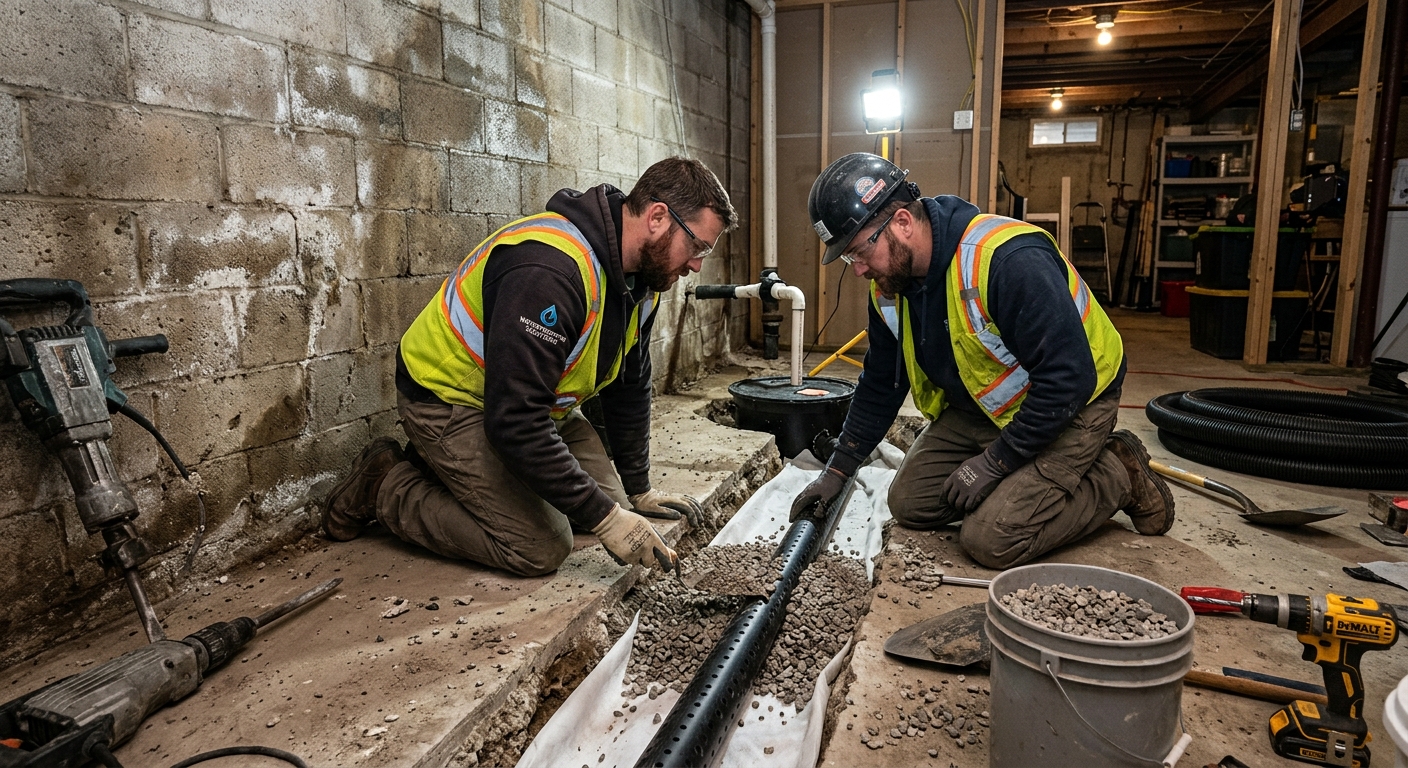
Below is a comparison of the main options Niagara Falls homeowners choose, what they address, and what disruption and lifespan typically look like.
| Method |
What It Addresses |
Disruption Level |
Durability |
Price Range |
| Exterior excavation + new membrane + drainage tile |
Water entry from outside the foundation; installs new drainage path and barrier |
High (excavation, landscape disruption, backfill) |
Long-term (typically 15–30+ years when installed to spec) |
$12,000–$25,000 |
| Interior perimeter drain channel + sump pit |
Water after it enters (hydrostatic relief); reduces seepage and floor dampness |
Moderate (floor cutting in targeted areas) |
Long-term (often 10–25 years depending on drainage design and pump) |
$8,000–$18,000 |
| Foundation crack injection (epoxy or polyurethane) |
Cracks that leak (active seepage) or cracks that allow water tracking |
Low (often limited to crack routing/port drilling) |
Good for stable cracks; typically 10–20 years |
$600–$1,800 |
| Sump pump installation (primary + battery backup) |
Controls collected groundwater; protects basement during peak wet periods |
Moderate (pit, discharge lines, wiring/backup) |
System-dependent (typically 10–20 years for components) |
$1,800–$4,200 |
| Window well drain installation |
Surface water and seepage around basement windows |
Low to moderate (excavation around wells) |
Medium to long-term (often 10–20 years) |
$1,200–$3,000 |
| Lot re-grading / downspout extension |
Redirects roof and surface water away from foundation |
Low (localized exterior work) |
Maintenance-influenced (often 5–15 years) |
$900–$2,500 |
Prices are estimates only and vary by project scope, site access and material selection.
What affects the price of waterproofing in Niagara Falls
In Niagara Falls, it’s not unusual to see quotes for the “same” basement leak that vary by 30–50% across the Hamilton–Niagara Peninsula region and wider Ontario. Two quotes can look similar on paper, but they often solve different problems: one contractor addresses source-water pressure with exterior drainage and membrane, while another only manages symptoms with an interior drain and sump. In clay-heavy pockets, the difference becomes more dramatic because excavation and drainage design have to handle moisture retention and freeze–thaw movement.
Three drivers separate Ontario costs from the national average: soil type, water table conditions, and freeze–thaw. Clay-heavy soils common in parts of Ontario can expand during freeze–thaw, exerting lateral pressure on foundation walls and worsening cracks over time. That pushes some projects into exterior excavation territory—commonly the $12,000–$25,000 band—when we need full membrane coverage and proper drainage stone and pipe placement. High water tables in the Hamilton–Niagara Peninsula area raise sump pump run times and require more robust systems, which can keep interior work in the $8,000–$18,000 band, especially when weeping tile is completely failed. For context, Niagara Falls has a large base of homeowners (70.4% of households own, Statistics Canada, 2021 Census), and older, mature lots mean contractors are frequently scheduled for both excavation logistics and matching replacement landscaping.
Concrete examples of cost swings in Niagara Falls: a home with a deeper basement on cohesive soils may require longer trenching, higher-quality drainage stone, and more membrane coverage than a shallower basement on better-draining fill. Conversely, a straightforward crawl-to-sump conversion on a property with access along a wide side yard may reduce labour and equipment time. If a foundation already has intact weeping tile to a functioning discharge point, you may avoid full interior excavation; but when older original tile (often 60+ years) is collapsed, interior sump systems typically need more underground work and component upgrades.
| Price Factor |
Why It Matters |
Cost Impact |
| Interior vs. exterior approach — interior is less disruptive but addresses symptoms |
Exterior targets source-water pressure; interior relieves pressure after entry |
Interior often $8,000–$18,000; exterior commonly $12,000–$25,000 |
| Foundation type — poured concrete vs. block vs. stone vs. ICF |
Wall makeup affects crack behaviour and best sealing method |
Poured often responds well to crack injection; block may need more comprehensive drainage |
| Soil type — clay expands more than sand, adding pressure |
Higher hydrostatic pressure and movement during freeze–thaw |
More robust membrane/drainage design and sometimes deeper excavation |
| Crack type and length — hairline vs. structural horizontal cracks |
Structural cracks can indicate movement that injection alone may not fix |
Structural assessment and potentially underpinning can add significant cost |
| Sump pump backup system — battery or water-powered backup needed |
Maintains pumping during outages common around spring peak wet periods |
Can add to the $1,800–$4,200 sump installation band |
| Access — landscaping, decks, or driveways must be removed for exterior |
Excavation equipment time and restoration scope |
Exterior jobs can rise if restoration is extensive |
| Weeping tile age — original tile (60+ years) may be completely failed |
Collapsed tile increases seepage volume and shifts the scope to drainage replacement |
Higher material and labour, often pushing exterior or fully rebuilt interior systems |
| Mould or efflorescence remediation required before sealing |
Contamination and salts can prevent successful coating/patch adhesion |
Additional prep and disposal can add time and cost before waterproofing begins |
Permits & regulations in Ontario
In Ontario, foundation excavation, structural crack repair, and changes to lot drainage typically require a building permit. If your waterproofing scope involves cutting and repairing structural components, addressing major cracks, or changing how stormwater is managed on your property, you should expect permit requirements to come into play. Sump pump installations that connect to the storm or sanitary sewer need municipal approval—this is especially important in older Niagara Falls neighbourhoods where discharge routing is often constrained by existing service lines.
For structural crack repair—particularly horizontal cracks in block walls or major step cracks—a structural engineer’s assessment is often required to determine whether underpinning or other structural work is needed. Before signing, ask your contractor whether they’ll coordinate engineering support when indicated, and confirm they carry liability insurance and WSIB/WCB coverage for workers. A reputable waterproofing contractor won’t treat permits as “optional paperwork”; they’ll build the approval steps into the schedule.
How to verify a Niagara Falls contractor (step-by-step): (1) Check their Ontario business information and any applicable trade credentials through public online listings; (2) Request a certificate of insurance showing current liability coverage and make sure the dates are valid; (3) Ask for WSIB/WCB clearance or proof of coverage (or a clearance letter where applicable); (4) For structural scopes, confirm how engineering will be obtained and who signs off on recommendations. What typically does not require a permit is minor interior cleaning, surface crack sealing on non-structural hairline cracks, and localized downspout extensions or re-grading that doesn’t alter drainage connections to municipal services.
Interior vs exterior waterproofing — what does Niagara Falls need?
The fundamental difference is whether you stop water before it enters or manage it after it gets in. Exterior waterproofing—full excavation, new membrane, new drainage tile, and backfill—addresses the source of water entry by controlling groundwater pressure outside the foundation. It costs significantly more and requires landscape disruption, but it’s the most complete solution when soils hold water or when the existing drainage system is failed. Interior waterproofing—perimeter drain channel, sump pit, and sump pump—manages water after entry. It can be less invasive and usually avoids full excavation, but it does not prevent hydrostatic pressure from pushing on the wall; it simply gives that pressure a safe exit route.
In Niagara Falls, the best choice often comes down to foundation type and how severe the water problem is. Poured concrete walls are frequently more predictable with crack injection because cracks can be stabilized and sealed effectively, especially when leakage is limited to identifiable pathways. Block foundations, by contrast, often benefit from interior drainage as a practical complement because water can travel through joints and capillary paths that don’t always fully respond to crack injection alone. Given Ontario’s climate, sump pump backup systems matter—spring flooding and power fluctuations can coincide with peak groundwater, so battery backup is commonly discussed for basements with finished floors or regular water intrusion patterns.
Here’s a practical dollar example: if you have active seepage through two to three cracks plus dampness after heavy rains, crack injection (often in the $600–$1,800 band) might cost far less than full excavation. But if the basement repeatedly floods and exterior weeping tile is failed, you may justify exterior work in the $12,000–$25,000 range because the interior sump is then “pushing” water that could be prevented at the source.
| Method |
Best For |
Addresses Source? |
Disruption |
Lifespan |
Price Band |
| Full exterior excavation + membrane |
Chronic seepage, high water volume, failed exterior drainage, wide exterior access |
Yes |
High |
15–30+ years |
$12,000–$25,000 |
| Interior French drain + sump system |
Interior dampness and seepage where exterior excavation is difficult |
No (relieves after entry) |
Moderate |
10–25 years (system-dependent) |
$8,000–$18,000 |
| Crack injection — epoxy (structural) |
Stable, non-moving cracks and cosmetic/structural crack sealing in poured concrete |
Partial (seals pathways) |
Low |
10–20 years |
$600–$1,800 |
| Crack injection — polyurethane (active leak) |
Active leaks and flexible sealing where water is present at the crack |
Partial (seals pathways) |
Low |
8–15 years (often longer with correct drainage) |
$800–$2,100 |
| Interior drain channel only (no sump) |
Light seepage and areas where water can drain by gravity to an approved discharge |
No |
Moderate (floor work) |
5–12 years |
$6,000–$12,000 |
| Re-grading + downspout extensions |
Surface water issues and splashback around foundation |
No (prevents adding water) |
Low |
5–15 years |
$900–$2,500 |
How to choose a waterproofing contractor in Niagara Falls
Choosing a contractor in Niagara Falls is mostly about verifying three things: coverage, clarity, and accountability. First, confirm Ontario licensing/credentials where applicable for the services being provided, then request proof of liability insurance and WSIB/WCB coverage. You should be able to see a current certificate of insurance (with coverage dates) and obtain WSIB/WCB clearance or proof of coverage in writing. If a contractor can’t provide documents or wants to “send them later,” treat that as a serious warning—waterproofing timelines can’t pause for paperwork after the excavation starts.
Next, get 2–3 itemised written quotes. Ask for a breakdown by labour and materials—don’t accept “lump sum” only. Look for specific line items such as membrane type, drainage tile size, sump pit details, disposal/restoration, and whether permit pull is included or billed separately. Also confirm what’s excluded: conditions like mould remediation, full replacement of failed weeping tile, or engineer involvement for structural cracks should be clearly stated.
Warranty matters too. Ask for workmanship warranty length (and what it covers), product/manufacturer warranty details, and whether warranties are transferable if you sell your home. For payment, never pay more than 10–15% upfront, and use a holdback until completion and final walkthrough. Finally, get the start date and completion estimate in writing—Ontario projects commonly shift due to weather and excavation conditions, but reputable contractors still set realistic targets.
- Ask for a site visit and written leak plan (how they’ll diagnose before pricing).
- Confirm exterior excavation scope includes drainage stone, pipe, membrane coverage extents, and backfill method.
- Request photos from comparable Niagara Falls basements (before/after and close-ups of detailing).
- Verify liability insurance limits and that workers are covered under WSIB/WCB.
- Ensure permit pull responsibilities are stated (included vs extra).
- Confirm where sump discharge will go and whether municipal approval is needed.
- Ask if battery backup is included or optional, and what triggers it.
- Get a disposal/restoration line item (topsoil, sod/seed replacement, and patio/deck reinstatement).
- Check warranty terms in writing: duration, exclusions, and what constitutes a failure.
- Look for details on crack injection method selection (epoxy vs polyurethane) and crack preparation.
- Require a material spec sheet list (membrane/drain board/pump model) rather than generic descriptions.
- Use a staged payment schedule with milestone acceptance (rough-in, waterproofing, backfill, final).
Red flags in Niagara Falls: vague “we’ll waterproof it” scopes with no system details, refusal to provide insurance/WSIB/WCB proof, missing permit responsibility clarity, quoting a basement waterproofing problem with only interior work when exterior drainage is obviously failed, and offering unusually low pricing that skips drainage fundamentals like proper stone/pipe bedding or membrane coverage at corners and transitions.
Frequently asked questions — waterproofing in Niagara Falls
How do I know if a foundation crack is serious?
In Niagara Falls, not every crack means structural failure, but some crack patterns deserve urgent attention. Hairline cracks that are stable and don’t show active seepage are often manageable with crack injection and monitoring. However, horizontal cracks in block walls, step cracking that spreads wider, and cracks accompanied by water tracking, dampness, or efflorescence typically require a more thorough assessment. Because older homes are common—60.8% built before 1981 (Statistics Canada, 2021 Census)—we also see cracks where original waterproofing has failed and freeze–thaw keeps reopening pathways.
Ask contractors to identify whether the crack is active and whether there’s evidence of wall movement. For structural patterns, Ontario practice usually involves a structural engineer review before undertaking major repair or underpinning.
How much does foundation crack repair cost in Niagara Falls?
Foundation crack repair in Niagara Falls is commonly priced by crack length, accessibility, and whether the crack is active (actively leaking) or stable. For many straightforward injection jobs, homeowners often see pricing in the $600–$1,800 range for repairs that are limited in extent and don’t require extensive prep or structural engineering. If the crack is actively leaking and polyurethane is needed, costs can trend higher due to more intensive crack preparation and sealing. The main cost difference is not just material—it’s labour time spent routing, porting, and ensuring the crack is properly cleaned so the injection works as intended.
Get itemised quotes that state injection type (epoxy vs polyurethane), the estimated number of ports, and how cleanup and monitoring are handled.
Do I need a sump pump in Niagara Falls?
A sump pump is often recommended when water collects after it enters the foundation, particularly in basements with recurring seepage or higher groundwater conditions. In the Hamilton–Niagara Peninsula area, groundwater can sit around roughly 2–4 m below grade in many locations, and perched water over shallow fill can increase seepage risk—especially for deeper basements. If your basement has floor dampness after storms or you can see water migration along the perimeter walls, a perimeter drain channel paired with a sump pit typically gives you measurable control.
Ontario also sees seasonal peak wet periods, and power outages can happen. That’s why some projects include a battery backup system in the sump installation band of about $1,800–$4,200, depending on complexity and discharge routing.
How does Niagara Falls's soil affect my foundation?
Niagara Falls foundations are influenced by clay and silty clay subsoils and glaciolacustrine deposits, which can hold moisture and expand during freeze–thaw. That expansion can exert lateral pressure on foundation walls, worsening cracks and increasing seepage over time. Where fill layers create perched water, you may notice dampness that changes by season—often worse after spring melt or during prolonged wet weather. In practical terms, this soil behaviour often increases the need for robust drainage design, including proper drainage stone and weeping tile replacement or interior drainage solutions.
Because Niagara Falls has a large older housing stock (60.8% built before 1981; Statistics Canada, 2021 Census), failed or undersized drainage components are common, making exterior or upgraded drainage systems more urgent.
Do I need a permit for foundation work in Ontario?
Often, yes—especially when your project involves foundation excavation, structural crack repair, or changing how water is managed on your lot. In Ontario, structural crack repairs (such as major horizontal or step cracks) may trigger permit requirements and can require an engineer assessment to determine if underpinning or structural intervention is needed. Sump pump installations that connect to storm or sanitary sewers also require municipal approval. For basic exterior grading or downspout extensions that don’t alter municipal connections, permits may not be required, but you should still confirm with your contractor and the municipality based on the exact scope.
Before you start in Niagara Falls, ask the contractor whether permit pull is included and who will manage it. A solid contractor will list permit responsibilities in the quote.
How long does waterproofing last?
Basement waterproofing longevity depends on whether the system addresses source water and how well it’s installed for Niagara Falls soil and groundwater conditions. Exterior waterproofing (full excavation + membrane + drainage tile) is designed to control the water path from outside and typically provides the longest service life—often 15–30+ years when properly detailed and matched with drainage stone and backfill practices. Interior systems (perimeter drain channel and sump) can last a long time too, but their lifespan is more dependent on pump reliability and whether the system can keep up during peak wet periods. Interior approaches commonly fall in the $8,000–$18,000 range and can perform well for 10–25 years with periodic checks and component replacement.
For crack injection, durability is linked to crack stability: stable cracks may last 10–20 years, while active leaks need the right sealing method and may require supplemental drainage for best results.