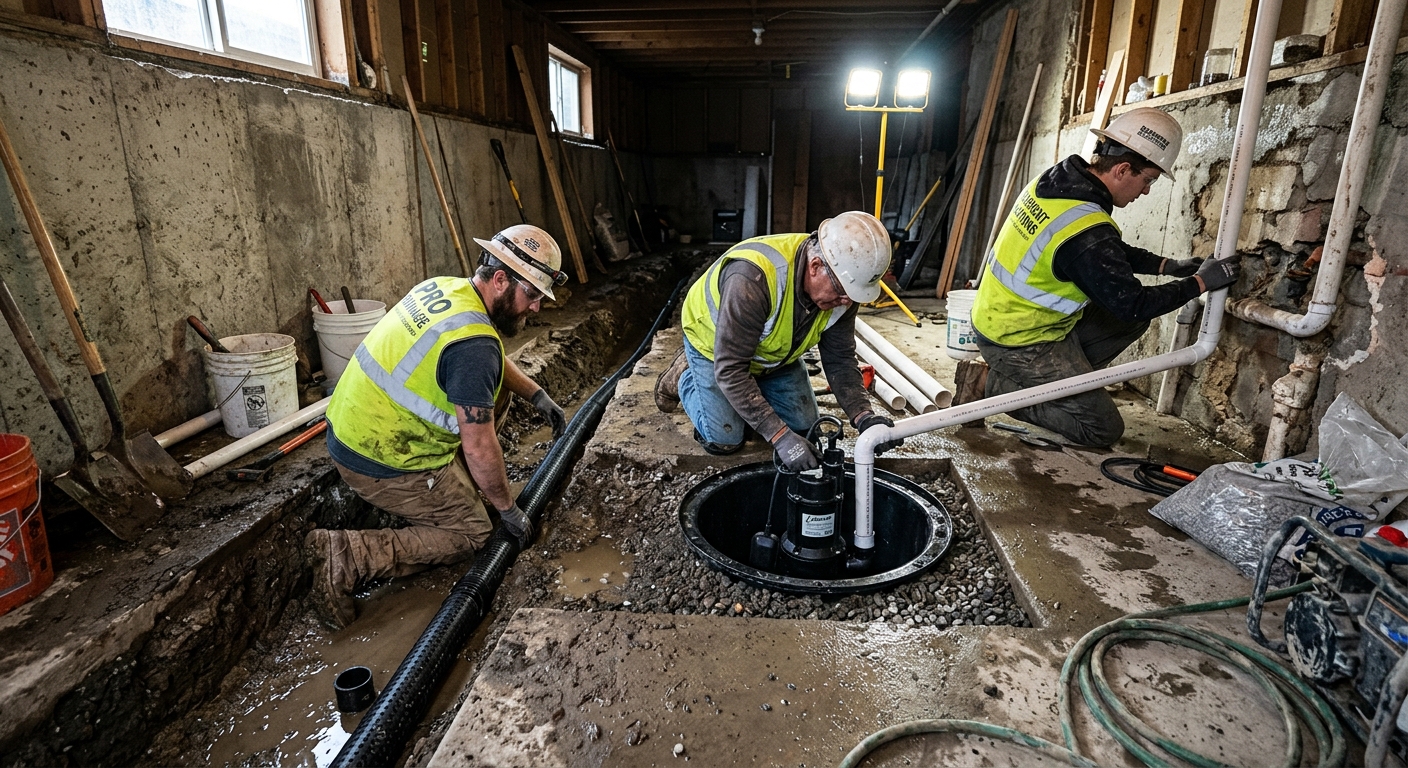
Basement waterproofing options and costs in Glenfield-Jane Heights
Basement waterproofing in Glenfield-Jane Heights usually comes down to where the water is entering and how strongly the surrounding soil is pushing back. With a local population of 30,491 (Statistics Canada, 2021 Census), there’s also plenty of competition from contractors across the Toronto market—helpful for scheduling, but it can make pricing vary widely for what looks like the same fix. Glenfield-Jane Heights has a lot of post-war and 1960–1980s housing, and those eras often mean older drainage systems: original clay weeping tile or early plastic drains can be partially collapsed or clogged. Once those fail, dampness and seepage can become “chronic,” even when homeowners don’t see obvious wall failures.
Toronto-area waterproofing costs are shaped by mixed glacial till and pockets of dense clay that hold water against foundations. In spring and during wet spells, high water tables increase lateral pressure on foundation walls, raising the chance of seepage through cold joints, tie holes, and cracks. Add freeze–thaw cycles, and tiny defects that were once hairline can widen into active leak paths after a few winters. Labour and access also drive budget differences: tight lots, landscaped yards, deck footings, and shared driveways can require more careful hand-digging and concrete protection, especially where interior drainage alone won’t stop the problem.
In Glenfield-Jane Heights—particularly around neighbourhood pockets with older drainage and heavier clay—contractors are frequently in demand for interior sump systems paired with targeted crack work, or for full exterior excavation when the weeping tile is completely failed. Use the table below to compare common options before you request itemised quotes.
| Method |
What It Addresses |
Disruption Level |
Durability |
Price Range |
| Exterior excavation + new membrane + drainage tile |
Lateral water pressure and bulk water entering through foundation walls; restores the drainage path to daylight or an approved discharge route |
High (yard excavation, potential deck/sidewalk impacts, major backfill) |
High (often the most complete source-control approach when properly detailed for clay soils) |
$7,500–$25,000 |
| Interior perimeter drain channel + sump pit |
Relieves water after it enters by collecting seepage and directing it to a sump; useful where exterior access is limited |
Medium (interior floor/wall demo along perimeter, localized jackhammering) |
Medium to high (depends on sump capacity, discharge route, and how well wall sealing is matched) |
$4,000–$14,500 |
| Foundation crack injection (epoxy or polyurethane) |
Stops isolated cracks; epoxy for structural stabilization, polyurethane for active leaking paths |
Low to medium (small drill/port layout; limited demo) |
Medium (best when paired with drainage control; freeze–thaw can re-activate defects if water pressure remains) |
$600–$3,000 |
| Sump pump installation (primary + battery backup) |
Maintains safe basement dryness during high water events and power interruptions; reduces risk of flooding |
Low to medium (minor interior demo; piping and discharge route work) |
Medium to high (strong performance when backup is sized correctly) |
$1,100–$4,200 |
| Window well drain installation |
Prevents water pooling at window wells; redirects seepage away from basement window openings |
Low to medium (excavation around wells, patching) |
Medium (improves performance when weeping/drainage are maintained) |
$900–$3,000 |
| Lot re-grading / downspout extension |
Stops roof runoff and surface water from feeding the foundation zone; helps reduce hydrostatic pressure |
Low to medium (yard work, landscaping reset) |
Low to medium (best as a complement; won’t fix failed below-grade drains) |
$700–$2,800 |
Prices are estimates only and vary by project scope, site access and material selection.
What affects the price of waterproofing in Glenfield-Jane Heights
Homeowners in Glenfield-Jane Heights often see the same type of basement leak solution quoted at prices that can differ by 30–50% across the Toronto area. The difference isn’t just “brand pricing”—it’s usually scope clarity, access, and whether contractors are solving the real water route. National averages don’t always reflect Toronto’s mix of glacial till and dense clay. In clay-heavy ground, soils expand when saturated and during freeze–thaw, which increases lateral pressure on foundation walls and can worsen cracks through cold joints and tie holes. At the same time, water tables in many Toronto neighbourhoods push more water toward the foundation, forcing higher sump capacity and more robust drainage detailing.
Two common local examples explain why costs jump. First, if your weeping tile is original and has failed (often 60+ years old in older neighbourhood pockets), interior drainage may need a stronger sump and more perimeter collection to keep up; that can move a job from a basic perimeter install to the $3,500–$15,000 band for full interior waterproofing. Second, homes with deck footings, driveways, or additions can make exterior excavation labour-intensive—hand-digging around structures and careful membrane protection can pull an exterior project toward the $7,000–$25,000 band rather than the low end.
Freeze–thaw is also a cost factor for crack repairs. A hairline crack that looks “dry” in summer can leak after winter expansion, meaning contractors may need polyurethane injection and/or additional drainage first. If mould or efflorescence is active, remediation and drying time add labour and scheduling costs before sealing can be safely completed.
| Price Factor |
Why It Matters |
Cost Impact |
| Interior vs. exterior approach — interior is less disruptive but addresses symptoms |
Interior systems manage water after it enters; exterior source control requires excavation and membrane detailing |
Exterior can be ~$3,000–$15,000 more depending on access and length of wall |
| Foundation type — poured concrete vs. block vs. stone vs. ICF |
Crack pattern and wall permeability differ; block often needs interior drainage complements |
Block and stone frequently increase the work scope by adding drainage and targeted sealing |
| Soil type — clay expands more than sand, adding pressure |
Clay saturation increases hydrostatic and lateral pressure, making drainage capacity more critical |
May require larger sump, more drain line, or exterior membrane—pushing costs toward the upper ranges |
| Crack type and length — hairline vs. structural horizontal cracks |
Horizontal/step cracking can indicate structural movement; injection alone may not be sufficient |
Potentially adds engineer review and structural measures; increases cost even if leak location seems small |
| Sump pump backup system — battery or water-powered backup needed |
Ontario spring weather and storm events can cause longer outages; backup prevents “no power” flooding |
Typically adds $500–$1,800 to pump-system pricing depending on backup type |
| Access — landscaping, decks, or driveways must be removed for exterior |
Urban lots often require hand excavation and restoration work |
Can raise exterior excavation labour costs by thousands |
| Weeping tile age — original tile (60+ years) may be completely failed |
Failing tile can force water into wall seams and increases “volume” of seepage |
May shift from localized fixes to full perimeter drainage and/or exterior replacement |
| Mould or efflorescence remediation required before sealing |
Sealers and membranes bond better to clean, dry surfaces; active contamination must be addressed |
Adds drying time, prep labour, and sometimes dehumidification costs |
Permits & regulations in Ontario
In Ontario, some basement waterproofing and foundation-related work requires permits, especially when you’re changing structural elements or altering site drainage. Foundation excavation, structural crack repair that may involve the integrity of a wall, and changes to lot drainage practices typically require municipal/building permit approval. If your plan includes connecting a sump discharge line to a storm or sanitary system, municipal approval is commonly required because it affects how water is managed in the broader network.
For structural crack repairs—such as horizontal cracks in block walls, major step cracks, or any cracking pattern that suggests movement—an engineer’s assessment is often required to determine whether underpinning or another structural remedial method is necessary. It’s important to confirm your contractor can coordinate engineering support when structural conditions are suspected, and that they carry liability insurance and WSIB coverage (commonly referred to as WSIB; coverage requirements are about protecting workers on site).
What usually does not require a permit: small-scale interior drying and sealing, localized crack injection for isolated non-structural leaks, and installing a window well drain on your own property in many straightforward scenarios. However, you should still confirm details with your contractor—if discharge routes, excavation depths, or foundation-touching work change, permit requirements can shift.
To verify coverage in Glenfield-Jane Heights: (1) ask for the contractor’s Ontario licence documentation or business registration proof (as applicable), (2) request a certificate of insurance that clearly lists the property address or at least names the policy type and effective dates, and (3) obtain a WSIB clearance letter showing coverage status. Reputable waterproofers will provide these documents before pricing finalizes.
Interior vs exterior waterproofing — what does Glenfield-Jane Heights need?
Understanding interior versus exterior waterproofing is the fastest way to budget correctly in Glenfield-Jane Heights. Exterior waterproofing—full excavation, new membrane, replacement or new drainage tile, and proper backfill—targets the water source before it enters. That’s the most reliable route in clay-heavy, high-water-table conditions, but it costs more and usually requires landscape disruption because contractors must access the exterior foundation wall.
Interior waterproofing (perimeter drain channel, sump pit, sump pump) manages water after it penetrates. It can be less invasive—often no full yard excavation—and it’s a practical choice when access is limited or when the drainage line can’t be reasonably replaced due to decks, driveways, or tight side yards. However, it doesn’t relieve the hydrostatic pressure acting on the wall, which is why crack strategy matters. In Toronto-area homes with poured concrete walls, crack injection can help seal specific leak paths, but it performs best when paired with drainage control to reduce reactivation from freeze–thaw cycles. With block foundations, interior drainage is often an effective complement because water can migrate through mortar joints and wall voids.
Because Ontario can see power outages during spring flooding and storms, sump pump backup systems are a smart investment when you’re relying on interior drainage alone. A battery backup helps maintain pumping during short outages; a more robust backup strategy can reduce the risk of interior flooding in extended events. In many Toronto basements, homeowners find the best value when interior work is targeted and matched to water routing.
For a cost example: if you have active seepage along a long perimeter and a failed older weeping tile, an exterior excavation plus membrane approach can land in the $7,500–$25,000 range, but it may prevent repeated interior interventions. If the leak is localized and the exterior access is poor, an interior perimeter drain with sump system often fits the $4,000–$14,500 band and can deliver a major improvement without rebuilding the whole yard.
| Method |
Best For |
Addresses Source? |
Disruption |
Lifespan |
Price Band |
| Full exterior excavation + membrane |
Clay-heavy soils, high water table conditions, failed exterior drainage, or widespread seepage |
Yes (source control by removing/redirecting exterior water pressure) |
High |
High (proper detailing can last decades) |
$7,000–$25,000 |
| Interior French drain + sump system |
Chronic seepage where exterior access is restricted or when weeping tile replacement isn’t feasible |
No (manages water after entry) |
Medium |
Medium to high (depends on sump sizing and backup) |
$3,500–$15,000 |
| Crack injection — epoxy (structural) |
Non-active or mostly stable cracks where reinforcement is needed |
Partial (seals the crack path if water pressure is reduced) |
Low |
Medium (can underperform if water pressure remains high) |
$600–$2,500 |
| Crack injection — polyurethane (active leak) |
Active seepage through cracks where water is entering now |
Partial (targets the leak path; best with drainage control) |
Low |
Medium to high when paired with correct drainage |
$900–$3,000 |
| Interior drain channel only (no sump) |
Light seepage/dampness where gravity discharge is possible and water volume is low |
No |
Medium |
Low to medium (limited during high water events) |
$2,500–$8,000 |
| Re-grading + downspout extensions |
Surface water runoff issues and poor grading causing pooling near foundation |
No (addresses surface contributions, not below-grade pressure) |
Low to medium |
Low to medium (improves performance, but doesn’t fix failed drains) |
$700–$2,800 |
How to choose a waterproofing contractor in Glenfield-Jane Heights
Choosing the right contractor in Glenfield-Jane Heights is mostly about verification and scope clarity. Start by confirming Ontario coverage essentials: request the contractor’s liability insurance certificate (it should show limits and effective dates) and WSIB/WCB clearance or proof of coverage for workers. If you can’t get WSIB proof, treat it as a “stop” until provided. For licensing and standing, use the contractor information you’re given and check the relevant online registry listings or business registration details that apply to the work type.
Next, get 2–3 itemised written quotes rather than a single lump-sum number. You want a breakdown of labour and materials (membrane system components, drainage tile type, pipe routing, backfill materials, disposal, and any pump/backup equipment). Read the exclusions carefully: what’s not included for disposal, permits, concrete restoration, or landscaping reinstatement? Ask whether a permit pull is included when required and who pays for it.
Warranty matters in waterproofing. Ask for the workmanship warranty length, what it covers (for example, system performance related to seepage), whether it’s transferable to future owners, and how product/manufacturer warranties apply to the membrane or injection materials. Payment terms should protect you: never pay more than 10–15% upfront; hold a portion until the job is complete and verified. Finally, insist on a start date and a completion estimate in writing, because basement waterproofing is often scheduled around drying time and interior restoration.
- Request WSIB proof and liability insurance certificate before signing anything.
- Ask for the exact waterproofing method and why it matches your leak route (not just “we’ll seal it”).
- Get a site-access plan in writing (hand-digging areas, deck/sidewalk protection, disposal route).
- Require an itemised quote: materials, labour hours, and equipment included.
- Confirm whether permits are included when the scope touches excavation, structural repair, or drainage discharge.
- Check sump specs: pump capacity, discharge line route, and whether backup power is included if needed.
- Ask how cracks are identified (mapping) and which injection product will be used (epoxy vs polyurethane) for your crack type.
- Ensure mould/efflorescence conditions are addressed before sealing (prep steps listed).
- Clarify who restores interior finishes and what’s covered (concrete patching, insulation, vapour barriers).
- Verify warranty details: workmanship term, product term, exclusions, and transferability.
- Review the payment schedule; avoid large deposits and pay only after key milestones.
- Ask for a post-install verification step (water test, inspection photos, and documentation).
In Glenfield-Jane Heights, red flags I commonly see include contractors who (1) promise “one-size-fits-all” waterproofing, (2) quote exterior work without discussing soil and water-table conditions, (3) avoid discussing whether backup power is included for sump installs, (4) skip a crack mapping/investigation step before injection, or (5) won’t provide written warranties and proof of WSIB/liability before starting.
Frequently asked questions — waterproofing in Glenfield-Jane Heights
Do I need a sump pump in Glenfield-Jane Heights?
You may need a sump pump in Glenfield-Jane Heights when seepage shows up during wet seasons or when your basement has chronic dampness that increases after heavy spring rains. Because the Toronto area can have higher local water pressure against foundation walls—especially in dense clay pockets—gravity drainage alone may not keep up during peak water events. If your contractor is recommending interior drainage, a sump is often the practical way to collect that water and pump it away. Typical interior waterproofing with sump work can land around $4,000–$14,500, and adding backup capability can push higher depending on the solution. A good contractor will also check your discharge route and whether backup power is appropriate for your specific risk level.
How does Glenfield-Jane Heights's soil affect my foundation?
In Glenfield-Jane Heights, many homeowners deal with mixed soils—often glacial till with pockets of dense clay that retain water. Clay expands when saturated and during freeze–thaw cycles, which increases lateral pressure on foundation walls and can turn small cracks into active leak paths over time. That’s why two homes on the same street can have very different outcomes: one may primarily struggle with surface runoff, while another may suffer from long-term seepage driven by a clogged or failed weeping tile. If your exterior drainage is older, the soil can push water into cold joints, tie holes, and cracks. Addressing drainage capacity (sump sizing or exterior membrane detailing) often matters as much as sealing the visible crack.
Do I need a permit for foundation work in Ontario?
In Ontario, you often need a permit for foundation-related work such as excavation and structural crack repair, particularly where the work may affect foundation integrity or where lot drainage is changed. If your sump discharge connects into storm or sanitary systems, municipal approval is typically required because it impacts local drainage infrastructure. Structural crack repairs—especially horizontal or step cracks—may require engineering assessment before any remediation plan is approved. Small interior sealing or localized crack injection for non-structural leaks often doesn’t trigger permitting, but the key is whether the scope involves excavation, structural elements, or changes to drainage pathways. In Glenfield-Jane Heights, ask your contractor to spell out in writing whether permits are required and who pulls them.
How long does waterproofing last?
Waterproofing longevity in Glenfield-Jane Heights depends on the method and whether it truly addresses the water source. Exterior excavation plus membrane and new drainage tile—properly detailed for Toronto’s freeze–thaw and clay conditions—can last decades. Interior systems can also perform for many years, particularly when designed to handle high water events; however, they rely on pump reliability and adequate drainage collection. Crack injection can last well when the underlying water pressure is reduced, but active seepage paths and expanding clay can re-activate failures if drainage isn’t corrected. If you’re budgeting, remember that exterior work often sits in the $7,000–$25,000 band while interior waterproofing may be $3,500–$15,000; the longer-term durability usually reflects how comprehensively the water route is managed.
Can I waterproof my basement from the inside only?
Yes, many basements in Glenfield-Jane Heights are successfully improved from the inside—especially when exterior access is constrained or when the leak is intermittent. Interior perimeter drains and a sump system can reduce seepage by collecting water after it enters, often improving humidity and preventing basement flooding. For crack leaks, injection (epoxy for more stable cracks or polyurethane for active seepage) can stop specific pathways. That said, interior-only waterproofing may not fully address ongoing hydrostatic pressure against the foundation wall if the exterior drainage is completely failed. In Toronto clay conditions, interior solutions typically work best as part of a coordinated plan: perimeter drainage plus targeted crack work, and sometimes window well drainage. If you’re quoted only for “sealing the wall” without drainage and pump control, ask how they’re addressing water volume and lateral pressure.
What causes foundation cracks in Glenfield-Jane Heights?
Foundation cracks in Glenfield-Jane Heights are commonly caused by soil movement and pressure changes—especially in clay-heavy ground that expands when saturated and contracts as it dries. Freeze–thaw cycles can widen defects in poured concrete or block foundations, turning hairline cracks into active leak routes over a few winters. Additional contributors include water intrusion through cold joints, tie holes, and areas where older drainage systems (original weeping tile or early plastic drains) have partially failed. In some cases, settlement or structural movement can cause horizontal or step cracks, which is why those crack patterns should be assessed rather than treated like simple leaks. A reliable contractor will map crack types, determine whether you have active seepage, and recommend epoxy versus polyurethane injection accordingly.