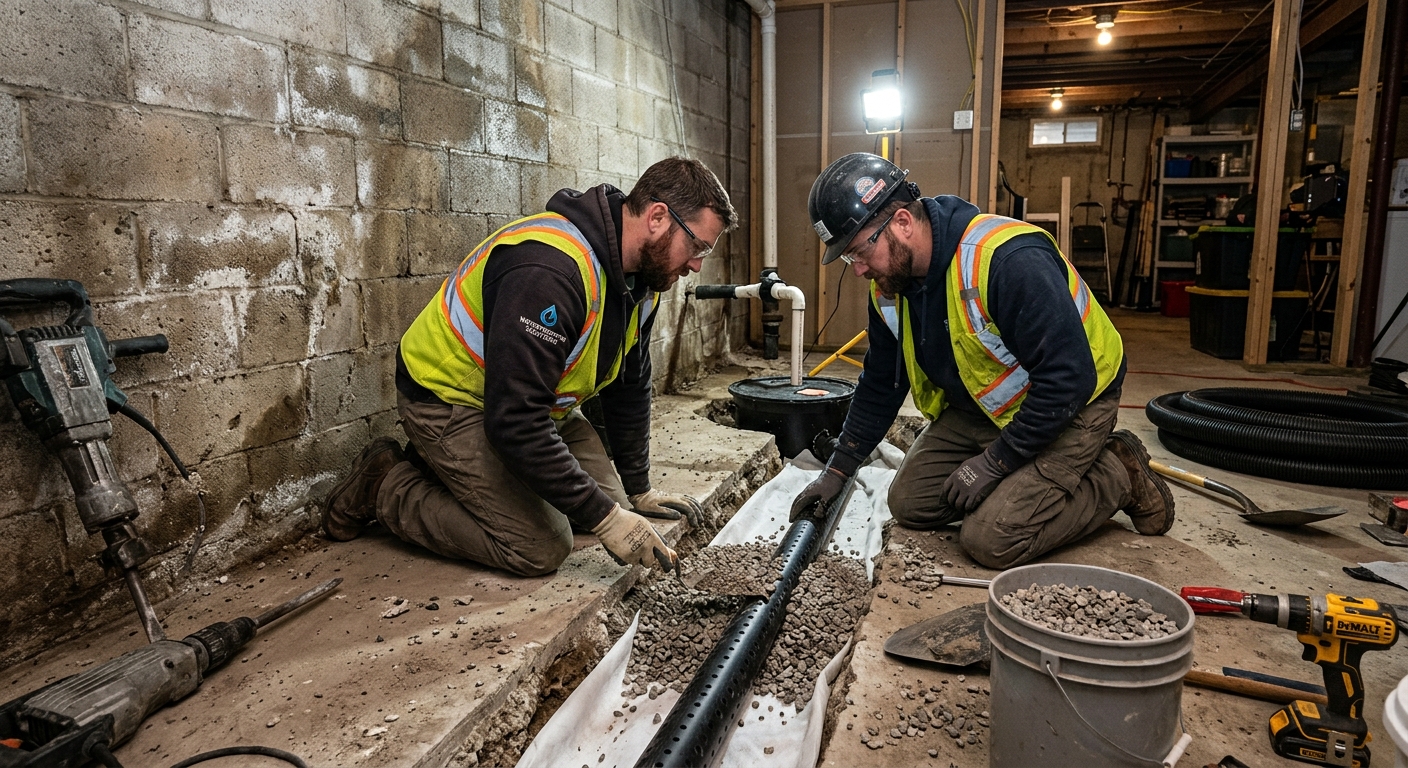
Basement waterproofing options and costs in Parkwoods-Donalda
Basement waterproofing in Parkwoods-Donalda is shaped by both older housing stock and the way Toronto’s soils behave when they get wet. Many neighbourhood basements sit behind mixed glacial till and pockets of dense clay, which can hold water against foundation walls and expand when saturated. In Parkwoods-Donalda specifically, that risk is more common in long-established pockets of the area where homes are older—these basements are more likely to have dated weeping tile (or clay weepers) that are partially clogged or collapsed, leading to dampness, efflorescence, and seepage rather than a single obvious exterior wall failure. Statistics Canada’s 2021 Census reports Parkwoods-Donalda’s population at 34,805, reflecting the tight, long-inhabited housing patterns that keep demand steady for exterior and drainage work (Statistics Canada, 2021 Census).
Cost is also affected by freeze–thaw. Small defects in concrete and block foundations can widen over several winters, turning “hairline” issues into active leaks through cold joints, tie holes, and cracks. On top of that, access in the Toronto market matters: decks, landscaping, and shared driveways often limit excavation space, so contractors may need more hand-digging and careful sequencing. In places like the Don Valley Parkway corridor edge and other mature lots where backyard space is constrained, exterior work can cost more due to disruption and logistics.
To help you compare apples to apples, use the options and ranges below as a planning guide, then we can narrow the scope based on where water is entering and whether hydrostatic pressure is present.
| Method |
What It Addresses |
Disruption Level |
Durability |
Price Range |
| Exterior excavation + new membrane + drainage tile |
Source water at the foundation by removing soil pressure and directing groundwater to a drain system |
High (excavation, landscaping restoration) |
Long-term when properly detailed for Toronto clay and freeze–thaw |
$7,000–$25,000 |
| Interior perimeter drain channel + sump pit |
Relieves interior hydrostatic pressure and captures seepage after it enters the basement |
Medium (floor and wall work along perimeter) |
Very effective for failing weepers and clogged drains |
$4,500–$14,000 |
| Foundation crack injection (epoxy or polyurethane) |
Seals isolated cracks; polyurethane is used for active leaks while epoxy targets non-moving cracks |
Low to Medium |
High when crack movement is correctly identified and addressed |
$600–$3,000 |
| Sump pump installation (primary + battery backup) |
Manages water flow during high water-table periods and power outages |
Low to Medium |
High with backup power and correct discharge routing |
$1,600–$5,000 |
| Window well drain installation |
Prevents overflow and surface water entry at basement windows |
Low to Medium |
Good for targeted entry points |
$1,200–$4,000 |
| Lot re-grading / downspout extension |
Stops roof and surface water from running toward foundation walls |
Low |
Moderate (best as a complementary fix) |
$650–$3,500 |
Prices are estimates only and vary by project scope, site access and material selection.
What affects the price of waterproofing in Parkwoods-Donalda
In Parkwoods-Donalda and the wider Toronto area, you can easily see quote differences of 30–50% for what sounds like the “same” waterproofing job. That gap usually comes from site conditions, how much of the drainage problem is actually being solved, and the amount of disruption required for safe, code-minded work. Two contractors might both offer an interior perimeter drain, but one may include sump discharge changes, efflorescence remediation, and proper grading checks—while the other treats symptoms only.
Three local drivers separate Toronto-area costs from the national average: soil type, water table behaviour, and freeze–thaw cycles. Clay-heavy pockets common around Toronto can expand when saturated and exert lateral pressure on foundation walls, worsening cracks over time. In areas with higher effective water tables, sump pumps may need longer run times and a properly sized system; that pushes labour and electrical work. Freeze–thaw then widens small defects in concrete and block walls, increasing the risk of active seepage through cold joints, tie holes, and newly opened crack paths.
Concrete examples in Parkwoods-Donalda: (1) a basement with original weeping tile failure often requires interior drainage plus sump upgrades, because the exterior drains are partially collapsed—this can move a project from roughly the $3,500–$7,000 band to $8,000–$14,000 depending on floor removal and wall work; (2) if the foundation is block with step cracks near mortar lines, crack injection may not be enough by itself, so you’ll see add-ons like perimeter drainage; (3) if access is tight due to deck footings or a shared driveway, exterior excavation can jump toward the upper end of the $7,000–$25,000 range due to hand-digging and longer excavation time.
Finally, housing age matters. Post-war and 1960–1980s homes often have older drainage designs. When those systems have spent decades under wet clay conditions, it’s common to find that interior solutions cost less initially, but exterior excavation may be justified where hydrostatic pressure is persistent.
| Price Factor |
Why It Matters |
Cost Impact |
| Interior vs. exterior approach — interior is less disruptive but addresses symptoms |
Exterior removes source pressure; interior captures water after it enters |
Interior often saves upfront cost, but exterior can prevent recurring leaks (can shift by thousands) |
| Foundation type — poured concrete vs. block vs. stone vs. ICF |
Crack behaviour and sealing methods differ; block/masonry joints can seep along mortar |
Block and stone often require more labour; poured concrete may respond better to injection |
| Soil type — clay expands more than sand, adding pressure |
Clay saturation increases lateral pressure on walls and floor edges |
Higher material and system sizing, especially for sump requirements |
| Crack type and length — hairline vs. structural horizontal cracks |
Structural movement needs assessment; active leaks require flexible sealing |
Structural repairs can add cost well beyond basic injection |
| Sump pump backup system — battery or water-powered backup needed |
Backup protects you during spring flooding and power interruptions |
Commonly adds to sump project budget but reduces risk of damage |
| Access — landscaping, decks, or driveways must be removed for exterior |
Excavation time and restoration scope increase with constrained access |
Exterior work can move toward the upper end of the price bands |
| Weeping tile age — original tile (60+ years) may be completely failed |
When exterior drains are gone, interior drainage becomes more critical |
Interior scope often expands: more floor demo, longer perimeter channel |
| Mould or efflorescence remediation required before sealing |
Sealers and membranes don’t perform reliably over untreated salts or contaminants |
Adds prep time; often necessary for long-term results |
Permits & regulations in Ontario
In Ontario, certain foundation and drainage changes typically require a permit. As a homeowner in Parkwoods-Donalda, you’ll most often encounter permit needs when you do foundation excavation, structural crack repair that may affect load paths, or changes to lot drainage that could alter how stormwater is managed. If your sump pump ties into a municipal sewer system (storm or sanitary), municipal approval is commonly required; the contractor should confirm discharge routing before work begins. For major crack repairs—especially horizontal cracks in block walls or step cracks that suggest movement—an assessment by a structural engineer is often required to determine whether underpinning or other structural work is necessary.
Before signing, verify your contractor carries engineering support when structural repairs are in scope, and confirm they have proper liability insurance plus WSIB/WCB coverage. The checklist you can follow in practice is simple: ask for the current certificate of insurance (COI) and ensure it names you as the insured where applicable; confirm WSIB/WCB registration or clearance status (and capture proof in writing); and for licensing, look up the contractor through the appropriate Ontario public registry and verify the exact trades/coverage they’re claiming for the work being performed.
Step-by-step, do this: (1) request a written scope that states whether excavation, structural crack work, and drainage tie-ins are included; (2) ask whether permits are pulled by the contractor and who is responsible for the permit fees; (3) review the contractor’s COI and WSIB/WCB clearance letter; (4) keep copies of all documents with your contract.
Work that commonly does not require a permit is small interior sealing, targeted crack injection, or minor downspout extensions and re-grading that does not change drainage discharge points to municipal systems—however, always confirm based on your exact scope and local requirements.
Interior vs exterior waterproofing — what does Parkwoods-Donalda need?
The decision between interior and exterior waterproofing comes down to whether you’re solving the water at the source or managing it after it enters. Exterior waterproofing involves full excavation, new membrane detailing, and new drainage tile systems, then backfilling and restoring the landscape. It permanently addresses the source of water entry and reduces hydrostatic pressure against the foundation wall—but it is disruptive and is often the higher-cost option in the Toronto market because excavation is labour-intensive and landscaping restoration can be substantial.
Interior waterproofing—typically a perimeter drain channel, sump pit, and sump pump—works by capturing water once it seeps past the foundation and directing it away from the basement. This is less invasive and frequently the better choice when original exterior drainage (like clay weeping tile) is failing or when excavation access is limited. However, interior systems don’t stop lateral soil pressure from acting on the wall itself; they manage the consequences. For Parkwoods-Donalda’s mixed glacial till and clay pockets, that means interior solutions must be designed for freeze–thaw and for consistent sump performance during wet seasons.
In many Toronto homes, poured concrete basements tend to respond well to crack injection when movement is limited, while block foundations often need interior drainage as a practical complement because moisture can travel through mortar joints. When you include a battery backup sump pump in Ontario, you protect your basement during power disruptions that can happen during spring storms and high-demand periods.
Here’s a concrete pricing example: if you have active seepage at a perimeter crack and clogged original weepers, a combined interior perimeter drain and sump plan might land in the $4,500–$14,000 range, while an exterior excavation and membrane can move toward $7,000–$25,000. The difference is justified when hydrostatic pressure is chronic and exterior drainage is truly beyond salvage or when access allows a complete source-control solution.
| Method |
Best For |
Addresses Source? |
Disruption |
Lifespan |
Price Band |
| Full exterior excavation + membrane |
Persistent seepage with high soil pressure and failed/unknown exterior drainage |
Yes |
High |
Long-term when properly detailed for Toronto clay and freeze–thaw |
$7,000–$25,000 |
| Interior French drain + sump system |
Basements with chronic dampness, efflorescence, and failing weepers where excavation is constrained |
No (manages water after entry) |
Medium |
Very effective when discharge, grading, and pump sizing are correct |
$4,500–$14,000 |
| Crack injection — epoxy (structural) |
Non-moving cracks in poured concrete where water entry is limited |
Not a source fix; targets an entry path |
Low |
High when cracks are stable and properly prepared |
$600–$3,000 |
| Crack injection — polyurethane (active leak) |
Active seepage where water is weeping through cracks |
Not a source fix; controls current leakage points |
Low |
High for active leaks when movement is addressed and drainage is adequate |
$600–$3,000 |
| Interior drain channel only (no sump) |
Small, intermittent moisture loads with low risk of power disruption |
No |
Medium |
Good only if seepage volume is truly limited |
$3,500–$9,000 |
| Re-grading + downspout extensions |
Surface-water problems: runoff toward foundation, poor roof drainage |
Yes for surface-water routes |
Low |
Moderate; depends on ongoing maintenance and soil movement |
$650–$3,500 |
How to choose a waterproofing contractor in Parkwoods-Donalda
Choosing a contractor in Parkwoods-Donalda is less about marketing and more about verification and scope control. Start with Ontario checks: confirm the contractor’s licensing/registration for the trades they’re doing, then review liability insurance documentation and proof of WSIB/WCB coverage. You can ask for a current certificate of insurance (COI) and check the insurer and coverage limits; for WSIB/WCB, request a clearance letter or equivalent proof and keep it with your contract. If the contractor is recommending structural repairs, verify they have engineering support and that the scope reflects it.
Next, get 2–3 itemised written quotes—not lump sums. A good quote breaks out labour versus materials, includes line items for demo, disposal, membrane/drain components, sump piping, electrical work (if applicable), and restoration allowances. Read exclusions carefully: is permit pulling included (when required), is mould/efflorescence remediation included, and is landscape restoration part of the price? Also ask about warranty details. The workmanship warranty should be clear on length and coverage; the product/manufacturer warranty should match the system being installed, and you should know whether it’s transferable to a future buyer.
On payment schedule, protect yourself: never pay more than 10–15% upfront, and use a holdback until the job is complete and verified. Require a start date and an estimated completion timeline in writing, tied to confirmed site access.
- Ask for proof of WSIB/WCB coverage (clearance letter) and store it with your contract.
- Request a COI and verify liability coverage limits are adequate for excavation and below-grade work.
- Confirm who pulls permits if your scope includes drainage changes or structural crack repairs.
- Get an itemised quote with disposal included (spoils, old tile where removed, and debris haul-off).
- Require a written scope that states exactly where water is being tested and how the entry points are identified.
- Ask whether battery backup is included for sump systems (and what triggers it).
- Clarify whether sump discharge is rerouted safely and where it discharges.
- For crack injection, require a plan to determine epoxy vs polyurethane based on active leakage and crack movement.
- Confirm prep steps for efflorescence and contamination before any sealing or membrane application.
- Demand a workmanship warranty length in years, and ask whether it covers materials and labour.
- Don’t accept vague “best efforts” wording—insist on quantities (linear feet of drain channel, number of injection ports).
- Use a staged payment schedule with a holdback until waterproofing performance and cleanup are verified.
Red flags I commonly see in Parkwoods-Donalda: contractors who offer exterior excavation without assessing whether interior drainage is also needed; quotes that don’t address weeping tile condition or sump sizing; no mention of freeze–thaw effects or crack movement assessment; very short warranties that don’t align with the system; and payment terms asking for large deposits or refusing a written scope and schedule.
Frequently asked questions — waterproofing in Parkwoods-Donalda
What is a battery backup sump pump and do I need one in Parkwoods-Donalda?
In Parkwoods-Donalda, a battery backup sump pump is a secondary pump system designed to run if the power goes out or if the primary pump is interrupted. During spring and after heavy rain, Toronto-area basements can experience rapid water inflow, and a power outage—while not constant—can be enough to cause localized flooding and cleanup headaches. A battery backup is especially valuable when you have a sump already, have chronic seepage, or when the basement is finished and hard to keep dry.
In practical terms, most homeowners who want full risk reduction pair a primary sump with backup, which often fits within the sump installation price band—commonly around $1,600–$5,000 depending on system design and backup type.
How much does basement waterproofing cost in Parkwoods-Donalda?
Basement waterproofing in Parkwoods-Donalda usually falls into a few predictable tiers depending on whether the work is interior-only or addresses the source with an exterior excavation. For interior perimeter drainage plus a sump approach, many projects land in the $3,500–$15,000 planning window; a typical installed interior perimeter drain plus sump solution can be around $4,500–$14,000. If you’re dealing with an active leak that requires targeted crack injection, foundation crack repair can be much lower—often $600–$3,000 for the repair scope, depending on crack length and preparation.
When soil pressure is high or the original exterior drainage is beyond salvage, exterior waterproofing excavation and new membrane work is the bigger-ticket item, commonly $7,000–$25,000 in this area because excavation time and restoration drive cost.
Interior vs exterior waterproofing — which is better?
“Better” depends on what’s causing your leaks. Exterior waterproofing is best when you need source control: excavation, membrane, and new drainage tile remove water pressure at the foundation. In Parkwoods-Donalda’s mixed glacial till and clay pockets, source control can be the most durable approach when hydrostatic pressure is chronic. But it’s disruptive and costlier due to excavation and landscape restoration.
Interior waterproofing is better when access is limited, when you’re trying to stop seepage quickly, or when original weeping tile is failing and exterior excavation isn’t practical. Interior solutions manage water after it enters using a perimeter drain channel and sump pit. Many basements are successfully stabilized with interior work, particularly when paired with appropriate sump performance and, where needed, crack injection.
Why is my basement leaking in Parkwoods-Donalda?
Common causes in Parkwoods-Donalda include high effective water pressure from clay-heavy soils, failing drainage around the foundation, and freeze–thaw widening defects. If you have dampness along the perimeter, efflorescence (white salt staining), or water pooling near specific wall sections, it often points to older weeping tile systems being clogged or collapsed—especially in post-war to 1960–1980s homes with dated drainage setups.
Cracks and cold joints can also become active leak paths over time, particularly after winters when small defects expand. Another frequent scenario is surface-water runoff: clogged downspouts, poor grading, or extensions missing can send roof water toward the foundation, increasing seepage load at the exact places you see staining.
How do I know if a foundation crack is serious?
In Ontario homes, not every crack is structural—but the pattern and behaviour matter. A hairline vertical crack can be less urgent than a horizontal crack or a step crack in block walls. Horizontal cracks, cracks that widen seasonally, or cracks that show moisture staining and continued weeping are often more concerning because they may indicate movement or active hydrostatic pressure.
In Parkwoods-Donalda, freeze–thaw can turn small cracks into active leaks, so you should treat any crack that’s associated with dampness, efflorescence, or water intrusion as a priority. A helpful contractor will identify whether crack injection is appropriate (epoxy for stable/non-moving cracks, polyurethane for active leaks) and recommend interior drainage upgrades if the crack is only one symptom of ongoing water pressure.
How much does foundation crack repair cost in Parkwoods-Donalda?
Foundation crack repair cost in Parkwoods-Donalda typically depends on crack length, number of injection ports, whether the crack is actively leaking, and how much prep is required. For targeted injection repairs, pricing commonly starts around the $600–$3,000 range for typical residential crack scopes. Active leaks usually require polyurethane-style injection and may require additional steps to address moisture at the crack line.
If the crack is part of a larger water-pressure problem (for example, failing weeping tile or chronic seepage along multiple walls), injection alone may not stop the issue long-term. In those cases, you’ll see the crack repair added to a broader interior or exterior drainage plan, where total budgets often move into the interior or exterior waterproofing bands.