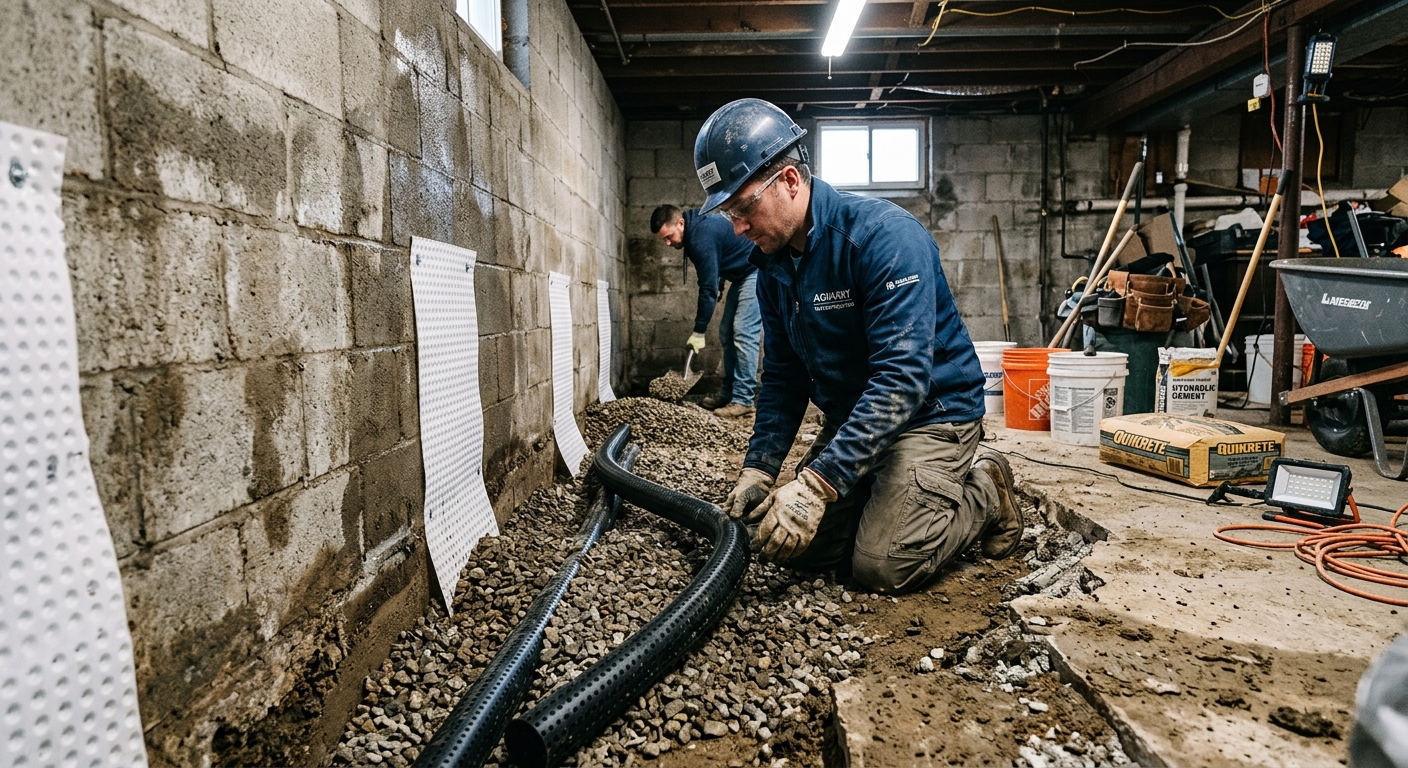
Basement waterproofing options and costs in Maple Leaf
In Maple Leaf, Ontario, basement waterproofing is often less about “one bad spot” and more about managing ongoing water pressure through aging foundations. With a population of 10,111 (Statistics Canada, 2021 Census), Maple Leaf homeowners typically share the same housing reality as nearby Toronto: many basements in the 1960–1970s era were built with early drainage concepts that didn’t always keep up once soils and drainage systems aged. In practice, that means contractors see more clogged or collapsed weeping tile, damp corners that never fully dry, and small leaks that become active seepage after Toronto’s freeze–thaw swings.
Toronto-area pricing is also shaped by access. Tight urban lots, shared driveways, and landscaping around deck footings can force more careful hand-digging and longer labour time—so even “similar” jobs can land far apart. Demand is especially high in older, established pockets where post-war foundations meet clay-heavy backfill and higher groundwater pressure, and this is where exterior excavation crews tend to book out first. In nearby neighbourhood-style areas such as the older sections of the broader Toronto fabric (where drainage systems from the first decades of the basement era are most often due for replacement), you’ll often find homeowners comparing exterior excavation with interior solutions—especially if they want to stop seepage but minimize yard disruption.
Below is a practical comparison of the most common methods contractors recommend in Maple Leaf, and the typical cost bands you’ll see in itemized quotes.
| Method |
What It Addresses |
Disruption Level |
Durability |
Price Range |
| Exterior excavation + new membrane + drainage tile |
Primary water entry by reducing hydrostatic pressure at the foundation; replaces failing drainage |
High (excavation, backfill, landscaping disruption) |
High (designed for long-term site conditions) |
$7,000 – $25,000 |
| Interior perimeter drain channel + sump pit |
Intercepts seepage after it enters; reduces basement wall wetting and efflorescence |
Medium (floor/wall saw cutting; less yard work) |
Medium-to-High (depends on ongoing water load) |
$3,500 – $15,000 |
| Foundation crack injection (epoxy or polyurethane) |
Stops isolated leaks through cracks; restores watertightness to the crack pathway |
Low (patching and surface prep) |
Medium (excellent for the right crack type) |
$600 – $3,000 |
| Sump pump installation (primary + battery backup) |
Moves collected water away; backup protects during outages during spring melt |
Medium (core drilling, discharge line routing) |
Medium-to-High (system reliability is key) |
$800 – $3,500 |
| Window well drain installation |
Prevents groundwater and surface water from pooling at window wells |
Low-to-Medium (localized excavation) |
Medium (depends on drainage grading) |
$900 – $4,500 |
| Lot re-grading / downspout extension |
Reduces water loading against foundation; directs roof runoff away |
Low (minor landscaping disruption) |
Low-to-Medium (must be maintained) |
$600 – $3,200 |
Prices are estimates only and vary by project scope, site access and material selection.
What affects the price of waterproofing in Maple Leaf
In Maple Leaf and across the Toronto economic region, the same basic “waterproofing” label can produce quotes that differ by roughly 30–50%. The biggest reason is that contractors are pricing the water source and site difficulty, not just a product. Two jobs that both include “drainage work” can be very different if one home has clay-heavy soil holding water against the foundation while another sits on sand that sheds water quickly.
Three drivers most strongly separate local costs from the broader Ontario average: soil type, water table, and freeze–thaw cycles. In clay pockets, saturated soil expands and exerts lateral pressure on foundation walls; that pressure can worsen cracks over time and turn a “dry basement” into one with active seepage. High water tables raise the duty cycle of sump pumps (and the amount of collected water), which affects piping size, pump selection, and whether you need a backup system. Toronto’s freeze–thaw also widens small defects in concrete and block foundations, so a small leak today can become a larger repair after a few winters—pushing you toward options like perimeter drainage or exterior membranes rather than patch-only solutions.
Concrete examples from typical Maple Leaf scenarios: (1) If your original weeping tile is 60+ years old and partially collapsed, reusing it is rarely a practical plan—replacement pushes costs toward the higher end of exterior excavation ranges (often closer to $7,000–$25,000). (2) If seepage is concentrated behind a finished basement wall on poured concrete, crack injection and interior drainage can keep disruption lower, sometimes landing near $600–$3,000 for isolated crack work plus optional interior drainage. On the flip side, good downspout routing and a simple drainage correction can be a lower-cost fix before full excavation becomes necessary.
| Price Factor |
Why It Matters |
Cost Impact |
| Interior vs. exterior approach — interior is less disruptive but addresses symptoms |
Exterior reduces water entry; interior captures water after it enters |
Interior often 40–70% less than full excavation; exterior rises with excavation and membrane complexity |
| Foundation type — poured concrete vs. block vs. stone vs. ICF |
Crack behaviour and crack sealing performance vary by material |
Block and stone usually require more careful drainage detailing; poured concrete may respond well to injection when isolated |
| Soil type — clay expands more than sand, adding pressure |
Clay holds water and increases hydrostatic and lateral loads |
Higher likelihood of ongoing seepage drives more comprehensive systems (interior drains/sumps or exterior membranes) |
| Crack type and length — hairline vs. structural horizontal cracks |
Some cracks are active leak paths; structural cracks may need engineering |
Active structural conditions can shift the job from injection to engineering/possible underpinning—adding cost |
| Sump pump backup system — battery or water-powered backup needed |
Ontario outages during heavy spring periods can leave a sump without power |
Backup adds upfront cost but reduces the risk of a “one-night flood” during extended melt events |
| Access — landscaping, decks, or driveways must be removed for exterior |
Urban access constraints increase labour and disposal |
Exterior excavation can jump when decks, stairs, or retaining walls must be temporarily removed and reinstalled |
| Weeping tile age — original tile (60+ years) may be completely failed |
Older drainage systems often clog or collapse |
If replacement is required, scope expands from repairs to full drainage replacement |
| Mould or efflorescence remediation required before sealing |
Moisture problems often involve contaminants and staining that must be addressed |
Can add remediation time and materials before waterproofing takes hold |
Permits & regulations in Ontario
In Ontario, waterproofing and foundation-related work sometimes requires permits, and the type of work matters. In general, foundation excavation, structural crack repair, and changes to lot drainage typically require a building permit because they can affect the building envelope and drainage conditions. If you’re installing a sump pump discharge that connects to a storm or sanitary sewer, municipal approval is commonly required before work begins. For structural crack repair—especially horizontal cracks in block walls or major step cracks—an assessment by a structural engineer is often needed to determine whether underpinning or other structural work is required.
What typically does not require a permit (but still should be done by a qualified contractor) includes localized crack injection for a clearly non-structural, isolated leak and interior perimeter drain work confined within the basement that does not alter the building structure or drainage plan. However, even “small” work can trigger permit needs if it includes changes to grading, weeping tile routing, or drainage discharge direction.
For Maple Leaf homeowners, verify three things step-by-step: (1) Licensing details: check the contractor’s licensing references and any trade registration information on the contractor’s own site and through the appropriate provincial public registry where applicable; (2) Certificate of Insurance: request a current certificate of insurance naming you as the additional insured (and verify liability and property damage coverage limits); (3) WSIB/WCB clearance: ask for a clearance letter or proof of coverage status. For structural work, confirm they have engineering support or a process to coordinate engineer scope, and always ensure liability insurance is active for the project start date.
Interior vs exterior waterproofing — what does Maple Leaf need?
In Maple Leaf, Ontario, the core difference is simple: exterior waterproofing targets the source by interrupting water entry, while interior waterproofing focuses on managing water after it enters. Exterior work involves full excavation, new membrane, new drainage tile (weeping tile replacement), and backfill. It’s the most comprehensive method for high lateral soil pressure and higher water tables common in many Toronto-area neighbourhoods—especially where clay-heavy backfill holds moisture against the foundation wall.
Interior waterproofing typically uses a perimeter drain channel and sump pit/pump to collect seepage. It is usually less invasive and can be installed without disturbing patios, decks, or driveways at the same level as exterior excavation. This approach is practical when you have chronic dampness, efflorescence, or basement flooding due to failing weepers, but you want to avoid removing landscape features on a tight lot. That said, interior systems don’t eliminate hydrostatic pressure against the wall; they intercept water before it spreads across floors and walls.
Given typical Toronto-era foundation styles, poured concrete walls often respond well to properly selected crack injection (when leaks are isolated and non-structural), while block foundations often benefit from interior drainage as a complement. For spring melt and wet weather, sump pump backup matters in Ontario—if power is lost during high runoff and the sump can’t run, even a small interruption can lead to standing water.
Where the price difference is justified: if exterior excavation is feasible, homeowners commonly spend more (within the $7,000–$25,000 exterior band) because it replaces the drainage pathway itself. If access is difficult or leaks are localized, interior solutions can stay closer to the $3,500–$15,000 band, and crack injection can be far more targeted when the crack type supports it (often $600–$3,000).
| Method |
Best For |
Addresses Source? |
Disruption |
Lifespan |
Price Band |
| Full exterior excavation + membrane |
High water pressure, repeating seepage, failed weeping tile, clay backfill loading |
Yes (primary source of water entry) |
High |
Long-term |
$7,000 – $25,000 |
| Interior French drain + sump system |
Chronic seepage, efflorescence, wet corners; when exterior access is limited |
No (manages water after it enters) |
Medium |
Medium-to-Long |
$3,500 – $15,000 |
| Crack injection — epoxy (structural) |
Non-moving cracks in poured concrete or stable crack patterns |
Partially (seals crack pathway, not the overall wall loading) |
Low |
Medium-to-Long when crack is stable |
$600 – $2,500 |
| Crack injection — polyurethane (active leak) |
Active seepage cracks with water movement through the crack |
Partially (seals active pathways) |
Low |
Medium (depends on crack movement and drainage conditions) |
$800 – $3,000 |
| Interior drain channel only (no sump) |
Light seepage where water can be managed without mechanical pumping |
No |
Medium-to-Low |
Short-to-Medium (system capacity limited) |
$2,000 – $8,500 |
| Re-grading + downspout extensions |
Surface water runoff issues; minor dampness from roof drainage |
Often (reduces water loading) |
Low |
Short-to-Medium (depends on maintenance) |
$600 – $3,200 |
How to choose a waterproofing contractor in Maple Leaf
Choosing the right waterproofing contractor in Maple Leaf starts with proof, not promises. In Ontario, you should verify (1) licensing/credentials for the trade(s) performing the work, (2) liability insurance, and (3) WSIB/WCB coverage (or a valid clearance status). How to check: ask for a current certificate of insurance (and confirm effective dates), request WSIB/WCB clearance letter information, and look for the coverage details matching the company name that will appear on your contract. Don’t accept “we’re covered” without documents.
Next, get 2–3 itemized written quotes—ideally a breakdown that separates labour, materials (membrane, drainage tile, pump, discharge piping), excavation/disposal, and any interior saw cutting and restoration. A credible quote lists what’s included and what’s excluded: permit pulling (if required), disposal, backfill type, sump discharge destination, and restoration limits for drywall, flooring, and landscaping. For warranty, ask for the workmanship warranty length, whether there’s a product/manufacturer warranty, and whether warranties are transferable to future homeowners.
For payment schedule, plan around protection: never pay more than 10–15% upfront. Hold back enough to ensure you have leverage—commonly until key waterproofing components are complete and tested. Finally, request a written timeline with a start date and completion estimate. Waterproofing work is weather-sensitive; delays often occur when excavations need to stay drained and protected.
- Ask for a detailed scope: where they dig, what they remove, and where they install drains/membrane
- Confirm whether a permit is required and who pulls it (and whether it’s included in the price)
- Verify insurance documents: liability coverage and (if applicable) workers coverage for the job duration
- Request WSIB/WCB clearance letter/proof before work begins
- Get pump specs in writing (gallons per hour, discharge size, check valve, cycling expectations)
- If installing a sump, confirm backup type (battery or water-powered) in the scope
- Clarify disposal and restoration: excavated soil hauling, landscape repair, and patching limits
- Confirm how they address efflorescence/mould before sealing
- Ask how they test water control (e.g., hose test, discharge verification, sump pump operational check)
- Check warranty terms: workmanship duration, exclusions, and transferability
- Ensure the quote is itemized (labour + materials), not a single lump-sum line
- Agree on payment milestones tied to completed waterproofing steps, not vague “progress”
Red flags in Maple Leaf: a quote that offers crack injection without addressing failed drainage or water pressure; no written scope or vague “we’ll waterproof everything”; refusing to provide insurance/WSIB/WCB clearance documents; warranties that don’t specify workmanship duration or have broad exclusions; and demanding large upfront payments (beyond 10–15%) or pushing you to sign before permits and site conditions are clarified.
Frequently asked questions — waterproofing in Maple Leaf
How do I know if a foundation crack is serious?
In Maple Leaf, most cracks aren’t automatically “structural,” but you should treat certain patterns seriously—especially with Toronto’s freeze–thaw cycles. A crack that is changing (wider over time), features horizontal movement in block walls, or shows recurring wetness after rain/melt is more concerning than a stable, hairline crack that stays dry. Signs of active leakage include dampness, efflorescence (white salt deposits), or water staining on the basement wall or floor. If you see step cracking in masonry, differential movement near corners, or persistent seepage along a crack line even after surface patching, you’ll likely need professional inspection. In those cases, injection alone may not be enough and an engineer assessment may be warranted before sealing. For isolated leaks that aren’t moving, crack repair can fall in the $600–$3,000 band, but structural concerns change the scope quickly.
How much does foundation crack repair cost in Maple Leaf?
Foundation crack repair in Maple Leaf typically depends on whether you’re sealing an isolated, stable crack or stopping active leakage. Many homeowners pay in the $600–$3,000 range when the work is limited to a few cracks with straightforward access and proper surface prep. Epoxy injection is often used for stable cracks, while polyurethane is selected when water is actively moving through the crack. Costs rise when crack lengths are longer, multiple areas require drilling and injection ports, or when there’s additional remediation for efflorescence/mould before sealing. If the crack is part of a wider structural issue, pricing can move beyond simple injection and may require engineering support and additional repairs. A good contractor will itemize the injection type and the number of injection points so you can compare like-for-like quotes rather than guessing from a single line item.
Do I need a sump pump in Maple Leaf?
You may need a sump pump in Maple Leaf if you have chronic seepage, recurring wet floor areas, or signs that water collects in the basement instead of staying only as minor wall dampness. Toronto-area soil conditions—especially clay pockets that hold water and expand during freeze–thaw—can increase lateral pressure and raise the chances of periodic groundwater entry. Many basements with failed or clogged weeping tile benefit from a perimeter drain channel leading to a sump pit, because it keeps water from pooling at the floor. If you already have a sump but it fails during storms or power interruptions, adding backup is often the practical upgrade. For budgeting, sump pump installations commonly fall around $800–$3,500 depending on whether you add primary plus battery backup and how complex the discharge routing is. A careful assessment (and sometimes a hose test) will help confirm whether gravity-only interior drainage is enough or if mechanical pumping is required.
How does Maple Leaf's soil affect my foundation?
Maple Leaf sits in a region with mixed glacial till and clay soils, and many lots include dense clay that holds water against foundation walls. When saturated, clay can expand during freeze–thaw and exert lateral pressure, which can widen cracks and turn small defects into active seepage over a few winters. This helps explain why homeowners sometimes see problems without “major” visible exterior wall failure—water finds the path through cold joints, tie holes, and cracks, then spreads as the freeze–thaw cycle repeats. If your property is on clay-heavy backfill or drainage is clogged, you’ll typically see recurring dampness, efflorescence, or basement flooding rather than a one-time event. The impact also shows up in cost: clay and higher water pressure often pushes you toward exterior excavation + membrane and new drainage tile, or a more comprehensive interior drainage/sump system rather than crack patching alone.
Do I need a permit for foundation work in Ontario?
In Ontario, permits are commonly required for foundation excavation, changes to lot drainage, and structural crack repair depending on the scope. In Maple Leaf, if the work involves excavating around the foundation, altering drainage routing, or addressing cracks that may be structural (for example, major horizontal or step cracking), you should expect that a building permit may be required. Sump pump installations can also require municipal approval if discharge connects to the storm or sanitary sewer. For homeowners, the key is to ask your contractor up front: what permit will be pulled (if any), who pulls it, and what documentation is provided before work starts. A reputable contractor will handle permits and provide proof of compliance, and will coordinate engineering support when structural concerns exist. If a contractor won’t discuss permits clearly, that’s a warning sign for waterproofing jobs that involve more than surface-level patching.
How long does waterproofing last?
Waterproofing lifespan in Maple Leaf depends heavily on the method and the cause of water entry. Exterior excavation + membrane and new drainage tile typically provides the longest service life because it addresses hydrostatic pressure at the source, especially in clay and higher-water-table conditions common in the Toronto area. Interior drainage and sump systems generally last a long time when maintained, but they manage water after it enters, so performance depends on whether the system is kept clear and if the pump and discharge lines remain reliable. Crack injection can last for years when the crack is stable and properly matched to the injection product, but active movement or widespread water pressure can shorten results. As a rough homeowner planning guide, exterior systems often outperform interior-only solutions over the long term, while injection is best suited to isolated leaks. If you’re budgeting, exterior options typically sit around $7,000–$25,000, while interior perimeter systems often fall in the $3,500–$15,000 band, reflecting the difference in how comprehensively the underlying water pathway is addressed.