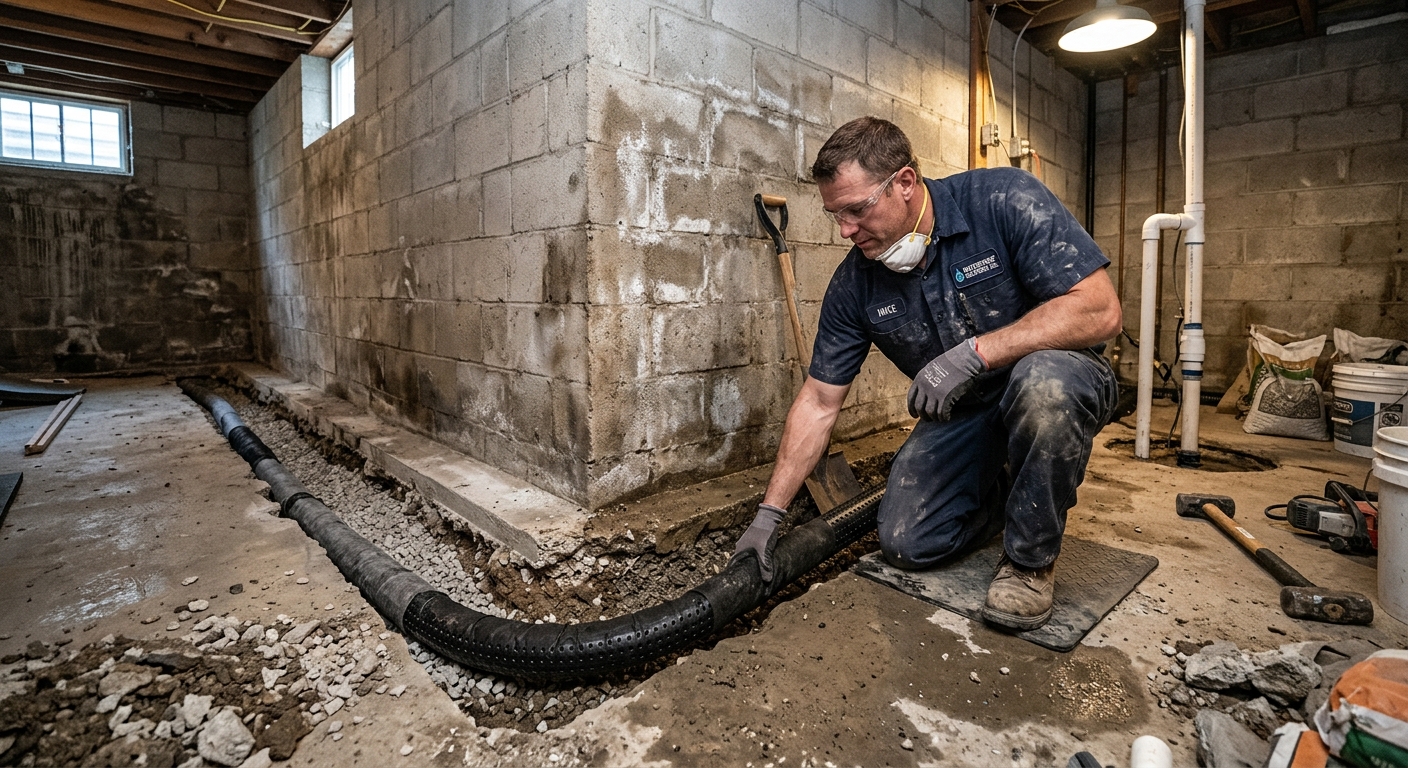
Basement waterproofing options and costs in ByWard Market
ByWard Market basement waterproofing is rarely a one-size-fits-all fix, because the source of water changes with the lot and the foundation details. In this area, many homes date back several decades, and older basements tend to have aging drainage systems (for example, original weeping tile or early plastic drains) that are partially collapsed or clogged. In the wider Toronto region, housing and population patterns reflect a mature urban base—ByWard Market itself has a population of 3,063 (Statistics Canada, 2021 Census)—which also means lots of established properties, tight access, and repeat moisture issues in long-standing foundations.
Toronto-area freeze–thaw cycles can turn small defects into active leaks: hairline cracks widen, and sealants at cold joints fail sooner when the wall repeatedly moves. Costs also track with how access works in an urban pocket like ByWard Market—removing landscaping, working around mature trees, or digging near additions and deck footings increases labour time and disposal.
In practice, contractors often see higher demand around the ByWard Market neighbourhood core and the older residential blocks just off the main streets, where basements can be prone to seepage at tie holes, cracks, and failing perimeter drains. That’s why it’s helpful to compare common methods by what they address, how disruptive they are, and what you should budget—then match the approach to your specific leak pattern.
| Method |
What It Addresses |
Disruption Level |
Durability |
Price Range |
| Exterior excavation + new membrane + drainage tile |
Hydrostatic water pressure at the foundation, saturated backfill, failing weepers |
High (excavation, landscape restoration) |
Long-term when done to detail (membrane + tile + proper backfill) |
$7,000–$25,000 |
| Interior perimeter drain channel + sump pit |
Water after entry (relieves seepage around footing), reduces basement flooding |
Medium (floor cutting at perimeter) |
High for chronic seepage if sump is sized correctly |
$3,500–$15,000 |
| Foundation crack injection (epoxy or polyurethane) |
Isolated cracks; epoxy for structural/stable cracks, polyurethane for active leaks |
Low (minimal demolition) |
Good for the right crack type and preparation |
$600–$3,000 |
| Sump pump installation (primary + battery backup) |
Improves performance during high water events and power interruptions |
Low to medium (pit + discharge line) |
High with proper maintenance and backup |
$800–$3,500 |
| Window well drain installation |
Surface and groundwater pooling around basement windows |
Medium (grading/stone work near wells) |
Moderate to high (depends on downspout grading and tile tie-in) |
$1,000–$4,000 |
| Lot re-grading / downspout extension |
Redirects roof runoff and reduces soil saturation near walls |
Low to medium |
Moderate (best as a complement to drainage fixes) |
$500–$3,000 |
Prices are estimates only and vary by project scope, site access and material selection.
What affects the price of waterproofing in ByWard Market
In ByWard Market, and across Toronto’s surrounding municipalities, quotes for the “same” waterproofing problem can swing by 30–50% because contractors price the details that determine how long the fix lasts. Soil type, water table conditions, and freeze–thaw are the three drivers that separate local costs from a national average. Toronto’s mixed glacial till and clay pockets can hold water against foundations; when saturated, clay expands during freeze–thaw and increases lateral pressure on walls. That extra movement worsens seepage through tie holes, cold joints, and cracks, so labour time and material choices (membrane systems, drainage specification, crack strategy) tend to increase.
High local water tables also change the system design. If the job requires a sump pit, contractors often need a properly sized pump and sometimes a backup system, especially where spring flooding and extended wet periods keep the pump running. For example, an interior perimeter drain channel with sump can fit within the $3,500–$15,000 band, while a full exterior excavation tends to be budgeted in the $7,000–$25,000 band because excavation, disposal, and restoration are major cost components in established, tight urban lots.
Two common ByWard Market examples: (1) a backyard with a deck or addition that limits excavation usually pushes the contractor toward an interior solution; (2) older drainage with partially collapsed clay weepers may force both interior drainage and targeted crack repair, rather than a quick injection alone. When the moisture source is roof runoff, re-grading and downspout extensions can reduce saturation cost-effectively, but they rarely replace a failing perimeter drainage system in consistently damp basements.
| Price Factor |
Why It Matters |
Cost Impact |
| Interior vs. exterior approach — interior is less disruptive but addresses symptoms |
Interior systems manage water after entry; exterior systems stop water at the wall |
Interior often reduces excavation costs, but may cost more over time if water pressure remains uncontrolled |
| Foundation type — poured concrete vs. block vs. stone vs. ICF |
Different walls crack and behave differently under freeze–thaw and lateral pressure |
Poured concrete may respond well to injection; block/stone often needs interior drainage as a practical complement |
| Soil type — clay expands more than sand, adding pressure |
Clay saturation and expansion drive seepage through joints and cracks |
Clay-heavy sites can push you toward exterior membranes or added drainage and stronger sump design |
| Crack type and length — hairline vs. structural horizontal cracks |
Stable cracks can be injected; active or horizontal movement may require engineering review |
Structural repair can expand scope beyond injection, increasing labour and potential consulting |
| Sump pump backup system — battery or water-powered backup needed |
Backups reduce flood risk during power interruptions during high-water periods |
Often adds a few hundred to a few thousand dollars depending on backup type and install complexity |
| Access — landscaping, decks, or driveways must be removed for exterior |
Urban lot work increases labour, disposal, and restoration |
Exterior projects can jump quickly when hand-digging around footings and shared driveways is required |
| Weeping tile age — original tile (60+ years) may be completely failed |
Old drains can collapse and stop diverting water away from the footing |
Failed drains often increase work to re-establish drainage lines and tie-ins |
| Mould or efflorescence remediation required before sealing |
Sealing over active salts or contaminated materials reduces adhesion and can trap moisture |
Can add remediation time before waterproofing materials are installed |
Permits & regulations in Ontario
In Ontario, foundation excavation, structural crack repair, and changes to lot drainage typically require a building permit. That often includes work that alters the foundation system or addresses water management at the footing level. Sump pump installations that tie into municipal sewer systems (storm or sanitary connections, depending on your discharge route) usually need municipal approval, and contractors should coordinate discharge routing to avoid creating a nuisance or backflow risk.
For structural crack repair—especially horizontal cracks in block walls, major step cracks, or signs of movement—an assessment by a structural engineer is often required to determine whether underpinning or other structural work is needed. Before you authorize the job, confirm the contractor has engineering support available for structural scopes, and ask for their liability insurance and WSIB/WCB coverage. Those documents matter for your protection and for job-site safety, particularly when excavation and concrete drilling are involved.
Here’s how a homeowner in ByWard Market can verify everything step-by-step:
- Ask for the contractor’s proof of WSIB/WCB coverage (or the appropriate clearance letter, if applicable).
- Request an up-to-date certificate of liability insurance and confirm it covers construction/waterproofing activities.
- Verify the contractor’s Ontario licensing/registration details through the appropriate online registry listing they provide in their proposal.
- Check whether the permit pull is included in the quoted scope and who is responsible for it.
- For structural concerns, request the engineer involvement in writing before any injection-only solution is offered.
- Keep copies of the insurance and clearance documentation with your contract paperwork.
Typically requires a permit: foundation excavation, below-grade drainage modifications, structural crack repair, and significant lot drainage changes at foundation level. Often does not require a permit (but depends on scope): targeted crack injection for stable cracks, window well drain additions, and localized re-grading/downspout extensions that do not alter the foundation system.
Interior vs exterior waterproofing — what does ByWard Market need?
The fundamental difference is whether you address water before it reaches the foundation wall or manage water after it enters the basement. Exterior waterproofing involves excavation around the foundation, installing membrane and new drainage tile at the footing level, then carefully backfilling and restoring the landscaping. Done correctly, it permanently reduces hydrostatic pressure against the wall. It’s also more disruptive and more expensive in ByWard Market because excavation in tight lots can require hand-digging, careful shoring near decks or additions, and detailed restoration.
Interior waterproofing—perimeter drain channels, sump pits, and sump pumps—works by collecting water that has already entered through cracks or joints and directing it to a sump. Interior systems are less invasive and often fall into the $3,500–$15,000 range, but they do not eliminate the wall pressure acting on cold joints and cracks. In Toronto-area conditions, that matters: clay-saturated soil and freeze–thaw cycles can keep pushing water through the same pathway, especially in older block foundation sections or walls with multiple prior patch points.
For poured concrete walls, crack injection paired with drainage can be a strong fit, because many leaks are isolated and respond well when the crack is stable. For block foundations, interior drainage is frequently a practical complement because block joints and mortar conditions can allow persistent seepage—so a sump strategy becomes the “always there” line of defence.
Sump pumps also need a plan for power interruptions during spring wet periods. Battery backup or an alternative backup protects you when municipal demand and storm conditions extend outages.
As an example, if you’re dealing with a single isolated crack and minor dampness, a crack injection in the $600–$3,000 band may be justified. But if the basement is consistently wet after rain and you see signs of failing exterior drainage, paying for exterior work closer to $7,000–$25,000 can be worth it because you’re stopping the source—rather than repeatedly pumping it out.
| Method |
Best For |
Addresses Source? |
Disruption |
Lifespan |
Price Band |
| Full exterior excavation + membrane |
Chronic seepage where soil saturation and lateral pressure are confirmed |
Yes (water entry is controlled at the wall) |
High (excavation and restoration) |
Long-term when drainage/tile are installed to detail |
$7,000–$25,000 |
| Interior French drain + sump system |
Basements with recurring dampness or water after entry (especially where exterior access is limited) |
Partially (manages water after entry) |
Medium (perimeter floor/ceiling access) |
High with correct pump sizing and maintenance |
$3,500–$15,000 |
| Crack injection — epoxy (structural) |
Stable cracks in poured concrete where the crack is not actively moving |
Yes (stops seepage through that crack pathway) |
Low |
Good when surface prep is done properly |
$600–$3,000 |
| Crack injection — polyurethane (active leak) |
Active weeping where water flow is ongoing |
Yes (targets active pathway) |
Low to medium |
Good for ongoing seepage when installation is correct |
$800–$3,500 |
| Interior drain channel only (no sump) |
Minor seepage where water volume is low and can be managed without pumping |
Partially (collects water after entry) |
Low to medium |
Moderate (depends on water conditions) |
$2,500–$9,000 |
| Re-grading + downspout extensions |
Roof runoff issues and early dampness near exterior wall lines |
No (does not fix below-grade entry pathways) |
Low to medium |
Moderate (best as a supplement) |
$500–$3,000 |
How to choose a waterproofing contractor in ByWard Market
Choosing the right waterproofing contractor in ByWard Market starts with verifying coverage and credentials before you compare prices. In Ontario, confirm the contractor has appropriate WSIB/WCB coverage and can provide proof—many will supply a clearance letter upon request. Ask for a current certificate of liability insurance showing they’re insured for work at residential sites. Also verify their Ontario registration/licensing details using the registry information they provide in their quotation package.
Next, get 2–3 itemised written quotes. You want a labour + materials breakdown, not a single lump sum, so you can see what’s included for excavation or interior floor work, how drainage tile is specified, and whether disposal and restoration are part of the contract. Read the scope carefully: what’s excluded (for example, failed drain replacement depth, removal of wet drywall, mould remediation), whether the contractor handles permit pull, and if engineering support is required for structural crack conditions.
Warranty matters. Ask for the workmanship warranty length in writing, the product/manufacturer warranty coverage, and whether it’s transferable if you sell your home. For payments, avoid large upfront cheques—never more than 10–15% upfront in a typical residential waterproofing schedule—and hold back a portion until the job is complete and cleaned up.
Finally, insist on a clear timeline: start date and completion estimate in writing. If a contractor can’t commit to dates or provides only verbal assurances, that’s a risk—especially where excavation access and material lead times drive schedule.
- Confirm WSIB/WCB clearance or coverage proof and keep it with your contract.
- Request liability insurance certificate and verify it matches the type of work.
- Use a signed, itemised scope with quantities (linear feet of drain, number of crack ports, pump model).
- Ask whether permits are included and who pulls them.
- Confirm disposal, hauling, and restoration scope (topsoil, sod, stone/brick replacement where applicable).
- Review warranty: workmanship term, product term, and transferability.
- Ensure discharge routing is described (no questionable connections to indoor drains).
- Ask how they determine crack type (epoxy vs polyurethane) and whether they address active leakage.
- Require a maintenance plan for sump pumps (check valves, discharge line inspection).
- Ask about backup power if you’ve experienced pump stoppages during outages.
- Confirm daily worksite protection (plastic containment, dust control if drilling indoors).
- Get a written timeline and material delivery assumptions.
Red flags in ByWard Market include: a quote that skips access/restoration details for exterior work; claiming a “one injection fixes all” approach without checking whether the crack is active; no written warranty terms (or a warranty that excludes workmanship or prep); refusing to provide insurance/WSIB/WCB documentation; and an unclear discharge plan for a sump pump that could create backflow or nuisance issues.
Frequently asked questions — waterproofing in ByWard Market
How do I know if a foundation crack is serious?
In ByWard Market (and across Ontario), seriousness depends less on the crack width at a single moment and more on whether it’s active and whether it suggests movement. Look for signs of active moisture (dampness right at the crack, mineral staining, or water weeping after rain) and structural patterns (horizontal cracks, step cracking in masonry, or cracks that widen seasonally). Freeze–thaw can turn hairline defects into “working” cracks, so repeated wetness over a few winters is a key indicator. If the crack is near a footing line, tie hole, or in a high-pressure water zone (clay-saturated soil pockets), treat it as potentially significant. For structural concerns, request an engineer assessment before injecting and resealing.
How much does foundation crack repair cost in ByWard Market?
Foundation crack repair in ByWard Market typically falls in the $600–$3,000 range, with pricing driven by how many cracks are treated, wall type (poured concrete vs. block), and whether it’s epoxy (stable) or polyurethane (active leak). If your crack is actively leaking, the installer may need more preparation and sometimes additional ports to control flow before sealing. If multiple cracks or wider structural patterns are present, the scope can expand beyond injection. For comparison, minor drainage fixes (like re-grading/downspout changes) can be cheaper than injection, but they won’t stop water coming through a true crack pathway. A written, itemised quote should specify the crack type and the injection material.
Do I need a sump pump in ByWard Market?
You might, especially if you have chronic seepage, recurring dampness after heavy rain, or any history of basement water during wet spring conditions. In Toronto’s mixed glacial till and clay pockets, saturated backfill can create lateral pressure and increased seepage through joints and cracks. If water is reaching your basement floor drains or you’re seeing puddling near the perimeter, a sump pump with a properly designed interior drainage system is often the practical solution. Many homeowners also add battery backup for spring storms because power interruptions can coincide with high water volumes. A sump pump installation commonly budgets in the $800–$3,500 range, but the total cost depends on whether you’re adding drainage channels, a pit, check valves, and backup.
How does ByWard Market's soil affect my foundation?
ByWard Market’s foundation risk is tied to the surrounding soils that can hold water against your basement walls. Toronto-area soils often include glacial till and pockets of dense clay that retain moisture; when saturated, clay can expand during freeze–thaw and increase lateral pressure on foundation walls. That pressure can worsen existing defects at cold joints, tie holes, and cracks, turning small issues into active seepage over a few seasons. If you have older drainage that’s partially clogged or collapsed, the soil stays wetter longer, which increases pump run times or recurring dampness. The upside is that once contractors identify whether your leak is driven by saturated soil/water table versus roof runoff, they can design exterior excavation + membranes or interior drainage with a clear basis.
Do I need a permit for foundation work in Ontario?
Often, yes—especially when you’re doing foundation excavation, structural crack repair, or changing lot drainage at the foundation level. In Ontario, certain below-grade work and any modifications that impact drainage or foundation performance commonly trigger permit requirements. Sump pump installations that connect to storm or sanitary sewer systems typically require municipal approval depending on discharge routing. For structural crack repairs (like horizontal cracks in block walls or step cracks suggesting movement), contractors frequently need a structural engineer assessment before choosing the repair method. The practical approach in ByWard Market is to ask your contractor upfront: “Is the permit pull included?” and “Who handles the paperwork?” A reputable contractor will also provide insurance and proof of coverage so you’re not taking on the risk.
How long does waterproofing last?
Longevity depends on the method and whether it addresses the actual source of water. Exterior waterproofing systems (membrane + new drainage tile + correct backfill) are typically designed for long-term performance when installed to detail, because they reduce hydrostatic pressure at the wall. Interior systems (drain channel + sump) can also last many years, but they manage water after it enters, so they perform best when the foundation remains stable and the sump is maintained. Crack injection can last for a long time when the crack is stable—however, if the crack is actively moving due to freeze–thaw and clay pressure, repairs may need the right injection strategy (epoxy vs polyurethane) or additional drainage work. In practice, the “durability” goal is tied to how well the contractor matched your soil and water conditions, which is why ByWard Market’s clay-heavy pockets and older drainage history matter.