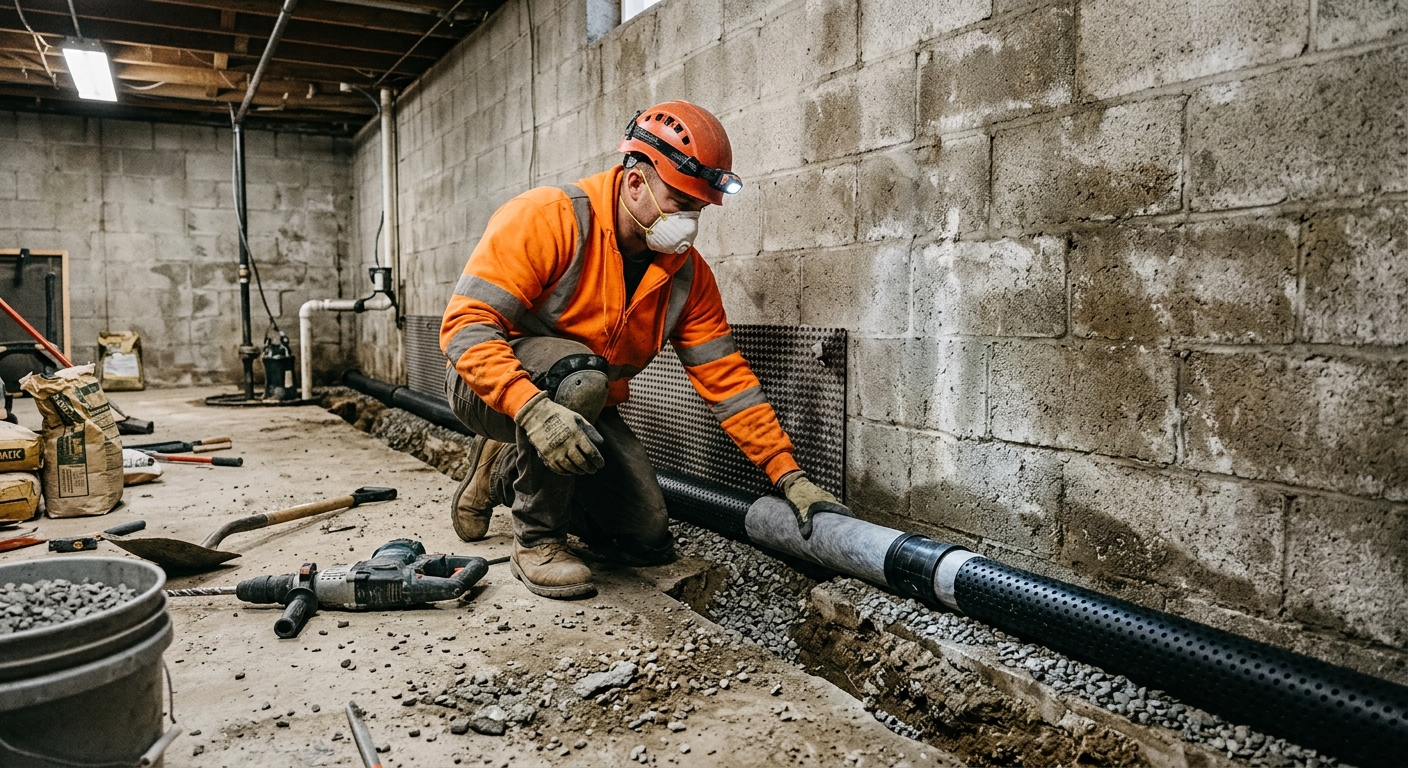
Basement waterproofing options and costs in Rosedale-Moore Park
Rosedale-Moore Park homeowners typically face basement leaks shaped by two realities: the area’s 2021 population of 20,923 (Statistics Canada, 2021 Census) supports an active trade base, and many older houses are more likely to be suffering from long-failed “original” drainage. In Toronto’s older, post-war homes, original tar-and-paper systems and early weeping tile often lose performance with age—so the first repairs that seemed “small” can turn into damp walls, efflorescence, and recurring seepage after a wet spring.
In this part of the Greater Toronto Area, glacial till and clay pockets can hold water against foundation walls, increasing lateral pressure during freeze–thaw cycles. That pressure widens small defects in concrete and block foundations and turns hairline cracks and tie-hole leaks into active pathways. Because access can be tight—especially near additions, mature landscaping, or shared driveways—exterior work can require careful hand-excavation and protection of finished surfaces, which affects pricing and scheduling.
If you’re in the pocket where contractors are busiest—around the Rosedale-to-areas closer to downtown where lots are older and narrower—you’ll often see exterior excavation bids priced higher than expected, and more homeowners moving to interior perimeter drainage and sump systems to stabilize the basement quickly. The sections below outline the main waterproofing approaches and typical ranges, so you can compare like-for-like before booking site visits.
| Method |
What It Addresses |
Disruption Level |
Durability |
Price Range |
| Exterior excavation + new membrane + drainage tile |
Stops water at the source by replacing failed weeping tile and installing a continuous waterproofing system with proper drainage |
High (excavation, backfill, landscaping restoration) |
High (multi-layer system; best when soil pressure and water table are active) |
$10,000 – $25,000 |
| Interior perimeter drain channel + sump pit |
Collects seepage after it enters; reduces hydrostatic pressure at the interior face |
Medium (interior cutting, limited demolition) |
High when paired with proper discharge and cover drains |
$6,500 – $15,000 |
| Foundation crack injection (epoxy or polyurethane) |
Seals cracks; epoxy for stable/structural cracks, polyurethane for active leaks and voids |
Low (targeted holes and surface patching) |
Medium to high (depends on crack type and whether water pressure keeps re-activating it) |
$600 – $3,000 |
| Sump pump installation (primary + battery backup) |
Moves collected water to prevent overflow and basement flooding during peak runoff |
Low to medium (pit + discharge routing) |
High with backup; best for chronic seepage zones |
$1,400 – $3,500 |
| Window well drain installation |
Prevents water pooling and directing into window wells; reduces staining and water entry near egress |
Medium (excavation around window) |
Medium to high (good drainage maintenance required) |
$800 – $2,800 |
| Lot re-grading / downspout extension |
Improves surface runoff so water doesn’t oversaturate backfill and find foundation cracks |
Low to medium (topsoil/stone/curb work) |
Medium (works best when combined with drainage correction) |
$2,000 – $7,500 |
Prices are estimates only and vary by project scope, site access and material selection.
What affects the price of waterproofing in Rosedale-Moore Park
In Toronto, you can easily see waterproofing quotes for the “same” basement problem vary by 30–50%—even when the photos look similar—because contractors price for what they find at inspection, not what’s visible on day one. Nationally, waterproofing is influenced by climate and soil, but in our region the biggest cost split comes from three drivers: clay-heavy soil and expansion during freeze–thaw, a higher likelihood of active lateral pressure against foundation walls, and the presence of older drainage systems that are partially collapsed or clogged.
Clay expands more during freeze–thaw and can push against foundations, worsening cracks over time. That means an interior-only plan might need a sump and more floor/footing work to keep up, while exterior drainage and membrane systems are often priced for the full source control. High local water tables in many neighbourhoods also raise sump pump run times and increase the required performance of drainage components, which shifts pricing when you’re in the range of $6,500 – $15,000 for interior drainage with a sump versus $10,000 – $25,000 when excavation and membrane replacement is the chosen path.
Concrete examples from Rosedale-Moore Park: if your home has a post-war foundation with failing weeping tile, excavation is typically more involved because debris and silt have accumulated—cost rises. If your discharge route can’t easily connect where the contractor prefers (tight municipal runs or shared-drive obstructions), sump piping and labour increase. Conversely, if the leak is a single, stable crack and testing confirms no active pressure behind it, a targeted injection can keep costs near $600 – $3,000 instead of escalating into full interior drainage.
| Price Factor |
Why It Matters |
Cost Impact |
| Interior vs. exterior approach — interior is less disruptive but addresses symptoms |
Exterior targets the water source; interior manages the water that enters |
Interior often costs less up-front, but chronic seepage can drive additions like sump pits and upgraded discharge; exterior can exceed interior by several thousand |
| Foundation type — poured concrete vs. block vs. stone vs. ICF |
Crack behaviour and sealing method differ by material |
Block foundations often need interior drainage complements; poured concrete may respond better to injection when cracks are stable |
| Soil type — clay expands more than sand, adding pressure |
Clay expansion increases hydrostatic and lateral pressure during freeze–thaw |
Higher pressure raises the need for full source control or stronger interior management |
| Crack type and length — hairline vs. structural horizontal cracks |
Structural movement can render simple sealing temporary |
Structural cracks can trigger engineering/underpinning assessment work, raising total cost |
| Sump pump backup system — battery or water-powered backup needed |
Reduces flood risk during spring outages and heavy runoff |
Backup adds cost but often prevents high-damage callbacks |
| Access — landscaping, decks, or driveways must be removed for exterior |
Tight lots increase excavation time and restoration scope |
Exterior pricing rises when deck/drive demolition and careful re-installation are required |
| Weeping tile age — original tile (60+ years) may be completely failed |
Old tile systems can be clogged, collapsed, or disconnected |
Complete replacement increases excavation depth and disposal/rebuild labour |
| Mould or efflorescence remediation required before sealing |
Sealers don’t bond reliably over contaminated or actively scaling surfaces |
Preparation steps can add time, containment, and labour before waterproofing proceeds |
Permits & regulations in Ontario
In Ontario, some waterproofing-related work commonly requires a building permit, particularly when you’re changing the structure or drainage function around the home. In practice, foundation excavation, structural crack repair that may affect load paths, and changes to lot drainage (especially where it affects how water leaves the property) are frequently permit-triggering. If you’re installing or modifying a sump system that ties into municipal drainage (storm or sanitary), you’ll need municipal approval in addition to the contractor’s building permit obligations.
For structural crack repair—like horizontal cracks in block walls or major step cracks—an assessment by a structural engineer is often required to determine whether underpinning or other structural measures are needed before sealing. This is also where you should insist the contractor has engineering support for structural repairs, not just “we’ll inject and see.”
How homeowners in Rosedale-Moore Park can verify compliance step-by-step:
- Ask the contractor for their Ontario licence/business info and the permit responsibility (who pulls it).
- Request a current certificate of insurance (liability) showing coverage effective dates.
- Confirm workers’ coverage via WSIB/WCB documentation; don’t accept a verbal promise.
- For structural cracks, request their process: when engineering is required and who supplies the engineer’s report.
- Verify what the written scope says about permits, inspections, and any municipal discharge approvals.
- Before work starts, ensure the permit number (if required) matches the address and scope.
Finally, insist on everything in writing: scope, exclusions, permit handling, and warranty details.
Interior vs exterior waterproofing — what does Rosedale-Moore Park need?
Exterior waterproofing is the source-control option: it involves full excavation around the foundation, installing a continuous membrane, restoring drainage tile, and then backfilling and re-grading. It costs more and usually disrupts landscaping, but it tackles the water entry point that’s being driven by saturated backfill and clay pressure. Interior waterproofing is different: perimeter drain channels, sump pits, and sump pumps manage water once it enters the basement. It’s typically less invasive, but it does not remove the hydrostatic pressure pushing against your walls—so it’s best when the goal is to control seepage and reduce basement damage while addressing the drainage strategy that keeps water from overwhelming the foundation.
In Rosedale-Moore Park’s Toronto climate zone, freeze–thaw cycles often convert small defects into active leaks. For poured concrete walls, properly selected crack injection (and a good interior water management layer when needed) can be very effective when cracks are stable. For block foundations and older drainage setups that have failed, interior perimeter drainage and a sump are often the practical complement, because interior systems can stabilize chronic seepage even when source control would be expensive due to access constraints.
Sump pump backup matters here in spring and shoulder seasons—power interruptions do happen during heavy weather. If you’re on the fence between approaches, use a practical cost example: exterior excavation and membrane replacement is commonly in the $10,000 – $25,000 band. If your leak is localized to a few seepage points or a failing perimeter area, an interior plan (like perimeter drain + sump) can land around $6,500 – $15,000 and stabilize the basement without full yard demolition.
| Method |
Best For |
Addresses Source? |
Disruption |
Lifespan |
Price Band |
| Full exterior excavation + membrane |
Homes with active water pressure, failing weeping tile, and recurring perimeter seepage |
Yes |
High (excavation, backfill, landscaping restoration) |
Long (multi-layer system when properly detailed) |
$10,000 – $25,000 |
| Interior French drain + sump system |
Chronic dampness/flood risk where excavation is limited by decks, driveways, or tight lots |
No (it manages water after entry) |
Medium (floor cutting and pit installation) |
High with correct discharge and pump maintenance |
$6,500 – $15,000 |
| Crack injection — epoxy (structural) |
Stable cracks where there’s no ongoing movement |
Partial (seals the pathway) |
Low (drill/patch) |
Medium to high if crack remains stable |
$600 – $2,500 |
| Crack injection — polyurethane (active leak) |
Active leaks, voids, or cracks where water keeps entering |
Partial (seals active pathway) |
Low (drill/patch) |
Medium to high when paired with drainage control |
$800 – $3,000 |
| Interior drain channel only (no sump) |
Light seepage where gravity discharge and low hydrostatic pressure is confirmed |
No |
Medium (floor/drain channel works) |
Medium (can be less reliable in high-water seasons) |
$3,500 – $9,000 |
| Re-grading + downspout extensions |
When surface water is the main contributor and downspouts discharge too close to the foundation |
Yes for surface runoff contribution |
Low to medium (grading/stone work) |
Medium (may need periodic maintenance) |
$2,000 – $7,500 |
How to choose a waterproofing contractor in Rosedale-Moore Park
Choosing the right waterproofing contractor in Rosedale-Moore Park is mostly about proof: proof of coverage, proof of experience with your foundation type, and proof that they can explain the scope in plain language. In Ontario, verify the contractor’s Ontario licence details (and who is responsible for any permits), then confirm their liability insurance certificate shows your address and has coverage in effect. Next, verify WSIB/WCB coverage—ask for the clearance/coverage documentation rather than a screenshot or an old certificate.
When you request quotes, ask for 2–3 itemised written proposals with a labour-and-material breakdown. You want line items that show what they’re excavating or cutting, what membrane/drain products they’re using, what disposal and restoration are included, and whether they’re allowing for test holes or camera inspection. Be wary of quotes that only list a total number without specifying discharge location, pipe size, filter fabric, backfill type, or sump discharge routing. Also confirm what’s excluded: permit pulls, engineering, mould remediation prep, and landscaping restoration are common “surprise” exclusions.
Warranty matters. Look for a workmanship warranty length, plus a manufacturer/product warranty for membranes and pumps where applicable. Ask if the warranty is transferable to you as the homeowner or to future owners if you sell.
For payment schedule, never pay more than 10–15% upfront. Hold back the balance until completion and final demonstration (pump operation checks, discharge flow verification, and a walkthrough of sealed areas). Finally, demand a written start date and an estimated completion timeline tied to weather and material lead times.
- Check that the scope matches your leak pattern (perimeter vs. window wells vs. crack-only).
- Confirm they’ll address both water entry and internal water handling when needed.
- Ask how they diagnose active vs. stable cracks before injection type selection.
- Require itemised disposal and landscaping restoration for exterior work.
- Verify sump discharge plan (where the pipe runs and how it prevents backup).
- Confirm pump model and backup option (battery or other backup) if recommended.
- Ask about backfill and drainage materials used behind the membrane.
- Look for a written warranty that states what is covered and for how long.
- Ask whether they maintain continuity of the membrane at corners and transitions.
- Require photos/video before closing (crack prep, excavation, drainage install).
- Confirm permit and inspection responsibility in writing, if required.
- Make sure the quote includes a clear change-order process.
Red flags I see in Rosedale-Moore Park: contractors who recommend exterior excavation without inspecting existing weeping tile performance; quotes that skip details about discharge routing for sump systems; injection-only proposals with no plan to differentiate active leakage from stable cracks; vague warranties that cover “defects in materials” but not workmanship and re-sealing; and “low deposit, guaranteed results” sales tactics that don’t include a written scope or proof of insurance/coverage.
Frequently asked questions — waterproofing in Rosedale-Moore Park
How much does basement waterproofing cost in Rosedale-Moore Park?
In Rosedale-Moore Park, most homeowners land somewhere between symptom control and source control depending on what’s driving the leak. Interior perimeter drainage with a sump typically comes in around $6,500 – $15,000, especially when excavation inside is needed and discharge routing must be planned carefully. If the problem is active water pressure from failed exterior drainage or saturated clay backfill, exterior excavation and a new membrane system is commonly $10,000 – $25,000. For isolated issues—like a limited number of cracks or tie-hole leaks—targeted foundation crack injection may be closer to $600 – $3,000. Final pricing depends on access, foundation type, and whether there’s mould/efflorescence requiring remediation first.
Interior vs exterior waterproofing — which is better?
“Better” depends on whether your leak is being driven from the outside or managed after it enters. Exterior waterproofing (excavation, membrane, and new drainage tile) is the strongest option because it addresses the water entry point—ideal when clay-heavy soils and local freeze–thaw keep re-activating wall pathways. However, in Rosedale-Moore Park, tight lots and landscaping can make exterior work costly and disruptive, so interior waterproofing often becomes the practical solution. Interior drainage and a sump are excellent for chronic seepage because they relieve interior water pressure and reduce flooding risk, especially during spring runoff. Many basements do best with a combined approach: exterior corrections where feasible, paired with interior management when you need reliability.
Why is my basement leaking in Rosedale-Moore Park?
Most leaks in Ontario basements come from water that collects around the foundation, then finds a pathway through cracks, tie holes, or joints. In the Rosedale-Moore Park area, clay pockets and mixed glacial till can hold water against foundation walls; when freeze–thaw cycles happen, small defects can widen and become active. Many homes also have older drainage systems (weeping tile or early drains) that are clogged or partially collapsed, so water doesn’t route away the way it used to. Common signs include damp corners after heavy rain, efflorescence along the perimeter, or recurring dampness even when the leak seems “small.” If the issue is near window wells, poor egress grading and pooling may be the driver rather than wall cracks alone.
How do I know if a foundation crack is serious?
It’s not just the width—it’s the crack behaviour and what it’s connected to. In Rosedale-Moore Park and across Toronto, hairline vertical cracks are often less concerning than horizontal or step cracks that suggest movement or significant pressure. If a crack is “actively wet,” appears after heavy rain or snowmelt, or has mineral deposits/efflorescence expanding over winters, it’s likely an active water pathway. If you notice stair-step cracking in block walls, misalignment of masonry, or a crack that keeps growing season-to-season, get an assessment promptly—structural repairs may require engineering before sealing. A good contractor will differentiate stable vs active leakage before choosing epoxy (structural) versus polyurethane (active leak) injection methods.
How much does foundation crack repair cost in Rosedale-Moore Park?
For crack repair, pricing depends on how many cracks are leaking, the crack length, depth, and whether the leak is active (ongoing water) or stable. Targeted injection for a limited number of cracks is often in the $600 – $3,000 band in this area. Epoxy injection for stable/structural cracks can land toward the lower end when it’s a small, manageable scope; polyurethane injection for active leaks often runs higher because it may require a different injection pattern and sometimes additional prep to address voids and active flow. If the crack repair is part of a larger interior or exterior plan, the crack work may be priced within the overall drainage scope.
Do I need a sump pump in Rosedale-Moore Park?
You may need a sump pump if you have chronic seepage, a wet perimeter, or if water management requires active discharge—especially when interior drainage collects water that can’t reliably drain by gravity. In Rosedale-Moore Park, clay-heavy soil and freeze–thaw can increase seepage during spring and heavy rain, and that’s when a sump helps prevent flooding. If you already see pooling at the base or recurring dampness that returns after storms, an interior perimeter drain with a sump pit is often the reliable route. Because Ontario basements can be affected by power outages during heavy weather, ask whether a backup is included (battery or other approved backup). Even when the leak is manageable, backup protection can be the difference between minor seepage and major cleanup.