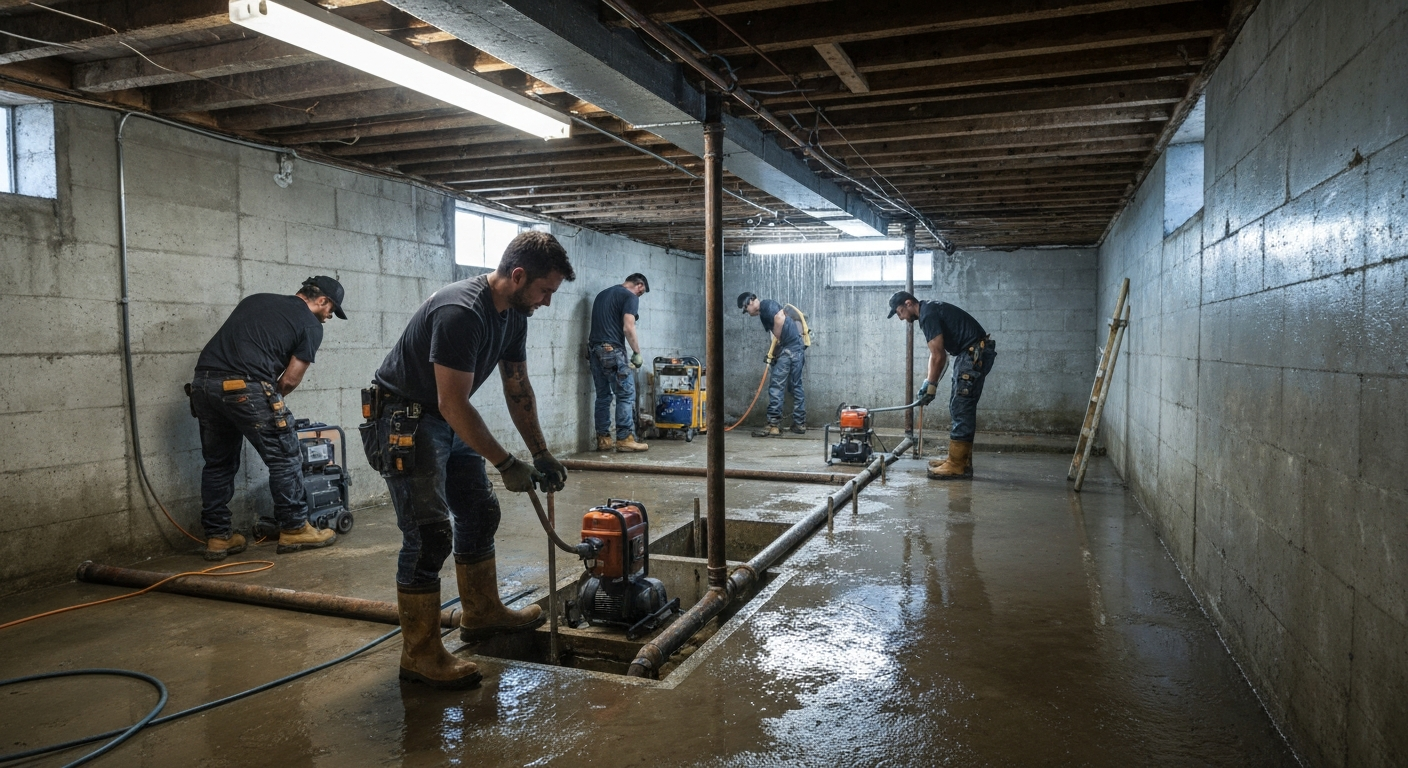
Basement waterproofing options and costs in Windsor
In Windsor, basement waterproofing needs are shaped by how water behaves around foundations in the Windsor–Sarnia corridor and by the age of the housing stock. In 2021, Windsor had 229,660 residents, and the majority of households own their homes (58,960 homeowner households, 62.5% of households) (Statistics Canada, 2021 Census). That ownership pattern matters because many basements are now being retrofitted rather than replaced. Just as importantly, 68.0% of homes in the local area were built before 1981, which means many foundations still rely on aging weeping tile, limited exterior damp-proofing, or older drainage details that no longer keep up when water tables rise.
Costs vary because Windsor’s soil conditions can keep moisture pressed against the foundation and because freeze–thaw cycles can widen older cracks and joints. Contractors in Windsor—especially around busy, older neighbourhoods such as Walkerville and East Windsor—see repeat demand for sump retrofits, interior drains, and combined exterior/interior systems where access is tight or where additions have complicated excavation. In practice, the biggest cost drivers are soil type, the local water table, and how much excavation is feasible. That’s why two homes with “the same” leak can land in different price ranges: one may need mainly drainage upgrades, while another needs exterior excavation plus membrane and robust footing drains.
Below is a clear comparison of common methods, what they address, and typical disruption and pricing ranges—then you can match the method to your symptoms and your foundation type.
| Method |
What It Addresses |
Disruption Level |
Durability |
Price Range |
| Exterior excavation + new membrane + drainage tile |
Primary water entry paths; reduces lateral hydrostatic pressure by managing groundwater at the footing |
High (yard disruption; excavation along foundation) |
High (source control when properly detailed) |
$12,000–$25,000 |
| Interior perimeter drain channel + sump pit |
Water that enters through cracks or seepage; redirects to sump |
Medium (interior floor/feature disruption near walls) |
High (when paired with clean-out access and good pump selection) |
$8,000–$18,000 |
| Foundation crack injection (epoxy or polyurethane) |
Seepage through specific cracks; can also stabilise some crack conditions |
Low to Medium (minor drilling; interior access needed) |
Medium to High (depends on crack type and whether the crack is active) |
$600–$2,500 |
| Sump pump installation (primary + battery backup) |
Ongoing control of groundwater intrusion; protects during power interruptions |
Low to Medium (sump pit excavation and electrical work) |
Medium to High (system reliability depends on backup + discharge routing) |
$1,800–$4,500 |
| Window well drain installation |
Water pooling around egress window wells; reduces seepage and ice buildup risk |
Medium (excavate/window well area) |
Medium to High (works best with proper grading and clear discharge) |
$1,500–$4,000 |
| Lot re-grading / downspout extension |
Surface water management so it doesn’t track toward the foundation |
Low to Medium (yard adjustments) |
Low to Medium (helps symptoms; doesn’t stop hydrostatic pressure) |
$2,000–$6,000 |
Prices are estimates only and vary by project scope, site access and material selection.
What affects the price of waterproofing in Windsor
In Windsor, two homeowners can receive quotes that differ by 30–50% for work that “sounds” similar—because waterproofing is highly site-specific. The main reason is that Waterloo-like internet generalities don’t apply here: Windsor pricing is driven by soil type and water-table behaviour, plus the reality of freeze–thaw cycling that keeps testing older foundations year after year. Nationally, average projects often assume more forgiving drainage and fewer freeze–thaw impacts, but in our corridor the seasonal rise of groundwater against basement walls can push you into more robust drainage layouts. That’s where Windsor–Sarnia costs commonly separate from the national average.
Soil type matters: clay-heavy soils expand during freeze–thaw and can exert more lateral pressure on foundation walls, worsening cracks over time. High water tables in the Windsor–Sarnia area increase sump run times and often require footing drains and careful discharge routing, not just a pump. When the work is purely internal, you may still manage the symptoms effectively, but an exterior approach that interrupts water at the source typically costs more—often aligning with the exterior band of $12,000–$25,000. On the other hand, many Windsor homes can be stabilized with an interior perimeter drainage plan in the $8,000–$18,000 range, especially if the foundation wall is mostly sound and the main issue is seepage through joints or clogged/failed weeping tile.
Concrete examples from Windsor projects: a Walkerville home with a tight front yard and established landscaping can force interior-only work, reducing excavation scope but increasing interior disruption. Conversely, an East Windsor property with open side access and known footing-level seepage often makes exterior excavation practical, which can justify the higher exterior pricing. Homes built before 1981 frequently show corroded weeping tile and older mortar joints; once those are failing, the system may require both drainage control and crack-specific repairs (sometimes additional to the interior drainage band).
| Price Factor |
Why It Matters |
Cost Impact |
| Interior vs. exterior approach — interior is less disruptive but addresses symptoms |
Exterior targets the source by managing groundwater; interior channels water after it enters |
Exterior commonly costs materially more; interiors usually sit in the lower band |
| Foundation type — poured concrete vs. block vs. stone vs. ICF |
Crack behaviour and sealing method depend on the wall material and jointing |
Block and stone often need more drainage work; ICF can still need crack/water routing |
| Soil type — clay expands more than sand, adding pressure |
Freeze–thaw can widen existing pathways |
Clay-heavy sites often push upgrades from “patch” to full drainage design |
| Crack type and length — hairline vs. structural horizontal cracks |
Active leaks and structural cracks require different repair strategies |
Structural repairs can require engineering and add labour and materials |
| Sump pump backup system — battery or water-powered backup needed |
Power interruptions can turn a “managed” leak into a flood |
Backup increases material/electrical cost but reduces risk during spring surges |
| Access — landscaping, decks, or driveways must be removed for exterior |
Excavation scope depends on how much can be safely removed and restored |
Hard access constraints can shift the design to interior solutions |
| Weeping tile age — original tile (60+ years) may be completely failed |
Failed tile can increase hydrostatic pressure and overwhelm basic pumping |
More extensive drain replacement or combined systems often needed |
| Mould or efflorescence remediation required before sealing |
Moisture-source control and surface treatment must be completed for coatings/sealants to bond |
Remediation adds time and materials to the project |
Permits & regulations in Ontario
In Ontario, basement waterproofing projects can cross into regulated territory depending on what you change. In Windsor, foundation excavation and any work that alters lot drainage or requires cutting through structural components typically triggers a permit requirement. For structural crack repairs—especially horizontal cracks in block walls or any cracking that suggests movement—an assessment is often required so the contractor can determine whether underpinning or other structural interventions are needed. Also, if a sump pump discharge is connected to a municipal sewer system or the connection is being altered, municipal approval is typically needed before work proceeds.
What usually DOES require a permit (or at minimum formal municipal approval): exterior foundation excavation that involves drainage changes; structural crack repair that addresses potentially structural conditions (not just cosmetic patching); and re-routing or connecting sump pump discharge to storm or sanitary systems. What typically does NOT require a permit: installing a standalone interior sump pit and pump where the discharge route stays within approved limits and doesn’t tie into municipal services, routine window-well drainage that stays surface-level, and basic downspout extension/re-grading that doesn’t alter buried services.
To verify a contractor in Windsor, start by checking their Ontario licence status via the appropriate provincial registry tools used for trades (and confirm the correct trade classification for the work). Next, request a current certificate of insurance (liability) and confirm the expiry date and coverage limits. For WSIB coverage, ask for a WSIB clearance letter. For structural crack work, verify they have access to engineering support and can show how the scope will be documented, insured, and coordinated.
Interior vs exterior waterproofing — what does Windsor need?
Windsor homeowners usually face a fundamental choice: exterior waterproofing or interior waterproofing. Exterior waterproofing involves full excavation along the foundation, installing a membrane system, and adding or upgrading drainage tile so groundwater is intercepted at the footing. It’s the most direct way to address the source of water entry, but it’s also the most invasive—yard excavation, backfill and careful frost-resistant detailing are involved. Interior waterproofing uses perimeter drainage channels and a sump system to manage water after it enters the basement; it can be much less disruptive, but it doesn’t relieve hydrostatic pressure acting on the wall.
In Windsor’s soils and climate, the decision often comes down to how water is getting in and how likely the wall is to keep transmitting moisture as freeze–thaw cycles repeat. For poured concrete foundations, crack injection combined with interior drainage can be effective when cracks are stable and primarily allow seepage; epoxy is suitable for properly prepared, non-moving cracks, while active-leak conditions often call for polyurethane injection. For block foundations, interior drainage is commonly the practical complement because joints and block seams can keep letting moisture in, especially when original weeping tile is clogged or failing. If you’re in a pre-1981 home with long-standing dampness or recurring seepage during spring, interior-only approaches can still solve the problem—but only if the drainage design has enough capacity and reliable pumping.
A real-world way to justify the price difference: if exterior excavation is feasible and your inspections show sustained footing-level seepage, the exterior band of $12,000–$25,000 may be worth it compared to $8,000–$18,000 for an interior perimeter system when the goal is source control. If access is constrained and the primary issue is localized seepage, interior waterproofing may be the better value—especially when sump backup is added for spring power reliability.
| Method |
Best For |
Addresses Source? |
Disruption |
Lifespan |
Price Band |
| Full exterior excavation + membrane |
Active seepage around the full perimeter; clay/saturated soils; recurring hydrostatic pressure |
Yes (source control at the foundation) |
High |
Long (often the most durable solution when properly detailed) |
$12,000–$25,000 |
| Interior French drain + sump system |
Basements with seepage and limited exterior access; older weeping tile failure |
No (manages water after entry) |
Medium |
High (depends on sump capacity, discharge routing, and maintenance) |
$8,000–$18,000 |
| Crack injection — epoxy (structural) |
Stable, properly prepared cracks where moisture is controlled and the crack is not actively moving |
Partial (fills the crack pathway) |
Low to Medium |
Medium to High |
$600–$2,500 |
| Crack injection — polyurethane (active leak) |
Active weeping or water flowing through cracks |
Partial (seals active pathways) |
Low to Medium |
Medium |
$900–$2,800 |
| Interior drain channel only (no sump) |
Very minor seepage with reliable drainage where gravity discharge is possible |
No (still relies on controlled seepage) |
Low to Medium |
Low to Medium (less resilient during high water events) |
$4,500–$9,000 |
| Re-grading + downspout extensions |
Surface water at the foundation; seasonal runoff issues |
No (doesn’t address groundwater pressure) |
Low to Medium |
Low to Medium |
$2,000–$6,000 |
How to choose a waterproofing contractor in Windsor
Start with licensing and coverage. In Ontario, ask the contractor for proof of the specific trade coverage relevant to your scope, a current certificate of liability insurance, and WSIB/WCB clearance. To check: (1) confirm the contractor’s registration/licence is active using the online provincial registry relevant to the trade category; (2) request a certificate of insurance showing the insured entity name matches the quote and that it’s not expired; (3) ask for the most recent WSIB clearance letter (or the applicable coverage documentation) and ensure it’s current for the date of your project. If they won’t provide these documents up front, that’s a major warning sign.
Next, get 2–3 itemised written quotes. You want line-by-line details for labour and materials: excavation limits (if exterior), membrane type, drain tile/gravel specification, pipe size, sump basin size, wiring/discharge method, and what’s included for disposal and restoration. Don’t accept vague exclusions like “patch and repair” without specifying whether floors, insulation, or landscaping are reinstated. Warranty matters too: confirm workmanship warranty length, product/manufacturer warranty terms, and whether the warranty transfers to future owners.
Payment schedules should be sensible. Never pay more than 10–15% upfront. Hold back the final portion until completion and a post-job walkthrough confirm drainage function and cleanup. Timeline should be written with a start date and realistic completion estimate—waterproofing schedules can swing with frost, access constraints, and cure times.
- Request a site inspection and a written moisture/water-entry plan (not just “we’ll add a sump”).
- Ask whether they’ll CCTV/inspect existing weeping tile if access is available.
- Confirm sump pump discharge routing and winter freeze protection details.
- Require a crack map: what cracks will be injected, how many ports, and which sealant type.
- Verify membrane system components (membrane type, seam treatment, protection board/backfill specs).
- Check whether they include excavation disposal and backfill compaction requirements.
- Ensure electrical work is specified and permits/approvals are discussed when needed.
- Ask about sump pump redundancy and backup (battery or other approved backup).
- Confirm mould/efflorescence remediation steps before sealing/coating.
- Get restoration scope in writing (flooring/trim, landscaping/grade changes, window well covers).
- Verify warranty terms and whether they’re in the contract documents.
- Use a clear payment schedule: small deposit, major payment after rough-in, final after commissioning.
Red flags in Windsor: contractors who dismiss soil/water-table questions; quotes that omit discharge details or backup power options; “lump-sum only” pricing with vague exclusions for excavation/restoration; no clear warranty terms for workmanship and products; or refusal to show WSIB/WCB clearance and current liability insurance before you sign.
Frequently asked questions — waterproofing in Windsor
Can I waterproof my basement from the inside only?
Yes, in many Windsor homes interior waterproofing can stop recurring seepage—especially when access is limited or the exterior yard can’t be excavated. Interior systems typically include a perimeter drain channel, sump pit, and sump pump (often with a battery backup), which redirects water after it enters. This approach is common in older neighbourhoods where landscaping and tight lots make exterior excavation expensive. However, interior work does not eliminate hydrostatic pressure against the wall, so it’s usually paired with crack injection or surface preparation when leaks track through joints or specific cracks.
For budgeting, interior perimeter drainage commonly falls around $8,000–$18,000, while a properly detailed exterior solution can be higher at $12,000–$25,000. The right answer depends on whether your problem is mainly surface runoff, footing-level groundwater, or both.
What causes foundation cracks in Windsor?
In Windsor, foundation cracks are often a result of movement and pressure changes over time, not just “settling once and done.” Freeze–thaw cycles can widen existing hairline cracks and stress joints as water in the concrete/block expands in winter and contracts in spring. Soil conditions matter too: clay-rich areas can expand and exert lateral pressure, which increases the likelihood of crack widening over repeated seasons. In homes built before 1981 (and many in Windsor fit that profile), original damp-proofing and weeping tile systems may be aging or clogged, which can keep moisture pressed against the wall and contribute to deterioration.
Not all cracks are equal. Hairline vertical cracks may be less urgent, but horizontal cracks in block walls can indicate structural movement and may require engineering assessment. Always get a contractor to map cracks, check whether they’re active (wet) and recommend the correct injection or drainage strategy.
How do I compare waterproofing quotes?
Compare quotes like-for-like: scope, materials, and how the contractor will manage water entry—not just the final total price. Ask for an itemised breakdown for labour and materials (membrane/drain tile specs, pump model and capacity, discharge method, and what disposal/restoration is included). A quote should clearly state whether it’s interior-only (drain channel + sump) or includes exterior excavation and membrane, because those addresses different parts of the problem.
Look closely at exclusions: do they include protection board, compaction/backfill details, or repairs to floors/trim? Confirm if a permit is included where required, and whether they’ll handle discharge approvals if the system ties into storm/sanitary services. For warranty, request the workmanship length and whether it’s transferable. If one quote is far lower—for example, an exterior job priced closer to $8,000–$18,000 instead of $12,000–$25,000—question what’s being left out.
How long does basement waterproofing take in Windsor?
Typical interior waterproofing timelines in Windsor are often measured in days to a couple of weeks, depending on how much floor removal is required, how complex the sump/basin discharge route is, and whether crack injection is included. Exterior waterproofing usually takes longer because excavation along the foundation, membrane installation, drainage tile setup, and engineered backfill/compaction must be sequenced correctly—then restoration follows.
Winter conditions in Ontario can affect scheduling. Cold weather may limit certain curing steps and can increase labour time for excavation and backfilling, so many companies prefer late spring through early fall for exterior work. Some solutions, like interior drainage or crack injection, can be scheduled more flexibly, but the contractor should still explain cure times and weather contingency plans. Ask for a written start date and completion estimate, and confirm what happens if frost or rain delays the job.
What is a weeping tile and does my Windsor home have one?
A weeping tile is a buried drain system along the foundation footing that collects groundwater and channels it away so it doesn’t build up around the basement walls. Many older Windsor homes—particularly those built before 1981—originally had weeping tile, but it may now be clogged, collapsed, disconnected, or reduced in effectiveness because of age and soil movement. That’s why basements can start leaking after years of “quiet,” especially when freeze–thaw cycles and spring groundwater levels rise.
Does your home have one? It’s not always visible. You can sometimes infer it if there’s an older sump pit, floor drains, or an exterior inspection point, but verification usually requires a basement assessment and, when feasible, inspections near foundation areas. A good contractor can review history (repairs, prior pumping, dampness patterns) and, with access, propose how to confirm the weeping tile’s condition. In many Windsor projects, weeping tile failure is a key reason interior drainage upgrades are needed.
Can I waterproof my basement in winter in Windsor?
You can sometimes do waterproofing in winter in Windsor, but it depends on what method you need. Interior work is often more feasible than exterior excavation during deep cold because basement excavation can be done without disturbing yards and frozen soils to the same extent. Crack injection and sump pump installation can often proceed if the contractor can safely access cracks or the foundation wall surfaces and manage curing requirements for sealants. However, if you need full exterior excavation, winter conditions can make excavation difficult, affect backfill handling, and increase the risk of frost-related workmanship issues unless the contractor has proper cold-weather procedures.
For many homeowners, the practical winter strategy is to stabilize the situation with interior drainage and reliable pumping—especially when spring flooding could otherwise overwhelm a system. If the leak is active, adding a sump pump with backup is often a priority. Ask your contractor for a winter plan, including how they’ll protect work areas, handle cure times, and manage discharge to prevent freeze-ups.