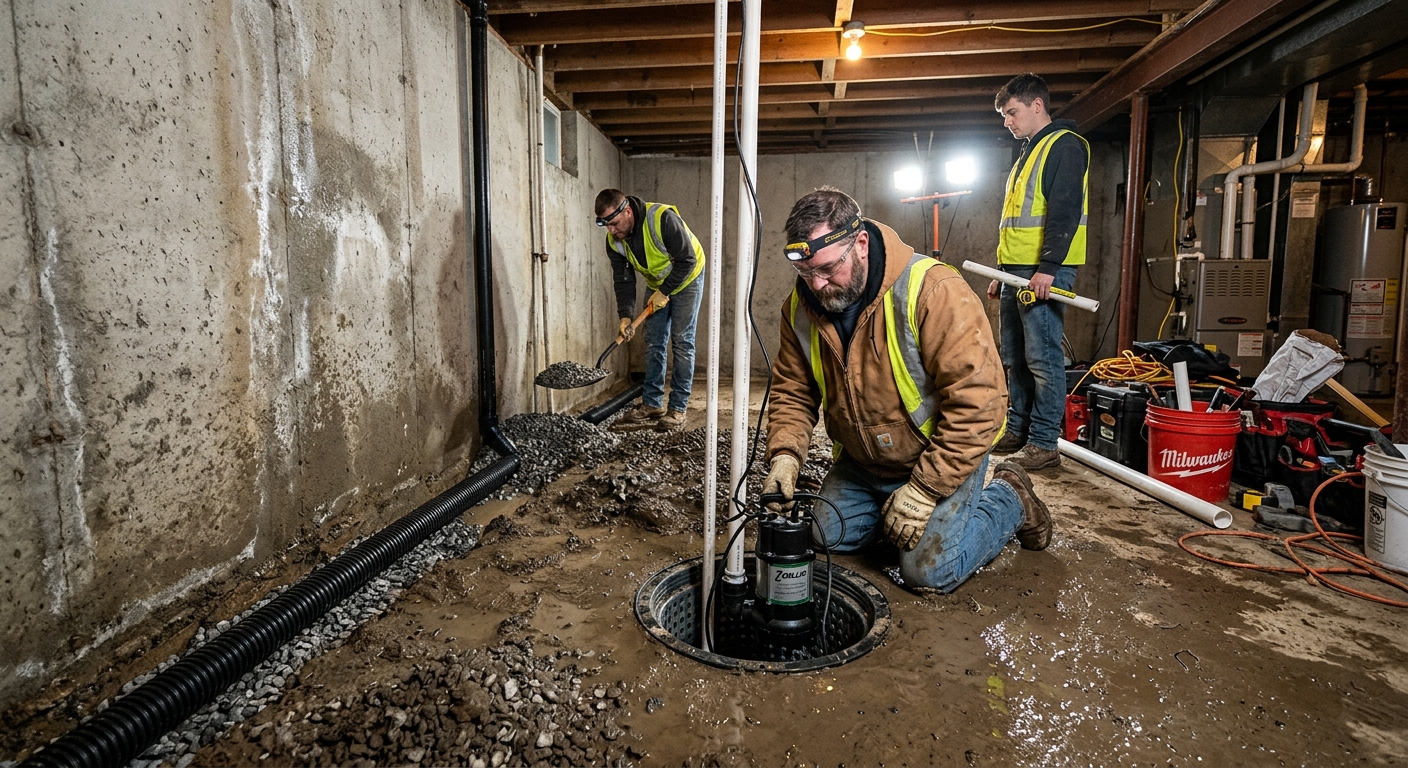
Basement waterproofing options and costs in King East
In King East, basement waterproofing is less about one “magic coating” and more about matching the method to how water is getting in—whether it’s hydrostatic pressure pushing through cold joints, failing weeping tile, or cracks widened by Toronto-area freeze–thaw. With a small local population base (2,040 residents per Statistics Canada, 2021 Census), many homeowners are dealing with the same root problem: older drainage systems and foundations that have been working through decades of moisture cycles. King East also shares Toronto’s housing reality—post-war and 1960–1980s homes were common for the region, and those eras often came with early clay weeping tile or partially clogged drains, which can lead to damp walls, efflorescence, and recurring seepage.
Pricing in the Toronto economic region can swing significantly because excavation is often constrained by tight urban lots, additions, deck footings, and shared driveways. On mixed glacial till and clay pockets, saturated soil expands during freeze–thaw and can press laterally on foundation walls, turning hairline defects into active leaks over a few winters. That’s why exterior excavation and membrane systems tend to cost more, but they address the water source. Interior drainage and sump solutions cost less and are often faster to schedule—especially when excavation access is limited—though they manage water after it enters.
Demand is typically especially high in older residential pockets near planned growth corridors and established neighbourhoods where original weeping tile has failed. From there, the best next step is usually a comparison of common approaches—see the cost ranges below.
| Method |
What It Addresses |
Disruption Level |
Durability |
Price Range |
| Exterior excavation + new membrane + drainage tile |
Primary water entry; replaces failed drainage and re-establishes a water path away from the foundation |
High (excavation, landscaping restoration) |
Long-term when properly detailed at corners and penetrations |
$7,000 – $25,000 |
| Interior perimeter drain channel + sump pit |
Chronic seepage through cracks/cold joints by collecting water indoors and pumping it out |
Medium (floor saw-cutting, limited demolition) |
Very good for clay/water-table issues when discharge is correctly designed |
$3,500 – $15,000 |
| Foundation crack injection (epoxy or polyurethane) |
Isolated cracks/active leaks depending on resin selection and crack condition |
Low (minimal demolition) |
Depends on crack type, wall movement, and whether the water source is ongoing |
$600 – $3,000 |
| Sump pump installation (primary + battery backup) |
Prevents basement flooding when water inflow exceeds passive drainage |
Low to Medium (pit, discharge routing, power considerations) |
High when paired with proper interior drainage and a backup system |
$800 – $3,500 |
| Window well drain installation |
Water pooling at window wells and seepage behind/around masonry |
Low to Medium (excavation at each window well) |
Good for localized infiltration when grading is corrected |
$1,200 – $4,200 |
| Lot re-grading / downspout extension |
Stops runoff from oversaturating soil near foundation and reduces inflow |
Low (site work and landscaping) |
Good for prevention and minor seepage; not a fix for failed drainage |
$900 – $3,500 |
Prices are estimates only and vary by project scope, site access and material selection.
What affects the price of waterproofing in King East
In King East and the broader Toronto area, two homeowners can receive quotes that differ by 30–50% for the “same” problem because the real driver is what’s happening in the soil at your foundation line—not what’s visible on the wall. Contractors price for water conditions (lateral pressure and inflow rate), foundation details, and how hard it is to access the work zone. For example, interior solutions often fall into the $3,500–$15,000 range when a perimeter drain and sump are needed, while exterior excavation can push into the $7,000–$25,000 band when we’re replacing drainage tile and adding membrane on clay-saturated backfill.
The three biggest separate-us-from-the-national-average forces in this region are soil type, water table, and freeze–thaw. Mixed glacial till with dense clay pockets expands when saturated; that expansion increases lateral pressure against foundation walls and can worsen crack leakage over time. High local water tables in many neighbourhoods increase sump pump run times and raise the engineering level required for discharge routing. In Ontario’s climate, repeated freeze–thaw cycles also widen small defects in concrete and block foundations, turning hairline cracks into active seepage pathways.
Concrete examples in King East: (1) a poured-concrete basement with a failed weeping tile often needs an interior drain channel plus sump, typically landing in the interior $3,500–$15,000 band; (2) a backyard with a deck over a section of foundation usually forces more careful excavation sequencing, which can add thousands to the exterior $7,000–$25,000 scope; (3) if your basement shows efflorescence and recurring dampness near corners, injection-only repairs may cost far less upfront, but they can underperform if the external drainage is still clogged or collapsed. That’s why matching solution selection to drainage age and moisture source matters as much as the resin or membrane itself.
| Price Factor |
Why It Matters |
Cost Impact |
| Interior vs. exterior approach — interior is less disruptive but addresses symptoms |
Interior controls water after entry; exterior stops water before it enters |
Exterior commonly adds major labour and excavation costs, often 2–4× interior |
| Foundation type — poured concrete vs. block vs. stone vs. ICF |
Different walls behave differently under hydrostatic pressure and crack movement |
Block and stone often require more interior drainage detailing |
| Soil type — clay expands more than sand, adding pressure |
Clay saturation increases lateral pressure and crack activity |
Higher risk = more extensive drainage/membrane detailing |
| Crack type and length — hairline vs. structural horizontal cracks |
Active, horizontal or stepped cracks may signal movement and need additional evaluation |
Injection can be minimal, or escalates into structural scope |
| Sump pump backup system — battery or water-powered backup needed |
Backup prevents overflow during power interruptions common in freeze seasons and storms |
Typically adds a few hundred to over $1,000 depending on system choice |
| Access — landscaping, decks, or driveways must be removed for exterior |
Hard-to-access areas increase excavation time and restoration |
Can add materially to the exterior $7,000–$25,000 range |
| Weeping tile age — original tile (60+ years) may be completely failed |
Old drainage often collapses or clogs and must be replaced for true resolution |
Replacement scope can move a job toward exterior pricing |
| Mould or efflorescence remediation required before sealing |
Sealers and membranes should not trap active contamination or moisture |
Remediation increases labour/materials before waterproofing |
Permits & regulations in Ontario
In Ontario, foundation excavation, structural crack repair, and changes to lot drainage typically require a building permit, particularly where you’re altering structural elements or regrading in a way that affects water management. Many homeowners focus on the visible basement leak, but the permitting lens is on structural safety and stormwater impacts. Sump pump installations that connect to the storm or sanitary sewer require municipal approval, and your contractor should confirm discharge routing options before work begins.
For structural crack repair—especially horizontal cracks in block walls or major step cracks—an assessment by a structural engineer is often required to determine whether underpinning, steel reinforcement, or other structural mitigation is needed. A reputable King East waterproofing company should carry engineering support (either in-house or via a partnered engineer) and hold appropriate liability insurance and WSIB/WCB coverage. Ask early; if they can’t clearly explain their coverage and who supplies engineered review when needed, that’s a warning sign.
How to verify a contractor in King East step-by-step:
- Check the contractor’s Ontario business/registration details and any relevant trade qualifications online.
- Request a current certificate of insurance (liability) showing the policy period and coverage limits.
- Ask for WSIB/WCB clearance letters or active account confirmation (not screenshots of emails).
- For structural work, confirm whether they include engineering review and whether the engineer issues written recommendations.
- Confirm whether the permit pull is included in the quote and who is responsible for inspections.
Interior vs exterior waterproofing — what does King East need?
Fundamentally, exterior waterproofing deals with the source of water entry: full excavation, new membrane, new drainage tile, and proper backfill so water is directed away from your foundation. It costs more because it’s labour-intensive and requires restoring landscaping, but when done correctly it’s the most permanent solution for chronically wet basements in clay-heavy pockets. Interior waterproofing focuses on what happens after water enters: perimeter drain channel, sump pit, and sump pump discharge. It’s generally less disruptive, but it does not reduce hydrostatic pressure against the wall itself—so it works best when paired with crack repair for isolated leaks or when exterior access is limited.
In King East’s freeze–thaw cycles, exterior methods can be more resilient because the waterproofing system stays outside the foundation, where it’s less vulnerable to interior condensation. That said, many Toronto-area basements are approached from the inside first due to tight lots and deck/driveway constraints. Poured-concrete walls often respond very well to crack injection (especially where the crack is the active pathway), while block foundations often benefit from interior drainage as a practical complement—especially when old weeping tile is partially collapsed or clogged.
Sump pump backup systems also matter in spring wet spells and outage-prone weather. If your inflow during heavy rain exceeds capacity or electricity is briefly interrupted, a backup system can be the difference between a dry basement and repeated cleanup. If you’re choosing between options: if the exterior scope is clearly required (e.g., pervasive dampness, failed exterior drainage indicators), an exterior project in the $7,000–$25,000 band can be justified compared to a repeated interior-only approach. If the issue is localized and access is tight, interior drainage in the $3,500–$15,000 range plus targeted crack repair may be the smarter first step.
| Method |
Best For |
Addresses Source? |
Disruption |
Lifespan |
Price Band |
| Full exterior excavation + membrane |
Chronic seepage, high water pressure, failing exterior drainage, clay-saturated backfill |
Yes |
High |
Many years with proper corner detailing and drainage discharge |
$7,000 – $25,000 |
| Interior French drain + sump system |
Ongoing dampness/flooding with limited exterior access; water table-driven seepage |
No (manages after entry) |
Medium |
Long-term if pump capacity, discharge, and plumbing are correct |
$3,500 – $15,000 |
| Crack injection — epoxy (structural) |
Non-moving cracks where sealing the structural opening will stop water entry |
Sometimes (depends on whether water source is external) |
Low |
Good when the crack isn’t actively moving and cause is addressed |
$600 – $3,000 |
| Crack injection — polyurethane (active leak) |
Active weeping leaks where flexible sealing is needed |
Sometimes (best for localized pathways) |
Low |
Very good for the crack pathway; may require drainage fixes if inflow continues |
$700 – $3,200 |
| Interior drain channel only (no sump) |
Light seepage where gravity drainage is reliable |
No |
Medium (floor work) |
Variable; depends on inflow and discharge reliability |
$1,800 – $6,500 |
| Re-grading + downspout extensions |
Prevention and minor dampness caused by runoff near foundation |
Yes for runoff source |
Low |
Good if maintained and slopes stay corrected |
$900 – $3,500 |
How to choose a waterproofing contractor in King East
Choosing the right waterproofing contractor in King East means verifying three things: Ontario licensing/qualifications where applicable, liability insurance, and WSIB/WCB coverage. Start by asking for a certificate of insurance (liability) that matches the dates of your project and lists coverage appropriate to construction work. Next, request WSIB/WCB clearance—contractors should be able to provide current proof rather than informal assurances. If they propose structural repair, confirm whether they include engineering support; for Ontario jobs involving structural crack repair, it’s the difference between “patching a leak” and treating the cause.
Then get 2–3 itemised written quotes. You want a labour + materials breakdown, not just a lump sum, so you can compare whether they’re including excavation depth, membrane type, drainage tile size, disposal, and restoration. Read the exclusions section carefully: what’s not included (permit fees, permit pull, engineered reports, excavation near footings, disposal of spoil, drainage discharge routing)? Warranty terms should be specific: workmanship warranty length, product/manufacturer warranty details, and whether warranties are transferable to future homeowners.
Payment scheduling is another key safeguard. In waterproofing, never pay more than 10–15% upfront. Hold back a portion until the final clean-up and documentation are complete. Ask for a start date and completion estimate in writing, including lead times for materials—especially membrane, drainage components, and pump systems.
- Confirm proof of WSIB/WCB coverage or clearance letter before signing.
- Verify liability insurance certificate is current and project-specific.
- Ask whether the quote includes permit pull (if required) and inspections.
- Require a written scope: excavation depth, membrane system, and drainage tile specs.
- Ensure discharge plan is described (where water exits and how it’s protected).
- Get pump specs in writing for sump work (capacity, float controls, discharge line size).
- Ask if battery backup is included when sump risk is high.
- Clarify what’s included for crack injection prep (surface cleaning, crack opening, curing time).
- Confirm restoration scope: grading, topsoil, sod/seed, or hardscape reinstatement.
- Ask how mould/efflorescence is remediated before sealing.
- Request warranty documents in writing and verify warranty transferability.
- Keep a clear payment schedule with a holdback until final inspection/hand-off.
In King East, concrete red flags include: (1) quoting “epoxy injection” for everything without identifying whether the crack is actively weeping or moving; (2) claiming a membrane will work while skipping drainage tile replacement on failed weeping systems; (3) refusing to provide itemised labour/materials and permit/disposal details; (4) asking for large upfront payments beyond 10–15%; and (5) vague warranty language with no workmanship term or proof of product coverage.
Frequently asked questions — waterproofing in King East
Do I need a sump pump in King East?
Not every basement needs a sump pump, but in King East the decision usually hinges on how often water arrives and where it collects. If you see recurring dampness during spring melt, efflorescence, or water pooling at floor-wall junctions, an interior drain channel that leads to a sump is often the most reliable way to manage water after it enters. In Toronto-area clay pockets, saturated soil can increase inflow and hydrostatic pressure, meaning passive drainage alone may not keep up during heavy rain. If a basement already floods, or if your weeping tile is partially collapsed/clogged, expect sump work to come up in most waterproofing scopes. Sump pump installations typically range from $800 – $3,500, and adding battery backup can be important if outages occur during storm events.
How does King East's soil affect my foundation?
King East sits in a Toronto-area region with mixed glacial till and frequent dense clay pockets. Clay holds water, saturates more slowly and more fully than sand, and expands when it freezes—so it can exert lateral pressure on foundation walls. During Ontario freeze–thaw cycles, that pressure can widen small cracks and make “old” leaks start showing again after a few winters. This is why many homeowners find damp walls and floor seepage even when there’s no single obvious failure point outside. It also helps explain why water-management methods that rely on exterior drainage (new drainage tile + membrane) often outperform crack injection alone when the weeping tile has reached end-of-life. When drainage is failing and clay expands, interior systems in the $3,500 – $15,000 band are commonly used to control recurring moisture.
Do I need a permit for foundation work in Ontario?
Often, yes—particularly when foundation excavation changes are involved, when you’re doing structural crack repair, or when lot drainage will be altered in a way that affects how water runs from the property. In Ontario, sump pump installations that tie into storm or sanitary sewer systems typically require municipal approval. For structural repair (for example, horizontal cracks in block walls or step cracks indicating potential movement), an assessment by a structural engineer is commonly required before any underpinning or reinforcement is considered. A practical way to protect yourself in King East is to verify whether your contractor will pull the permit, who attends inspections, and that the work matches the engineered scope if one is required. If the contractor won’t clarify permit responsibility in the written quote, that’s a major risk.
How long does waterproofing last?
Longevity depends on whether the solution addresses the water source or only manages water after entry. Exterior excavation with new membrane and drainage tile typically lasts many years when the system is installed with correct detailing at corners, penetrations, and discharge routing. Interior perimeter drains and sump systems can also perform long-term, especially for clay/water-table driven seepage, but they rely on ongoing performance of pumps and correct discharge. Crack injection (epoxy or polyurethane) can be highly effective when the crack pathway is isolated and movement is minimal—but if the weeping tile is failing or inflow remains high, the basement can develop new seepage points. For homeowners comparing options, it’s common to see exterior projects in the $7,000 – $25,000 range when source control is required, while interior solutions in the $3,500 – $15,000 range manage water entry patterns. A clear scope and warranty are what make “how long” measurable.
Can I waterproof my basement from the inside only?
Yes, in many King East basements you can waterproof from the inside only—especially when exterior access is constrained by decks, driveways, or tight lot lines. Interior drainage (perimeter drain channel) and sump pit installation is a common approach for chronic seepage where water arrives through cracks, cold joints, or corners. Interior work is also often faster to schedule and lower disruption than full excavation. However, interior systems don’t relieve hydrostatic pressure against the wall; they collect and pump water after it enters, so results depend on correct floor-to-wall detailing, discharge design, and pump capacity. Where seepage appears primarily localized through one crack, injection may be appropriate with a typical repair range of $600 – $3,000. If dampness is widespread and signs point to failed exterior drainage tile, an interior-only plan can become a repeating cycle.
What causes foundation cracks in King East?
In King East, foundation cracks are commonly driven by soil moisture changes and freeze–thaw effects rather than a single “bad pour.” Dense clay expands when saturated and can increase lateral pressure on walls. When water freezes, expansion and movement can widen small defects in concrete and block foundations, turning hairline cracks into active leaks over a few winters. Settlement or seasonal movement can also create step cracks in block walls. Another contributor is failing drainage: when older weeping tile partially collapses or clogs, water can accumulate near the foundation line, increasing pressure at exactly the time freeze events occur. That’s why contractors often look for patterns—crack location, whether it’s horizontal/stepped, and whether efflorescence or seepage aligns with the crack. For isolated crack pathways, injection may help; for persistent movement and inflow, you’ll typically need drainage and possibly engineered assessment.