Basement waterproofing options and costs in Heritage Park
Heritage Park, Ontario is a community where basement dampness is often a long game: water that seems minor in the first couple of seasons can turn into recurring seepage after freeze–thaw and soil saturation. With a population of 7,263 (Statistics Canada, 2021 Census), the local housing mix includes many older neighbourhood pockets where original drainage systems—like clay weeping tile or early plastic drains—are now partially clogged or collapsed. In the Toronto economic region, that matters because failing weepers and cold joints typically become active along foundation cracks, tie holes, and around footing lines.
Toronto-area pricing is also shaped by access realities. Many Heritage Park basements sit under homes built post-war through the 1960–1980s period, when excavation depth and drainage details were often less robust than today. Contractors frequently need to hand-dig around additions, decks, and tight urban lot lines, and that labour gets reflected directly in exterior excavation budgets (which can range widely). At the same time, interior approaches are often faster to schedule and less disruptive, but they focus on managing water after it enters rather than relieving hydrostatic pressure at the wall.
In practice, we see highest demand in the Heritage Park areas closest to older drainage patterns and older lots with mature landscaping—especially where downspouts discharge near foundations. From there, the best next step is matching your symptoms (musty odours, efflorescence, damp wall corners) to the correct method, which is why the comparison table below is a useful starting point before you request a detailed, itemised quote.
| Method |
What It Addresses |
Disruption Level |
Durability |
Price Range |
| Exterior excavation + new membrane + drainage tile |
Hydrostatic pressure at the foundation and bulk water entry; replaces failing drainage |
High (landscape removal, excavation, backfill) |
Long-term source control when detailed correctly |
$7,000–$25,000 |
| Interior perimeter drain channel + sump pit |
Captures seepage and redirects water to sump; helps with chronic dampness |
Medium (interior floor access, small cuts) |
Very effective for seepage symptoms |
$3,500–$15,000 |
| Foundation crack injection (epoxy or polyurethane) |
Stops isolated cracks; polyurethane targets active leaks |
Low to Medium (surface prep, small openings) |
Strong for the right crack type and preparation |
$600–$3,000 |
| Sump pump installation (primary + battery backup) |
Manages collected water during wet seasons and power interruptions |
Low to Medium (pit, discharge line, backup integration) |
High when paired with correct drainage pathway |
$800–$3,500 |
| Window well drain installation |
Reduces water pooling around basement windows |
Low to Medium (excavation near window well) |
Good for localized window-area seepage |
$900–$4,000 |
| Lot re-grading / downspout extension |
Moves roof runoff away from foundation; reduces repeated saturation |
Low to Medium (minor landscape work) |
Moderate—best as a complement, not a full fix |
$1,200–$6,500 |
Prices are estimates only and vary by project scope, site access and material selection.
What affects the price of waterproofing in Heritage Park
In Heritage Park and the broader Toronto area, two quotes for the “same” basement leak can differ by 30–50% because the work is often sized to the real cause—plus site constraints. One contractor might address the source of water entry (exterior excavation, membrane, and new drainage tile), while another might only manage symptoms inside (interior drains and a sump). Both can be valid depending on your soil, foundation type, and whether the water is driven by hydrostatic pressure against clay-heavy ground.
The three biggest pricing drivers that separate Toronto-area costs from a national average are soil type, water table conditions, and freeze–thaw. Mixed glacial till and pocket dense clay common in parts of the region can expand when saturated, increasing lateral pressure on foundation walls and turning small defects into active leaks after a few winters. When local water tables are high, sump run times rise and drainage requirements expand—sometimes requiring additional discharge planning or backup systems. Freeze–thaw then widens minor cracks, especially at cold joints, tie holes, and along older block or poured-concrete edges.
Concrete examples from Heritage Park basements: (1) if your downspouts discharge near the foundation, a re-grading and extension might cost in the low thousands, but it won’t prevent seepage if your original weeping tile is failed and the wall is under lateral pressure; (2) if you have a failing interior system, adding a sump with a proper battery backup can be a far more cost-effective first step than full exterior excavation—often a mid-range option within the $3,500–$15,000 band for interior waterproofing plus pump work; and (3) in tight lots where exterior excavation means removing a deck or landscaping, exterior projects can quickly push toward the upper part of the $7,000–$25,000 range.
Age of drainage matters, too. Many older homes experience blocked or collapsed original tile after decades, leading to interior dampness, efflorescence, and basement flooding even when exterior wall cracks look small. That’s why the “right” solution in Heritage Park is often a matching approach: source control where pressure is high, and interior collection where excavation access is limited.
| Price Factor |
Why It Matters |
Cost Impact |
| Interior vs. exterior approach — interior is less disruptive but addresses symptoms |
Exterior relieves pressure at the foundation; interior controls water after it enters |
Interior often 40%–60% lower than full exterior, but may be higher over time if source is untreated |
| Foundation type — poured concrete vs. block vs. stone vs. ICF |
Different wall materials crack and move differently under clay expansion and freeze–thaw |
Block and older masonry often require more interior drainage work or targeted prep |
| Soil type — clay expands more than sand, adding pressure |
Clay saturation increases hydrostatic and lateral pressure on walls |
Clay-heavy sites can push the project toward exterior excavation or more robust interior collection |
| Crack type and length — hairline vs. structural horizontal cracks |
Active leaks and horizontal movement need different materials and sometimes structural evaluation |
Structural movement increases costs due to engineering support and potential structural remediation |
| Sump pump backup system — battery or water-powered backup needed |
Ontario power outages during storms can coincide with spring runoff |
Backup adds cost, but reduces flood risk; commonly a mid-range add-on within the sump band |
| Access — landscaping, decks, or driveways must be removed for exterior |
Tight lots increase labour and disposal/restore work |
Access issues can swing exterior pricing significantly upward |
| Weeping tile age — original tile (60+ years) may be completely failed |
Old drainage often collapses or clogs, forcing water to find cracks and joints |
Failed weeper often increases scope toward new drainage tile and membrane detailing |
| Mould or efflorescence remediation required before sealing |
Sealers and membranes don’t bond well over contaminated surfaces |
Remediation adds time and labour, especially with ongoing moisture |
Permits & regulations in Ontario
In Ontario, foundation excavation, structural crack repair, and changes to lot drainage typically require a building permit. If you’re installing a sump pump and connecting the discharge to storm or sanitary systems, municipal approval is often required—your contractor should confirm what applies for Heritage Park and your specific drainage route before any work begins. For structural crack repair, especially horizontal cracks in block walls or step cracks that suggest movement, an engineer’s assessment is often necessary to confirm whether underpinning or additional structural work is needed.
Before hiring, verify three things: (1) that the contractor carries the correct Ontario licence/registration for the work they’re performing, (2) liability insurance, and (3) WSIB/WCB coverage (or the equivalent clearance for the type of work and employer status). Then ask for a clear scope that states whether the contractor will pull permits (if required) and whether their warranty covers workmanship and materials.
Step-by-step for homeowners: start with the contractor’s documentation request and check the certificate of insurance for the policy holder name, expiry date, and coverage limits; next, confirm WSIB/WCB status by requesting a clearance letter or proof of coverage (and match the business name on the letter to the contractor’s invoicing entity); then look up the contractor’s Ontario registration/licence online using the legal business name on their quote. Finally, for structural work, confirm whether they have engineering support listed in writing and whether they will coordinate any permit/inspection steps.
These checks help prevent “repair-by-guesswork,” which is especially important in Heritage Park where clay saturation and freeze–thaw can reopen improperly detailed cracks within a few seasons.
Interior vs exterior waterproofing — what does Heritage Park need?
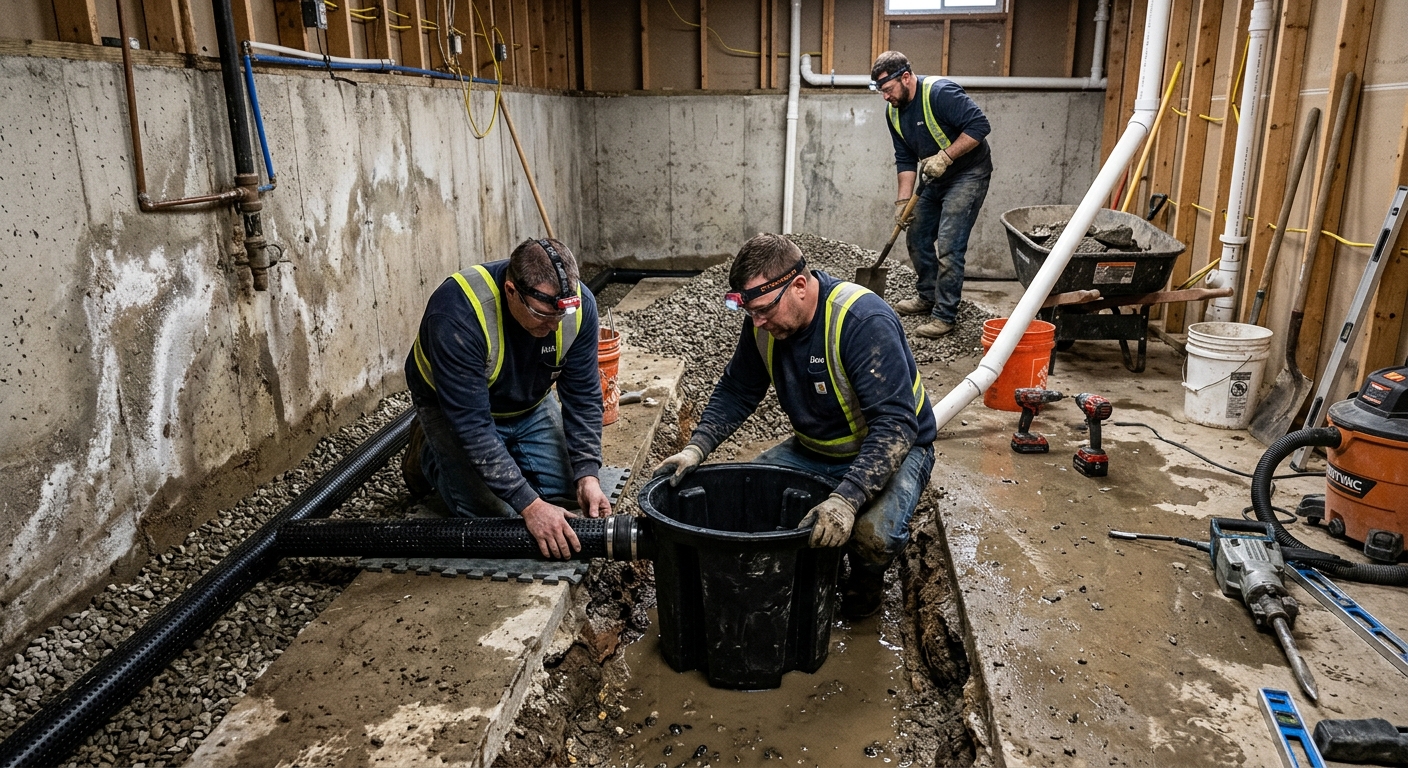
In Heritage Park, the fundamental choice comes down to source control versus symptom management. Exterior waterproofing—full excavation, new membrane, new drainage tile, and backfill—treats the water entry at the foundation and reduces hydrostatic pressure against the wall. It’s the most permanent approach when your soil and site drainage are contributing to lateral pressure, but it’s also the most disruptive because it may require removing landscaping and working around decks and driveways. Interior waterproofing—typically a perimeter drain channel with a sump pit and sump pump—manages water after it enters the basement. It’s less invasive and often the quickest path to dry basements, but it doesn’t stop the wall from being pressured by saturated soils.
Given the Toronto-region climate and local soil mix of glacial till and pocket dense clay, exterior solutions often make the most sense when you have chronic seepage, efflorescence spreading across the wall, or evidence that the original drainage is failed. Poured-concrete foundations generally respond well to properly executed crack injection for isolated leaks, but block foundations frequently need interior drainage as a practical complement because water routes through mortar joints and block seams when clay holds saturation. In other words, the “best” solution is sometimes a combination: targeted crack injection on the interior side and a drainage upgrade to reduce ongoing pressure.
Sump pump backups are worth planning in Ontario because wet spring periods can overlap with power interruptions. A battery backup (or other engineered backup approach) is not the cheapest add-on, but it can prevent a basement flood when the pump can’t run.
To see where the price difference can be justified: if you have repeated interior flooding and failing exterior drainage, exterior waterproofing can land in the $7,000–$25,000 range. If your issue is localized seepage and a few active cracks, crack injection and sump support might stay in the $600–$3,000 plus $800–$3,500 bands, often making interior options far more cost-effective—provided the water pathway is truly controlled.
| Method |
Best For |
Addresses Source? |
Disruption |
Lifespan |
Price Band |
| Full exterior excavation + membrane |
Chronic seepage, high lateral pressure, failed drainage tile, heavy efflorescence |
Yes (source control) |
High |
Long-term when drainage + membrane detailing are correct |
$7,000–$25,000 |
| Interior French drain + sump system |
Basements with dampness or recurring seepage where exterior access is limited |
No (controls water after entry) |
Medium |
Very durable with correct pump sizing and discharge planning |
$3,500–$15,000 |
| Crack injection — epoxy (structural) |
Dry-to-slightly damp, non-moving cracks in poured concrete or stable block areas |
Partial (stops leakage through the crack, not wall pressure) |
Low |
Long-lasting when cracks are stable and surfaces are prepped |
$600–$2,400 |
| Crack injection — polyurethane (active leak) |
Active weeping through cracks or joints during wet seasons |
Partial (targets active water paths) |
Low |
High effectiveness for active leaks when done correctly |
$900–$3,000 |
| Interior drain channel only (no sump) |
Mild seepage where water can be collected and managed without pump lift |
No |
Medium |
Moderate—depends on site drainage and gravity discharge |
$2,500–$8,500 |
| Re-grading + downspout extensions |
Dry basements that only show moisture near the surface during storms |
Indirect (reduces water load near the foundation) |
Low to Medium |
Moderate—needs ongoing maintenance of discharge paths |
$1,200–$6,500 |
How to choose a waterproofing contractor in Heritage Park
Choosing the right contractor in Heritage Park starts with verifying credentials and proving they can stand behind the work. In Ontario, always ask for evidence of liability insurance and WSIB/WCB coverage (a clearance letter is ideal). For licensing/registration, confirm the contractor’s Ontario registration online using the legal name on the quote and ensure it matches the invoicing company. If they are doing any structural-related work, require them to state whether they have engineering support and include that in the scope.
Next, get 2–3 itemised written quotes—not just a lump sum. A proper estimate should break out labour and materials (membrane type, drainage tile, sump components, injection materials, disposal/restoration), and it should list what’s included and excluded. Ask specific questions: “Is permit pulling included if required?” “Is excavation/disposal included?” “How will you restore landscaping?” “Will you replace any damaged weeping tile lines if found failed?”
Warranty is a make-or-break detail. Look for a workmanship warranty length written clearly, along with any manufacturer warranty for products used. Ask whether the warranty is transferable to future homeowners and whether it covers normal seasonal seepage scenarios common to Toronto’s freeze–thaw.
For payment schedule, never pay more than 10–15% upfront. Hold back a portion until completion and final walkthrough. And insist on a written start date and completion estimate—waterproofing is easier to manage when the sequence (preparation, drying time, membrane work, backfill, testing) is planned up front.
- Request proof of liability insurance with expiry dates and matching business name.
- Ask for WSIB/WCB clearance or proof of coverage before signing.
- Verify Ontario licensing/registration online using the contractor’s legal name.
- Require a written scope with included/excluded items (permits, excavation, disposal, restoration).
- Ask what happens if water appears during wet-season testing or after backfill.
- Confirm foundation type and crack strategy (epoxy vs polyurethane) are selected after inspection.
- Get sump discharge details in writing (where it discharges and any approvals needed).
- Confirm whether a battery backup is included if you have prior history of flooding.
- Ask what surface prep is required for injection and whether they’ll address efflorescence/mould first.
- Check warranty: workmanship term, product term, and whether it’s transferable.
- Keep payment milestones conservative (10–15% max upfront; holdback until closeout).
- Require start date, schedule, and curing/drying time expectations in the contract.
Red flags to watch for in Heritage Park: (1) quotes that skip site access realities and restoration details for exterior work; (2) “one-size-fits-all” crack injection without identifying whether leaks are active or the crack is structurally moving; (3) refusing to provide insurance/WSIB clearance or having mismatched business names on documents; (4) omitting discharge and backup specs for sump systems; and (5) vague warranties that don’t clearly define workmanship coverage or what happens if seepage returns after freeze–thaw.
Frequently asked questions — waterproofing in Heritage Park
What is a battery backup sump pump and do I need one in Heritage Park?
A battery backup sump pump is an additional power source that keeps your sump operating during power interruptions. In Heritage Park and across Ontario, heavy spring rain and wet freeze–thaw cycles can coincide with outages, and a stalled pump can quickly turn seepage into standing water. If you’ve ever seen water rise during storms or you have a history of basement flooding, a battery backup is usually the right risk-management step. Pricing varies by system complexity, but sump pump installation commonly sits around $800–$3,500, and adding a proper backup typically increases total sump costs. If you’re only getting a small damp patch, you may not need backup—but if water is reaching a sump level or you have frequent run cycles, backup becomes more important.
How much does basement waterproofing cost in Heritage Park?
Basement waterproofing cost in Heritage Park depends on whether contractors are addressing source water entry or managing water after it enters. For many projects, interior waterproofing and weeping tile-style approaches fall in the $3,500–$15,000 range, especially when a perimeter drain and sump pit are included. If the solution requires exterior excavation to install membrane and new drainage tile, budgets are commonly in the $7,000–$25,000 band due to excavation, membrane, backfill, and site restoration. Isolated leaks like a few active cracks are often less expensive when treated with crack injection, which can be around $600–$3,000. The biggest swing factor is access: removing decks or landscaping for exterior work can add substantial labour in tight Toronto lots.
Interior vs exterior waterproofing — which is better?
Neither option is automatically “better”; the better choice depends on your water pathway and site conditions common in Heritage Park. Exterior waterproofing (full excavation, new membrane, and drainage tile) addresses the source by reducing hydrostatic pressure against the foundation—often the most complete solution where clay soil holds saturation and original drainage has failed. Interior waterproofing (perimeter drains, sump pit, and sump pump) is often less disruptive and can be very effective at collecting water that enters after it finds a route through cracks or joints, but it doesn’t stop the wall from experiencing pressure. A practical example: if you’re dealing with widespread efflorescence and chronic seepage, the higher exterior cost in the $7,000–$25,000 band can be justified. If you have localized cracks and dampness that’s manageable, crack injection plus sump support may keep you closer to the lower $600–$3,000 and $800–$3,500 ranges—without unnecessary landscape disruption.
Why is my basement leaking in Heritage Park?
In Heritage Park, leaks usually come from a combination of older drainage systems and Toronto-region freeze–thaw pressure on foundations. Mixed glacial till and dense clay pockets can hold water against basement walls; when the soil freezes and thaws, tiny defects widen and active cracks can form at joints, tie holes, and along cold interfaces. Many post-war and 1960–1980s homes also have older weeping tile lines that are partially collapsed or clogged, so water routes around the foundation and into the basement rather than draining away. Efflorescence (white salt staining) often indicates moisture movement through concrete or masonry, not just surface condensation. A contractor will typically inspect crack locations, check for active leaks during wet conditions, and consider whether interior drainage is failing or whether a source-control exterior fix is required.
How do I know if a foundation crack is serious?
Not all cracks are equal, and in Heritage Park’s freeze–thaw climate, “hairline” cracks can still become active if water finds them. Serious signs include horizontal or step cracking in block walls, cracks that are widening over time, and cracks with ongoing moisture—especially when you see fresh dampness, dripping, or efflorescence tracking from the crack line. Another red flag is a crack that aligns with tie holes, footing lines, or areas near additions where drainage may be different. If your basement is also developing musty odours, recurring wet corners, or seasonal flooding, treat the crack as part of a larger water-entry system rather than a one-off cosmetic issue. For structural-sounding cracks, Ontario practice often calls for a structural engineer assessment to determine if underpinning or structural intervention is needed before waterproofing alone.
How much does foundation crack repair cost in Heritage Park?
Foundation crack repair cost in Heritage Park is usually determined by crack type (hairline vs active weeping vs structural movement), total length, and whether the crack is in poured concrete or block. For targeted injection work, many homeowners fall within the $600–$3,000 band when a limited number of cracks are identified and prepared correctly. Epoxy injections are often used where cracks are stable and not actively leaking; polyurethane is used when there is active moisture movement and the repair needs to seal under wet conditions. If the crack requires additional steps—like mould/efflorescence remediation before sealing or engineering assessment for structural concerns—your total can rise beyond the simple injection range. That’s why good contractors document crack locations, moisture presence, and how freeze–thaw affects the leak pathways before pricing.