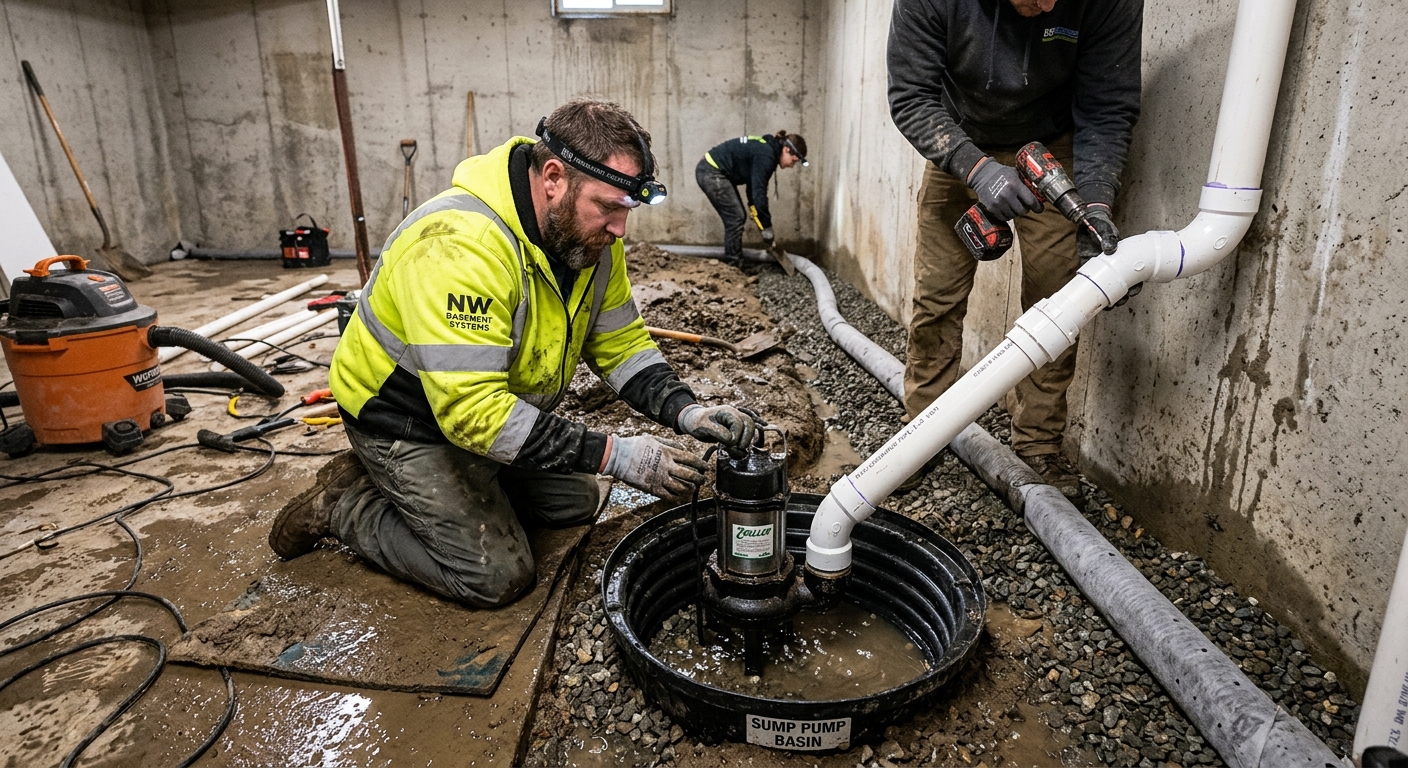
Basement waterproofing options and costs in Country Hills
Country Hills, Ontario has a lot of basements, and the waterproofing approach you choose depends on how water is getting in—and how hard the soil is pushing back. With a population of 4,821 (Statistics Canada, 2021 Census), the local trades market is smaller than Toronto proper, so homeowners often get fewer specialist bidders and may see wider quote swings. Country Hills also has a mix of older post-war homes, where original tar-and-paper systems and early weeping tile were often installed when clay conditions and drainage performance were less tightly engineered. When those drainage lines clog or collapse, moisture typically shows up as damp walls, efflorescence, and “slow” basement flooding rather than dramatic exterior wall failure.
In the Toronto economic region, freeze–thaw cycles widen small cracks and turning points in the drainage network can quickly escalate costs. If access is tight—common around additions, deck footings, or shared driveways—excavation becomes slower and more expensive. In neighbourhoods near dense clay pockets where weeping tile has been partially failed for decades, interior drainage and sump systems are in steady demand because they reduce interior water even when full excavation isn’t practical. Many homeowners also call us for work in and around established residential pockets closer to major arterials, where yard space is limited and the job often involves careful hand-digging.
Below is a practical comparison of the most common methods used around Country Hills, including typical disruption and realistic price bands. Use it to frame your contractor conversations before you request itemised quotes.
| Method |
What It Addresses |
Disruption Level |
Durability |
Price Range |
| Exterior excavation + new membrane + drainage tile |
Primary water entry by treating the foundation from the outside and adding a complete drainage system |
High (excavation, re-grading, landscape reinstatement) |
Long-term source control when properly detailed |
$7,000–$25,000 |
| Interior perimeter drain channel + sump pit |
Hydrostatic pressure management after water enters; helps with chronic seepage |
Medium (flooring/finishes in select areas) |
Very effective for dampness and recurring seepage |
$3,500–$15,000 |
| Foundation crack injection (epoxy or polyurethane) |
Isolated cracks: epoxy for structural sealing, polyurethane for active leaks |
Low (minimal demolition) |
Excellent when the crack is the true source and the details are correct |
$600–$3,000 |
| Sump pump installation (primary + battery backup) |
Removes collected water and reduces freeze-related failure risk during outages |
Low–Medium (pit cut, discharge line tie-in) |
High with backup and proper discharge routing |
$800–$3,500 |
| Window well drain installation |
Water entry at window openings; reduces seepage near egress wells |
Medium (yard/egress area work) |
Good for site-specific window-area leaks |
$1,200–$4,500 |
| Lot re-grading / downspout extension |
Redirects roof runoff and reduces saturation around the foundation |
Low–Medium (soil rework) |
Moderate (best when drainage failures are the main cause) |
$1,000–$6,000 |
Prices are estimates only and vary by project scope, site access and material selection.
What affects the price of waterproofing in Country Hills
In Country Hills, two homeowners can receive very different quotes for what looks like the “same” basement leak—often by 30–50% once soil conditions, access constraints, and what’s truly failing are accounted for. The big separation between the Toronto region and the national average comes from three repeat drivers: soil type, water table, and freeze–thaw behaviour. Toronto-area soils commonly include mixed glacial till and dense clay pockets, which can hold water against foundation walls and expand when saturated. That lateral pressure worsens cracks over time and makes active leakage more common at cold joints, tie holes, and older seepage paths. At the same time, freeze–thaw cycles in Ontario can turn hairline defects into repeating leaks after a few winters, especially in older poured concrete and block foundations.
Local pricing is also shaped by how many days crews can stay working without rework. For example, if your drainage is partially collapsed (old clay weeping tile), interior systems (like a perimeter drain and sump) may start within days at a lower band such as $3,500–$15,000, but an exterior excavation with full membrane and new drainage tile can jump into the $7,000–$25,000 range when access is tight and backfill/reinstatement is labour-intensive. In dense clay pockets, we sometimes see costs rise because excavation must be more careful and wetter, slowing hand-digging. Conversely, if your downspouts already discharge correctly and the leak is limited to one crack, crack injection in the $600–$3,000 band can be a cost-effective fix—provided the crack is verified as the source.
In short: clay-heavy saturation, higher run times for sump pumps, and freeze–thaw-driven crack growth all influence material choice, labour hours, and how “complete” the drainage solution must be. That’s why the same symptom (damp basement) can require very different scopes.
| Price Factor |
Why It Matters |
Cost Impact |
| Interior vs. exterior approach — interior is less disruptive but addresses symptoms |
Exterior treats water at the source; interior manages water after entry |
Interior often costs less upfront; exterior costs more but provides stronger source control |
| Foundation type — poured concrete vs. block vs. stone vs. ICF |
Material differences affect sealing strategy and crack behaviour |
Block and older stone often need complementary drainage and more sealing labour |
| Soil type — clay expands more than sand, adding pressure |
Clay saturation increases hydrostatic and lateral pressure on the wall |
Higher excavation time and stronger drainage detailing; typically increases cost |
| Crack type and length — hairline vs. structural horizontal cracks |
Structural cracks may indicate movement and require engineering |
Injection-only jobs cost less; structural follow-up can raise the total |
| Sump pump backup system — battery or water-powered backup needed |
Ontario outages and spring flooding can stop primary pumps |
Backup adds cost but prevents costly freeze/overflow damage |
| Access — landscaping, decks, or driveways must be removed for exterior |
More removal and careful hand-digging means more labour hours |
Exterior work can spike significantly if site access is constrained |
| Weeping tile age — original tile (60+ years) may be completely failed |
Old tile lines clog or collapse, so water routing may be ineffective |
Often increases scope from “repair” to “replace,” raising cost |
| Mould or efflorescence remediation required before sealing |
Moisture staining and salts can interfere with coatings and long-term adhesion |
Remediation adds labour but improves the success rate of sealing |
Permits & regulations in Ontario
In Ontario, not every waterproofing step needs a permit, but several common items do. In general, foundation excavation, structural crack repair where a wall’s integrity could be impacted, and changes to how roof or surface water drains away from the lot may trigger permit requirements depending on the scope and whether it affects grading near the foundation. Sump pump installations can also involve municipal approval when discharging to a sewer system (storm or sanitary) rather than to an approved surface discharge location.
For structural crack repair—especially horizontal cracks in block walls or major “step” cracks—homeowners should expect an assessment by a structural engineer to determine whether underpinning, reinforcement, or other structural work is needed before sealing. The contractor should be able to show how the work will be engineered and documented where applicable.
Here’s a homeowner-friendly way to verify a contractor in Country Hills. Start by confirming they have the correct Ontario licence/registration for the type of work they’re performing (check their credentials and the trade classification they claim). Next, request a certificate of insurance: look for general liability with coverage limits appropriate to the job, and make sure the certificate clearly lists your address as an additional interest where feasible. Then verify worker protection coverage (WSIB/WCB): ask for a clearance letter or confirmation number. Finally, for structural repairs, ask whether they carry or coordinate engineering support and whether they will include engineer sign-off where required. If a contractor can’t provide documentation promptly, that’s a practical warning sign before you sign anything.
Interior vs exterior waterproofing — what does Country Hills need?
In Country Hills, the fundamental difference is whether you stop water before it reaches the foundation or control it after it enters. Exterior waterproofing involves full excavation, new membrane, installation (or replacement) of drainage tile, and careful backfill. It is the most direct “source control” method, but it’s also disruptive—landscaping, patios, and sometimes deck edges need to be disturbed and reinstated. Interior waterproofing typically uses a perimeter drain channel and a sump pit/pump to collect water that passes through the wall or footer area. It’s less invasive and often the fastest path to a dry basement, but it does not remove hydrostatic pressure from the foundation wall itself.
Given Toronto-area soils—mixed glacial till with dense clay pockets—exterior work is usually most appropriate when seepage is widespread, drainage systems are clearly failed, or you’re seeing repeated dampness along multiple walls. Poured concrete walls often respond very well to crack injection as a targeted measure, because correctly detailed sealing can stop isolated pathways. Block foundations, on the other hand, frequently benefit from interior drainage as a practical complement because water can pass through mortar joints and at the wall/floor transitions even when only portions of the wall appear cracked.
Ontario’s freeze–thaw cycles also matter. When there’s spring saturation, sump pumps can run for long stretches, and the added risk of power loss is why backup systems come up so often. The right sump setup can be the difference between a managed wetting event and a freeze-related overflow.
For a simple cost comparison: if you’re dealing with one confirmed active crack pathway, crack injection in the $600–$3,000 band may be justified, while full excavation and membrane with new drainage tile can reach $7,000–$25,000 when the true cause is broad lateral water pressure around the foundation. The best choice is the one that matches the source—not the one that’s cheapest on day one.
| Method |
Best For |
Addresses Source? |
Disruption |
Lifespan |
Price Band |
| Full exterior excavation + membrane |
Widespread seepage, failed exterior drainage, high lateral pressure from clay |
Yes (water entry treatment at the foundation) |
High |
Long-term when detailed and backfilled correctly |
$7,000–$25,000 |
| Interior French drain + sump system |
Chronic seepage, damp walls, weeping tile failure where exterior access is limited |
Partially (controls water after entry) |
Medium |
Very effective with proper discharge and maintenance |
$3,500–$15,000 |
| Crack injection — epoxy (structural) |
Non-moving cracks that are verified as stable pathways |
Yes (seals the pathway when stable) |
Low |
Good to excellent for properly assessed cracks |
$600–$3,000 |
| Crack injection — polyurethane (active leak) |
Active seepage through cracks or joints with ongoing water pressure |
Yes (stops active flow through the pathway) |
Low |
Strong when paired with correct crack prep |
$600–$3,000 |
| Interior drain channel only (no sump) |
Light seepage where water can be managed by drainage and site discharge |
No (still relies on water management rather than source control) |
Low–Medium |
Can be shorter if water volumes increase |
$2,000–$8,000 |
| Re-grading + downspout extensions |
Roof runoff and surface water issues with minimal wall seepage |
Partially (reduces saturation risk) |
Low–Medium |
Moderate; depends on ongoing maintenance |
$1,000–$6,000 |
How to choose a waterproofing contractor in Country Hills
Choosing the right contractor in Country Hills comes down to proof: insurance, the ability to detail a correct scope, and a warranty you can actually rely on. Start with Ontario compliance. Ask for their WSIB/WCB clearance letter (or confirmation), and request a certificate of insurance that shows general liability coverage. Then verify the contractor is appropriately licensed/registered for the category of work they’re proposing. If they won’t provide paperwork quickly, that’s a red flag.
Next, get 2–3 itemised written quotes. You want a labour + materials breakdown, not a single lump sum. The scope should list what’s included for disposal, excavation limits (if exterior work), membrane/drainage materials, sump location, pump model, and whether discharge is routed to a permitted location. Confirm whether a permit is included (and who pulls it). Also ask what happens if hidden defects are found—will there be unit pricing, or will you be forced into change orders?
Warranty matters. Look for a workmanship warranty length that matches the job type, plus product/manufacturer warranty details (and whether the warranty transfers if you sell your home). For payment, keep it controlled: never pay more than 10–15% upfront; then use a holdback until the job is complete and materials are verified. Finally, insist on a timeline in writing with a start date and estimated completion window—waterproofing often depends on weather, cure times, and backfill scheduling.
- Provide WSIB/WCB clearance letter or proof of coverage
- Provide certificate of insurance with appropriate general liability limits
- Use a detailed written scope (not just “waterproof basement”)
- Include material specifications (membrane type, drain tile, pump model)
- List what is excluded (e.g., mould removal, interior finish replacement)
- State whether permits are included and who is responsible for pulling them
- Confirm disposal of excavated soil and old drainage components
- Detail the discharge method and confirm it’s permitted/approved for Ontario
- Include a waterproofing warranty for workmanship and the product warranty
- Require an itemised quote with unit pricing for change orders
- Schedule a pre-start moisture/inspection walkthrough and photo documentation
- Use a controlled payment schedule with a holdback until completion
For Country Hills specifically, watch for these red flags: vague scope language that doesn’t identify drainage routing; quotes that promise “fixing the leak” without diagnosing soil/water entry (especially in clay pockets); no mention of sump backup when long spring saturation is likely; injection-only proposals for widespread dampness without confirming the true source; and contractors who ask for full upfront payment with no holdback or delayed warranty documentation.
Frequently asked questions — waterproofing in Country Hills
How do I compare waterproofing quotes?
When comparing quotes in Country Hills, focus on the scope and the diagnosis—not just the bottom line. Ask each contractor to explain the water entry path: crack/cold joint/tie hole versus footer seepage versus surface saturation. Look for itemised pricing that separates labour from materials, and confirm what’s included for disposal, excavation limits (if exterior), and re-grading/restoration. If one quote is interior-only and another is exterior, you should ask whether the exterior is necessary due to clay pressure and suspected drainage failure (for example, partially clogged weeping tile). Also compare warranties and what they cover. A “cheap” injection quote might fall in the $600–$3,000 band, but if there’s widespread seepage, the real solution may sit higher.
How long does basement waterproofing take in Country Hills?
Timelines vary based on whether you’re doing interior drainage or exterior excavation. Typical interior perimeter drains and a sump installation can often be scheduled for about several days to a couple of weeks including concrete saw cuts, waterproofing install, pump commissioning, and allowing finishes to re-set—weather matters less because you’re working inside. Exterior waterproofing usually takes longer due to excavation, membrane installation, drainage tile detailing, inspection (if required), and cure/backfill time, plus landscape reinstatement. In a clay-heavy Toronto-area site, wet soil can slow excavation and extend schedule. If you’re dealing with active leaks that require polyurethane injection, those can be quicker, but only if the crack source is confirmed. Always get a written start date, completion estimate, and dependencies (permits, cure times, weather windows) before work begins.
What is a weeping tile and does my Country Hills home have one?
A weeping tile is the foundation drainage system installed around (or near) the footing to collect groundwater and direct it away—historically often clay tile, later sometimes plastic or improved materials. Many older basements in the Country Hills area do have an original weeping tile, but it’s frequently partially collapsed or clogged after decades, especially in saturated clay pockets where silt and fines build up. You may not see it unless someone opens access or excavates, so the “presence” can’t always be assumed from visible foundation features. Signs your weeping tile may be failing include interior dampness that worsens during spring saturation, efflorescence near the base of walls, and basement flooding that appears even when gutters are functioning. A contractor should assess drainage routing before proposing replacement versus interior drainage.
Can I waterproof my basement in winter in Country Hills?
Yes, in many cases you can waterproof in winter in Ontario, but the best approach depends on the method. Interior work like perimeter drains, sump pump installation, and crack injection can often proceed because the work is indoors and does not require large exterior excavation. Exterior excavation is more limited: freezing temperatures can complicate soil removal, membrane detailing, and backfill compaction, and cure times can be harder to manage. If your leak is active now and you need immediate damage control, interior measures can buy you time and prevent freeze damage from uncontrolled seepage. Keep in mind that some sealing products have temperature requirements, and proper surface prep is non-negotiable for long-term adhesion. If you’re getting quotes, ask specifically what they can complete during winter versus what must wait for thaw-and-dry conditions.
What is the difference between waterproofing and damp-proofing?
“Damp-proofing” usually means making the foundation resistant to minor moisture (often with basic coatings or partial measures) but not necessarily handling active hydrostatic pressure. “Waterproofing” is designed to manage water entry more robustly—either by treating the foundation exterior with membrane and drainage tile (source control) or by collecting and relieving pressure through an interior drain channel and sump system. In Country Hills, because clay soils can hold water and freeze–thaw cycles can worsen cracks, damp-proofing alone often isn’t enough when seepage is recurring. If you have efflorescence, recurring dampness, or water entering during heavy spring periods, you need a scope that addresses hydrostatic pressure and drainage performance. That’s where interior perimeter drains with a sump or exterior excavation with membrane and new drainage routing typically makes the difference.
Will basement waterproofing affect my property value in Country Hills?
Basement waterproofing can positively affect property value because it reduces the risk of ongoing water damage, odours, and costly remediation down the road. In a market like the Toronto area, buyers often treat chronic dampness as a major concern, especially in post-war and older homes where drainage systems can be failing and freeze–thaw can exacerbate cracks over time. Clear documentation—photo record, itemised scope, product specs, and a transferable workmanship warranty—helps justify the investment. The value impact depends on how complete the solution is: a targeted repair that stops a confirmed leak pathway can be a good cost-effective move (often in the $600–$3,000 range), while widespread exterior drainage failures usually justify more comprehensive work that can reach the $7,000–$25,000 band. At minimum, waterproofing should improve insurability and peace of mind by turning an unpredictable problem into a controlled system.