Basement waterproofing options and costs in Mississauga Beach
Mississauga Beach homeowners usually see waterproofing become a real decision after a wet spring, a string of winter freeze–thaw nights, or water showing up after downpours. With a 2021 population of 4,662 (Statistics Canada, 2021 Census), the local contractor pool is smaller than Toronto proper, so availability can affect lead times and sometimes pricing. It’s also a market where many homes are older—post-war and 1960–1980s foundations are common—meaning original clay weeping tile or early drains may now be partially clogged or collapsed. In that situation, you can have interior dampness, efflorescence, and basement seepage even when the exterior wall looks “fine.”
Toronto-area waterproofing costs are shaped by mixed glacial till and clay pockets that hold water against foundation walls, raising lateral pressure and pushing seepage through cold joints, tie holes, and cracks. Freeze–thaw cycles then widen small defects in concrete and block foundations, converting hairline problems into active leaks over a few winters. On top of that, many Mississauga Beach lots have tight access around additions, decks, and shared driveways, so excavation and disposal costs can rise. Areas near the waterfront and low-lying pockets where drainage is challenging typically see higher demand for sump solutions and exterior excavation.
Below are the common waterproofing methods and what they typically cost in this tier, so you can compare like-for-like before you ask for quotes.
| Method |
What It Addresses |
Disruption Level |
Durability |
Price Range |
| Exterior excavation + new membrane + drainage tile |
Active water entry from the outside, hydrostatic pressure at the wall, failed weeping tile |
High (hand-digging, landscaping/driveway protection, backfill) |
High (source control at the foundation) |
$10,500–$25,000 |
| Interior perimeter drain channel + sump pit |
Water that migrates through cracks/cold joints, interior seepage, persistent damp floors |
Medium (floor patching; minimal exterior disturbance) |
Medium–High (depends on wall condition and discharge management) |
$5,500–$15,000 |
| Foundation crack injection (epoxy or polyurethane) |
Isolated leaks through cracks; sealing and/or stopping active flow |
Low–Medium (interior wall access; limited drilling) |
Medium (epoxy seals; polyurethane often targets active leaks) |
$600–$3,500 |
| Sump pump installation (primary + battery backup) |
Chronic seepage and high run times; protection during outages |
Low–Medium (utility routing, basin prep) |
Medium–High (backup improves resilience) |
$1,200–$4,000 |
| Window well drain installation |
Water intrusion around egress windows, surface runoff, localized seepage |
Low–Medium (excavate near window wells) |
Medium (local fix; not a full foundation solution) |
$900–$3,000 |
| Lot re-grading / downspout extension |
Redirecting surface water away from foundation |
Low (often exterior only) |
Low–Medium (works best with a functioning drainage system) |
$1,500–$6,000 |
Prices are estimates only and vary by project scope, site access and material selection.
What affects the price of waterproofing in Mississauga Beach
In Toronto and the surrounding GTA, two homeowners can receive quotes that differ by 30–50% for the “same” basement symptom because waterproofing is designed around water pathways, not just what you see on the wall. Exterior excavation, disposal, labour hours for hand-digging, and the amount of drainage replacement all vary widely between neighbourhoods and lot layouts. In many Mississauga Beach homes, limited access around decks, additions, and narrow side yards can force more manual labour and slower setup, which pushes labour costs above what you might expect from a “standard” basement job.
The three biggest cost drivers that separate this region from the national average are soil type, water table, and freeze–thaw. Clay-heavy soils common across Ontario can expand as they saturate and freeze, creating lateral pressure against foundation walls and worsening cracks over time. Where high water tables are an issue, sump systems must run longer and discharge routing becomes more detailed. In older homes, weeping tile that is 60+ years old may be completely failed, and contractors often need to excavate deeper than homeowners assume.
Concrete examples from Mississauga Beach: (1) a poured-concrete wall with multiple hairline cracks may be addressed economically with targeted crack injection, while (2) a block foundation with active seepage often requires interior drainage plus a sump to manage hydrostatic pressure. (3) If your downspouts discharge close to the foundation, re-grading can be a lower-cost first step, but only if the subsurface drainage is still performing. In practical terms, interior drainage projects often land in the $3,500–$15,000 band, while true exterior source-control work commonly moves into the $7,000–$25,000 range.
| Price Factor |
Why It Matters |
Cost Impact |
| Interior vs. exterior approach — interior is less disruptive but addresses symptoms |
Interior systems manage water after it enters; exterior works at the source |
Interior often 30–60% cheaper; exterior often $7,000–$25,000 depending on access |
| Foundation type — poured concrete vs. block vs. stone vs. ICF |
Crack pattern and sealing methods differ by material |
Poured walls may respond better to injection; block often needs drainage complements |
| Soil type — clay expands more than sand, adding pressure |
Saturated clay increases lateral wall loading during freeze–thaw |
Clay-heavy sites can increase sealing failures and require more robust drainage |
| Crack type and length — hairline vs. structural horizontal cracks |
Structural cracking can indicate more than just water penetration |
Horizontal/structural cracks can trigger engineered assessments and higher scopes |
| Sump pump backup system — battery or water-powered backup needed |
Outages during spring flooding can cause overflow |
Backup can add cost but reduces risk; commonly increases by roughly $400–$1,200+ |
| Access — landscaping, decks, or driveways must be removed for exterior |
Exterior work is labour-intensive where restoration is required |
Access constraints can push exterior excavation to the upper $20k+ end |
| Weeping tile age — original tile (60+ years) may be completely failed |
Old drainage systems often collapse or clog, losing function |
More removal/replacement typically required for reliable exterior control |
| Mould or efflorescence remediation required before sealing |
Sealers don’t adhere well to contaminated, damp surfaces |
Additional prep steps can add days and material costs |
Permits & regulations in Ontario
In Ontario, foundation excavation, structural crack repair, and changes to lot drainage typically require a building permit. If you’re having work that affects structural elements—especially foundation repairs tied to horizontal cracks in block walls or conditions that could involve load-bearing changes—you should assume permitting may be required. For sump pump installations that connect to the storm or sanitary sewer, municipal approval is commonly needed before tie-in, and the contractor should confirm the discharge route and permissions.
Step-by-step verification is the homeowner’s best protection. First, ask the contractor for their Ontario business/licence documentation (where applicable) and the permit plan: which permits they’ll pull, and which items are “by permission” versus “no permit required.” Second, for structural crack repair, request evidence they use appropriate engineering support when needed (for example, an engineer’s assessment where major/structural cracking is suspected). Third, get a current certificate of insurance that includes liability coverage and ensure the company can provide proof of WSIB/WCB coverage (or exemption paperwork where relevant). Fourth, confirm the warranty and exclusions in writing—waterproofing failures often occur where prep isn’t complete.
If a contractor refuses to discuss permits, engineering support, or insurance documentation, treat it as a red flag and move on.
Interior vs exterior waterproofing — what does Mississauga Beach need?
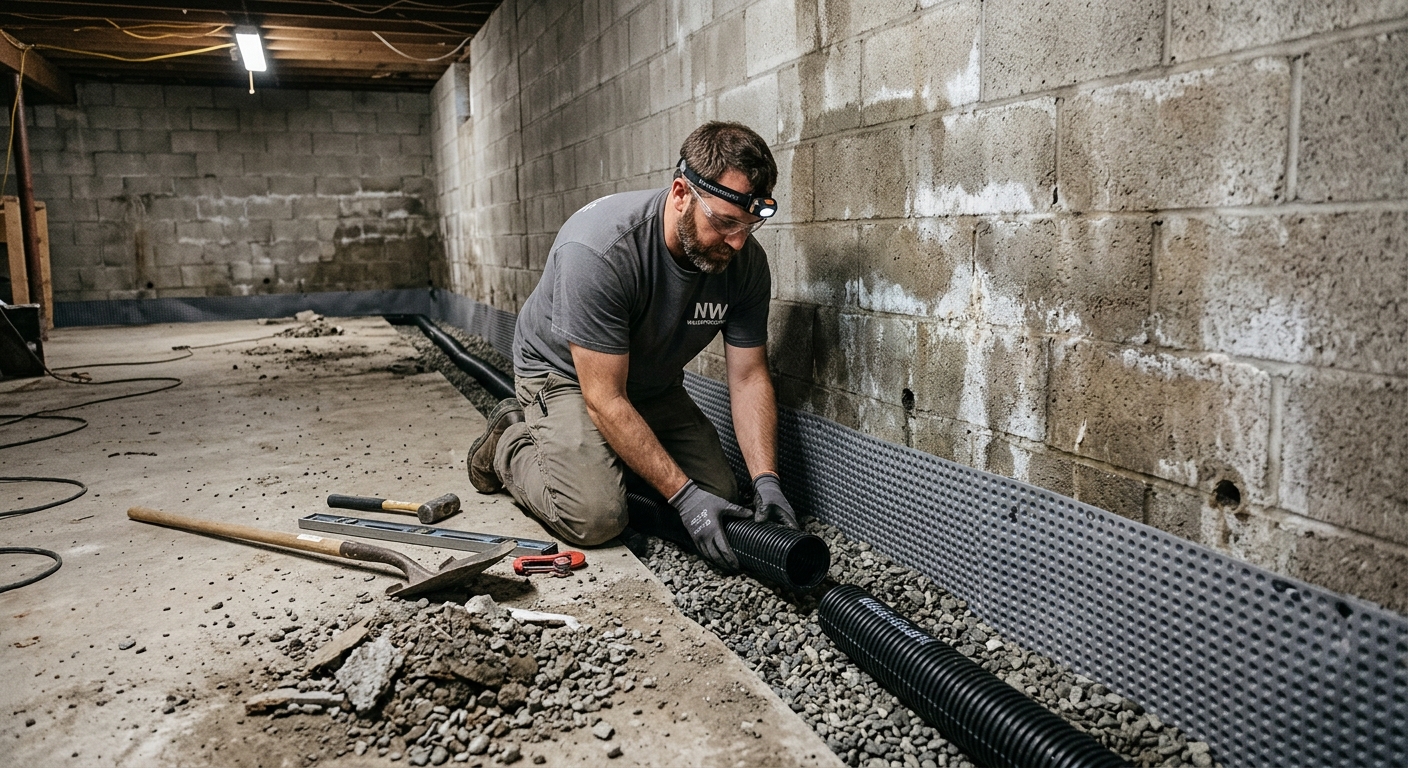
The key difference in Mississauga Beach is whether you control water at the source or manage it after it enters. Exterior waterproofing—full excavation, new membrane, and new drainage tile—addresses the source of water entry by reducing hydrostatic pressure against the wall. It costs more and requires disruption because excavation is done along the foundation perimeter and backfill/restoration must be completed. Interior waterproofing—perimeter drain channel, sump pit, and sump pump—intercepts water that has already migrated through cracks, tie holes, or deteriorated weeping tile pathways. Interior work is often less invasive, but it doesn’t eliminate the pressure acting on the wall itself, so wall prep and proper drainage discharge still matter.
Given Toronto-area freeze–thaw cycles and the region’s clay-heavy pockets that hold water against foundations, many homeowners need interior drainage as a practical complement, especially where access makes full excavation difficult. Poured concrete walls can often seal well when cracks are well defined and treated with injection; block foundations more commonly benefit from interior drainage because water pathways may be more diffuse through units and mortar joints. If you’re planning a sump, Ontario’s typical spring flooding patterns make backup systems a serious consideration—battery backup or a water-powered alternative can prevent nuisance and overflow during outages when run times spike.
Where the price difference is justified: if you have failed original weeping tile and active seepage near multiple sections of wall, exterior excavation and drainage replacement can be the long-term fix in the $10,500–$25,000 range. If the issue is a limited area with isolated cracks, interior crack injection and a sump pump strategy can be closer to $600–$3,500 for injection plus $1,200–$4,000 for pumping in the right scenario.
| Method |
Best For |
Addresses Source? |
Disruption |
Lifespan |
Price Band |
| Full exterior excavation + membrane |
Widespread seepage, failed weeping tile, high lateral soil pressure, chronic dampness |
Yes |
High |
High when drainage is properly restored |
$10,500–$25,000 |
| Interior French drain + sump system |
Interior water migration, clogged/failed exterior drains, basements that can’t be fully excavated |
No (manages after entry) |
Medium |
Medium–High with correct pump and discharge |
$5,500–$15,000 |
| Crack injection — epoxy (structural) |
Non-moving cracks where water paths can be sealed without active flow |
Partially (seals entry point) |
Low–Medium |
Medium |
$600–$2,200 |
| Crack injection — polyurethane (active leak) |
Active seepage through cracks or dynamic leakage that needs flexible sealing |
Partially (stops entry point) |
Low–Medium |
Medium (often paired with interior drainage) |
$800–$3,000 |
| Interior drain channel only (no sump) |
Minor seepage where gravity discharge is possible and water volumes are low |
No |
Medium |
Lower where hydrostatic pressure is high |
$3,500–$8,000 |
| Re-grading + downspout extensions |
Surface water management issues (overflowing eavestroughs, pooling near foundation) |
Yes for surface sources |
Low |
Low–Medium (depends on subsurface drainage) |
$1,500–$6,000 |
How to choose a waterproofing contractor in Mississauga Beach
Start with compliance and documentation. In Ontario, verify the contractor’s licensing/registration details where applicable, then request a certificate of liability insurance and proof of WSIB/WCB coverage. To check: (1) look for the contractor’s insurance certificate naming your property address and confirming coverage limits; (2) confirm WSIB/WCB status with the documentation they provide; and (3) ensure any structural-related work includes engineering support when required. A reputable Mississauga Beach contractor will not treat these as “optional.”
Next, get 2–3 itemised written quotes with a labour + materials breakdown, not a lump sum. Make sure the scope explains what’s included: permit pulls (if required), disposal, excavation depth assumptions, restoration of landscaping, and who removes and replaces affected flooring or drywall. For warranties, ask for workmanship warranty length and whether the manufacturer warranty applies to the specific system components installed. Also ask if the warranty is transferable to a new homeowner—important for resale in the GTA.
Payment schedule matters: never pay more than 10–15% upfront, and hold back a portion until punch-list items and final cleanup are complete. Finally, demand a timeline with a start date and estimated completion date in writing, because waterproofing often depends on drying conditions and access restoration.
- Ask for an itemised scope that lists exact products (membrane type, drain piping, pump model, discharge method).
- Confirm whether they will assess and address failed weeping tile and how they’ll verify drainage pathways.
- Get clarification on excavation access limits (deck, driveway, addition sides) and what restoration includes.
- Require a written plan for discharge (where water goes after the pump/drain).
- Check that the quote states whether a sump backup system is included or optional.
- Verify they include proper substrate prep (mould/efflorescence removal) before sealing/injection.
- Confirm they will test and clean out eavestrough/downspout drainage as part of the exterior scope.
- Ask who pulls permits (when required) and what inspections are expected.
- Ensure warranty terms specify workmanship duration and exclusions for misuse or incomplete drying.
- Look for a clear payment schedule tied to milestones, with a holdback.
- Request a disposal plan for soil/old drainage materials and include it in the quote.
- Get proof of insurance and WSIB/WCB coverage before signing anything.
Specific red flags in Mississauga Beach: (1) quoting “one product fits all” without checking crack type, wall material, or drainage pathways; (2) skipping permit/municipal discharge discussions while proposing sump tie-ins; (3) offering vague warranty wording (no workmanship duration or unclear exclusions); (4) demanding a large upfront payment (over 10–15%); (5) refusing to provide insurance/WSIB/WCB documentation when asked.
Frequently asked questions — waterproofing in Mississauga Beach
Do I need a permit for foundation work in Ontario?
In Ontario, many foundation-related activities—especially excavation along the foundation perimeter, structural crack repair that may relate to load-bearing concerns, and changes to lot drainage—often require a building permit. If the plan includes connecting a sump pump discharge to storm or sanitary infrastructure, you typically need municipal approval for the tie-in route. For Mississauga Beach homeowners, the practical approach is to ask the contractor to confirm (in writing) what permits they pull and what they handle versus what you’d need to request. Also ask if structural cracking triggers an engineer assessment before repairs proceed.
How long does waterproofing last?
Waterproofing lifespan depends on what failed and what the system actually addresses. Exterior waterproofing with a proper membrane plus new drainage tile is built for long-term source control, but only if the drainage pathway remains clear and backfill is done correctly. Interior systems (French drains and sump pumps) can last a long time, but they rely on ongoing pump performance and discharge management—so backup power and battery replacement matter. Crack injection typically has a medium lifespan because it seals entry points; if the underlying hydrostatic pressure remains high due to failed weeping tile, the system may need complementary drainage. Your contractor should match the method to your conditions to protect your investment.
Can I waterproof my basement from the inside only?
Yes, in many Mississauga Beach basements you can manage water from the inside only, especially when exterior access is limited or when you’re dealing with chronic seepage after failed original drains. Interior perimeter drainage channels and a sump system can intercept migrating water and reduce dampness and efflorescence. Typical cost ranges for interior waterproofing are often around $5,500–$15,000, depending on how much concrete/floor is opened and whether mould remediation is needed first. That said, interior-only work doesn’t remove the hydrostatic pressure acting on the wall, so it should be considered an “after-entry management” approach unless the water entry points are clearly limited and sealed.
What causes foundation cracks in Mississauga Beach?
Foundation cracks here are commonly driven by soil behaviour and climate cycles. Toronto-area mixed glacial till and clay pockets can hold water against foundations; as saturation changes and freeze–thaw repeats, clay expansion and contraction increase lateral pressure on basement walls. Over time, that can turn hairline cracks into active seepage pathways through cold joints, tie holes, and mortar joints. Older housing stock in the region increases the odds that original drainage is partly collapsed or clogged, which means more water pressure stays in contact with the foundation. Water pressure, not just “settling,” is often the reason cracks become wetter after spring rains or during winter thaws.
How do I compare waterproofing quotes?
Compare quotes like a system, not like a price. Ask each contractor to provide an itemised breakdown: labour, materials, disposal, permit pull handling, pump model (if included), drainage type, and restoration scope. Ensure they specify whether they’re solving the source (exterior excavation + membrane + drainage tile) or managing after-entry symptoms (interior drain + sump). For example, exterior projects in this tier can be roughly $10,500–$25,000, while interior approaches often fall closer to $3,500–$15,000. If one quote is “much cheaper” but excludes discharge routing, backup power, or mould/efflorescence prep, it may not be comparable. Also confirm warranty terms and who carries insurance and WSIB/WCB coverage.
How long does basement waterproofing take in Mississauga Beach?
Timelines vary with access, scope, and cure/drying conditions, but many homeowners can plan around days to a few weeks depending on whether the work is interior or exterior. Interior drain channel and sump installations often take less time than exterior excavation because there’s no full perimeter dig. Crack injection jobs can be relatively fast (typically within days), but the timeline can extend if surfaces require extensive prep for mould or efflorescence removal. Exterior excavation is slower because contractors must plan safe access, remove and restore landscaping, replace drainage tile/membranes, and complete proper backfill/compaction. Ask for a start date and completion estimate in writing, and confirm what weather windows the contractor expects in Ontario’s freeze–thaw season.