Basement waterproofing options and costs in Kanata
In Kanata, homeowners usually start with one big question: how do we stop basement dampness and leaks without overspending? With about 90,000 residents in the area (Statistics Canada, 2021 Census), Kanata’s housing stock includes many older detached homes where original basement drainage systems are more likely to be silted, collapsed, or missing. That matters because Ottawa-area freeze-thaw cycles can turn a small seepage problem into an active leak over a few winters, especially when clay-heavy soils hold water and expand.
In the Ottawa economic region, cost is driven by both ground conditions and the amount of excavation needed. Clay-rich soils and a relatively high local water table increase lateral pressure on foundation walls and raise the risk of cracking and seepage during spring melt and heavy rain. Where grading is poor or downspouts discharge near the foundation, contractors often recommend exterior waterproofing (excavation, membrane, and new drainage tile) rather than “symptom-only” fixes. That said, interior solutions—perimeter drains, sump pits, and crack injections—remain common in Kanata when landscaping access is limited or when the foundation is sound enough that managing water entry is the fastest, most cost-effective path.
In neighbourhoods like South March (and other established Kanata pockets with mature landscaping), exterior work is especially in demand because driveways, decks, and retained slopes can block maintenance-grade access to weeping tile lines. The next step is comparing realistic methods side-by-side to match your leak pattern and budget, as shown in the table below.
| Method |
What It Addresses |
Disruption Level |
Durability |
Price Range |
| Exterior excavation + new membrane + drainage tile |
Hydrostatic pressure and water entry (full system replacement), plus outside drainage control |
High (excavation, landscaping disruption, heavy clay removal/disposal) |
Long-term when backfill, membrane protection, and tile slopes are correct |
$9,000–$45,000 |
| Interior perimeter drain channel + sump pit |
Captures seepage inside and reduces hydrostatic pressure at the floor/wall interface |
Medium (limited concrete cutting; cleanup of interior water paths) |
Good when sump sizing and discharge routing are properly designed |
$6,000–$20,000 |
| Foundation crack injection (epoxy or polyurethane) |
Stops seepage through specific cracks; restores integrity based on crack type |
Low (minor prep; limited drilling) |
Variable—best results when the right product is used for the crack behavior |
$600–$3,000 |
| Sump pump installation (primary + battery backup) |
Continuous water evacuation during spring melt and heavy rain; backup for outages |
Low to medium (pit installation; discharge line and wiring) |
High—when backup is included and floats/alarms are set correctly |
$2,200–$3,500 |
| Window well drain installation |
Manages water pooling around basement window wells and improves drainage away from openings |
Low to medium (excavation around wells, modest landscaping changes) |
Good—depends on grading, gravel bedding, and discharge routing |
$1,200–$5,000 |
| Lot re-grading / downspout extension |
Moves roof and surface water away from the foundation to reduce future loading |
Low to medium (soil movement; topsoil/sod reinstatement) |
Moderate—often a must-do maintenance item, but not enough for active leaks alone |
$2,000–$10,000 |
Prices are estimates only and vary by project scope, site access and material selection.
What affects the price of waterproofing in Kanata
In Kanata and the wider Ottawa region, two quotes for “the same basement” can differ by 30–50% because contractors price for the reality of excavation access, clay removal, foundation condition, and how much of the drainage system must be rebuilt (not just patched). On paper, one company may propose interior perimeter drainage and crack injections, while another recommends full exterior excavation to address hydrostatic pressure at the source—especially when weeping tile is older and failing.
Three local drivers most often separate Ottawa-area costs from the national average: soil type, water table, and freeze-thaw. Clay-heavy soils common locally expand during cold cycles and exert more lateral pressure on foundation walls, which widens cracks over time and increases seepage. High water pressure also means sump systems often need more capacity and longer run times during spring melt. Freeze-thaw cycles then worsen openings: small hairline cracks can become active channels as water repeatedly freezes and expands inside the foundation plane.
To make it practical, consider these Kanata examples. If your exterior excavation is through heavy clay, excavation and disposal can add significant cost—clay can raise excavation and waterproofing expenses by roughly 25–50% compared with better-draining ground. If your weeping tile is original (often 60+ years in older homes), contractors typically find collapsed sections or silted lines, pushing the job toward exterior reconstruction (commonly within the $9,000–$45,000 range). If the issue is localized to one or two cracks and the wall isn’t moving, crack injection is often the more economical first step (commonly within $600–$3,000) before spending on excavation.
Finally, pricing changes with household details. Older housing stock in established Kanata streets has higher rates of interior dampness, efflorescence, and basement flooding during spring melt—so remediation (mould control, concrete cleaning, and drying) is sometimes required before any sealing or drainage work can succeed.
| Price Factor |
Why It Matters |
Cost Impact |
| Interior vs. exterior approach — interior is less disruptive but addresses symptoms |
Exterior reduces water entry at the source; interior manages water after it arrives |
Interior often saves on landscaping removal but may cost more over time if water entry continues |
| Foundation type — poured concrete vs. block vs. stone vs. ICF |
Crack behavior and detailing differ; some systems perform better with certain sealing methods |
Block/stone often need more drainage detail; poured concrete may respond better to crack injection |
| Soil type — clay expands more than sand, adding pressure |
Increases lateral pressure and seepage risk under freeze-thaw |
Excavation/disposal and waterproofing complexity commonly rises |
| Crack type and length — hairline vs. structural horizontal cracks |
Product selection and engineering scope depend on crack behavior |
Structural cracks can require engineered assessment and additional work, increasing costs |
| Sump pump backup system — battery or water-powered backup needed |
Power outages during spring flooding can turn a “managed” system into an emergency |
Backup increases the upfront budget but reduces risk and cleanup |
| Access — landscaping, decks, or driveways must be removed for exterior |
More removal means more labour and reinstatement |
Can swing the job by thousands, especially where access is tight |
| Weeping tile age — original tile (60+ years) may be completely failed |
Old systems are often silted or collapsed, failing under saturated conditions |
May shift the plan from partial repairs to full drainage replacement |
| Mould or efflorescence remediation required before sealing |
Sealers don’t bond well over wet salts or active contamination |
Adds drying time, cleaning steps, and sometimes protective coating work |
Permits & regulations in Ontario
In Ontario, you may need permits when foundation excavation, structural crack repair, or drainage changes alter how water is managed at and around the lot. For many typical basements in Kanata, contractors often pull a permit when they are doing foundation excavation, making repairs to structural elements, or making significant grading/drainage modifications that affect stormwater flow and discharge.
Where plumbing tie-ins are involved, confirm approvals too. Sump pump discharge can require municipal approval depending on where the discharge is routed (for example, connecting to storm or sanitary services typically requires municipal authorization). Even when a contractor can legally install the pump and piping, the “where it discharges” portion is where paperwork often comes in.
For structural crack repair—particularly horizontal cracks in block walls or other major crack patterns—an engineering assessment is commonly required to determine whether additional structural work (like underpinning or other stabilization) is necessary. A reputable waterproofing contractor should either include engineering support or clearly coordinate it, and carry liability insurance and WSIB/WCB coverage.
Step-by-step for homeowners in Kanata:
- Ask the contractor which items specifically require a permit and which do not, in writing.
- Verify the contractor’s Ontario licence/registration through the appropriate online registry for their trade category.
- Request a current certificate of insurance (liability) showing coverage amounts and effective dates.
- Request WSIB/WCB clearance—confirm they have active coverage, not expired or “pending” status.
- For structural work, ask who provides the engineering report and whether it is prepared by a licensed professional.
- Confirm who pulls the permit (contractor vs. homeowner) before work starts.
Typical items that often do trigger permits: excavation near foundations, significant crack repair that affects structural integrity, and drainage/grading changes tied to water flow. Items that often do not require permits: small interior sealing tasks after confirmation that no structural modifications are involved, and targeted crack injection when no structural engineering scope is required—however, the final call depends on the specific conditions and scope.
Interior vs exterior waterproofing — what does Kanata need?
The fundamental difference is simple: exterior waterproofing aims to stop water entry at the source, while interior waterproofing manages water after it gets into the basement. Exterior work means full excavation along the foundation, installation of membrane and a new drainage tile system, then re-compaction and backfill. This approach is the most “permanent” when clay-heavy soil and higher local groundwater create consistent hydrostatic pressure. It also costs more because excavation, heavy clay removal, and landscaping reinstatement are labour-intensive in Kanata.
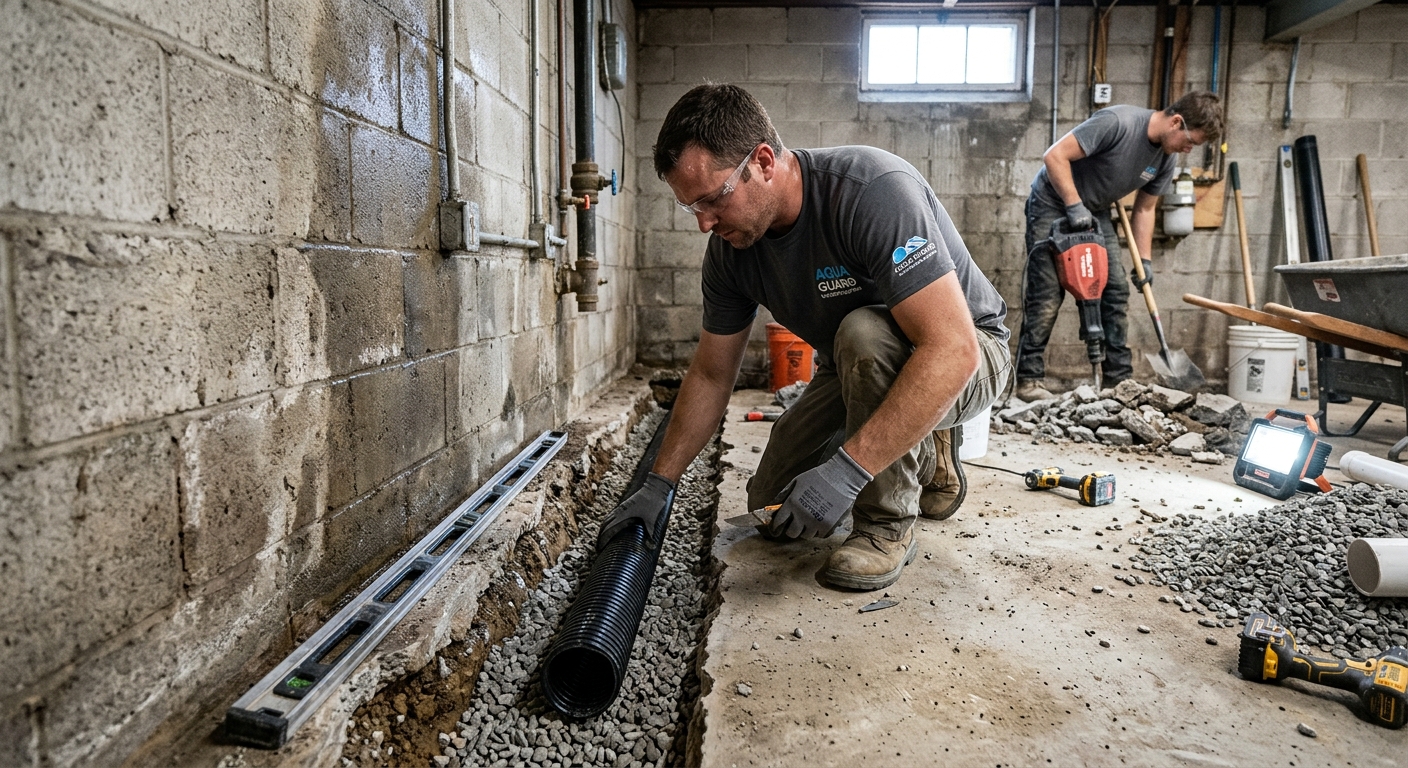
Interior waterproofing usually includes a perimeter drain channel, sump pit, sump pump, and sometimes tie-ins to a basement drain system. It’s less disruptive and faster to schedule, but it does not stop hydrostatic pressure against the wall—it collects and evacuates seepage once it enters. That’s often the practical route for homes with limited exterior access (retaining walls, established landscaping, or busy driveways), or when the foundation condition suggests that controlling water at the floor/wall interface is enough.
For Kanata’s typical conditions—freeze-thaw cycles and clay-driven lateral pressure—poured concrete foundations often perform well with proper crack injection as a targeted step, while block foundations frequently need interior drainage as a complement because joints and pathways can remain vulnerable. If your basement is showing efflorescence or recurring spring flooding, a sump with a backup strategy becomes important. Ontario power interruptions during spring melt can turn an otherwise controlled system into active pooling without secondary protection.
Example: if you have localized crack seepage plus interior dampness, crack injection in the $600–$3,000 range may be justified as a first-stage fix—provided there’s no evidence of failing exterior drainage. If instead the perimeter floor area stays wet during heavy melt and the weeping tile is clearly failed, spending toward interior drainage and sump systems in the $6,000–$20,000 range can be justified. If the water entry is clearly pressure-driven along multiple wall segments, exterior excavation (often $9,000–$45,000) is the option that best addresses the root cause.
| Method |
Best For |
Addresses Source? |
Disruption |
Lifespan |
Price Band |
| Full exterior excavation + membrane |
Ongoing seepage from saturated soil and weak points along the entire perimeter |
Yes—stops water entry and reduces hydrostatic pressure at the wall |
High (excavation and landscaping disruption) |
Long-term when tile slopes, backfill, and membrane protection are done correctly |
$9,000–$45,000 |
| Interior French drain + sump system |
Basements with interior seepage where exterior access is limited or excavation risk is high |
No—manages water after entry |
Medium (floor cutting for channel/pit) |
Good when pump sizing, discharge routing, and backup are included |
$6,000–$20,000 |
| Crack injection — epoxy (structural) |
Cracks that appear stable (often after surface repair and assessment) |
Limited—primarily restores crack integrity and reduces seepage through that path |
Low (drilling and injection only) |
Longer-lasting when the crack is not actively moving |
$600–$3,000 |
| Crack injection — polyurethane (active leak) |
Active seepage through cracks where water is still finding a path |
Limited to the crack path—reduces/halts flow through targeted openings |
Low to medium (more ports and preparation when actively leaking) |
Good for active channels when the correct product is chosen |
$800–$3,500 |
| Interior drain channel only (no sump) |
Minor seepage situations where drainage can be gravity-assisted or meets design criteria |
No—still relies on collection/removal rather than source control |
Medium (floor modifications) |
Moderate—depends heavily on discharge and maintenance |
$3,500–$12,000 |
| Re-grading + downspout extensions |
Moisture tied to roof/surface water runoff and poor foundation perimeter drainage |
Yes for surface/roof runoff contributing to saturation |
Low to medium (soil movement and reinstatement) |
Moderate—must remain maintained as landscaping settles |
$2,000–$10,000 |
How to choose a waterproofing contractor in Kanata
Choosing the right waterproofing contractor in Kanata comes down to proof: proof they’re licensed/eligible for the work, proof they’re insured, and proof their scope matches your foundation and water source. Start by verifying Ontario coverage and compliance. Ask for their Ontario registration/licence for the trade category they’re operating under, and then request a current certificate of liability insurance showing coverage and effective dates. Finally, confirm WSIB/WCB clearance—don’t accept “we’ll get it later.” The simplest approach is to ask for the clearance letter or certificate and cross-check that the coverage is active.
Next, get 2–3 itemised written quotes. You want labour and materials broken down, with allowances called out for disposal, excavation size, concrete cutting limits, and whether waterproofing materials include membrane protection boards, sealant types, and proper drainage pipe bedding. Also check exclusions: is permit pulling included? Is rough site access assumed? Is debris disposal included, or will you be invoiced separately for heavy clay haul-away?
Warranty matters in waterproofing. Confirm workmanship warranty length and whether it covers both labour and any relevant system components. Product/manufacturer warranties should be provided in writing, and you should ask if they are transferable to future homeowners. A clear payment schedule is another indicator: never pay more than about 10–15% upfront. Hold back the remainder until the job is complete and the final walkthrough is done. Finally, insist on a written timeline with a start date and estimated completion window—Ontario’s freeze-thaw makes scheduling and curing time especially important.
- Ask which parts require a permit and whether the contractor pulls it.
- Request itemised quotes (labour, materials, disposal, and sub-trade costs).
- Confirm liability insurance and active WSIB/WCB coverage with certificates/clearance letters.
- Have them identify your foundation type (poured concrete vs block vs stone) and match the method.
- Require a site plan showing where the drainage tile/discharge will go.
- Check if they include sump pump alarms and discharge piping design (not “generic” fittings).
- Ask whether they include mould/efflorescence remediation if salts or growth are present.
- Confirm prep steps for injection: crack cleaning, port spacing, and product selection (epoxy vs polyurethane).
- Review backfill and compaction approach (especially around clay soils).
- Clarify disposal and heavy-clay excavation haul-away is included.
- Get warranty details: duration, exclusions, and transferability.
- Keep a signed scope with inclusions/exclusions before paying the first deposit.
Red flags to watch for in Kanata: vague scopes with no permit/disposal details, “one-size-fits-all” proposals that ignore freeze-thaw and hydrostatic pressure, missing WSIB/WCB or outdated insurance documents, pressure to pay most of the job up front, and warranty terms that only cover materials (not workmanship) without clear coverage timelines.
Frequently asked questions — waterproofing in Kanata
Do I need a permit for foundation work in Ontario?
In Ontario, permits are commonly required for foundation excavation, structural crack repairs that affect structural elements, and significant lot drainage/grading changes that influence how water flows around your home. For Kanata homeowners, the key is the scope: installing a sump pump is sometimes straightforward, but where the discharge goes (storm or sanitary tie-ins) may require municipal approval. Also, if you’re dealing with major crack patterns (for example, horizontal cracks in block walls), an engineering assessment is often needed before deciding on repair strategy, and that can trigger permit requirements. The best approach is to ask your contractor what they will permit-pull and who pulls it, then request the written scope before work begins.
How long does waterproofing last?
Waterproofing longevity depends on whether the work addresses the source of water entry or only manages what gets in. Exterior excavation with new membrane and drainage tile is typically the most durable approach when installed correctly, because it reduces hydrostatic pressure at the foundation wall. Interior drainage systems can also last many years, but they rely on proper sump sizing, discharge routing, and maintenance—especially during Ottawa-area spring melt and freeze-thaw cycles. Crack injection longevity depends heavily on whether the crack is stable; epoxy works best for stable cracks, while polyurethane is used for active leaks. In Kanata, homeowners with clay-heavy soils and older drainage lines often see better long-term results when the plan fits the cause rather than repeating the same internal patchwork.
Can I waterproof my basement from the inside only?
Yes, in many Kanata cases you can improve a basement using inside-only solutions like a perimeter drain channel and sump pit, and in some situations crack injection for targeted seepage. Interior systems are less disruptive than full excavation and are often chosen when landscaping access is limited. However, interior work doesn’t fully stop hydrostatic pressure pushing on the wall; it collects and evacuates water after entry. That’s why success depends on understanding your water source—clay soils that swell and high seasonal saturation can overwhelm an undersized interior system. If you’re getting recurring dampness or flooding during spring melt, interior-only can still help, but you may need to include a sump with backup. Pricing commonly falls within $6,000–$20,000 for interior perimeter drainage and sump systems.
What causes foundation cracks in Kanata?
In Kanata and the Ottawa region, foundation cracks are often tied to soil movement, moisture changes, and freeze-thaw cycling. Clay-rich soils absorb water, swell during wet periods, and exert lateral pressure on foundation walls. During winter, freeze-thaw cycles widen existing cracks and can convert minor seepage into active leaks. Aging drainage systems also contribute: original weeping tile can become silted or fail in older neighbourhoods, increasing water pressure near the foundation. Improper grading and downspout discharge can add to the saturation load. Finally, some cracks reflect foundation movement (especially in block), which means injection product selection and whether an engineer assessment is needed becomes critical.
How do I compare waterproofing quotes?
Compare quotes by scope, not just total price. Ask for itemised breakdowns: labour vs materials, concrete cutting limits, membrane system details, drainage tile type and placement, disposal/haul-away, and whether permits are included. Check exclusions in writing—many disagreements happen when one quote assumes exterior excavation and another doesn’t, or when one includes mould remediation and another only applies sealant after the surface is cleaned. For price, make sure the recommended method matches the likely cause in Kanata’s clay-and-freeze-thaw conditions. For example, a crack injection-only proposal might land in the $600–$3,000 band, while a true source-control exterior project is usually far higher, commonly within $9,000–$45,000. If a “cheap” quote ignores exterior drainage where it’s clearly failing, it may be treating symptoms.
How long does basement waterproofing take in Kanata?
Timelines vary by method and access. Crack injection is usually the fastest—often completed over a short window once cracks are prepped and the right product is selected (epoxy vs polyurethane). Interior perimeter drain and sump projects typically take longer because they require floor cutting, channel/pit installation, plumbing/discharge routing, and proper drying time for surfaces. Exterior excavation can be the most time-consuming due to excavation, membrane installation, drainage tile replacement, backfilling/compaction, and landscaping reinstatement—plus curing and weather considerations during Ottawa freeze-thaw periods. When contractors provide a start date and estimated completion time in writing, it’s easier to evaluate whether they’re planning realistic curing and sequencing. If your contractor can’t give a schedule or relies on “weather permitting” without specifics, ask for a more detailed timeline before proceeding.