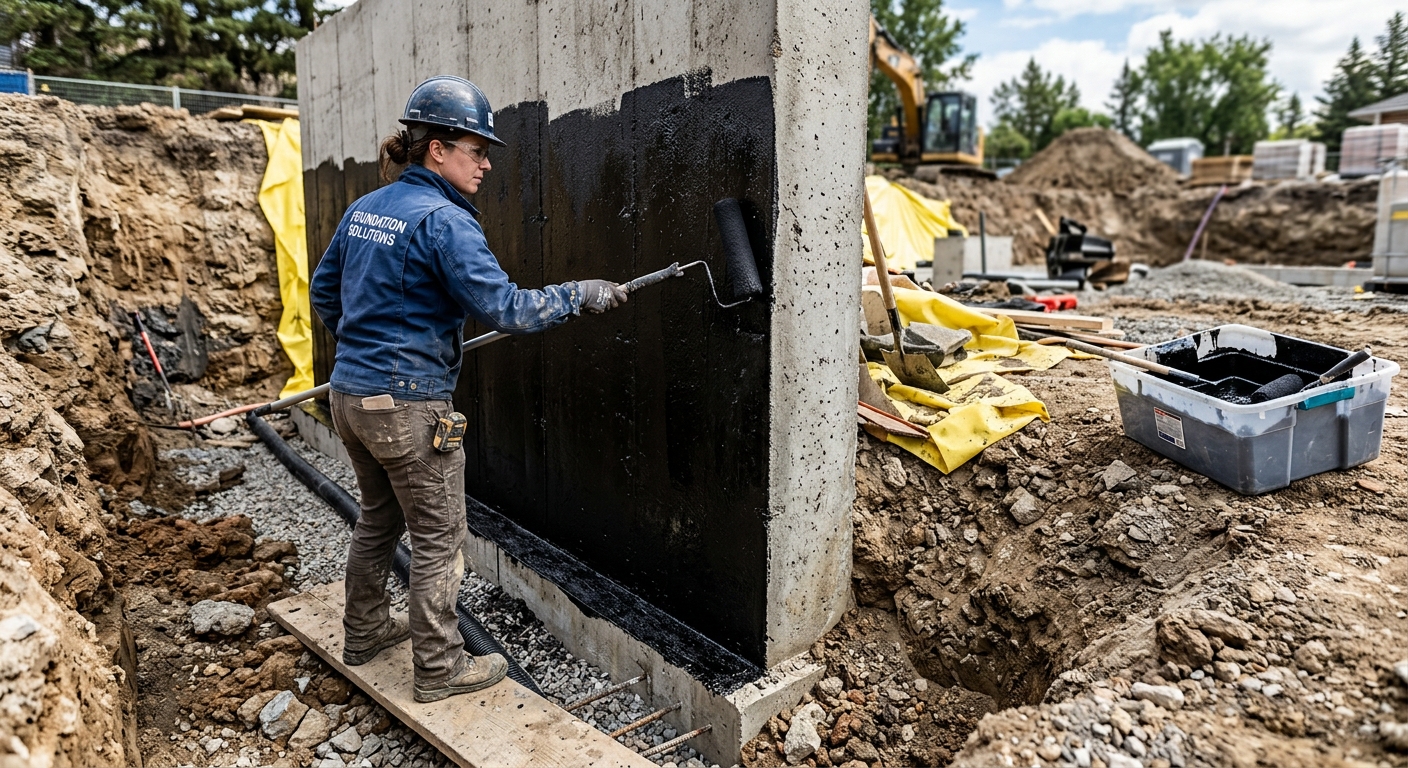
Basement waterproofing options and costs in County Park
County Park, Ontario sits in a part of the Toronto economic region where basements often struggle against both soil moisture and seasonal freeze–thaw. With a population of 3,367 (Statistics Canada, 2021 Census), we see a steady mix of older and mid-age homes, and that matters: foundations in the post-war and 1960–1980s housing stock are frequently tied to aged clay weeping tile, clogged drains, and concrete defects that become active leaks once winters start. In practice, waterproofing costs can be driven less by “how it looks today” and more by what water is doing behind the wall during saturation and freezing.
In Toronto-area neighbourhoods where clay pockets hold water, foundation walls can experience greater lateral pressure. That pushes water through cold joints, tie holes, and cracks—sometimes without obvious exterior wall failure. It’s also common for interior dampness, efflorescence, and basement flooding to be traced back to partially collapsed or clogged drainage systems rather than a single dramatic crack. Access constraints in tight lots and working below deck footings or around additions can add labour time for excavation, while blocked or failing drain lines can change how much restoration is required before sealing. Local contractors—especially in the older south-end and established infill pockets around the GTA—are in high demand for both exterior excavation and “right-size” interior retrofits.
Below is a practical comparison of the most common options and typical cost ranges in County Park, so you can line up your quote to the actual source of water entry.
| Method |
What It Addresses |
Disruption Level |
Durability |
Price Range |
| Exterior excavation + new membrane + drainage tile |
Hydrostatic pressure at the foundation and water entry through the exterior wall area |
High (excavation, landscaping reinstatement) |
Long-term when membrane and drainage are properly detailed |
$7,000 – $25,000 |
| Interior perimeter drain channel + sump pit |
Captures water after it enters; reduces seepage and basement puddling |
Medium (floor/finish disruption in basement perimeter) |
High for chronic seepage when sump is sized correctly |
$3,500 – $15,000 |
| Foundation crack injection (epoxy or polyurethane) |
Stops isolated crack leakage; reduces water paths through joints/voids |
Low to medium (chipping and surface prep) |
Good when crack type is matched to the product |
$600 – $3,000 |
| Sump pump installation (primary + battery backup) |
Reduces flooding risk during high-water periods; protects during power interruptions |
Low to medium (pit cutting and discharge routing) |
Good when paired with backup and proper discharge |
$800 – $3,500 |
| Window well drain installation |
Stops localized water pooling and seepage at egress areas |
Low to medium (excavation and grading around wells) |
Moderate to high when drainage connects to proper discharge |
$1,000 – $4,500 |
| Lot re-grading / downspout extension |
Improves surface water control so less water reaches the foundation |
Low (minor yard work; interior impact minimal) |
Moderate (depends on how well slopes and dispersal are maintained) |
$900 – $6,000 |
Prices are estimates only and vary by project scope, site access and material selection.
What affects the price of waterproofing in County Park
In County Park and across the Toronto area, you can see the same “waterproof the basement” request quoted 30–50% differently, even when it sounds identical on the phone. The spread usually comes down to whether the contractor identifies the real water path (exterior water entry vs interior hydrostatic seepage), how much excavation access is needed, and how complete the drainage system will be. In waterproofing, half-measures can look cheaper at first but cost more after the next freeze–thaw cycle turns hairline issues into active leaks.
Three local drivers separate Toronto-area costs from a national average: soil type, water table, and freeze–thaw. Mixed glacial till and clay pockets can expand during freeze–thaw and exert lateral pressure on foundation walls, worsening cracks over time. High water tables in many areas raise sump run times and drainage requirements, which can push jobs from basic interior drainage into interior systems that include backups, deeper pits, and better discharge routing. In a region with older housing stock, failing weeping tile (often clay) and age-related concrete/block deterioration are frequent triggers for dampness—so contractors may need both crack treatment and drainage improvements to actually stop the moisture.
Concrete examples that commonly raise cost in County Park: (1) a basement with efflorescence and a floor drain that turns into a “wet perimeter” often needs interior drain channel plus a sump, moving a project toward the $3,500 – $15,000 band; (2) an exterior project with deck footings, mature landscaping, or a tight driveway can push excavation toward the higher end of the $7,000 – $25,000 exterior range due to hand-digging and restoration. When you instead have isolated, well-identified leakage and a stable crack pattern, a targeted injection may keep costs closer to the $600 – $3,000 foundation-crack repair band.
| Price Factor |
Why It Matters |
Cost Impact |
| Interior vs. exterior approach — interior is less disruptive but addresses symptoms |
Exterior reduces water entry at the source; interior manages water after entry |
Interior often costs less up front; exterior can be higher but more complete |
| Foundation type — poured concrete vs. block vs. stone vs. ICF |
Different wall materials handle moisture differently and require different detailing |
Block and older poured concrete may need more crack and joint strategy |
| Soil type — clay expands more than sand, adding pressure |
Clay saturation during freeze–thaw increases lateral pressure and leak pathways |
Can increase need for membrane + drainage or larger interior sump capacity |
| Crack type and length — hairline vs. structural horizontal cracks |
Correct product choice prevents failure; structural movement can require engineering |
Horizontal/structural cracks can add assessment and possible underpinning costs |
| Sump pump backup system — battery or water-powered backup needed |
Power outages and high-water periods often coincide during spring cycles |
Backup adds cost but meaningfully reduces flood risk |
| Access — landscaping, decks, or driveways must be removed for exterior |
Hand-digging, shoring considerations, and restoration drive labour time |
Access constraints can push exterior excavation toward the upper band |
| Weeping tile age — original tile (60+ years) may be completely failed |
Old drains are often clogged/collapsed and don’t reliably shed water |
May require full replacement rather than “tie-in” only |
| Mould or efflorescence remediation required before sealing |
Sealers need clean, stable surfaces; moisture damage may require controlled drying |
Adds remediation time and sometimes increases interior workscope |
Permits & regulations in Ontario
In Ontario, foundation excavation, structural crack repair, and changes to lot drainage typically require a building permit. For example, if a project involves digging near footings, altering how water is directed around the property, or performing work that could affect structural integrity, you should expect permit requirements. If a sump pump discharge is connected to the storm or sanitary sewer system, municipal approval is commonly required. Always confirm the exact discharge route in your area—contractors familiar with Toronto-region rules will spell this out in the pre-job paperwork.
For structural crack repair—especially horizontal cracks in block walls, major step cracking, or any sign the wall may have shifted—an assessment by a structural engineer is often required to determine whether underpinning, wall reinforcement, or other structural work is necessary. Ask your contractor whether they provide engineering support (or coordinate it) for structural repairs, and ensure the scope clearly states who is responsible for drawings/letters if needed.
To verify contractor credentials in County Park, start by checking an Ontario licence/registration status through the appropriate provincial registry for the work category the contractor performs. Next, request a certificate of insurance and confirm it includes liability coverage for the job site. Finally, verify WSIB/WCB coverage (or the contractor’s exemption status if applicable) before work begins; many reputable firms can provide a clearance letter or proof instantly. If any of this is difficult to obtain or “we’ll send it later,” treat that as a warning sign and move on.
Interior vs exterior waterproofing — what does County Park need?
The fundamental difference is what you’re trying to stop. Exterior waterproofing—full excavation, membrane, new drainage tile, and backfill—addresses water entry at the source. That means it can significantly reduce hydrostatic pressure against the wall, which is important in Toronto-area conditions where glacial till and dense clay retain water and expand during freeze–thaw. The trade-off is disruption: excavation is more expensive and can require landscaping removal and careful reinstatement.
Interior waterproofing manages water after it enters. It typically includes a perimeter drain channel, sump pit, and sump pump (often with a battery backup for spring surges and occasional power interruptions). This approach is less invasive, which helps when exterior access is tight. However, interior systems don’t eliminate the lateral pressure on the wall itself, so they’re best when water is entering through manageable pathways (cracks, joint seepage, or failing weeping tile that can’t be accessed) rather than when the exterior waterproofing is broadly failing.
In County Park’s typical climate and market, pour-in-place concrete walls often respond well to targeted crack injection plus interior drainage, because cracks can be isolated and stabilized. Block foundations frequently benefit from interior drainage as a practical complement, since moisture can wick through masonry and mortar joints even when the wall looks otherwise intact. If you’re weighing cost, a realistic example is: if an exterior project lands near $7,000 – $25,000 because of excavation and drainage tile replacement, but your inspection shows isolated seepage best solved with interior perimeter drainage and a correctly sized sump, you may be able to target the $3,500 – $15,000 band instead. The “cheaper” option is only justified when the water source is confirmed—not just guessed.
| Method |
Best For |
Addresses Source? |
Disruption |
Lifespan |
Price Band |
| Full exterior excavation + membrane |
Chronic seepage with high lateral pressure and failing exterior drainage |
Yes |
High (yard/landscape disruption) |
Long (when detailed and drained correctly) |
$7,000 – $25,000 |
| Interior French drain + sump system |
Water intrusion you need to capture; tight access where excavation isn’t feasible |
No (it manages entry) |
Medium (basement perimeter works) |
Long with proper pump sizing and discharge |
$3,500 – $15,000 |
| Crack injection — epoxy (structural) |
Stable cracks with no active movement; concrete where crack width is consistent |
Partially (stops the leak path, not exterior hydrostatic pressure) |
Low to medium |
Good for the right crack type |
$600 – $3,000 |
| Crack injection — polyurethane (active leak) |
Cracks with active seepage and variable moisture pressure |
Partially (stops water path and helps reduce weeping) |
Low to medium |
Good for active leaks when properly prepped |
$600 – $3,000 |
| Interior drain channel only (no sump) |
Mild seepage where gravity drainage and discharge are adequate |
No |
Medium (floor/perimeter disruption) |
Moderate (depends on discharge reliability) |
$2,000 – $8,000 |
| Re-grading + downspout extensions |
Surface-water problems; gutters and downspouts dumping near foundation |
No (reduces supply of water) |
Low |
Moderate (slope maintenance matters) |
$900 – $6,000 |
How to choose a waterproofing contractor in County Park
Start by verifying Ontario licensing and core coverage. For waterproofing in County Park, you should ask every contractor for (1) their Ontario licence/registration details for the type of work they perform, (2) certificate of liability insurance naming you as an additional insured if required, and (3) WSIB/WCB coverage proof (or exemption documentation). How to check: confirm the licence status online, review the insurance dates and coverage limits on the certificate, and match the WSIB/WCB proof to the company performing the work—not a subcontractor “we might use.”
Next, get 2–3 itemised written quotes. You want labour and materials broken out separately (membrane type, drainage components, pump model, disposal/restoration, and any concrete cutting). Watch for exclusions: is permit work included, is debris disposal included, and what happens if soils are wetter than expected? A legitimate quote will also specify the inspection findings it’s based on (crack locations, whether the weeping tile is failing, signs of efflorescence, and where discharge will go).
Warranty is another key decision point. Ask for the workmanship warranty length and the product/manufacturer warranty details, and confirm whether warranties are transferable if you sell. For payment, never agree to more than 10–15% upfront; hold back until key milestones are complete and verified. Finally, require a written timeline with a start date and completion estimate, including when crews will return for landscaping restoration—so you aren’t stuck waiting through multiple wet cycles.
- Request licence/registration number and verify it online before scheduling.
- Ask for certificate of insurance and confirm coverage date ranges and job-site applicability.
- Verify WSIB/WCB clearance (or exemption) in writing before the first day on site.
- Insist on 2–3 itemised quotes (labour vs materials vs disposal vs restoration).
- Confirm whether a permit is included or excluded, and who pulls it.
- Ask where discharge will go for sump drains (and whether it needs municipal approval).
- Check whether pump backup (battery or water-powered) is included if you’re in a high-water area.
- Require product specs: membrane system, drainage board, piping diameter, and fittings.
- Get the crack injection plan matched to crack type (epoxy vs polyurethane) with quantities.
- Ask how mould/efflorescence is remediated before sealing or finishing.
- Clarify the warranty: workmanship duration, product warranty, and transferability.
- Use a payment schedule with a holdback until tests/cleanup are complete.
Red flags in County Park: quotes that don’t explain the water path (source vs symptom), vague scopes like “seal and waterproof” without crack mapping or drainage details, refusal to provide proof of WSIB/WCB or insurance, payment demands that exceed 10–15% upfront, and warranties that cover materials only (no workmanship) or won’t be provided in writing.
Frequently asked questions — waterproofing in County Park
Do I need a permit for foundation work in Ontario?
In Ontario, permit requirements commonly apply when you excavate around the foundation, repair structural cracks, or make changes that affect lot drainage. If the work could impact structural integrity or involve significant alteration near footings, expect a building permit. For sump pump installations, whether a permit or municipal approval is needed often depends on where discharge goes—connecting discharge to storm or sanitary systems typically requires municipal approval. For County Park homeowners, the simplest verification step is to ask the contractor to state in writing: (1) whether they will pull the permit, (2) what inspections are expected, and (3) who is responsible if the discharge location requires additional approvals. Also confirm the contractor has liability insurance and WSIB/WCB coverage before any excavation begins.
How long does waterproofing last?
Basement waterproofing longevity in Ontario depends on whether the approach matches the water source and whether it’s detailed for freeze–thaw. Exterior excavation with a proper membrane system and new drainage tile is typically the most durable route because it reduces water entry at the foundation interface. Interior systems can be very effective for chronic seepage, but they manage water after it enters; they rely on sump pump performance, discharge reliability, and maintenance. Crack injection can last a long time when the crack is stable and the correct product is used (epoxy for stable cracks, polyurethane for active seepage). In County Park, homeowners often notice problems reappearing when failing weeping tile is left in place while only sealing visible areas. As a reference point, if your waterproofing scope is in the $7,000 – $25,000 exterior range with drainage replacement, durability tends to be strongest.
Can I waterproof my basement from the inside only?
Yes—interior waterproofing can work well in County Park when exterior excavation isn’t practical or when inspections show the main issue is chronic seepage being fed by an already-failed drainage system. Typical interior solutions include a perimeter drain channel, sump pit, and sump pump; adding battery backup can be important during spring wet periods and power interruptions. Interior work is also appropriate for localized leakage addressed by crack injection. However, interior approaches don’t stop hydrostatic pressure against the wall itself, so if your exterior waterproofing is broadly failing or if lateral water pressure is high due to clay saturation and freeze–thaw, an interior-only plan may delay the inevitable. That’s why you should insist on a scope based on inspection findings, not a guess. For many basements, interior solutions fall in the $3,500 – $15,000 band depending on how extensive the drainage and remediation are.
What causes foundation cracks in County Park?
In County Park and the Toronto region, common causes of foundation cracks include freeze–thaw expansion, saturated clay pressure, and normal building movement over time. When dense clay pockets hold water, they can expand during winter and increase lateral pressure against foundation walls, turning small defects into active leaks over a few cycles. Another frequent contributor is failing drainage: when original clay weeping tile or early plastic drains become clogged or partially collapsed, water concentrates near the foundation and worsens seepage. Poor surface water control—like downspouts directing runoff toward the foundation—can add to the problem. Finally, concrete and block walls experience stress around tie holes and cold joints, especially when water entry is recurring. If you have horizontal cracks or step cracking that appears structural, a structural engineer assessment is often needed before simply injecting or sealing.
How do I compare waterproofing quotes?
To compare quotes in County Park fairly, ensure each bid addresses the same water entry scenario and includes the same deliverables. Look for itemised labour and materials: membrane system and drainage components for exterior jobs, drain channel and sump specifications for interior jobs, and clear details for crack injection (product type, crack mapping, number of ports/linear feet). Ask whether disposal and restoration are included, and whether permits are included or excluded. Confirm who is responsible for municipal approval if the sump discharge route requires it. Price differences can be significant because access constraints in tight urban lots often increase labour, and because failing weeping tile age changes the scope. As a practical benchmark, exterior excavation is often in the $7,000 – $25,000 band, while interior waterproofing/weeping tile-style work commonly sits in the $3,500 – $15,000 band—so a quote that’s far outside those ranges without a clear reason deserves extra scrutiny.
How long does basement waterproofing take in County Park?
Timeline depends on whether you’re doing interior-only work, crack injection, or full exterior excavation. Interior drainage and sump installations can often be completed in a matter of several days to about a week, depending on basement size, accessibility, and whether floor/finish removal is extensive. Crack injection for isolated leaks is typically shorter—often a couple of days including prep and curing—though drying and surface readiness can affect scheduling. Full exterior excavation is the longest because of excavation time, membrane and drainage installation, and required backfill/compaction plus landscaping reinstatement. Weather matters in Toronto-area freeze–thaw seasons; crews also plan around soil moisture so the drainage system performs as intended. Before signing, ask for a written start date, a completion estimate, and when restoration will be done—so disruptions don’t stretch into multiple wet cycles.