Basement waterproofing options and costs in Toronto
Toronto homeowners typically face waterproofing sooner than many expect because the city sits across mixed glacial till and pockets of dense clay that hold water against foundations. With 58.1% of homes in Toronto built before 1981, many basements still rely on older waterproofing approaches and earlier drainage configurations that have aged out. On top of that, freeze–thaw cycles in Southern Ontario widen small concrete and block defects, turning hairline cracks into active leak paths after a few winters.
Local soil and water conditions also shape labour and access costs. In neighbourhoods like the older stock areas around Rosedale and parts of Old East York, contractors often deal with crowded lots, additions that limit excavation space, and drainage weeping tile that’s partially collapsed or clogged—so the “same” leak can take very different amounts of labour to correct. The availability of skilled excavation crews and the need for matching solutions to local water pressure (especially lateral pressure from saturated clay) can widen price ranges quickly.
Below is a practical comparison of common options—what each method addresses, how disruptive it usually is, and the typical Toronto price bands—so you can match the scope to your basement symptoms before you get quotes.
| Method |
What It Addresses |
Disruption Level |
Durability |
Price Range |
| Exterior excavation + new membrane + drainage tile |
Stops water at the source by replacing failing waterproofing and providing new perimeter drainage away from the foundation |
High (excavation, landscape removal/restoration, potential footing exposure) |
High (when properly detailed with membrane, weeping tile, and backfill compaction) |
$7,000 – $25,000 |
| Interior perimeter drain channel + sump pit |
Collects seepage after it enters and manages hydrostatic pressure via an interior drainage system |
Medium (floor cutting, limited wall access, mechanical work for sump) |
Medium-to-High (depends on sealing strategy and sump reliability) |
$3,500 – $15,000 |
| Foundation crack injection (epoxy or polyurethane) |
Seals isolated cracks; epoxy suits stable cracks, polyurethane handles active leaks and pressure |
Low-to-Medium (minor drilling/patching; less impact than excavation) |
Medium-to-High (best when the crack is correctly identified) |
$600 – $3,000 |
| Sump pump installation (primary + battery backup) |
Prevents water from collecting at the bottom and reduces seepage-related dampness risks |
Low-to-Medium (in-floor work for pit; electrical considerations) |
High when paired with proper drainage and backup |
$800 – $3,500 |
| Window well drain installation |
Routes water away from basement window wells to reduce pooling, seepage, and dampness at window penetrations |
Low-to-Medium (excavation at window wells and minor landscaping) |
Medium (effective when weeping paths are properly connected to drainage) |
$1,000 – $4,500 |
| Lot re-grading / downspout extension |
Reduces water loading around the foundation by improving surface runoff and directing downspouts away |
Low (typically does not require demolition of floors or walls) |
Low-to-Medium (often best as a complement, not a standalone fix) |
$1,200 – $6,000 |
Prices are estimates only and vary by project scope, site access and material selection.
What affects the price of waterproofing in Toronto
In Toronto, you can see the same basement leak quoted 30–50% differently across contractors because waterproofing is a site-specific “system” job, not a single product swap. Even within the Toronto economic region, crews face different conditions that change labour time: excavation access, the condition of existing drainage, how far water is travelling, and whether the work must address active hydrostatic pressure or only a stable seep.
The three biggest cost drivers that separate Toronto pricing from a national baseline are soil type, water table behaviour, and freeze–thaw. Clay-heavy soils—common in many Ontario neighbourhoods—hold water and expand when saturated, increasing lateral pressure on foundation walls. Freeze–thaw then enlarges small defects in concrete and block foundations, especially at cold joints, tie holes, and cracks. When water loading is high, a sump system may run frequently; that can add cost for upgraded pumps and backup, rather than a basic pump. In addition, older housing stock increases the chance of failing original drainage: in homes built before 1981, older weeping tile is often partially blocked or collapsed, leading to interior dampness and efflorescence rather than dramatic exterior wall failure.
Concrete examples from Toronto jobs: (1) homes with narrow side yards or deck/driveway constraints often require careful hand-digging for exterior work, pushing exterior excavation toward the upper part of the $7,000–$25,000 band; (2) basements with widespread dampness after heavy spring rains can require interior drainage plus sump backup, moving from the lower end of $3,500–$15,000 toward mid-range solutions; and (3) isolated, stable vertical cracks may be addressed more economically using targeted crack injection closer to the $600–$3,000 range—if the crack type matches the product.
| Price Factor |
Why It Matters |
Cost Impact |
| Interior vs. exterior approach — interior is less disruptive but addresses symptoms |
Exterior targets water entry; interior manages water after it reaches the basement floor |
Interior often saves on excavation and landscaping, typically lowering cost versus exterior by thousands |
| Foundation type — poured concrete vs. block vs. stone vs. ICF |
Different materials crack and leak differently; repair methods and detailing vary |
Block and older stone often require more drainage and crack evaluation, raising labour and materials |
| Soil type — clay expands more than sand, adding pressure |
Saturated clay increases lateral hydrostatic pressure and worsens crack activity |
Higher risk = stronger sealing systems and better drainage, increasing scope |
| Crack type and length — hairline vs. structural horizontal cracks |
Active or structural movement changes whether injection will succeed long-term |
Structural cracks can trigger engineering/underpinning, significantly increasing cost |
| Sump pump backup system — battery or water-powered backup needed |
Power interruptions during spring heavy rain can cause rapid water accumulation |
Backup increases material/electrical scope; often adds a meaningful but worthwhile cost |
| Access — landscaping, decks, or driveways must be removed for exterior |
More demolition and restoration equals higher labour and disposal/restoration charges |
Can swing exterior pricing materially upward depending on site constraints |
| Weeping tile age — original tile (60+ years) may be completely failed |
Old drains clog or collapse; the new system must perform reliably |
Often increases drainage replacement time and excavation depth/length |
| Mould or efflorescence remediation required before sealing |
Wet dust/efflorescence can prevent proper adhesion and may require cleaning and drying |
Adds remediation labour and drying time before final waterproofing steps |
Permits & regulations in Ontario
In Ontario, many basement waterproofing scopes trigger permit or municipal approval depending on what you’re changing and how it affects drainage and structure. In Toronto, foundation excavation and any work that alters drainage at the foundation line typically requires a permit, especially when digging near footings or making changes that affect how water moves around the property. Structural crack repair is another trigger: if you have major horizontal cracks in block walls or step cracks that suggest movement, contractors often need a structural engineer’s assessment first, and the subsequent structural work may require a permit.
Where permits are commonly required: excavation that exposes the foundation perimeter, structural crack remediation where engineering is involved, and modifications related to lot drainage that change runoff patterns. Where approvals are commonly required: sump pump installations that connect to municipal sewer systems (storm or sanitary) or any connection approach that involves routing discharge to public infrastructure. If the scope only involves sealing cracks, adding interior perimeter drainage, or installing a sump with discharge handled privately (e.g., via an approved discharge location), permit needs can be different—your contractor should confirm the exact approach.
To verify a Toronto contractor properly: (1) ask for their Ontario licence details, (2) request a current certificate of liability insurance, (3) ask for WSIB/WCB clearance and/or clearance letter (for workers), and (4) for structural repair scopes, confirm they have engineering support or access to engineering assessments. Any reputable contractor should provide these documents before work starts.
Interior vs exterior waterproofing — what does Toronto need?
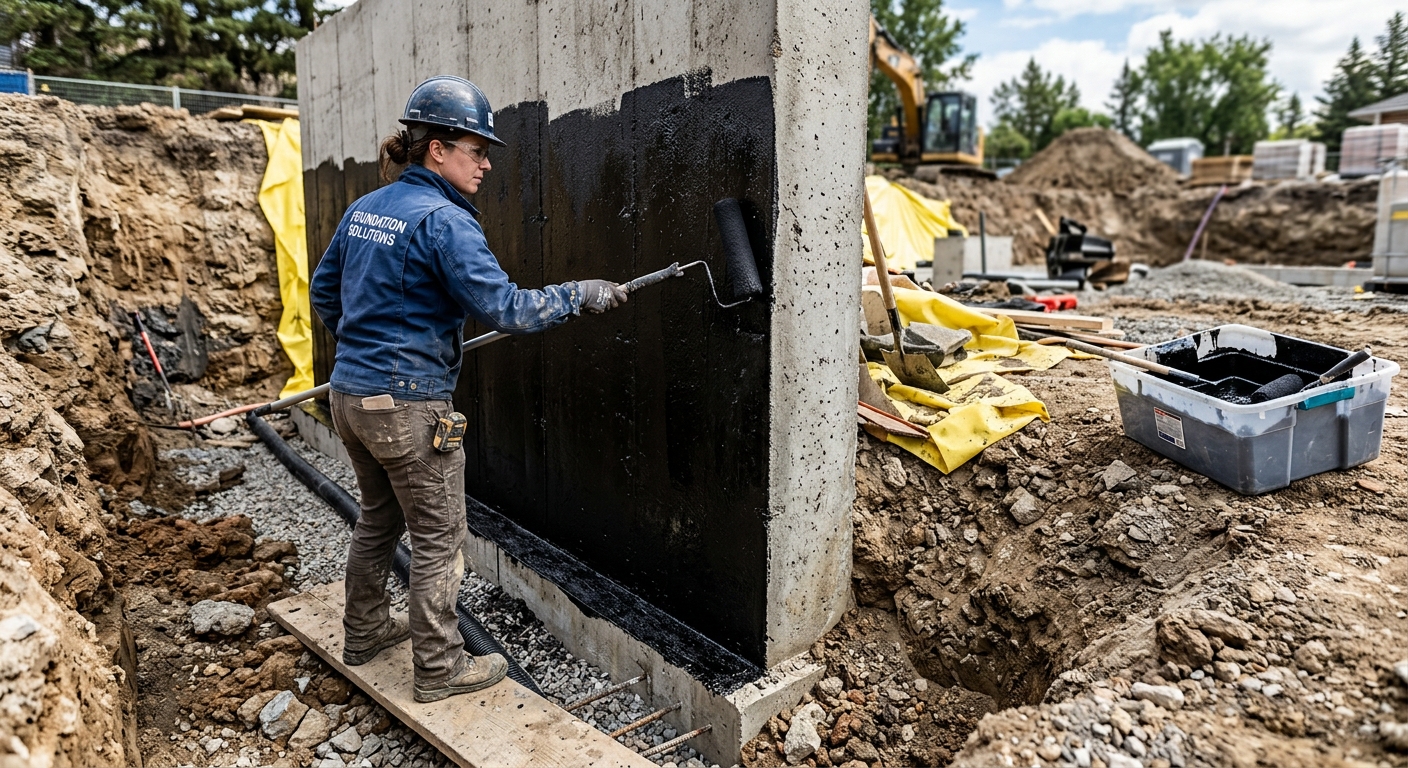
Exterior waterproofing and interior waterproofing are different in both purpose and long-term performance. Exterior waterproofing usually means full excavation along the foundation, followed by new membranes, new drainage tile, and proper backfill and grading. Done correctly, this addresses the source of water entry by reducing water pressure at the wall. The trade-off is higher cost and more landscape disruption, which matters in Toronto where access can be tight and disposal/restoration is often required.
Interior waterproofing typically includes a perimeter drain channel and/or sump pit and sump pump. This approach manages water after it enters and reduces the amount of water that accumulates on the basement floor. It is less invasive and often less expensive up front, but it does not stop hydrostatic pressure against the foundation wall itself. That’s why local installers focus on identifying whether leaks are coming through a few crack paths (where targeted crack injection may help) or from widespread moisture conditions driven by saturated clay and failing exterior drainage.
Toronto’s mix of older foundations means exterior solutions are common when original weeping tile has failed or when water is actively pushing laterally through cold joints. Poured concrete walls often respond well to crack injection when cracks are stable, while block foundations frequently benefit from interior drainage as a practical complement because water can track through mortar and multiple micro-voids. Given Ontario’s spring flooding patterns and the risk of short power outages, homeowners choosing a sump system should ask about primary pumps paired with battery backup—especially if you’ve had water intrusion during heavy rain periods.
As a cost example, a full exterior excavation project may land in the $7,000–$25,000 range, while interior perimeter drainage and a sump system often fits $3,500–$15,000. If your leak is widespread after rain because the original drainage is clogged, the extra cost of exterior work can be justified; if you have one or two isolated seep points, interior drainage and targeted sealing may be the smarter value.
| Method |
Best For |
Addresses Source? |
Disruption |
Lifespan |
Price Band |
| Full exterior excavation + membrane |
Ongoing seepage where exterior drainage and waterproofing have failed; high lateral pressure from saturated clay |
Yes (targets water entry) |
High (excavation and landscaping restoration) |
Long (when detailed and backfilled properly) |
$7,000 – $25,000 |
| Interior French drain + sump system |
Chronic dampness, interior-only solutions when exterior access is constrained |
No (manages water after entry) |
Medium (floor work and sump pit) |
High (if pump and discharge are reliable) |
$3,500 – $15,000 |
| Crack injection — epoxy (structural) |
Stable, non-moving cracks in poured concrete where water entry is limited to predictable crack paths |
Partial (seals a specific path) |
Low-to-Medium (drilling and patching) |
Medium-to-Long (for stable cracks) |
$600 – $3,000 |
| Crack injection — polyurethane (active leak) |
Active leaks under pressure, including some block/concrete crack situations where water is still moving |
Partial (seals the active path) |
Low-to-Medium (drilling and targeted injection) |
Medium-to-High (when crack type is correctly matched) |
$600 – $3,000 |
| Interior drain channel only (no sump) |
Light to moderate seepage where water can be managed without pumping (site and grading-dependent) |
No (still internal management) |
Medium (floor cutting; less mechanical work) |
Medium (depends on ability to drain) |
$1,800 – $7,500 |
| Re-grading + downspout extensions |
Surface water problems, ponding near foundation, early-stage dampness that tracks with rainfall |
Indirect (reduces water loading) |
Low (no heavy demolition) |
Low-to-Medium (works best as part of a system) |
$1,200 – $6,000 |
How to choose a waterproofing contractor in Toronto
Choosing the right waterproofing contractor in Toronto comes down to verification, transparency, and scoping discipline. Start by confirming Ontario licensing details (ask for the number and proof), then request a certificate of liability insurance—this should list the correct legal entity and be current for the project dates. Next, verify WSIB/WCB coverage: ask for a clearance letter or equivalent documentation for the period the workers will be on site. If a contractor won’t provide these, it’s a major operational and risk red flag.
Get 2–3 itemised written quotes rather than lump sums. You want labour and materials broken down so you can compare like-for-like scopes: excavation depth, membrane type, drainage tile specification, pipe routing/discharge method, and disposal/restoration allowances. Ask whether a permit pull is included (and for which parts of the job), and whether excavation restoration is included (topsoil, sod, or landscaping reinstatement). Also request both a workmanship warranty (length and what triggers service) and the product/manufacturer warranty. Confirm if warranties are transferable if you sell the home.
Payment terms should be conservative. Never pay more than 10–15% upfront for materials/planning, and hold back a portion until the job is complete and waterproofing details are finished. Finally, insist on a start date and completion estimate in writing, including time for drying and cure periods where membranes or crack injection requires proper curing.
- Provide Ontario licence details in writing and match the company name on the insurance documents.
- Show WSIB/WCB clearance letter before any work begins.
- Include certificate of liability insurance with project-specific effective dates.
- Quote must specify exact waterproofing materials (membrane system, drainage tile, pipe size, geotextile).
- Scope should state what’s excluded (e.g., underpinning, structural engineering, mould remediation, landscaping reinstatement).
- Confirm whether disposal is included for excavated soil and debris.
- Clarify sump pump discharge location and whether it needs municipal approval.
- Ask how they confirm crack type (epoxy vs polyurethane decision process).
- Include pump specs (primary + backup type, float switch approach, alarms if offered).
- Require a clear warranty document with workmanship terms and response timelines.
- Payment schedule: 10–15% maximum upfront, holdback until close-out and cleanup.
- Project schedule: drying/cure time, inspection checkpoints, and expected reinstatement date.
In Toronto, common red flags include: contractors who can’t explain why they’re choosing interior vs exterior (or epoxy vs polyurethane), quotes that omit disposal and landscaping/restoration details, promises of “guaranteed waterproofing” without a scope that addresses water pressure and drainage, vague warranty terms, and refusing to provide insurance/WSIB clearance documentation.
Frequently asked questions — waterproofing in Toronto
How much does basement waterproofing cost in Toronto?
Toronto pricing typically depends on whether you stop water at the source (exterior) or manage it after it enters (interior). For exterior excavation with a new membrane and drainage tile, homeowners often budget about $7,000 – $25,000 depending on access and how much of the perimeter must be opened. For interior perimeter drainage plus a sump system, many projects fall within $3,500 – $15,000. If the leak is limited to specific cracks, targeted crack injection may be closer to $600 – $3,000, but only when the crack type is correctly identified. With Toronto’s freeze–thaw cycles and older housing stock (58.1% pre-1981), failed drainage and active crack movement are common, which can push scopes toward the upper end.
Interior vs exterior waterproofing — which is better?
“Better” depends on how your leak behaves. Exterior waterproofing is best when the perimeter drainage/waterproofing is failing and saturated clay is applying lateral pressure—this is when fully addressing the source has the most long-term payoff. Interior waterproofing is often the right choice when excavation access is limited, when leaks are widespread and best managed by collecting seepage, or when you need a less disruptive option first. In Toronto, exterior work can be $7,000 – $25,000, while interior perimeter drainage and sump solutions often fall in $3,500 – $15,000. If you’ve got active seep through cracks and you’re choosing injection, the injection material matters: stable cracks may suit epoxy, while active leaks often need polyurethane.
Why is my basement leaking in Toronto?
Basement leaks in Toronto usually come from water loading around the foundation, then finding pathways through cracks, tie holes, cold joints, or window well areas. Mixed glacial till and dense clay can hold water against foundation walls, and freeze–thaw cycles can widen small defects over time. If your home is older—remember, 58.1% of Toronto homes were built before 1981—original drainage may be partially collapsed or clogged, so water can show up as dampness, efflorescence, or flooding even if the exterior wall doesn’t look obviously failed. Sometimes the cause is surface water: downspouts that discharge too close to the foundation, or grading that directs rain toward the basement. A good contractor will map seepage locations first, then match the solution to the water path.
How do I know if a foundation crack is serious?
Not every crack is structural, but certain patterns should be assessed. In Toronto basements, small hairline cracks can be cosmetic or related to shrinkage, especially if they don’t change season to season and there’s no active seepage. Cracks are more concerning when they are horizontal, show noticeable step movement in block walls, widen over time, or are associated with water staining, dampness, or efflorescence. Active leaking cracks may also indicate hydrostatic pressure forcing water through the fracture path. A contractor should inspect crack length, direction (vertical vs horizontal/step), and whether water is actively present. If there are signs of movement or structural concern, a structural engineer’s assessment is often required before structural crack repair or any underpinning planning.
How much does foundation crack repair cost in Toronto?
Foundation crack repair in Toronto is commonly priced by crack path and the repair approach. For typical crack injection in concrete or block, many homeowners budget about $600 – $3,000, depending on the number of ports, length of the crack, access conditions, and whether surface preparation and patching are included. The biggest variable is whether the crack is stable or active: epoxy injection is often used where the crack is not moving, while polyurethane may be selected for active leaks under pressure. If the crack is part of a broader issue (widespread seepage, failing weeping tile, or signs of structural movement), injection alone may not be sufficient, and you may need interior drainage or additional scope.
Do I need a sump pump in Toronto?
You may need a sump pump if you experience recurring seepage, groundwater accumulation, or frequent wetting during spring rain and snowmelt. In Toronto, the freeze–thaw cycle and the way clay soils hold water can increase hydrostatic pressure, making passive drainage insufficient in many basements. A sump system typically pairs well with interior perimeter drains, and many homeowners choose backup because power interruptions can happen during heavy weather and spring flood events. Sump installations (including a primary pump with backup options) often fall in the $800 – $3,500 band, depending on pump selection and whether battery backup is included. If the leak is from one isolated crack, injection plus targeted drainage may sometimes reduce the need for a sump—your contractor should evaluate where the water is entering and how it collects.