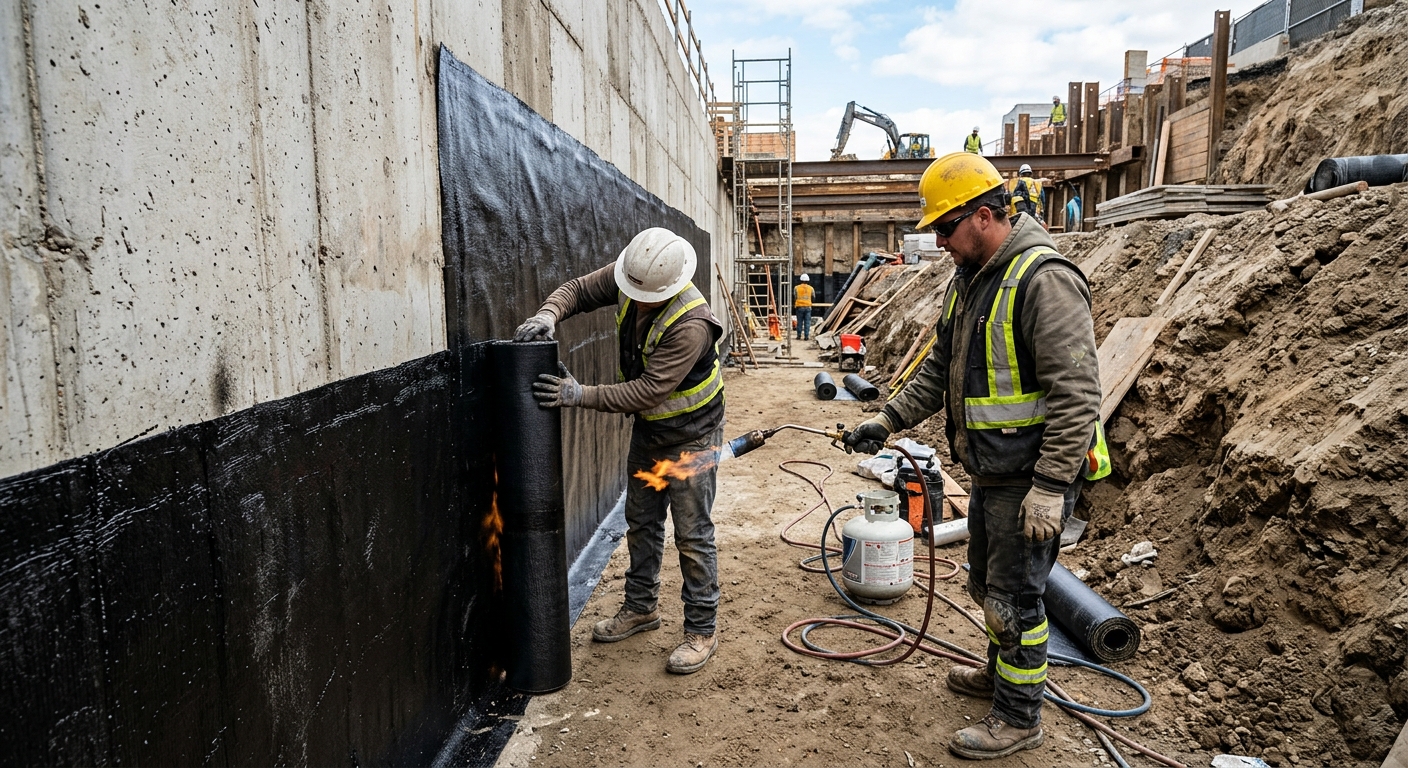
Basement waterproofing options and costs in Etobicoke West Mall
In Etobicoke West Mall, homeowners typically see basement seepage long before there’s obvious wall failure. That’s because many houses here are post-war or built during the 1960–1980s era, when original tar-and-paper systems, early plastic drainage, and older weeping-tile runs are now well past their intended service life. In practice, this means the basement problem is often “water management” rather than a single broken pipe. With Toronto’s mixed glacial till and clay pockets, saturated soil can expand and push laterally on foundation walls, increasing the chance of seepage through cold joints, tie holes, and cracks after freeze–thaw.
Cost and contractor availability are also shaped by Toronto lot conditions. Tight urban access around additions, shared driveways, and decks forces more hand excavation and careful protection of landscaping. In neighbourhoods with higher foot traffic and denser lots—often the same areas where basements are finished and valued—contractors are especially in demand for interior systems that avoid major disruption, while still dealing with ongoing water pressure. (In Etobicoke West Mall, the local population is 11,848 per the 2021 Census, Statistics Canada.) That customer demand helps explain why some pricing is competitive for interior drainage and sump work, while exterior excavation remains the most variable due to labour, staging, and disposal.
If you’re comparing options, start by deciding whether you need to address the source of water entry (exterior) or manage water after it enters (interior). The table below summarizes common approaches and realistic price ranges for this area, including exterior excavation at $7,000–$25,000 and interior systems often starting around $3,500.
| Method |
What It Addresses |
Disruption Level |
Durability |
Price Range |
| Exterior excavation + new membrane + drainage tile |
Primary source of hydrostatic pressure; replaces failed drainage and water barrier |
High (excavation, landscaping restoration, disposal) |
High (best “source control” when access allows) |
$7,000 – $25,000 |
| Interior perimeter drain channel + sump pit |
Collects seepage and relieves pressure at the foundation floor line |
Medium (limited demo of interior slab/wall edge) |
Medium to high (depends on wall crack/soil conditions) |
$3,500 – $15,000 |
| Foundation crack injection (epoxy or polyurethane) |
Stops isolated leaks; epoxy for stable cracks, polyurethane for active seepage |
Low to medium (small access holes; minimal demo) |
Medium (crack stability and surface prep matter) |
$600 – $3,000 |
| Sump pump installation (primary + battery backup) |
Moves water away reliably during heavy spring wetting and outages |
Low to medium (pit cutout; electrical work) |
High (especially with backup) |
$800 – $3,500 |
| Window well drain installation |
Prevents surface runoff/spring melt from saturating the foundation at egress wells |
Medium (excavation around wells) |
Medium to high (if grading and weep management are corrected) |
$1,200 – $5,000 |
| Lot re-grading / downspout extension |
Reduces water load near the foundation; improves bulk water shedding |
Low to medium (topsoil removal/placement) |
Medium (best as a supplement to failed drainage) |
$1,000 – $4,500 |
Prices are estimates only and vary by project scope, site access and material selection.
What affects the price of waterproofing in Etobicoke West Mall
In Etobicoke West Mall, you can see quotes for the “same” basement waterproofing job vary by 30–50% across Toronto and Ontario, mainly because contractors price the site conditions they actually discover—not the symptom you point to on day one. The three biggest regional cost drivers are soil type, water table, and freeze–thaw. Toronto sits on mixed glacial till and clay pockets; clay-rich ground expands when saturated, exerting lateral pressure on foundation walls and worsening cracks over winters. High local water conditions also translate into higher sump cycling and more robust drainage detailing when exterior weepers have failed.
Freeze–thaw matters because it turns minor defects into active leak paths. As trapped moisture expands, hairline cracks, cold joints, and tie holes can widen, and the crack becomes a repeated pathway rather than a one-time nuisance. In the same way, older housing stock in Toronto (including many 1960–1980s basements) often has original clay weeping tile or early drains that are partially collapsed or clogged. That shifts cost toward interior drainage and sometimes sump installation, instead of simple exterior sealing.
Two examples that commonly move the number up or down in Etobicoke West Mall: (1) If excavation can only happen in a narrow strip beside a deck, exterior excavation can require more hand-digging and careful bracing, pushing you toward the upper end of exterior waterproofing at $7,000–$25,000. (2) If the issue is limited to a few active seepage cracks and a short crack run, an injection-only approach may stay closer to the $600–$3,000 foundation crack band—especially when surface prep and crack selection are done correctly. Conversely, widespread wall seepage plus failing weeping tile typically increases the scope into interior drainage and sump work.
Because the work is priced by what’s under the surface (and how many access points you need), it’s smart to compare scope, not just totals—especially when homes are exposed to changing moisture conditions each spring.
| Price Factor |
Why It Matters |
Cost Impact |
| Interior vs. exterior approach — interior is less disruptive but addresses symptoms |
Exterior targets the source of hydrostatic pressure; interior primarily manages collected water |
Interior often costs less initially; exterior can be 2x+ due to excavation/disposal |
| Foundation type — poured concrete vs. block vs. stone vs. ICF |
Wall composition changes crack behaviour and the best sealing method |
Block and stone often require more drainage detailing; poured concrete may inject more cleanly |
| Soil type — clay expands more than sand, adding pressure |
Saturated clay increases lateral pressure and seepage frequency |
More robust drains/membranes and higher sump capacity can raise costs |
| Crack type and length — hairline vs. structural horizontal cracks |
Active or structural cracks need different products and sometimes engineering |
Structural/severe cracks can add engineering and potential structural work |
| Sump pump backup system — battery or water-powered backup needed |
Backups protect against power interruptions during spring wet cycles |
Typically adds meaningful cost, but reduces long-term risk |
| Access — landscaping, decks, or driveways must be removed for exterior |
More removal and restoration increases labour and schedule time |
Can move exterior projects toward the upper price band |
| Weeping tile age — original tile (60+ years) may be completely failed |
Old drainage systems may be collapsed/clogged and not recoverable |
Often converts a “repair” into replacement, increasing scope |
| Mould or efflorescence remediation required before sealing |
Moisture-related salts and growth must be treated for coatings to last |
Adds prep time and specific materials; reduces risk of reoccurrence |
Permits & regulations in Ontario
In Ontario, certain basement waterproofing and drainage-related activities are treated as permit-worthy work—especially when they alter structure, lot drainage, or tie into municipal services. As a practical rule for Etobicoke West Mall homeowners, foundation excavation, structural crack repairs (where cracks could affect load paths), and changes to lot drainage typically require a building permit. If the scope includes underpinning or any work that a building department considers structural, you should assume engineering may be required as well.
Sump pump installations can also trigger municipal approval depending on how the discharge is handled. If the system is connected to the storm or sanitary sewer, you generally need approval before any tying-in is done. Contractors who do this work regularly should be able to tell you whether a permit and inspections are required for your exact tie-in and discharge route.
For major structural crack repair—such as horizontal cracks in block walls or step cracks in ways that indicate movement—an assessment by a structural engineer is often required to determine whether underpinning or other structural measures are needed. When you interview contractors, confirm they have engineering support available for structural scopes, along with liability insurance and WSIB coverage (or the applicable equivalent coverage requirements for your contractor’s status).
To verify compliance step-by-step: (1) ask for the contractor’s Ontario business identification details, (2) request a current certificate of insurance and confirm it matches your job address, (3) ask for WSIB/WCB clearance information and check that coverage is active, (4) review the written scope to see exactly what permits are included (and which permits are your responsibility), and (5) confirm whether any discharge connection needs municipal sign-off. For structural work, insist on the engineer’s involvement being identified in writing before pricing finalization.
Interior vs exterior waterproofing — what does Etobicoke West Mall need?
The fundamental difference is simple: exterior waterproofing addresses the water before it reaches the foundation by excavating around the perimeter, installing new membranes, and replacing drainage tile so water is carried away before it builds pressure. Interior waterproofing manages water after it enters by using a perimeter drain channel and often a sump pit/pump. In Etobicoke West Mall’s Toronto-area clay-heavy soils and freeze–thaw conditions, exterior work can be the most permanent source-control solution, but it’s also the most disruptive because excavation and landscaping restoration are unavoidable.
Whether you should go interior or exterior depends on the practical reality of the site and what kind of foundation you have. Poured concrete walls often respond well to crack injection when the cracks are stable, but they can still leak under lateral pressure if drainage is failing. Block foundations are more porous and can leak through mortar joints; interior drainage is often a practical complement because it immediately collects seepage at the perimeter even when the wall itself is hard to “seal from the outside” due to access constraints.
Sump pump backup systems matter in Ontario. During spring wet periods, interruptions or reduced electrical service can turn “manageable seepage” into floor flooding. A backup (battery or water-powered) is a risk-control upgrade, particularly for finished basements common in the Toronto market.
Dollar-wise, exterior work is usually justified when you’re seeing chronic seepage from multiple sides, evidence of failed weeping tile, or ongoing hydrostatic pressure. If your issue is isolated—say a small number of active cracks—crack injection can be a more cost-effective start. For example, a crack injection scope may fit within the $600–$3,000 band, while an exterior excavation and membrane project is commonly in the $7,000–$25,000 range; you’d only jump to the higher exterior band if source control is truly needed.
| Method |
Best For |
Addresses Source? |
Disruption |
Lifespan |
Price Band |
| Full exterior excavation + membrane |
Chronic seepage, high water pressure, failing exterior drainage, accessible yards |
Yes |
High (excavation + landscaping restoration) |
Long (typically the most durable approach when done correctly) |
$7,000 – $25,000 |
| Interior French drain + sump system |
Basements with recurring dampness, blocked/collapsed weeping tile, limited exterior access |
No (manages water entry) |
Medium (interior demo and pit work) |
Medium to high (improves dramatically with proper pump sizing and backup) |
$3,500 – $15,000 |
| Crack injection — epoxy (structural) |
Stable cracks in poured concrete with no active seepage |
Partial (seals the crack pathway) |
Low (small access holes) |
Medium (works best when crack movement is not ongoing) |
$600 – $3,000 |
| Crack injection — polyurethane (active leak) |
Active seepage through cracks where water is currently finding a path |
Partial (stops the active leak path) |
Low to medium (access and surface prep) |
Medium to high (if water source is controlled and prep is correct) |
$600 – $3,000 |
| Interior drain channel only (no sump) |
Light seepage where gravity discharge is feasible and loads are low |
No (captures water after entry) |
Low to medium |
Medium (less reliable during power issues or heavy wet cycles) |
$3,000 – $8,000 |
| Re-grading + downspout extensions |
Surface water management problems and minor dampness |
Helps reduce source load |
Low to medium |
Medium (best as a supplement if subsurface drainage is failing) |
$1,000 – $4,500 |
How to choose a waterproofing contractor in Etobicoke West Mall
Choosing the right contractor in Etobicoke West Mall starts with documentation. In Ontario, confirm licensing where applicable, but more importantly for waterproofing work, verify liability insurance and WSIB/WCB clearance. Ask the contractor for a current certificate of insurance (and ensure the coverage dates are active and the policy is not expired) and request their WSIB/WCB clearance documentation. If they can’t provide it promptly or try to delay it until after you sign, that’s a red flag.
Next, get 2–3 itemised written quotes. Insist on a labour + materials breakdown rather than a single lump-sum number—this makes scope comparisons meaningful (e.g., how many linear feet of drain, what depth of excavation allowance, which pump model for sump work, and disposal/restoration inclusions). Read exclusions carefully: does the quote include permit pull (where required), site protection, removal and reinstatement of stairs/decking, and debris disposal? Make sure they define what happens if they uncover failed weeping tile that needs replacement instead of repair.
Warranty matters. Ask for both a workmanship warranty length and a product/manufacturer warranty, and clarify whether the warranty is transferable to future owners. Finally, payment schedules should protect you: never pay more than 10–15% upfront; use a holdback until completion and handover of documentation (as-builts, pump test notes, and warranty paperwork). A good contractor will also give a written start date and a realistic completion estimate tied to weather and access limitations.
- Request proof of active liability insurance and confirm your address is covered.
- Ask for WSIB/WCB clearance (or equivalent coverage) and check it’s current.
- Compare quotes using itemised scope: linear feet, number of pits/cracks, and pump specifications.
- Confirm whether permits are included for foundation excavation, drainage changes, and structural crack work.
- Check if disposal, backfill compaction, and landscape restoration are included.
- Ask what they do about efflorescence/mould before sealing.
- Confirm product details: membrane type, drain sock/filter, injection product (epoxy vs polyurethane).
- For sump systems, ask about backup (battery or water-powered) and power-failure strategy.
- Clarify discharge routing: where the water goes and whether approval is needed.
- Require workmanship and product warranties in writing, including transfer terms.
- Use a payment schedule with a holdback until the job is complete and tested.
- Get timelines in writing and ask how they handle delays from municipal inspections or winter conditions.
Red flags in Etobicoke West Mall: (1) they recommend exterior excavation without checking whether access limits the drainage path or whether weeping tile is failed and needs full replacement; (2) they offer “seal the walls” paint/coating only when water pressure and clay saturation are likely drivers; (3) they can’t explain epoxy vs polyurethane injection selection for active leaks; (4) they won’t provide insurance/WSIB clearance documentation; and (5) they want most payment upfront or won’t include disposal/landscape reinstatement details in the contract.
Frequently asked questions — waterproofing in Etobicoke West Mall
How long does basement waterproofing take in Etobicoke West Mall?
In Etobicoke West Mall, typical basement waterproofing timelines depend more on access and drying/inspection needs than on the method alone. Interior drainage and sump installation often runs faster—commonly several days for demo, drain/channel installation, pump/pit work, and cleanup—plus additional time if concrete saw cuts or slab removal is required. Exterior excavation is longer because of staging, excavation around the foundation, membrane and drainage tile installation, then backfill compaction and landscaping restoration, often stretching to 1–3 weeks depending on yard access and municipal inspection scheduling. If you’re doing crack injection, that portion can be quick, but prep and curing can still add time. Contractors should provide a start date and completion window in writing.
What is a weeping tile and does my Etobicoke West Mall home have one?
A weeping tile is an underground perimeter drain system installed near the foundation footing to collect groundwater and direct it away. In older Toronto and Etobicoke-area homes, many have clay weeping tile that can be decades old; by now, some are partially collapsed or clogged, which is why basements may show dampness, efflorescence, or flooding even when the exterior wall doesn’t look cracked. Homes built or modified in the post-war and 1960–1980s era are especially likely to have older drainage systems. You can confirm by checking the basement perimeter for past drain lines, inspection points, or evidence of historic discharge plumbing, and by reviewing whether an earlier drain line was tied into a sump. A proper contractor will verify conditions before recommending exterior replacement versus interior capture.
Can I waterproof my basement in winter in Etobicoke West Mall?
Yes, you can often waterproof in winter in Ontario, but the approach may shift depending on temperatures and access. Interior solutions—like installing a perimeter drain channel, a sump pit, or performing crack injection—are commonly feasible in winter because the work is inside and doesn’t require exterior excavation and backfill exposure. Exterior excavation and membrane work can be more constrained when soil is frozen and drainage excavation becomes harder, and contractors may need to manage curing times and compaction carefully. In Etobicoke West Mall, freeze–thaw is a year-round factor, so contractors should also plan to correct the underlying water pathway rather than only applying surface sealing. If you’re considering exterior work, ask the contractor how they manage frozen ground, disposal logistics, and inspection timing during cold months.
What is the difference between waterproofing and damp-proofing?
In homeowner terms, “damp-proofing” generally aims to reduce minor moisture seepage and is often more about surface protection, while “waterproofing” is designed to manage active water entry under hydrostatic pressure. In Etobicoke West Mall’s clay-heavy soil pockets, saturated ground can exert lateral pressure on foundations and turn hairline cracks into recurring leaks during freeze–thaw. If your basement has recurring water, damp-proofing coatings alone may not be enough because the water pathway continues. True waterproofing typically includes proper drainage management (exterior drainage tile and membrane where feasible, or interior perimeter drains and sump systems where exterior access is limited), plus targeted repair like polyurethane injection for active leaks. Your contractor should explain what pressure conditions they’re designing for, not just what coating they’re applying.
Will basement waterproofing affect my property value in Etobicoke West Mall?
Generally, yes—because a dry, usable basement reduces the risk of ongoing damage and supports buyer confidence in a Toronto-area market where many homes are older and drainage issues are common. While a full exterior excavation project can be expensive (often in the $7,000–$25,000 range), the value is tied to resolving the cause of seepage, documented repairs, and transferable warranties. Interior systems can also improve marketability, particularly when they stop recurring dampness and flooding (often falling within $3,500–$15,000 depending on scope). The biggest driver is whether the solution matches the water source: for instance, stopping an active crack leak with injection (commonly $600–$3,000) can be valuable if it’s truly the source, but it won’t help much if failed weeping tile is saturating the foundation. Request written scope details and proof of warranty/coverage so you can document the work for a future sale.
What drainage issues are most common in Etobicoke West Mall homes?
The most common issues in Etobicoke West Mall typically include seepage through cracks/cold joints and perimeter floor edges, often linked to failing or clogged weeping tile and general water saturation in clay-heavy pockets. Many homeowners notice damp walls, musty odours, efflorescence (white salts), or water pooling after spring melt and heavy rains. A second common pattern is drainage around window wells and egress points, where bulk runoff saturates the area and forces water toward the foundation. Freeze–thaw can widen minor defects, turning small cracks into active leaks after a few winters. Finally, some basements show chronic dampness because earlier drainage systems are partially collapsed or disconnected—so interior drains/sumps are used to manage the water after it enters. A site-specific inspection is important to distinguish “surface water” from “groundwater pressure.”