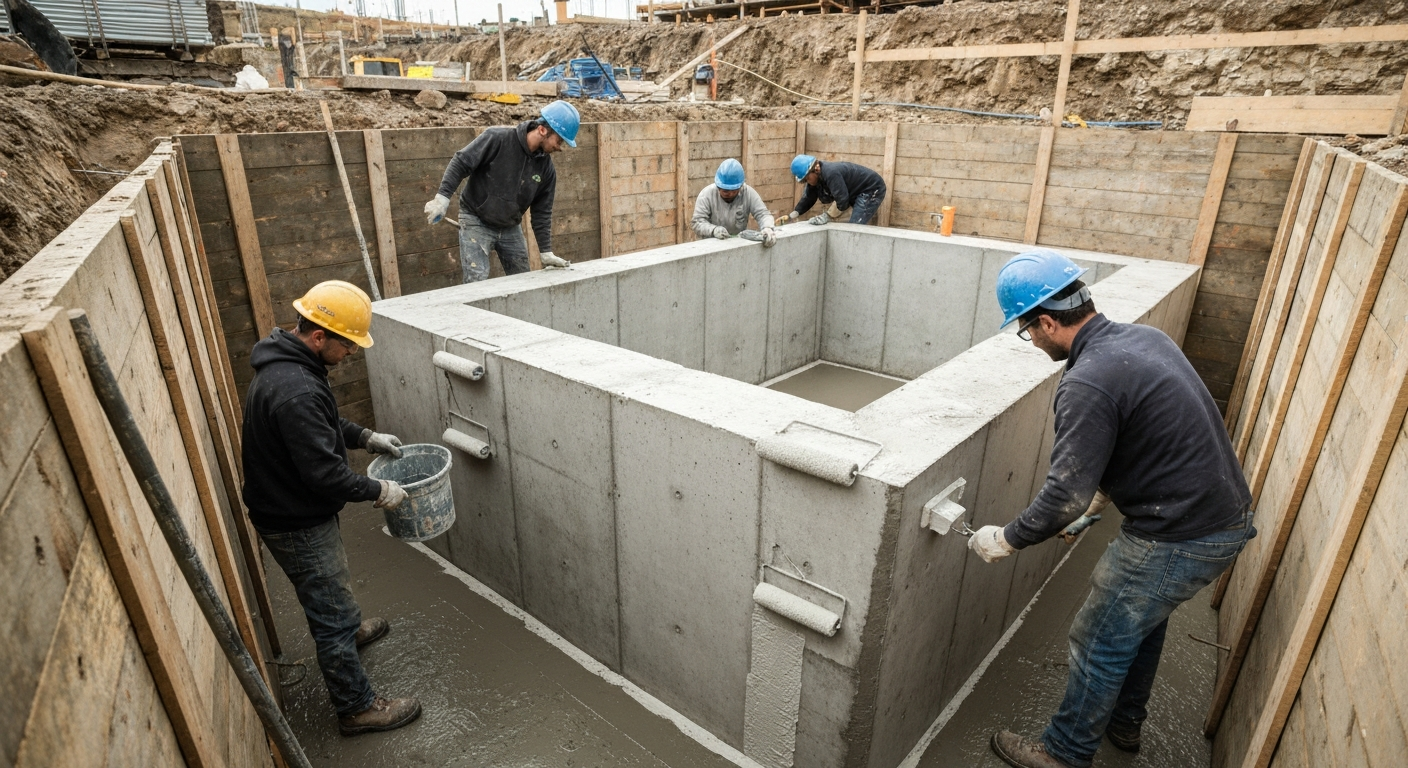
Basement waterproofing options and costs in Shelburne
Shelburne homeowners typically start comparing waterproofing options once they notice damp concrete, musty odours, or spring-time seepage. With 8,994 residents and an older housing mix—38.5% of homes built before 1981 (Statistics Canada, 2021 Census)—it’s common to find original systems that have simply reached the end of their service life. Many basements from that era relied on tar-and-paper style waterproofing and older weeping tile layouts that were never designed for today’s drainage and grading conditions, so leaks often return in new forms: hairline cracks, blocked downspout discharge paths, or interior seepage during freeze-thaw cycles.
In the Kitchener–Waterloo–Barrie corridor, pricing is pushed up or down mainly by how much water has to be managed and how hard it is to access the foundation. Clay-heavy soils in southern Ontario hold moisture, expand as temperatures swing, and increase lateral pressure on foundation walls—so small defects can widen over time. Contractors also factor in excavation depth, soil removal, and labour availability in busier stretches of the region. In Shelburne, this trade is especially in demand around the Dundalk Road / Victoria Street area and along residential pockets where driveways and landscaping limit excavation access. That’s why you’ll see exterior solutions priced higher, while interior drains and sumps are often chosen when spring leaks are the main symptom or when excavation would be extremely disruptive.
Below is a practical comparison of typical methods and price ranges you’ll see in Shelburne, to help you line up like-for-like scopes before you request quotes.
| Method |
What It Addresses |
Disruption Level |
Durability |
Price Range |
| Exterior excavation + new membrane + drainage tile |
Source water entry by rebuilding the waterproofing barrier and directing groundwater to a proper drain |
High (excavation, backfill, landscaping restoration) |
Highest (most complete, longest-term solution when access is feasible) |
$7,000–$15,000 |
| Interior perimeter drain channel + sump pit |
Collects seepage water inside and reduces hydrostatic pressure impacts on the floor/walls |
Medium (cutting along perimeter, sump installation) |
High (good for ongoing groundwater or when exterior access is limited) |
$6,000–$20,000 |
| Foundation crack injection (epoxy or polyurethane) |
Stops leakage through cracks; epoxy seals for non-moving cracks, polyurethane targets active seepage |
Low to Medium (surface prep and targeted drilling) |
Medium to High (depends on whether the crack is stable vs actively moving) |
$1,200–$3,000 |
| Sump pump installation (primary + battery backup) |
Moves collected water out of the basement during wet weather/power interruptions |
Low to Medium (pit work and discharge line routing) |
High (best protection when backup is included) |
$900–$3,600 |
| Window well drain installation |
Prevents rain and groundwater from pooling around basement egress windows |
Medium (small excavation near window wells) |
Medium to High (very effective when the grading/swale is corrected) |
$1,200–$4,000 |
| Lot re-grading / downspout extension |
Redirects surface water away from foundation to reduce infiltration at the source |
Low to Medium (light excavation and exterior work) |
Medium (best when combined with drainage corrections) |
$1,000–$3,800 |
Prices are estimates only and vary by project scope, site access and material selection.
What affects the price of waterproofing in Shelburne
In Shelburne and across the Kitchener–Waterloo–Barrie corridor, quotes for the “same” basement can still vary by 30–50% once contractors price site conditions, not just the general method. Even within Ontario, an interior perimeter drain can be $6,000-ish when it’s straightforward, but it can climb toward the $20,000 band when there are multiple problem areas, significant demolition, or extensive drainage tie-ins. Likewise, exterior waterproofing may land closer to the lower end when the foundation is easy to access, but it can be forced into the upper range when decks, walkways, mature trees, or deep excavation are involved.
Three local drivers that separate regional costs from the national average are soil type, water table conditions, and freeze-thaw. Clay-heavy ground expands during winter and pushes laterally against foundation walls, which can worsen existing cracks over time. When groundwater is high or drainage is poor, a sump system has longer run times and requires better discharge planning—often increasing labour and materials. In Shelburne specifically, older homes (38.5% built before 1981) frequently have older, failing weeping tile, so contractors may need both drainage upgrades and interior management. For example, if a basement leak is mainly crack seepage, crack injection can be a targeted solution in the $1,200–$3,000 band; but if that same crack is fed by groundwater pressure, injection alone may not stop recurring water and the scope may move into interior drain and sump territory—often within the $6,000–$20,000 range.
Two common Shelburne examples: (1) downspouts that discharge toward the foundation can raise the cost because the contractor must re-route exterior drainage before sealing; (2) basement layouts with finished flooring, utility obstructions, or limited access increase demolition time and disposal. Bottom line: stable cracks with good drainage typically cost less, while active leaks fed by groundwater and difficult excavation typically cost more.
| Price Factor |
Why It Matters |
Cost Impact |
| Interior vs exterior approach — interior is less disruptive but addresses symptoms |
Exterior rebuilds the source barrier; interior manages water after it enters |
Exterior often costs more, interior can be cheaper but may need fuller perimeter systems |
| Foundation type — poured concrete vs. block vs. stone vs. ICF |
Crack behaviour and sealing methods differ by foundation material and age |
Block and older systems may require more interior drainage; ICF often affects sealing strategy |
| Soil type — clay expands more than sand, adding pressure |
Clay cycles increase hydrostatic and lateral pressure on walls |
More robust drainage and possibly sump redundancy is priced in |
| Crack type and length — hairline vs. structural horizontal cracks |
Moving cracks need flexible, targeted injection and may require engineering assessment |
Structural concern increases labour, testing, and potential engineering follow-up |
| Sump pump backup system — battery or water-powered backup needed |
Power interruption risk can turn a “wet basement” into major water entry |
Backup increases upfront cost but reduces catastrophic risk |
| Access — landscaping, decks, or driveways must be removed for exterior |
Excavation is labour-intensive when obstructions are present |
Removal and restoration push totals upward in the exterior range |
| Weeping tile age — original tile (60+ years) may be completely failed |
Failed tile can mean groundwater bypasses into interior spaces |
Replacement or tie-in work increases scope beyond “patch” repairs |
| Mould or efflorescence remediation required before sealing |
Sealers and membranes need clean, properly prepared surfaces |
Moisture-impacted areas may require extra prep and drying time |
Permits & regulations in Ontario
In Ontario, waterproofing work can be regulated depending on what you change. In general, foundation excavation around a house, structural crack repair that could affect load paths, and changes to lot drainage that alter how water is managed often require a building permit. If the scope involves sump pump discharge that connects into municipal storm or sanitary infrastructure, municipal approval is commonly required before tie-in.
For structural crack repair—especially horizontal cracks in block walls, major step cracks, or any signs of movement—a structural engineer’s assessment is often necessary to determine whether underpinning or other structural remediation is required. Reputable waterproofing companies will either arrange engineering support for you or only quote after an assessment is completed. You should also confirm they carry liability insurance and WSIB/WCB coverage for the work crew.
How to verify compliance step-by-step for a Shelburne contractor: (1) ask for their Ontario business licence or the applicable contractor registration details and confirm the company name matches the quote and invoices; (2) request a certificate of insurance and verify the expiry date and that it includes general liability for the type of work; (3) ask for their WSIB/WCB clearance letter and check that it’s current and covers the workers assigned to your job; (4) for structural scopes, request proof they have engineering support available and that the recommendation is documented. For permits, ask who will pull them and what is included in your written scope so there are no surprises mid-job.
Interior vs exterior waterproofing — what does Shelburne need?
In Shelburne, the choice between interior and exterior waterproofing comes down to where the water is entering and how much hydrostatic pressure the foundation is dealing with. Exterior waterproofing means full excavation, new membrane, new drainage tile, and backfill—essentially rebuilding the barrier at the source. It’s the most durable approach because it prevents groundwater from contacting the foundation wall in the first place, but it costs more and requires significant landscape disruption.
Interior waterproofing—like a perimeter drain channel, sump pit, and sump pump—does something different: it collects water after it enters, then reduces the impact on floors and lower walls. This is often the practical choice when excavation isn’t feasible (finished landscaping, decks, or limited side-yard access) or when the main issue is recurring spring seepage. With southern Ontario freeze-thaw, interior systems work best when they’re paired with the right pump strategy; a battery backup sump pump is a sensible safeguard during power interruptions that can coincide with wet weather and spring storms. For many Shelburne basements, poured concrete walls respond well to a combination of crack injection and interior drainage, because properly sealed cracks can reduce direct seepage. Block foundations often need an interior drain as a practical complement, especially if the exterior drainage is compromised.
To see why the price gap can make sense: if a basement has persistent groundwater pressure, a full exterior project in the $7,000–$15,000 band can be justified because it tackles the source and reduces the likelihood of future interior retrofits. By contrast, a straightforward interior perimeter + sump system may start around the lower part of the $6,000–$20,000 range when access and scope are limited, making it a better fit for some homeowners—even though it doesn’t stop hydrostatic pressure from reaching the wall.
| Method |
Best For |
Addresses Source? |
Disruption |
Lifespan |
Price Band |
| Full exterior excavation + membrane |
Recurring groundwater seepage, failing exterior drainage, and homes where full access is possible |
Yes (primary water entry is controlled) |
High |
Long (often the most dependable for many decades) |
$7,000–$15,000 |
| Interior French drain + sump system |
Interior wetness from seepage, limited excavation access, or unknown exterior drainage condition |
No (manages water after entry) |
Medium |
Good (depends on pump quality, discharge routing, and maintenance) |
$6,000–$20,000 |
| Crack injection — epoxy (structural) |
Stable, non-moving cracks where you need a rigid seal |
Often partially (seals pathways through the wall) |
Low |
Medium to long if crack movement is not recurring |
$1,200–$3,000 |
| Crack injection — polyurethane (active leak) |
Active seepage through cracks and situations where flexibility is needed |
Often partially (treats the leak pathway) |
Low to Medium |
Medium to long if hydrostatic conditions are controlled |
$1,200–$3,000 |
| Interior drain channel only (no sump) |
Mild seepage where water can be managed without pump capacity |
No (still after-entry management) |
Medium |
Shorter where water volumes spike in spring |
$4,500–$12,000 |
| Re-grading + downspout extensions |
Surface water issues at the foundation perimeter, gutter overflow patterns, and minor dampness |
Yes (reduces surface water entry) |
Low to Medium |
Medium (must stay maintained) |
$1,000–$3,800 |
How to choose a waterproofing contractor in Shelburne
Choosing the right contractor in Shelburne starts with verification, not promises. In Ontario, confirm their insurance and worker coverage: request their certificate of insurance (so you can see the coverage type and expiry date), and ask for their WSIB/WCB clearance letter before work begins. You can also verify the business details through Ontario business registries and cross-check that the company name on the quote matches the insured legal name on the documents. For waterproofing involving structural crack repair, ask about engineering support and documentation—especially if you’re seeing horizontal or widening step cracks.
Next, get 2–3 itemised written quotes rather than a single lump sum. Look for a breakdown of labour and materials (membrane/drainage components, sump pump model, discharge piping, excavation and disposal, and restoration). Scope clarity matters: ask what’s excluded (e.g., removal of stonework, interior drywall cutting limits, or re-finishing floors), whether a permit is included if required, and whether soil disposal and backfill are part of the price. Warranty quality should be explicit—workmanship warranty length, product/manufacturer warranty coverage, and whether warranties are transferable if you sell.
Payment schedule: never pay more than 10–15% upfront. Use a holdback until the job is complete and verified. Finally, insist on a start date and completion estimate in writing so you’re not left waiting through spring weather when leaks are most active.
- Request itemised quotes with labour/material line items (not “allowance” only).
- Confirm WSIB/WCB clearance letter is current and matches the workers assigned.
- Verify certificate of insurance (coverage type, limits, expiry date).
- Ask who pulls permits (and confirm in writing what’s included).
- Confirm excavation disposal is included (soil removal costs can be significant).
- Review drainage routing—where discharge goes and how discharge is protected.
- For sumps, confirm pump model, alarms (if included), and backup type.
- Ask whether they address downspouts and grading in the scope.
- Ensure crack injection is matched to crack type (stable vs active leak).
- Get warranty details in writing: workmanship + product coverage.
- Agree on holdback (hold back until successful water-test/cleanup).
- Ask for job timeline with start date and completion target.
Red flags to watch in Shelburne: contractors who won’t put the scope and exclusions in writing; vague wording like “we’ll waterproof it” without identifying drainage routing and crack strategy; pressure tactics to take large upfront payments; no proof of WSIB/WCB or insurance upon request; and offering only one method (e.g., “just inject it”) regardless of whether the leak appears to be driven by groundwater pressure.
Frequently asked questions — waterproofing in Shelburne
How do I choose a waterproofing contractor in Shelburne?
Start by comparing like-for-like scopes from 2–3 contractors. In Shelburne and throughout Ontario, ask for an itemised quote showing labour, materials, excavation/disposal, and restoration steps (not just a lump sum). Verify the contractor’s WSIB/WCB clearance letter is current and request a certificate of insurance—confirm the insured legal name matches the quote. If the job includes structural crack repair or anything that looks like a horizontal/step crack pattern, ask how engineering support is handled and whether recommendations are documented. Finally, match warranty terms: workmanship warranty duration, product warranty coverage, and whether warranties are transferable. If one quote is far lower, it’s often because key items like sump backup, proper drainage tie-in, or permit handling are excluded.
What is a battery backup sump pump and do I need one in Shelburne?
A battery backup sump pump is a secondary pump system that can run during power outages, keeping water from rising in your sump pit when the main power fails. In Shelburne, it’s most valuable when you experience spring wet weather and heavy rain events where power interruptions can coincide with high groundwater. If your plan includes an interior perimeter drain + sump, I often recommend backup because basement flooding usually happens during the first long period of wetness plus any outage. Pricing is typically within the regional sump installation band—often $900–$3,600 depending on pump type and installation complexity. You don’t always “need” it for minor dampness, but if you’re already investing in drainage infrastructure, backup is cheap insurance against the worst-case scenario.
How much does basement waterproofing cost in Shelburne?
Costs in Shelburne depend on whether you’re treating the source (exterior) or managing water after it enters (interior), plus access and foundation condition. Exterior waterproofing typically falls around $7,000–$15,000 for excavation, new membrane, and drainage tile. Interior solutions—like a perimeter drain channel and sump system—commonly range from $6,000–$20,000 depending on demolition needs and how extensive the drainage tie-ins are. Smaller repairs like foundation crack injection are often closer to $1,200–$3,000 when cracks are stable and localized. Because Shelburne has a large older-home share (38.5% built before 1981, Statistics Canada, 2021 Census), we sometimes see added scope like failing weeping tile upgrades or extra remediation before sealing.
Interior vs exterior waterproofing — which is better?
Exterior waterproofing is usually “better” for long-term control because it rebuilds the water barrier at the source: excavation, membrane, and new drainage tile. It’s also the most durable when your exterior drainage has failed. However, it’s more expensive and more disruptive because landscaping and sometimes hardscaping must be disturbed. Interior waterproofing is often the best choice when excavation is constrained or when the basement leak is driven mainly by recurring seepage that you can manage with a perimeter drain and sump. Interior doesn’t stop hydrostatic pressure from contacting the foundation wall, but it can prevent floors and lower walls from staying wet. In Shelburne’s climate and soil conditions, many homeowners choose exterior when access is feasible, and choose interior when access is limited or when the leak is seasonal and localized.
Why is my basement leaking in Shelburne?
Most basement leaks in Shelburne are caused by water movement through either foundation cracks or the drainage path around your home. In southern Ontario, freeze-thaw cycles can widen existing cracks and turn a small defect into a larger water-entry route. Soil type matters too: clay-heavy ground can hold moisture and exert more pressure against foundation walls during cold-weather expansion. If downspouts discharge too close to the foundation, surface water can concentrate at the perimeter and feed seepage. In older homes (many built before 1981), original weeping tile systems may have failed, meaning groundwater can bypass the intended drainage route and move inward. The key is identifying whether your leak is mainly “surface water” (addressable with grading/downspouts) or “groundwater/seepage” (usually requiring drainage and sometimes a sump).
How do I know if a foundation crack is serious?
Not every crack is dangerous, but in Shelburne you should treat certain patterns seriously. Hairline cracks that stay the same width over time can be non-structural, and they often respond well to targeted crack injection. Cracks that are widening, show signs of water seepage, or run in horizontal/step patterns—especially on block foundations—can indicate movement or higher structural concern. Also watch for repeating cracks after freeze-thaw seasons, bulging, or cracking that appears in multiple areas at once. For serious crack patterns, Ontario typically expects engineering assessment before structural decisions are made. Practical next step: ask the contractor to document crack location, length, orientation, and whether it’s actively wet—then match the remedy (epoxy for stable cracks vs polyurethane for active leaks) and confirm if interior drainage is needed to stop recurring hydrostatic pressure.