Basement waterproofing options and costs in Wychwood
Wychwood homeowners typically start by asking which waterproofing option is “best,” but the right answer depends on where the water is coming from and how the foundation has aged. With a local population of 14,349 in the Wychwood area (Statistics Canada, 2021 Census), you’ll notice a steady mix of older, character neighbourhood basements alongside post-war homes—styles that often had early drainage systems and waterproofing that didn’t stand up to today’s moisture demands. In older properties, original weeping tiles (sometimes clay, sometimes early plastic) may be partially collapsed, and foundation coatings or tar-and-paper membranes—if present at all—can degrade after decades of freeze–thaw.
In Toronto’s mixed glacial till and clay pockets, saturated backfill can expand during winter cold snaps, increasing lateral pressure against foundation walls. That pressure can turn hairline cracks and aging tie holes into active seepage. It also affects price because exterior work usually involves excavation, disposal, and careful membrane detailing around footings and drains. In Wychwood, contractor demand is especially high around the older streets near the Wychwood Park area, where tight access and mature landscaping mean more time is spent protecting gardens and working around additions.
Below is a practical comparison of common basement waterproofing methods you’ll see in Wychwood, along with typical cost ranges. Use this as a starting point before you ask for itemised quotes, because the “same” method can change significantly depending on soil, water table behaviour, and how much concrete or landscaping must be removed.
| Method |
What It Addresses |
Disruption Level |
Durability |
Price Range |
| Exterior excavation + new membrane + drainage tile |
Primary water source at the foundation exterior; adds drainage to reduce hydrostatic pressure |
High (excavation, backfill, landscape restoration) |
Long-term, often the most complete solution when access is workable |
$7,000 – $25,000 |
| Interior perimeter drain channel + sump pit |
Water that enters through cracks or at slab/wall intersections; captures seepage and discharges it |
Medium (wall cutting at perimeter, sump installation) |
Strong performance with proper discharge and maintenance |
$3,500 – $15,000 |
| Foundation crack injection (epoxy or polyurethane) |
Isolated cracks; stops seepage pathways (polyurethane for active leaks, epoxy for stable cracks) |
Low to Medium (surface prep, drilling, patching) |
Good for targeted repairs when crack cause is addressed |
$600 – $3,000 |
| Sump pump installation (primary + battery backup) |
Prevents chronic seepage accumulation during spring rain and freeze–thaw wet cycles |
Low to Medium (pit work, routing discharge) |
Reliable when power backup and discharge routing are correctly designed |
$800 – $3,500 |
| Window well drain installation |
Surface runoff and groundwater around basement window wells |
Low to Medium (excavation around wells) |
Good for localized water entry points |
$1,200 – $4,000 |
| Lot re-grading / downspout extension |
Improves surface water control so runoff doesn’t over-saturate backfill |
Low (minor excavation, landscaping adjustments) |
Useful baseline measure; may not stop hydrostatic pressure alone |
$1,500 – $6,500 |
Prices are estimates only and vary by project scope, site access and material selection.
What affects the price of waterproofing in Wychwood
It’s common to see waterproofing quotes for the “same” basement go in very different directions across Toronto—often by 30–50%—because contractors price for risk: site access, how the soil behaves, how old the drainage is, and what they must do to guarantee performance. Even when the method sounds similar (for example, “interior drainage”), the labour and materials change if the crew must remove floors, deal with efflorescence, repair blocked weeper lines, or cut around utilities.
Three local drivers tend to push costs above a national average: soil type, water table behaviour, and freeze–thaw. In the Toronto region, many lots sit on mixed glacial till and clay that can expand when saturated—exerting lateral pressure that worsens crack movement. When that happens, interior measures like perimeter drains may still be needed, but the work often includes more prep and higher-capacity sump discharge. High local water tables in many neighbourhood pockets increase sump run times and can require backup power, more robust piping, and careful tie-in detailing. By contrast, a site with more sand and better natural drainage often costs less because the walls and floor stay drier between rainfall events.
Two practical Wychwood examples: (1) If a home has a 1960–1980s basement with original clay weeping tile now partially collapsed, the interior perimeter drain may be combined with sump work—often bringing projects toward the $3,500 – $15,000 band rather than a smaller patch repair. (2) If exterior access is restricted by deck footings or tight setbacks, excavation may be delayed and more labour-intensive, nudging exterior projects closer to the $7,000 – $25,000 range.
For homeowners, the takeaway is simple: the best price reflects a plan that matches how water actually moves under your lot—especially in clay-heavy, freeze–thaw-prone neighbourhoods like Wychwood.
| Price Factor |
Why It Matters |
Cost Impact |
| Interior vs. exterior approach |
Interior typically manages water after entry; exterior reduces water pressure at the source |
Exterior can add excavation, membrane labour and restoration, often widening the job cost by several thousands |
| Foundation type |
Sealing behaviour differs across poured concrete, block, stone, and ICF |
Block and older walls often need complementary drainage; ICF may require different detailing for penetrations |
| Soil type |
Clay expands more than sand, increasing wall pressure during freeze–thaw |
More active cracking and seepage can mean more prep and higher-capacity drainage systems |
| Crack type and length |
Hairline cracks may be stable; structural horizontal cracks can signal ongoing movement |
Active/longer cracks require more injection ports and sometimes engineer-led solutions |
| Sump pump backup system |
Backup reduces the risk of seepage during power loss and spring surges |
Battery backup can increase cost but prevents high-damage scenarios when water arrives faster than the pump can handle |
| Access |
Landscaping, decks, shared driveways, or additions may need removal or careful hand-digging |
Restricted access raises labour hours and increases disposal/restoration scope for exterior work |
| Weeping tile age |
Original weeping tile (often 60+ years) may be fully failed or partially blocked |
If ties must be re-established, piping upgrades and additional drainage work can be required |
| Mould or efflorescence remediation required before sealing |
Sealers and membranes require a clean, dry surface for proper adhesion |
Adds time, cleaning materials, and sometimes drying equipment before any long-term waterproofing coating |
Permits & regulations in Ontario
In Ontario, some parts of a basement waterproofing job typically need permits, while other parts usually do not. Foundation excavation and changes that affect lot drainage are commonly handled under a permit process, particularly when work involves altering drainage patterns, working near foundation elements, or modifying how water is routed away from the building. Structural crack repair—especially for horizontal cracks in block walls or major step cracks—often requires a structural assessment. If the engineer determines underpinning or structural stabilization is required, that typically triggers a permit pathway as well.
Sump pump installations can also require municipal approval depending on how the discharge is connected. If the discharge ties into storm or sanitary services, plan for the contractor to coordinate the required approvals. Even when the work is mainly “waterproofing,” any scope that changes drainage connections or impacts how water leaves the property should be verified in advance.
Step-by-step, here’s how a Wychwood homeowner can verify a contractor is qualified:
- Ask for the company’s Ontario licence/registration (if applicable to their trade activities) and confirm it matches the legal entity on the quote.
- Request a current certificate of insurance (liability) and confirm it covers excavation and water-management work.
- Verify WSIB/WCB clearance for the workers involved—ask for the clearance letter and check that dates are current.
- For structural repairs, confirm whether they use a licensed structural engineer for assessment and sign-off.
- Ask whether permits will be pulled (or who pulls them) and get this stated in writing before signing.
Never assume: require the contractor to document insurance, WSIB/WCB clearance, and—where relevant—engineering support for structural scope.
Interior vs exterior waterproofing — what does Wychwood need?
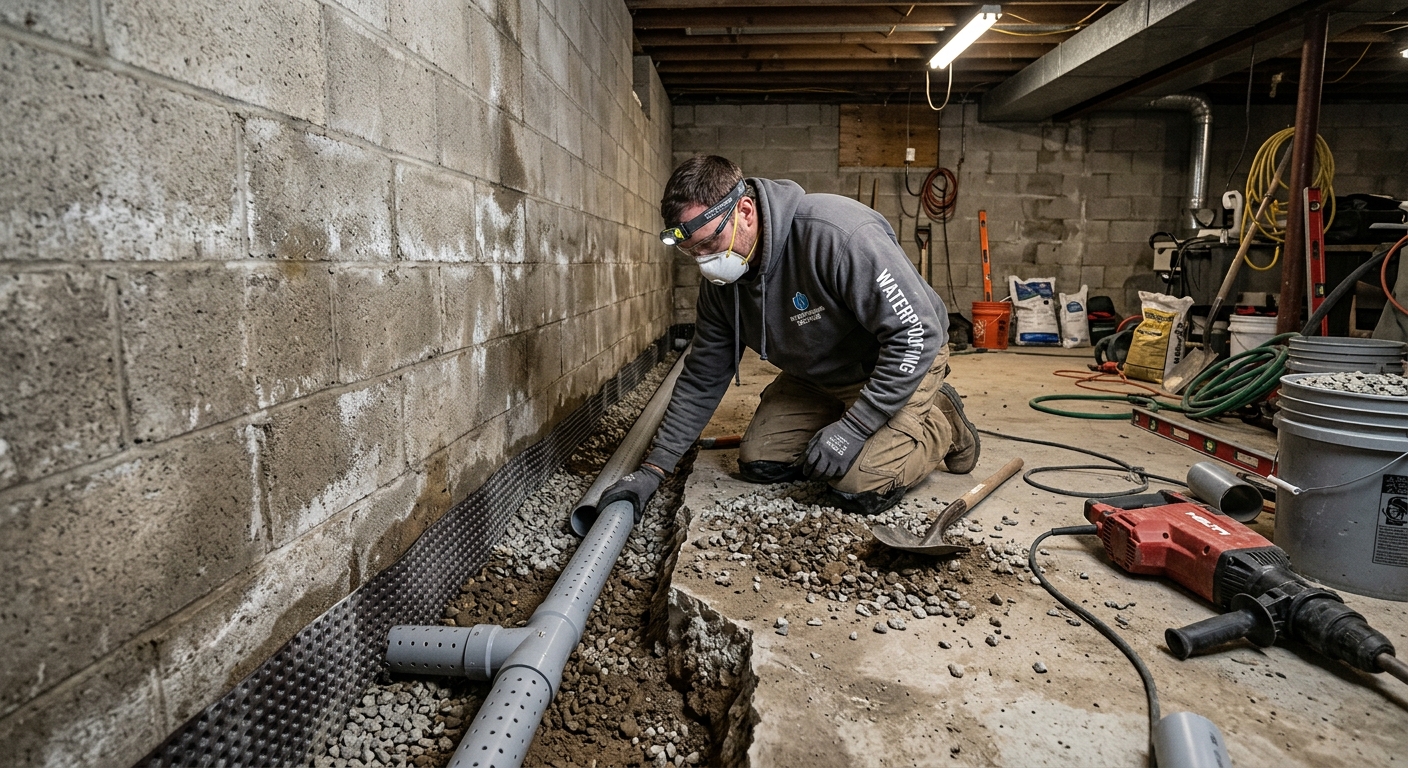
Think of waterproofing in Wychwood as choosing between solving the water source or managing the symptoms after water gets in. Exterior waterproofing—full excavation, new membrane, new drainage tile, and backfill—targets the outside face of the foundation where water and hydrostatic pressure first build up. It’s the most comprehensive option, but it’s also more expensive and disruptive because it involves excavation and landscape restoration. Interior waterproofing—perimeter drain channel, sump pit, and sump pump—captures water after it enters and routes it away from the basement area. It’s less invasive, but it doesn’t relieve the external pressure pushing on the wall.
In Toronto’s freeze–thaw climate, both methods can be effective, but the best fit depends on soil and foundation type. For poured concrete walls with stable cracking, crack injection (often with epoxy for stable cracks) can create a clean barrier, and an interior system can handle any residual seepage. For block foundations, we often see more movement at mortar joints and at service penetrations, making interior drainage a practical complement even if some exterior measures are possible.
Sump pump backup matters in spring when storms coincide with wet ground conditions and power interruptions are more likely. A battery backup can keep the pit functioning long enough to prevent a small leak from becoming a flood.
Here’s a realistic example of when the price difference is justified: if your exterior excavation would cost toward $7,000 – $25,000 but your basement has repeated seepage tied to failing exterior drainage and active lateral pressure, the exterior solution can be cost-effective over time. If, however, the issue is limited to a couple of interior seep points and you already have functional exterior drainage, a targeted interior system in the $3,500 – $15,000 range may achieve similar day-to-day results with far less disruption.
| Method |
Best For |
Addresses Source? |
Disruption |
Lifespan |
Price Band |
| Full exterior excavation + membrane |
High water pressure, chronically wet basements, failed exterior drainage |
Yes |
High |
Long-term when drainage tile and detailing are done correctly |
$7,000 – $25,000 |
| Interior French drain + sump system |
Chronic seepage, clogged/failed weeping tile, interior wet walls |
No (manages entry after it occurs) |
Medium |
Long if pump capacity, discharge, and maintenance are handled properly |
$4,500 – $15,000 |
| Crack injection — epoxy (structural) |
Stable cracks where water isn’t actively running through under pressure |
Partially (seals a pathway) |
Low |
Good for stable, clean crack conditions |
$600 – $3,000 |
| Crack injection — polyurethane (active leak) |
Active seepage, damp cracks with ongoing water movement |
Partially (seals active pathways) |
Low to Medium |
Excellent when the crack is the primary source and prep is thorough |
$800 – $3,500 |
| Interior drain channel only (no sump) |
Light moisture, occasional seepage that doesn’t pool |
No (collects interior water) |
Medium |
Moderate; performance can drop if water volume spikes |
$3,500 – $9,500 |
| Re-grading + downspout extensions |
Surface runoff issues, wet corners after rain |
No (reduces exterior saturation) |
Low |
Good as a baseline if drainage conditions improve |
$1,500 – $6,500 |
How to choose a waterproofing contractor in Wychwood
When you hire a waterproofing contractor in Wychwood, verification should be as important as price. Start by confirming the contractor’s Ontario business details and the specific coverage that protects you during messy excavation and concrete work. Ask for a current certificate of liability insurance (make sure it’s for the company listed on the contract), then request WSIB/WCB clearance for their workers. In practice, you should be able to see a clearance letter with an active date—don’t accept a vague “we’re covered.”
Next, request 2–3 itemised written quotes. You want labour and materials broken down, not a single lump sum with no details. Make sure the scope clarifies what’s included: permit pulling (if applicable), disposal of excavated soil, whether dust control and protection of finishes are included, and how discharge routing will be handled for a sump system.
Check the warranty carefully. Look for a workmanship warranty length (not just product warranty), confirm which materials are covered and for how long, and ask whether the warranty is transferable if you sell your home. Finally, payment schedule matters: plan to pay no more than 10–15% upfront, and insist on holdback until completion and walk-through. Get a written timeline with a target start date and completion estimate—waterproofing schedules slip quickly when crews are waiting on curing times and backfill material.
- Ask for their last 5 basement waterproofing project photos in Toronto (similar soil/access if possible).
- Confirm the crack repair method (epoxy vs polyurethane) is chosen based on crack behaviour, not guessing.
- Require a site-specific plan for drainage tile routing and sump discharge location.
- Ensure excavation scope includes how they protect patios, decks, and nearby foundations.
- Ask what product system they’re using (membrane type, drainage board/pipe details, sealants) and where it’s applied.
- Verify whether mould/efflorescence remediation is included before sealing (if present).
- Get disposal and landscape restoration listed—no “allowance” that disappears in change orders.
- Confirm whether a structural engineer is required for structural crack repairs and who provides it.
- Ask for pump specifications if sump work is included (capacity, float switch type, backup system).
- Request a clear statement of permit responsibility in writing.
- Agree on inspection checkpoints: pre-excavation conditions, membrane installation, drainage verification, and post-backfill.
- Review the warranty in plain language and request it in writing before you pay a deposit.
Red flags we see in Wychwood include: (1) contractors recommending only “interior sealing” without inspecting drainage or crack movement, (2) vague quotes with no mention of discharge routing or sump backup, (3) inability to provide a current liability certificate or WSIB/WCB clearance, (4) dismissing permits for anything that alters drainage connections, and (5) “one price fits all” crack injection that doesn’t specify epoxy vs polyurethane or the number of ports.
Frequently asked questions — waterproofing in Wychwood
What causes foundation cracks in Wychwood?
In Wychwood, foundation cracks usually come from movement: seasonal soil expansion and contraction, hydrostatic pressure against the wall, and freeze–thaw cycling that widens small defects. Toronto’s mixed glacial till and clay pockets can hold water against foundations; when saturated clay expands, it pushes laterally and can activate cracks at tie holes, mortar joints, and corners. In older basements—common in the Toronto housing mix—original weeping tile or early drainage may be partially failed, so water accumulates behind/around the foundation. Over a few winters, hairline cracks can become active seepage points, especially when the crack path intersects with damp areas and utility penetrations.
How do I compare waterproofing quotes?
Compare Wychwood waterproofing quotes line-by-line, not just by the total price. Ask for an itemised breakdown that separates labour and materials, and confirm exactly what’s included: excavation depth (if exterior), membrane system details, drainage tile routing, sump pump model/capacity, and whether battery backup is included. Look for scope clarity around disposal, permit pulling (where required), and restoration. If one quote includes a sump with backup and the other doesn’t, the difference can be justified even if the line items look similar. For example, an interior drainage plan may land in the $3,500 – $15,000 band, while a full exterior approach can be closer to $7,000 – $25,000 when lateral pressure is the primary problem.
How long does basement waterproofing take in Wychwood?
Timelines in Ontario depend on weather, drying/curing needs, and how disruptive the scope is. For interior work such as perimeter drains and sump pit installation, many Wychwood projects can be completed in several days, with additional time for concrete cutting, installation, and patching. Crack injection projects are often quicker—sometimes within a day or two—because the main scheduling driver is proper surface prep and cure time for the injection materials. Exterior projects take longer because excavation must be done safely, membranes and drainage components must be installed correctly around footings, and backfill and restoration require planning. Crews also account for the freeze–thaw schedule—work may be sequenced to avoid leaving trenches open during unsuitable conditions.
What is a weeping tile and does my Wychwood home have one?
A weeping tile is the foundation drainage layer installed around (or beneath) the perimeter to collect groundwater and direct it to a sump or discharge point. Many older Wychwood homes—especially those with basements from post-war and earlier eras—originally had clay weeping tile, sometimes later replaced or supplemented with early plastic drains. In Toronto neighbourhoods with high moisture pressure, failed or partially collapsed weeping tile is a common reason for recurring dampness, efflorescence, and basement flooding even when exterior walls look “fine.” To determine if yours exists, ask the contractor what they can inspect (cleanouts, discharge lines, accessible drain connections) and whether they’ll locate the drainage path rather than assuming it’s working.
Can I waterproof my basement in winter in Wychwood?
Yes, but “winter waterproofing” in Ontario is usually limited to interior-focused work. In Wychwood winters, excavations for exterior membrane work are often delayed because frozen soil increases excavation difficulty and can complicate drainage installation and backfill compaction. Interior methods—like perimeter drain channels, sump pit installation, and targeted crack injection—are commonly completed in cooler months because they don’t require large excavation outside. That said, contractors must still manage moisture and surface readiness: mould/efflorescence needs remediation, and surfaces must be prepared so sealants and injection products adhere properly. If you’re dealing with active seepage during freeze–thaw, a sump with appropriate discharge routing and backup may stabilize conditions quickly.
What is the difference between waterproofing and damp-proofing?
Homeowners often hear both terms, but they’re not the same. Waterproofing is designed to prevent water intrusion under real moisture pressure conditions—typically combining drainage systems, sealing of entry pathways (cracks/penetrations), and proper discharge. Damp-proofing focuses on limiting moisture penetration; it may help with minor dampness or condensation but often isn’t built for sustained hydrostatic pressure. In Wychwood, where clay-heavy soils can hold water and freeze–thaw can worsen defects, damp-proofing alone frequently leaves you managing recurring seepage. A proper plan might include an interior perimeter drain with sump in the $3,500 – $15,000 range, or exterior excavation and membrane closer to $7,000 – $25,000 when the exterior source of water pressure is the driver.