Basement waterproofing options and costs in Westfort
In Westfort, Ontario, basement waterproofing is rarely one-size-fits-all because water pressure behaves differently on mixed soils, and many homes in the Toronto area sit on glacial till and pockets of dense clay that hold water against foundations. Westfort’s population is 8,256 (Statistics Canada, 2021 Census), and that same broader Toronto housing stock pattern means contractors often see older basements with aging drainage systems—particularly in post-war and 1960–1980s homes where original tar-and-paper membranes and weeping tiles have typically been in service for decades. In practical terms, that timing matters: once original drainage is partially collapsed or clogged, seepage often shows up as damp walls, efflorescence, musty odours, and eventually interior flooding rather than obvious exterior wall failure.
Cost is also shaped by Toronto’s freeze–thaw cycles. Small cold-joint gaps, tie holes, and hairline cracks that might only weep in a mild season can become active leaks over a few winters as defects widen and concrete expands. Add high lateral pressure from saturated clay, and you’ll find more demand for exterior excavation in tight urban lots—especially around common neighbourhood pockets like the Westfort/St. Clair-Howard Park area where mature landscaping and limited setbacks create access challenges.
Below are the main approaches we see in Westfort, along with typical disruption and price ranges. Use this as a baseline before you compare itemized proposals, because the “best” method usually depends on whether the water is entering through the wall/footing or arriving as chronic groundwater after it enters.
| Method |
What It Addresses |
Disruption Level |
Durability |
Price Range |
| Exterior excavation + new membrane + drainage tile |
Primary source of seepage through walls/footings; replaces failing weeping tile system and relieves hydrostatic pressure |
High (excavation, landscaping restoration, deck/driveway impacts as needed) |
Long-term when installed to detail; typically 15–25 years+ |
$7,000–$25,000 |
| Interior perimeter drain channel + sump pit |
Water after it enters; captures seepage at the base and sends it to sump for pump discharge |
Moderate (remove interior finishes at perimeter; limited exterior work) |
Good; often 10–20 years with maintained pump and sealed penetrations |
$3,500–$15,000 |
| Foundation crack injection (epoxy or polyurethane) |
Targeted repair of specific cracks; epoxy for static/structural sealing, polyurethane for active leaks |
Low to moderate (chipping/cleaning at crack line; minor interior or exterior access) |
Varies by crack type and activity; commonly 5–15 years+ |
$600–$3,000 |
| Sump pump installation (primary + battery backup) |
Prevents interior flooding during pump failure or power interruptions; improves resilience during spring saturation |
Low to moderate (pit excavation, discharge line routing, electrical work) |
Depends on system maintenance; typically 10–15 years+ |
$800–$3,500 |
| Window well drain installation |
Controls water infiltration at egress points; manages pooled water and runoff near basement windows |
Low to moderate (excavation around the window well; limited landscaping) |
Good with correct grading/drain routing; often 8–15 years+ |
$1,000–$4,000 |
| Lot re-grading / downspout extension |
Redirects surface water away from foundation; reduces runoff driving seepage at wall/footing line |
Low to moderate (topsoil/grading work; downspout rerouting) |
Fair to good; often 5–10 years depending on soil settling and maintenance |
$1,200–$6,000 |
Prices are estimates only and vary by project scope, site access and material selection.
What affects the price of waterproofing in Westfort
In Westfort and the wider Toronto economic region, you can see the same “basement waterproofing” described three different ways in quotes—interior drainage only, targeted crack work, or full exterior remediation—and that’s why pricing can swing by 30–50% between contractors even when homeowners describe the same symptoms. National averages also don’t fully capture Toronto realities: labour costs are higher, sites are tighter, and many homes are older enough that drainage systems have aged out.
The three most significant local drivers are soil type, water table, and freeze–thaw. In clay-heavy pockets, saturated soil expands and applies lateral pressure, making hairline cracks open and re-seal cycles less reliable—especially on block and older poured concrete sections. Where high water tables exist in spring and early thaw, sump pump run times increase, and discharge logistics (and backups) become more important to prevent interior flooding. Freeze–thaw then widens small defects, which increases the amount of prep needed before membranes or coatings can be sealed properly.
Concrete examples from Westfort projects: (1) a house with active stair-step cracks plus saturated clay often needs exterior excavation and drainage relief, pushing projects closer to the $7,000–$25,000 exterior band rather than an interior-only fix; (2) a small, localized weeping issue may justify foundation crack injection in the $600–$3,000 range, especially when the crack is vertical and the rest of the perimeter stays dry; (3) older weeping tile that’s completely failed can turn an “easy interior drain” into a bigger job because more water must be captured and routed reliably.
Contractor availability and access constraints also matter in Toronto: removing landscaping, working under deck footings, and excavating around additions or shared driveways can add hours and disposal costs, even when the membrane scope itself is unchanged.
| Price Factor |
Why It Matters |
Cost Impact |
| Interior vs. exterior approach — interior is less disruptive but addresses symptoms |
Interior drainage manages water after entry; exterior addresses the entry path by relieving hydrostatic pressure |
Interior often saves excavation cost but may not fully stop pressure-driven seepage |
| Foundation type — poured concrete vs. block vs. stone vs. ICF |
Crack behaviour and sealing detail differ by material; block joints can weep along mortar lines |
Block and mixed foundations usually require more targeted drainage/repair |
| Soil type — clay expands more than sand, adding pressure |
Clay saturation increases lateral pressure and makes wall leaks more active during thaw |
Higher pressure can push scope toward exterior excavation and drainage |
| Crack type and length — hairline vs. structural horizontal cracks |
Hairline cracks may be treated with localized injection; horizontal/step cracks may indicate movement |
Structural concerns can raise costs due to engineering and additional remediation steps |
| Sump pump backup system — battery or water-powered backup needed |
Backups reduce flood risk during power interruptions in storm or spring events |
Backup adds equipment and testing; commonly moves you toward the upper sump band |
| Access — landscaping, decks, or driveways must be removed for exterior |
Tight lots require careful hand excavation and more restoration work |
Exterior work cost can increase substantially due to access and restoration |
| Weeping tile age — original tile (60+ years) may be completely failed |
Partially clogged tile can still move water; completely failed tile needs replacement |
Failed systems often justify full exterior drainage replacement |
| Mould or efflorescence remediation required before sealing |
Sealing over contamination can reduce adhesion and trap moisture |
Additional prep and cleaning adds labour and materials before waterproofing |
Permits & regulations in Ontario
In Ontario, foundation excavation, structural crack repair, and changes to lot drainage commonly require a building permit. As a general rule, exterior work that modifies grading around a foundation, new or altered drainage discharge routes, and any structural crack work that may affect load paths should be discussed with your contractor and verified with the municipality. Sump pump installations that connect into a municipal sewer system (storm or sanitary) typically need municipal approval before the system is connected.
For structural crack repair—especially horizontal cracks in block walls, significant step cracking, or signs of movement—an assessment by a structural engineer is often required to determine whether underpinning or other structural work is needed. That doesn’t mean every crack is structural in Westfort, but the right contractor should be able to explain what they see and when engineering support is appropriate.
To verify a contractor in Westfort, start with their Ontario licensing details (check their online listing for the relevant category of work and whether they list a business number and valid coverage). Next, request a certificate of insurance showing general liability; for employment-related coverage, ask for WSIB/WCB clearance. Then, ask for the actual certificate details—name of the insured, policy dates, and limits—and confirm the dates cover your project. For structural repairs, verify they can provide engineering support or documentation that explains who assessed the crack conditions and what remediation was recommended.
Interior vs exterior waterproofing — what does Westfort need?
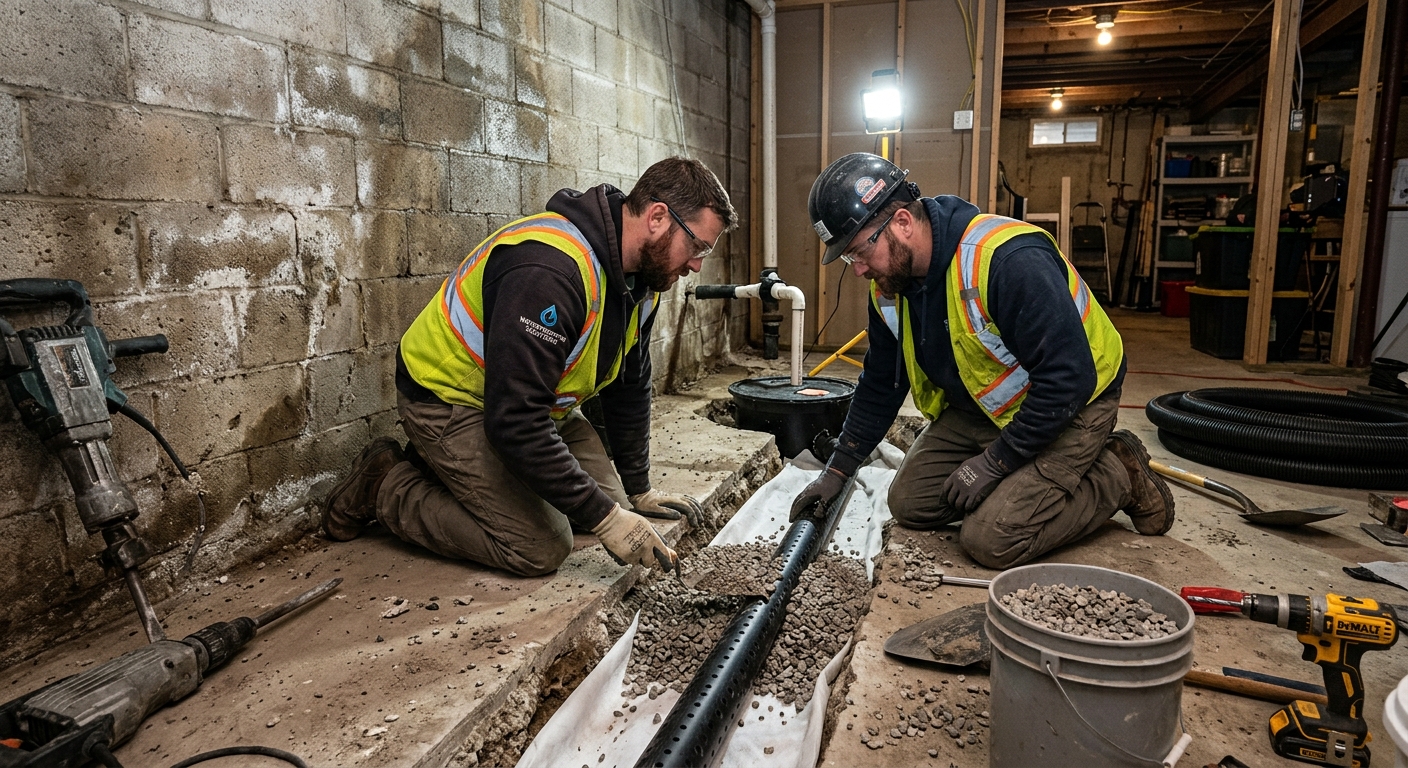
The fundamental difference in Westfort is whether you address the water entry point or manage the water after it enters. Exterior waterproofing means full excavation along the foundation, installation of a new membrane, replacement (or upgrading) of drainage tile, and correct backfill and grading. This approach is typically the most permanent because it relieves hydrostatic pressure at the wall/footing level. The trade-off is higher cost and more disruption: landscaping removal, disposal, and restoration are common, especially on established lots.
Interior waterproofing—like a perimeter drain channel, sump pit, and sump pump—captures seepage after it enters. It’s usually less invasive and often the fastest path to improving day-to-day basement conditions. However, it does not eliminate hydrostatic pressure against the wall itself, so in Westfort’s clay-and-freeze–thaw conditions, interior systems are commonly best as part of a strategy when exterior access is limited or when symptoms are localized and manageable.
Given typical Toronto foundation types, poured concrete walls often respond well to properly prepared crack injection paired with drainage where needed. Block foundations, on the other hand, can have more paths for water to track through mortar joints and block voids, so interior drainage (and sometimes targeted injection) is frequently used as a practical complement. Because power outages can occur during spring events, a backup system for sump pumps is a wise add-on; it reduces the risk of a power-loss basement flood when groundwater levels spike.
As a dollar example, if your issue is one active crack or tie-hole seepage, crack injection in the $600–$3,000 band may be justified—especially when rest of perimeter is dry. But if multiple walls show dampness and efflorescence during thaw, exterior excavation and drainage can be worth the jump toward the $7,000–$25,000 exterior range because it tackles the source.
| Method |
Best For |
Addresses Source? |
Disruption |
Lifespan |
Price Band |
| Full exterior excavation + membrane |
Chronic seepage, high lateral pressure areas, failing exterior drainage/weeping tile, or multiple wet walls |
Yes (targets entry path by relieving hydrostatic pressure) |
High |
15–25 years+ |
$7,000–$25,000 |
| Interior French drain + sump system |
Water entering at the perimeter/footing; limited exterior access; recurring basement dampness or localized seepage |
No (manages water after entry) |
Moderate |
10–20 years with pump upkeep |
$3,500–$15,000 |
| Crack injection — epoxy (structural) |
Static cracks where water is not actively moving through under pressure |
Partial (seals the crack, but doesn’t replace failed drainage around the wall) |
Low to moderate |
5–15 years+ |
$600–$3,000 |
| Crack injection — polyurethane (active leak) |
Active leaks, flowing water through cracks/tie holes where flexible sealing is needed |
Partial (stops specific pathways, but doesn’t relieve overall hydrostatic pressure) |
Low to moderate |
5–15 years+ |
$600–$3,000 |
| Interior drain channel only (no sump) |
Light to moderate dampness where water can be controlled without frequent pump cycling |
No (relies on capturing seepage and routing it without active pumping) |
Moderate |
5–10 years (depends heavily on water volume and site conditions) |
$2,000–$8,000 |
| Re-grading + downspout extensions |
Surface-water problems, gutter overflow, and early dampness symptoms near window wells or corners |
Sometimes (reduces driving water against the foundation, but may not fix deep seepage) |
Low to moderate |
5–10 years |
$1,200–$6,000 |
How to choose a waterproofing contractor in Westfort
When you’re comparing waterproofing contractors in Westfort, Ontario, the goal is to confirm they’re properly licensed, insured, and accountable—then to ensure their scope matches your actual water pathway. Start by verifying Ontario licensing: ask for their Ontario business registration details and the relevant licensing/registration information for the work they’re doing. Next, request proof of general liability insurance (certificate of insurance) and confirm coverage dates match your project window. For WSIB/WCB, ask for a clearance letter or proof of coverage; you don’t want to discover later that subcontractors aren’t covered.
Then get 2–3 itemized written quotes. A good quote breaks down labour and materials separately (excavation, membranes, drainage tile, disposal, pump equipment, electrical tie-ins), and it lists what’s included in prep work like crack cleaning, efflorescence removal, and concrete chipping. Watch the exclusions section: ask whether disposal is included, whether permit pull is included, and how landscaping restoration will be handled (topsoil, sod/seeding, grading). Warranty matters too: ask for workmanship warranty length, whether the product warranty is separate, and if the warranty is transferable to future owners. Finally, payment schedule should be sensible—never pay more than 10–15% upfront; keep a holdback until substantial completion and cleanup are done. Ask for a firm start date and a realistic completion estimate in writing.
- Ask for photos or a written assessment showing where water is entering (not just where it pools).
- Confirm whether they recommend exterior, interior, or both—and why based on your crack type and staining.
- Check that their quote includes sump discharge routing details and backup option if needed.
- Verify permit responsibilities: who pulls permits and what work requires approval.
- Confirm disposal is included for excavated soils and damaged materials.
- Make sure crack injection includes prep requirements (surface cleaning, proper ports, cure times).
- Ask for the membrane system components (type, thickness/grade, manufacturer details).
- Review the warranty: workmanship term, what conditions void it, and whether it transfers.
- Request references from comparable Westfort-type basements (clay, older drains, tight access).
- Confirm they include finishing restoration (grading, topsoil depth, and downspout extensions).
- Use holdback language in writing until final inspection and testing are completed.
- Ensure the contract spells out timelines and weather delays.
Red flags I see in Westfort include: quotes that avoid discussing soil water conditions or crack activity, “one price fits all” proposals with no breakdown of labour/materials, no written warranty details, claiming they can connect drainage/pumps to municipal services without approvals, and asking for a large upfront deposit without a clear schedule.
Frequently asked questions — waterproofing in Westfort
How long does waterproofing last?
In Westfort, the lifespan depends on whether the system addresses the water entry path or mainly manages it after it arrives. Exterior waterproofing with a proper membrane and new drainage tile typically lasts 15–25 years+ when detailed correctly and paired with sensible downspout drainage and grading. Interior systems (perimeter drain channel and sump) are often very effective but rely on ongoing performance of the pump and sealed penetrations; many homes see 10–20 years of reliable service with routine upkeep. Targeted crack injection can last 5–15 years+ depending on whether the crack is truly static or actively moving during freeze–thaw. If your home is from the post-war era, original drainage may be near the end of life, which is why proactive updates can extend performance beyond what short-term repairs achieve. (Statistics Canada, 2021 Census)
Can I waterproof my basement from the inside only?
Yes, many Westfort basements are improved with interior waterproofing, especially when exterior access is limited by landscaping, decks, driveways, or tight lot lines. Interior perimeter drains and a sump pit capture seepage at the base and reduce interior dampness and flooding risk. However, interior work does not relieve the wall’s hydrostatic pressure in the way exterior excavation does—so if you have multiple wet walls, ongoing efflorescence across seasons, or very active leaks tied to lateral soil pressure, interior-only can be a partial solution. For some homeowners, a hybrid approach works well: crack injection (often in the $600–$3,000 band) plus an interior drain/sump. If interior-only is chosen, make sure the sump plan includes a backup strategy, because spring saturation and power interruptions can quickly overwhelm a single pump.
What causes foundation cracks in Westfort?
In Ontario basements like those in Westfort, foundation cracks usually come from a combination of movement and moisture. Freeze–thaw cycles widen small defects as water in the concrete/blocks expands during thaw-freeze transitions, turning hairline cracks into active leaks over a few winters. Clay-heavy soils can also contribute: when saturated, clay expands and exerts lateral pressure on foundation walls, worsening separation around cold joints, tie holes, and areas where the foundation geometry changes (additions, transitions, or older patches). Poor drainage around the foundation—like downspouts that discharge too close to the wall—can keep the ground consistently wet and increase the rate of deterioration. Finally, older drainage systems (weeping tile that’s clogged or failed) can increase how often the foundation perimeter is saturated, which makes cracks appear and leak more predictably during seasonal thaws.
How do I compare waterproofing quotes?
To compare quotes in Westfort, require itemized scopes and make sure the method matches the water entry pathway. Look for breakdowns that separate labour vs materials (membrane system components, drainage tile, disposal, sump equipment, and electrical tie-ins). Ask what is included for prep work: crack cleaning, efflorescence/mould remediation, and how they protect openings during work. Confirm whether disposal and landscaping restoration are included for exterior work. Also check warranty details and whether product warranties are manufacturer-backed. A quote that’s lower but leaves out key pieces—like backup power for sump pumps, appropriate drainage tile detail, or engineering support for structural cracks—often costs more later. As a quick reference point, a proper interior drainage/sump scope commonly sits within the $3,500–$15,000 band, while exterior excavation and membrane work usually aligns closer to the $7,000–$25,000 range, depending on access.
How long does basement waterproofing take in Westfort?
Typical timelines depend on whether the job is interior, exterior, or crack-focused. Interior perimeter drains and sump installation can often be completed faster because it’s largely contained within the basement; many Westfort projects run in the range of several days to about 1–2 weeks including drying time and finish reinstatement. Crack injection is usually the quickest path—often a short schedule when only localized work is needed. Exterior excavation is more weather- and logistics-dependent in Toronto: excavation, membrane and drainage tile installation, backfilling, and then landscaping restoration can extend timelines, especially with tight access or deck/driveway constraints. Contractors also need time for cures and for verifying discharge routing and pump operation. Ask your contractor for a start date, a completion target, and what happens if freeze–thaw conditions delay cure or backfill work.
What is a weeping tile and does my Westfort home have one?
A weeping tile is the perimeter drain system installed around many basements to collect groundwater and seepage, then direct it to a sump pit or discharge location. In Westfort, many older homes likely have some form of original clay weeping tile, while others used earlier plastic drains—either way, these systems often partially collapse or clog after decades. You may not be able to see it directly without opening sections of the foundation perimeter, but signs include persistent damp corners, efflorescence near joints, and basement flooding patterns during spring thaw even when there’s no obvious exterior wall failure. If your home is from the post-war or 1960–1980s era, it’s reasonable to assume the original system may be near end-of-life. A contractor can confirm drainage condition by inspection openings and by reviewing how water responds during rain and thaw seasons, then deciding whether replacing tile is needed as part of interior or exterior waterproofing.