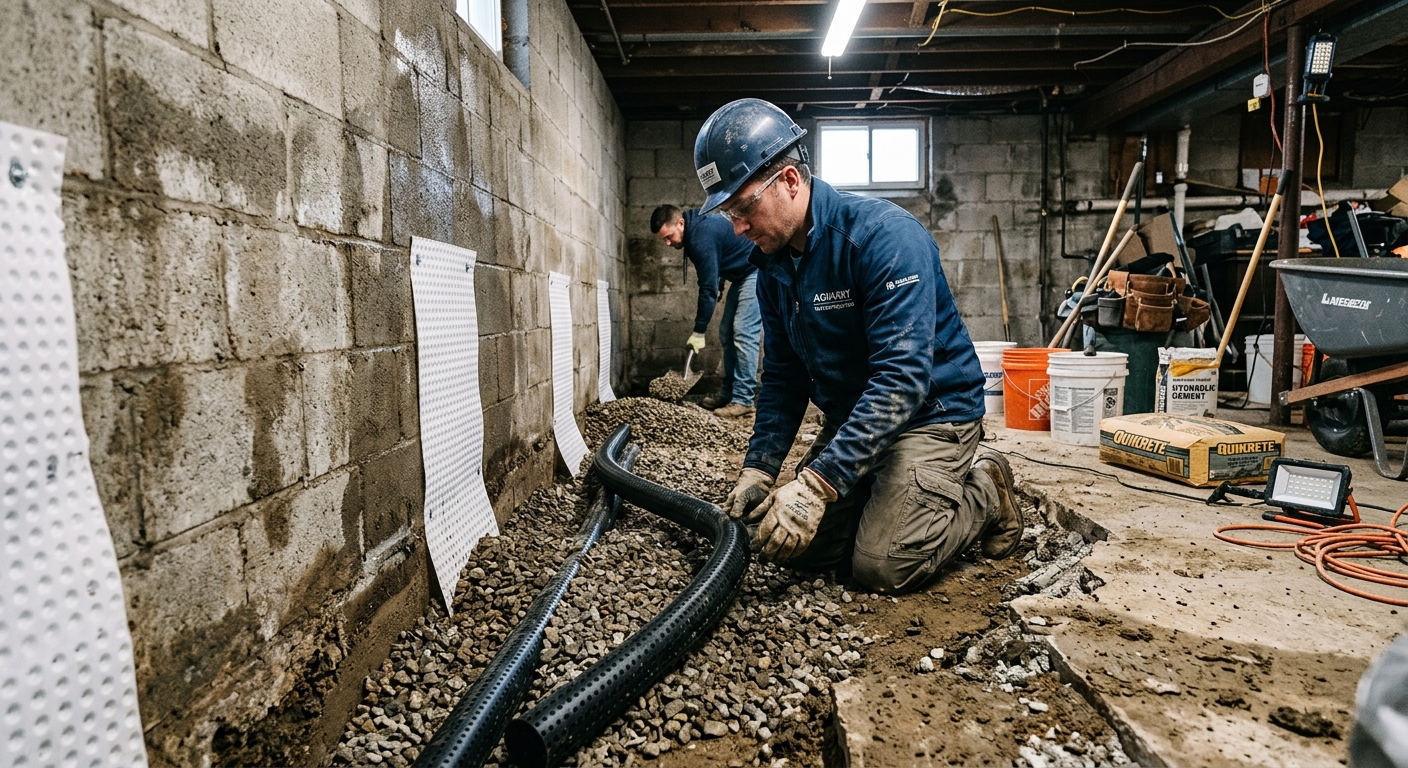
Basement waterproofing options and costs in Oakville
Oakville homeowners typically feel the first signs of basement water the same way: damp concrete smell, a salt-like chalky film (efflorescence), or slow seepage along the perimeter—often long before a wall looks “damaged.” That’s why the best waterproofing approach depends on whether your house is experiencing active seepage through cracks/holes or hydrostatic pressure pushing water through cold joints and older drainage systems. In Oakville’s housing stock, 27.0% of homes were built before 1981, which matters because many original systems (tar-and-paper style coatings and older weeping tile or early drain lines) are now well beyond their expected service life. When drainage fails, water is trapped in clay soils near the foundation and the freeze–thaw cycle in the Toronto area can widen tiny defects over a few winters.
Costs can also vary because of Oakville lot conditions. In areas with mature landscaping and tight side yard setbacks, contractors often need careful hand-digging around additions, patios, or deck footings, and disposal and access work can add hours. Where demand is especially high, like in the north Oakville and Kerr Village–area pockets with older post-war homes, homeowners frequently call for either full exterior corrections or a combination of interior drainage plus targeted crack work.
Below is a practical comparison of the common methods contractors use in Oakville, along with typical durability and the price band you should expect to see in itemised proposals—then you can match options to your symptoms and foundation condition in the table.
| Method |
What It Addresses |
Disruption Level |
Durability |
Price Range |
| Exterior excavation + new membrane + drainage tile |
Primary source of water entry by redirecting water away from foundation; replaces failing weeping tile and re-establishes drainage system |
High (excavation, landscaping restoration, backfill) |
Long-term when installed to correct slope and with proper membrane detailing |
$7,000–$25,000 |
| Interior perimeter drain channel + sump pit |
Water that enters through cracks/joints by capturing and pumping it away |
Medium (saw-cutting, interior floor/footing work) |
Very good when paired with a reliable pump and proper discharge routing |
$3,500–$15,000 |
| Foundation crack injection (epoxy or polyurethane) |
Isolated crack leaks by sealing flow paths (epoxy for structural/stable cracks; polyurethane for active leaks) |
Low to Medium (minor interior/exterior surface prep) |
Good for correctly identified crack type; may need complementary drainage if hydrostatic pressure persists |
$600–$3,000 |
| Sump pump installation (primary + battery backup) |
Reduces basement water accumulation during high water table seasons and power interruptions |
Low to Medium (pit, discharge line, minor interior work) |
Strong protection when backup system and alarms are included |
$800–$3,500 |
| Window well drain installation |
Controls surface water infiltration around window wells and directs it away from the opening |
Low to Medium (well excavation and liner changes) |
Good when slopes and discharge are maintained seasonally |
$1,200–$4,500 |
| Lot re-grading / downspout extension |
Stops roof runoff from soaking soil near the foundation; improves surface drainage |
Low (groundwork) to Medium (restoration depending on access) |
Good for surface-water issues; less effective for deep hydrostatic pressure |
$1,000–$6,000 |
Prices are estimates only and vary by project scope, site access and material selection.
What affects the price of waterproofing in Oakville
In Oakville, even two homes with “the same” damp basement can come in 30–50% apart because the quote follows different assumptions: where the water is entering, whether drainage systems are partially collapsed, and how difficult it is to reach the foundation in a mature neighbourhood. Toronto-area labour and material availability also influence scheduling—when crews are booked around spring thaw, excavation and membrane work can carry higher mobilization and disposal costs.
The three biggest regional drivers that separate Oakville pricing from the national average are soil type, water table behaviour, and freeze–thaw cycles. In much of the Greater Toronto Area, mixed glacial till and dense clay pockets can hold water against foundation walls and expand when saturated. That lateral pressure worsens cracks at cold joints, tie holes, and block seams. During Ontario’s freeze–thaw, small defects widen, and seepage shifts from “dry most of the year” to “active during heavy spring rain.” When high water tables or clogged weepers are the issue, sump pump run times rise and the project can require interior drainage plus primary and backup pumping.
Concrete examples help explain the money: (1) A 1960–1970s home with original clay weeping tile that’s partially collapsed often pushes you toward exterior waterproofing or a full interior perimeter drain + sump system—interior-only work can be $3,500–$15,000, but exterior excavation can jump into the $7,000–$25,000 range when access and membrane detailing are required. (2) If you have efflorescence and dampness after heavy rain but no obvious wall failure, you may pay for interior drainage rather than full excavation. (3) Conversely, an isolated crack repair might stay near $600–$3,000 when the crack type is stable and you don’t have chronic hydrostatic pressure.
Age of housing also matters. With 27.0% of Oakville homes built before 1981, failing drainage and degraded coatings are simply more frequent, which increases the likelihood that contractors must address both waterproofing and drainage system replacement.
| Price Factor |
Why It Matters |
Cost Impact |
| Interior vs. exterior approach — interior is less disruptive but addresses symptoms |
Exterior typically replaces the water-management system at the source; interior often captures water after entry |
Exterior can cost materially more due to excavation and restoration (commonly shifts you toward the $7,000–$25,000 band) |
| Foundation type — poured concrete vs. block vs. stone vs. ICF |
Block and older wall assemblies often require different detailing and may perform differently under lateral clay pressure |
Can change labour and materials; crack strategy and drainage sizing may alter pricing by thousands |
| Soil type — clay expands more than sand, adding pressure |
Clay saturation increases hydrostatic pressure and can overwhelm limited surface grading solutions |
Higher likelihood of needing perimeter drainage and/or exterior membrane and tile; pushes toward upper ranges |
| Crack type and length — hairline vs. structural horizontal cracks |
Structural/horizontal cracking can indicate movement and may require engineering assessment |
Hairline vertical cracks may be injected around the $600–$3,000 band; structural repair can exceed that |
| Sump pump backup system — battery or water-powered backup needed |
Spring storms and power outages can make primary pump failure costly |
Often adds to total cost; commonly brings sump projects closer to the $800–$3,500 band |
| Access — landscaping, decks, or driveways must be removed for exterior |
Excavation around additions, mature trees, and shared driveways increases labour and disposal |
Exterior projects can rise quickly when removal/restoration is extensive |
| Weeping tile age — original tile (60+ years) may be completely failed |
Old drains clog or collapse, forcing water to migrate to cracks and wall joints |
More likely to require replacement (exterior) or intensive interior drainage; shifts you toward higher exterior or combined scopes |
| Mould or efflorescence remediation required before sealing |
Sealers and membranes won’t perform well over contaminated or actively wet surfaces without prep |
Adds steps and labour; can delay sealing until moisture levels drop |
Permits & regulations in Ontario
In Ontario, foundation excavation and drainage modifications commonly require a building permit, especially when the work affects structural elements or changes lot drainage pathways near the foundation. Structural crack repair is another area where permits and oversight are often expected—particularly if you’re dealing with horizontal cracks in masonry/block walls or signs of movement that may require underpinning or other structural measures. Sump pump installations that connect into storm or sanitary infrastructure usually need municipal approval before discharge routing is finalized.
Step one for homeowners in Oakville: ask the contractor, in writing, which items require permits for your specific scope (e.g., exterior excavation, changes to discharge location, structural crack repair). Step two: verify the company is properly licensed where applicable, and confirm they carry liability insurance and WSIB/WCB coverage for their workers. You should be able to request (and receive) a certificate of insurance with the correct company name and coverage dates.
Step three: if the job involves structural crack conditions, require proof the contractor has access to an engineer assessment or engineered repair plan. Step four: confirm whether permit pulling is included in the quote and who is responsible for inspection scheduling. Finally, request clearance documentation where applicable for the work type—before construction starts—so you know the project is compliant from day one.
Interior vs exterior waterproofing — what does Oakville need?
Exterior waterproofing is the “source control” option. It involves full excavation to the foundation level, installing a continuous membrane, replacing or installing drainage tile, and then backfilling and restoring grading. Done correctly, it manages water before it ever reaches the wall. The trade-off is disruption: excavation is labour-intensive, can require landscaping removal, and restoration typically affects patios, beds, and sometimes driveways. In Oakville’s clay-heavy pockets, exterior work is often the most reliable way to relieve lateral pressure—especially when original drainage systems are failing.
Interior waterproofing is “symptom management.” It uses a perimeter drain channel and often a sump pit/pump to collect water that already enters through cracks and joints. It’s generally less invasive and can be a great choice when excavation access is constrained or when the leak is limited to specific areas. However, interior systems do not stop hydrostatic pressure from acting on the foundation wall itself, so they’re usually best as a practical complement—particularly for older block foundations where the wall assembly can be harder to seal fully from the inside.
Crack injection fits between these approaches. In Oakville, poured concrete walls often respond well to targeted crack injection when the cracks are stable; for example, sealing an isolated leak with injection work may fall near the $600–$3,000 band. But if you have active seepage or chronic water pressure, injection alone may not hold—then you budget for interior drainage and possibly a sump backup.
Power reliability is a real consideration here. Ontario spring flooding and heavy rain can coincide with outages, so a sump pump with battery backup (or a suitable backup system) can prevent water accumulation during a failure window.
As a concrete example: if exterior excavation is $7,000–$25,000 because access is limited and membranes require careful detailing, but your leak pattern shows mostly surface runoff and a short crack line, you may justify a smaller scope—interior perimeter drainage and sump work can be $3,500–$15,000, while isolated crack injection can stay closer to $600–$3,000 when hydrostatic pressure is controlled.
| Method |
Best For |
Addresses Source? |
Disruption |
Lifespan |
Price Band |
| Full exterior excavation + membrane |
Chronic seepage with high water pressure, failing weeping tile, or clay soil holding moisture near walls |
Yes |
High |
Long-term with correct membrane continuity and drainage slopes |
$7,000–$25,000 |
| Interior French drain + sump system |
Basements where water enters through multiple cracks/joints, or where exterior access is limited |
Mostly (captures and manages after entry) |
Medium |
Very good with properly sized pump and discharge |
$3,500–$15,000 |
| Crack injection — epoxy (structural) |
Stable, non-moving cracks (often in poured concrete) where the leak path is clearly isolated |
Partial (seals the leak path) |
Low to Medium |
Good when crack stability is confirmed |
$600–$3,000 |
| Crack injection — polyurethane (active leak) |
Active seepage through cracks, including water-pressurised paths where flexibility is needed |
Partial (seals flow under movement/flow) |
Low to Medium |
Good for active leaks when paired with correct drainage strategy |
$800–$3,500 |
| Interior drain channel only (no sump) |
Light seepage/dampness where water amounts are manageable and can be directed without a pump |
No (does not remove water reliably during peak events) |
Medium |
Variable; depends heavily on water pressure and gravity discharge |
$2,000–$8,000 |
| Re-grading + downspout extensions |
Surface water issues after storms or poor roof runoff control |
No (addresses how water reaches the foundation) |
Low to Medium |
Good when maintained and when it’s truly the main cause |
$1,000–$6,000 |
How to choose a waterproofing contractor in Oakville
Start by verifying insurance and coverage, not just credentials on a website. For liability insurance, request a certificate of insurance and confirm it’s issued to the correct legal business name and includes coverage for the type of work being performed (exterior excavation, interior drainage, crack injection). For WSIB/WCB, ask for proof of clearance or coverage status for their workers—this is especially important on excavation and saw-cutting jobs where worker exposure increases.
Next, get 2–3 itemised written quotes. The best quotes separate labour, materials, and disposal, and they list what’s included (permit pull, engineering support if structural cracks are suspected, dehumidification or mould remediation prep if needed). A lump-sum quote without scope details is risky because waterproofing performance depends on membrane continuity, drainage slope, crack mapping, and discharge routing.
Warranty matters twice: workmanship and product. Ask for the length of the installation warranty, what it covers (materials, labour, exclusions), whether the warranty is transferable to a future homeowner, and if the manufacturer offers a separate product warranty. For payment scheduling, never allow more than about 10–15% upfront; hold back a portion until key milestones are verified (e.g., membrane installation and backfill inspection, pump testing, and final restoration). Finally, insist on a written start date and a completion estimate, including weather-dependent work windows in Oakville’s spring freeze–thaw conditions.
- Ask how they identify the leak source (inspection method, dye/water testing, crack mapping).
- Request a scope that states what is included in excavation, membrane, and drainage—plus restoration limits.
- Confirm whether permit pulling is included and who submits/coordinates it.
- Verify certificate of liability insurance and coverage dates before work begins.
- Provide WSIB/WCB clearance proof (or equivalent documentation for the workforce).
- Ask if they include disposal/haul-away in the quote.
- Ensure discharge routing is described (where water goes, and how it prevents re-entry).
- For sums, confirm primary pump sizing and the exact backup system (battery type or alternative backup).
- Get the warranty in writing—workmanship term and product/manufacturer terms.
- Confirm whether warranty is transferable on sale.
- Review exclusions: mould treatment, structural engineering, underpinning, and landscape restoration scope.
- Use milestone-based payments and request a signed schedule of holdback.
In Oakville, red flags I see too often include: quotes that skip a site inspection and only “estimate by the square foot,” promises to “guarantee no water forever” without documenting soil/water conditions, refusing to put permit responsibility and warranty details in the contract, vague discharge plans for sump systems, and asking for large upfront payments (often more than 15%) without a clear milestone schedule.
Frequently asked questions — waterproofing in Oakville
What causes foundation cracks in Oakville?
In Oakville, foundation cracks are commonly driven by movement and moisture: clay-rich soils can expand when saturated, increasing lateral pressure on foundation walls, and then contract again as soils dry. Over time, freeze–thaw cycles can widen small defects and turn hairline cracks into active seepage points, especially at cold joints and around tie holes. Age also plays a role—because 27.0% of homes were built before 1981, many have older construction details and drainage that don’t manage water the same way newer systems do. If you see cracks near window wells, along corners, or where downspouts discharge toward the foundation, that can signal water management problems rather than isolated “structural failure.” If cracks are horizontal or show signs of movement, get an engineering assessment before sealing only.
How do I compare waterproofing quotes?
When comparing waterproofing quotes in Oakville, don’t look only at the total price—compare the scope line-by-line. A true comparison will specify the method (exterior excavation vs. interior perimeter drain vs. crack injection), the extent of excavation/disposal, whether a membrane and new drainage tile are included, and how discharge is routed. Ask each contractor what’s excluded (permit pulling, restoration, engineering, mould remediation). For example, exterior excavation/membrane work commonly falls in the $7,000–$25,000 band, while interior drainage and weeping tile solutions are more often in the $3,500–$15,000 band. If one quote is far lower, it may be treating symptoms only (interior) when your site conditions suggest source control (exterior). Finally, verify warranty type and workmanship term—performance depends on correct installation details, not just products.
How long does basement waterproofing take in Oakville?
Typical timelines vary based on whether you’re doing exterior excavation or interior work. Interior perimeter drain + sump systems often take days to a couple of weeks depending on floor/foundation access, number of tie-ins, and drying/curing requirements. Crack injection can be completed faster—sometimes within a few days for the mapped sections—provided prep and sealing conditions are met. Exterior excavation usually takes longer because crews must excavate around landscaping, install membrane and new drainage tile, complete backfill, and then coordinate restoration. Oakville’s freeze–thaw season can also affect scheduling; contractors frequently plan excavation and membrane work around temperatures that allow proper curing and backfill conditions. Ask for a written start date and a completion estimate in the contract, and confirm how weather impacts your specific schedule.
What is a weeping tile and does my Oakville home have one?
A weeping tile (also called a foundation drain) is the drain system installed around or near a foundation, designed to collect groundwater and redirect it to a safe discharge point—often via gravity or into a sump pit. Many homes built before 1981 in Oakville are more likely to have older clay weeping tile or early drain configurations, and those systems can become partially collapsed or clogged after decades of soil movement and freeze–thaw. To confirm if your home has one, check basement records, older photos, or prior inspection reports. You can also ask a contractor to perform a dye or exploratory assessment near the sump area (if present) or trace the drain outlet where it exits to the discharge point. If you do not have an obvious sump, you might still have buried weepers that have failed over time, which can present as dampness and efflorescence.
Can I waterproof my basement in winter in Oakville?
It can be possible, but it depends on conditions and the waterproofing method. In Oakville, winter brings deeper freezing into soil and foundation areas, and that can make exterior excavation difficult and can affect curing of sealants and membranes. Interior work is often more feasible because floors and walls are inside, but you still need surfaces dry enough for proper installation and adhesion. If your basement is actively leaking due to freeze–thaw pressure, some systems—like certain crack injection methods—may still be scheduled, but the contractor must confirm that the leak conditions and surface prep are manageable. If you’re dealing with high water pressure issues typical of clay-heavy ground and elevated water conditions, contractors may recommend planning exterior drainage and membrane work for periods that allow proper backfill and slope performance. Ask the contractor how they manage temperature and moisture testing during winter.
What is the difference between waterproofing and damp-proofing?
In everyday language, people use the terms interchangeably, but in Ontario practice they’re different in intent. Waterproofing is designed to manage water entry and direct it safely—either by stopping water at the source (often through exterior membrane and drainage tile) or by capturing it with interior perimeter drains and sump pumping. Damp-proofing generally means coatings or measures aimed at reducing moisture penetration, often for minor dampness rather than active leaks under hydrostatic pressure. In Oakville’s climate, where freeze–thaw and saturated clay soils can increase lateral pressure, damp-proofing alone can fall short if water pressure is pushing through cracks and joints. That’s why projects with chronic seepage may need interior drainage and a sump system (frequently $3,500–$15,000 for more complete scopes) or exterior excavation and membrane (often $7,000–$25,000) when source control is required.