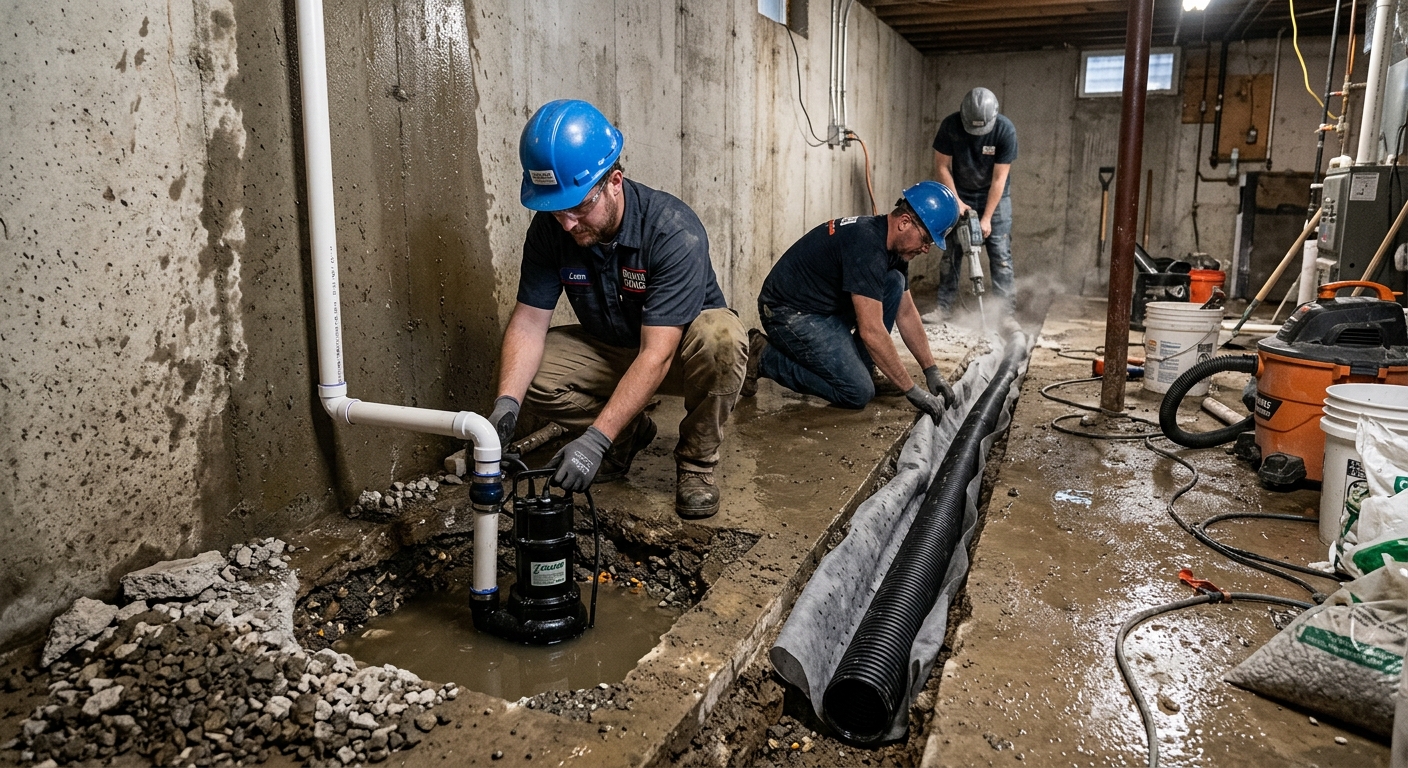
Basement waterproofing options and costs in Vineland
Basement waterproofing in Vineland usually starts with identifying where the water is coming from—groundwater, surface runoff, or an active leak through a crack—and then matching the method to soil pressure and drainage conditions. Vineland is a small community within the Toronto economic region, and local homeowners often run into similar failures as nearby Toronto: older drainage systems, freeze–thaw movement, and clay-heavy backfill that holds water against foundations. With a 2021 population of 4,074 (Statistics Canada, 2021 Census), Vineland may feel “quiet,” but the surrounding demand still drives pricing and scheduling because crews travel in from the Greater Toronto Area.
Two common realities shape costs here. First, many basements in the region are in post-war and 1960–1980s homes, when original weeping tile and early plastic drains were installed without the later understanding of high water-table dynamics. When those original systems fail (sometimes after 60+ years), dampness and efflorescence can appear long before there’s obvious exterior failure. Second, the freeze–thaw cycles in southern Ontario expand small defects—cold joints, tie holes, and cracks—so a “dry” basement can become an active seepage problem after a few winters.
Contractors in the Lincoln / Vineland area also see access constraints more often than homeowners expect: rear additions, tight lots, and working around decks or shared driveways. In demand pockets are typically near older housing clusters and established neighbourhood streets where excavation is harder, so exterior work can be priced higher. Below is a practical comparison to help you translate your symptoms into the right scope and budget before you request quotes.
| Method |
What It Addresses |
Disruption Level |
Durability |
Price Range |
| Exterior excavation + new membrane + drainage tile |
Stops water at the source; relieves hydrostatic/lateral pressure |
High (full dig, landscaping restoration) |
Long-term when installed to depth and properly backfilled |
$7,500 – $25,000 |
| Interior perimeter drain channel + sump pit |
Collects seepage after it enters; reduces water seepage and flooding |
Medium (floor/edge work, limited yard impact) |
Very good for ongoing seepage when drainage discharge is planned |
$3,500 – $14,500 |
| Foundation crack injection (epoxy or polyurethane) |
Seals isolated cracks; epoxy for structural cracks, polyurethane for active leaks |
Low (spot repairs) |
Good when the crack is the correct cause and surface prep is thorough |
$600 – $3,000 |
| Sump pump installation (primary + battery backup) |
Moves collected water away; battery backup helps during outages |
Medium-low (drainage and pit work) |
High reliability with proper discharge and service access |
$1,200 – $3,500 |
| Window well drain installation |
Prevents water pooling at egress/window areas |
Low-medium (excavation around openings) |
Solid when tied to a proper discharge/collection route |
$900 – $2,800 |
| Lot re-grading / downspout extension |
Reduces surface water at foundation; relieves saturated soil near walls |
Low (surface changes) |
Best for surface-runoff driven issues |
$650 – $4,000 |
Prices are estimates only and vary by project scope, site access and material selection.
What affects the price of waterproofing in Vineland
In Vineland and across the Toronto area, two quotes for what looks like the “same” basement waterproofing job can differ by 30–50%. The variation is usually not the material—it’s the site conditions and the amount of labour required to correct the real water path. Even within the same region, contractors may propose different combinations of exterior excavation, interior drainage, and targeted crack repair depending on whether water is coming from the soil side (lateral pressure and water-table saturation) or from localized defects (cold joints, tie holes, or cracking).
Three local drivers typically separate Toronto-area pricing from the national average: soil type, water table, and freeze–thaw. Mixed glacial till and pockets of dense clay can hold water against foundation walls and exert lateral pressure, which can worsen cracks over time. When freeze–thaw cycles hit small defects in poured concrete or block foundations, repairs that “look fixed” can re-open, creating additional labour in later seasons. Higher local water-table conditions also mean sump systems may need stronger pumps, backup power, and carefully planned discharge routes.
Practical examples homeowners notice in Vineland include: (1) clay-heavy backfill around a basement perimeter that stays saturated longer—this often pushes costs upward because it can require excavation and membrane work rather than only an interior drain; (2) older weeping tile that has collapsed or clogged—this increases the likelihood that interior drains and sometimes new sump components are required; and (3) tight side yard access where decks, fencing, or driveway edges must be removed for exterior excavation, increasing labour and disposal.
As a ballpark, exterior waterproofing (excavation) is commonly in the $7,000–$25,000 range, while interior waterproofing / weeping tile scopes tend to land around $3,500–$15,000. A home that only needs targeted crack injection can come in closer to $600–$3,000, but that price only holds when the crack is the true source—not a symptom of recurring hydrostatic pressure.
| Price Factor |
Why It Matters |
Cost Impact |
| Interior vs. exterior approach — interior is less disruptive but addresses symptoms |
Exterior corrects water entry; interior manages water after entry |
Interior can be 30–60% cheaper, but may not solve source pressure |
| Foundation type — poured concrete vs. block vs. stone vs. ICF |
Different crack patterns and joint performance change labour and method |
Block and older stone often require more prep and interior drainage |
| Soil type — clay expands more than sand, adding pressure |
Clay saturation increases hydrostatic and lateral pressure |
Clay-heavy sites often push scope toward exterior or combined systems |
| Crack type and length — hairline vs. structural horizontal cracks |
Structural cracks may require engineering assessment and more work |
Horizontal/structural cracks can multiply repair cost and duration |
| Sump pump backup system — battery or water-powered backup needed |
Reduces risk of flooding during outages in spring wet cycles |
Backup can add roughly $300–$1,500 depending on configuration |
| Access — landscaping, decks, or driveways must be removed for exterior |
More removal/disposal and careful restoration increases labour |
Commonly increases exterior pricing by thousands in tight lots |
| Weeping tile age — original tile (60+ years) may be completely failed |
Failed drains increase seepage volume and require rerouting/repair |
Often shifts from “repair” to “replacement” drainage scope |
| Mould or efflorescence remediation required before sealing |
Moisture must be controlled before coatings/injection can bond reliably |
Remediation can add time, materials, and cleaning labour |
Permits & regulations in Ontario
In Ontario, waterproofing projects are often straightforward, but some scopes do require approvals—especially anything that affects structural performance or lot drainage systems. In many cases, foundation excavation, structural crack repair (for example, horizontal cracks in block walls or step cracks that suggest structural movement), and changes to how water is managed at the property line typically require a building permit. Also, sump pump installations that connect to the storm or sanitary sewer usually require municipal approval before discharge.
For structural crack repair, Ontario practice commonly involves a structural engineer’s assessment first when the crack pattern indicates possible movement. That report helps determine whether the job is “seal and monitor” (injection only) or whether additional work like underpinning or other structural measures is needed.
To protect yourself, verify the contractor carries engineering support where structural work is recommended, along with liability insurance and WSIB/WCB coverage (or proof of coverage where applicable). Step-by-step for homeowners in Vineland: (1) ask for the contractor’s WSIB/WCB clearance details and check the certificate; (2) request a current certificate of insurance showing liability coverage relevant to basement/waterproofing; (3) confirm whether engineering is included for structural crack cases; (4) ask who pulls the permit and whether it’s included in the written proposal; and (5) review the contract for exclusions like “permit not included” or “disposal not included.” If they can’t clearly explain the permit and insurance pieces, treat it as a risk signal.
Interior vs exterior waterproofing — what does Vineland need?
The fundamental difference is source control versus water management. Exterior waterproofing—full excavation, membrane application, new drainage tile, and backfill—targets the water entry point. When installed correctly to the right depth and paired with a functioning drainage discharge route, it reduces the hydrostatic pressure pushing on foundation walls. The trade-off is cost and disruption: exterior work often means removing landscaping, accessing around the foundation, and restoring the site afterward.
Interior waterproofing is designed to catch water after it enters the basement—typically through a perimeter drain channel, sump pit, and sump pump system. It’s generally less invasive and can be faster in tight lots, but it does not stop the wall from experiencing lateral pressure. In homes with poured concrete walls, crack injection often seals better when the wall movement isn’t active; for block foundations, interior drainage is frequently a practical complement because moisture can migrate through joints and small openings over time.
In Vineland’s freeze–thaw climate, sump pump redundancy matters for comfort and insurance outcomes. A battery backup system helps during spring rain events when power outages do occur, keeping the sump from stopping mid-storm. If the house has chronic seepage or past drainage failures, relying on an interior system without addressing discharge reliability can lead to repeat wet basements.
Example: if you have localized seepage at a few cracks with minimal evidence of saturated soil, a crack injection scope can be in the $600–$3,000 range. But if you’re seeing recurring dampness after heavy rains, an interior perimeter drain + sump commonly falls within the $3,500–$14,500 band, while exterior excavation + membrane and drainage tile is often $7,000–$25,000. The higher exterior cost is justified when clay-heavy soil and water-table pressure are consistently overwhelming the foundation without reliable source drainage.
| Method |
Best For |
Addresses Source? |
Disruption |
Lifespan |
Price Band |
| Full exterior excavation + membrane |
High hydrostatic pressure, repeated flooding, failed exterior drainage |
Yes |
High |
Long-term (proper drainage + backfill matters) |
$7,000 – $25,000 |
| Interior French drain + sump system |
Chronic seepage, clogged/failed weeping tile, tight access lots |
No (controls water after entry) |
Medium |
Very good with correct discharge and maintenance |
$3,500 – $15,000 |
| Crack injection — epoxy (structural) |
Cracks that are stable, typically non-active leakage |
Partial (seals the pathway, but doesn’t relieve pressure) |
Low |
Good when the crack isn’t moving seasonally |
$600 – $2,500 |
| Crack injection — polyurethane (active leak) |
Active weeps/streams or leaks under pressure |
Partial (seals the pathway to stop water entry) |
Low |
Good to very good when prepped and matched to conditions |
$800 – $3,000 |
| Interior drain channel only (no sump) |
Minor dampness where water volume is low and flow can be controlled |
No |
Low-medium |
Limited if water volume increases or discharge plan is weak |
$2,500 – $7,000 |
| Re-grading + downspout extensions |
Surface runoff issues, short wet spots after storms |
Helps reduce surface entry (not groundwater pressure) |
Low |
Moderate (depends on grading longevity) |
$650 – $4,000 |
How to choose a waterproofing contractor in Vineland
Choosing the right waterproofing contractor in Vineland is mostly about verifying coverage and making sure the scope matches your failure type. Start with Ontario licensing and proof of responsibility: ask for their liability insurance certificate and confirm the coverage is current and appropriate for basement waterproofing/excavation work. Next, request evidence of WSIB/WCB coverage and a clear clearance or account statement. If a contractor cannot provide documentation immediately, that’s a problem—water management projects can involve excavation, access work, and after-hours calls.
Then get 2–3 itemised written quotes. You want labour and materials breakdowns, not just a lump sum. A solid quote will spell out what’s included (permit pull included or not, disposal/dump fees included or not, how drainage discharge is handled, and what restoration is guaranteed). For warranties, look for both workmanship warranty length and the product/manufacturer warranty. Ask whether the warranty is transferable if you sell the home—this is often overlooked but matters to future owners.
For payment, keep the schedule safe: never pay more than 10–15% upfront; hold back until the job is complete and you’ve received the warranty paperwork. Finally, insist on a timeline in writing with a start date and completion estimate, and ask how they handle weather delays—especially in southern Ontario when freeze–thaw and spring rains can change conditions quickly.
- Confirm insurance certificate is current and matches the type of work (excavation and interior water control).
- Verify WSIB/WCB clearance/coverage documentation before work begins.
- Ask if permits are required for your scope; confirm who pulls them.
- Request an itemised proposal (labour, materials, pump/drain components, membrane type, disposal).
- Check exclusions: mould remediation, permit fees, landscape restoration, and disposal should be explicit.
- Require the discharge plan for sump systems (where water goes) and backup strategy.
- Ask how they determine whether a crack is active leak vs. stable structural crack (polyurethane vs. epoxy).
- Confirm site protection measures (plastic sheeting, dust control, crack monitoring if needed).
- Get warranty details in writing: workmanship length, product warranty, and transferability.
- Set a safe payment schedule: 10–15% max upfront; holdback at completion.
- Request photos/documentation during prep and after membrane/drain installation.
- Get a written schedule and weather-delay plan suited to Ontario spring/frost conditions.
Red flags in Vineland include: contractors who quote exterior work without addressing soil pressure/clay saturation, refusing to explain why they chose interior vs exterior for your specific water path, promising “guaranteed dryness” without citing drainage discharge and hydrostatic pressure, skipping insurance/WSIB proof until after you sign, and offering injection-only solutions for homes showing chronic seepage/efflorescence after heavy rains.
Frequently asked questions — waterproofing in Vineland
What is a battery backup sump pump and do I need one in Vineland?
A battery backup sump pump is a secondary power source that runs the sump pump when electricity fails, typically during storms or spring wet periods. In Ontario, outages are unpredictable, and when water is entering your basement faster than the pump can remove it, a power loss can quickly turn chronic seepage into a flood event. In Vineland, where freeze–thaw and heavy rain can coincide with higher groundwater pressure, battery backup is often recommended if you already have water during storms or if your home has a history of sump-related flooding.
Cost-wise, sump pump installations with primary + battery backup are commonly within the $800–$3,500 band depending on basin size, pump choice, and discharge details. If you’re debating it, ask your contractor to explain your discharge routing, alarm option, and whether your site’s water levels are likely to overwhelm a primary sump during an outage.
How much does basement waterproofing cost in Vineland?
In Vineland, the price depends on whether you’re treating water at the source (exterior) or managing it after it enters (interior). Exterior waterproofing (excavation with membrane and drainage tile) is typically estimated in the $7,000–$25,000 range because it involves significant labour, excavation around the foundation, and site restoration. Interior waterproofing—like a perimeter drain and sump pit—commonly lands in the $3,500–$15,000 range, especially when access is tight or when the main issue is failing weeping tile or cold-weather seepage.
For isolated leaks, foundation crack repair by injection may be closer to $600–$3,000, but that assumes the crack is the true cause and the surrounding wall isn’t being pressured by saturated clay soil. Always request an itemised scope so you understand what’s included (permits, disposal, and restoration) before comparing quotes.
Interior vs exterior waterproofing — which is better?
“Better” depends on your water path. Exterior waterproofing is generally best when water pressure from saturated clay soil is constantly pushing against foundation walls, or when exterior drainage is failed. It excavates, installs membrane, replaces/installs drainage tile, and addresses the source of water entry. That’s why the exterior range is commonly higher—$7,000–$25,000—especially where landscaping and access constraints add time.
Interior waterproofing is often the best practical solution when excavation is difficult or when you need to control recurring seepage quickly. Interior systems (perimeter drain channel + sump) manage water after it enters and typically fall around $3,500–$15,000. For poured concrete walls, targeted crack injection can help when cracks are stable; for block foundations, interior drainage is frequently a necessary complement. In many Vineland homes, a combined approach (crack injection + interior drainage) is the most realistic way to reduce future risk in freeze–thaw conditions.
Why is my basement leaking in Vineland?
Basement leaks in Vineland are usually caused by a mismatch between how the property manages water and the way Toronto-region soils and climate behave. The big triggers are clay-heavy soils holding water, higher local groundwater conditions, and freeze–thaw cycles that widen small defects in concrete and block foundations. Water can enter through cold joints, tie holes, or cracks and then migrate toward low points in the basement.
Another frequent driver is drainage failure: original weeping tile or older plastic drains can clog or collapse, creating interior dampness, efflorescence, and eventual flooding rather than an obvious exterior wall failure. If your basement leaks more after heavy rain or spring thaws, the issue is often connected to saturated backfill and lateral pressure. If it leaks in a very specific spot during storms, crack injection may be part of the answer—but if the crack is a symptom of hydrostatic pressure, interior drainage or exterior source control may still be required.
How do I know if a foundation crack is serious?
Not all cracks are the same. In Ontario and the Vineland area, hairline vertical cracks can be “cosmetic,” while wider or horizontal cracks in block walls (or step cracks) can indicate structural movement or loss of integrity in joints—conditions that need closer evaluation. Serious cracks are typically accompanied by signs of active moisture (tide-like seepage, water tracks, or recurring dampness), increased crack width over multiple seasons, or cracking that appears to “step” around block units.
Clues you should not ignore include: dampness or efflorescence along the crack line, repeated leaks after rain/spring thaw, cracks that widen following freeze–thaw cycles, and cracks that are actively leaking (streams or wet seep). A reputable contractor will assess whether the crack is stable or actively leaking before choosing epoxy (often for stable, structural) versus polyurethane (often for active leaks). If there’s any doubt about structural implications, ask for an engineering assessment before committing to injection-only repairs.
How much does foundation crack repair cost in Vineland?
Foundation crack repair in Vineland is often priced based on whether it’s an isolated crack and whether it’s actively leaking. For typical, targeted injection work, homeowners commonly see estimates in the $600–$3,000 range. Epoxy injection is usually associated with stable cracks where sealing the pathway is the main objective, while polyurethane injection is often used for active leaks under pressure. The total can increase if multiple crack segments are involved, if surface prep and crack cleaning require more labour, or if mould/efflorescence remediation must happen first to ensure good bonding.
It’s important to be cautious about low quotes: if your basement also shows ongoing dampness or water after heavy storms, crack injection alone may not solve the underlying pressure from saturated clay soil. In those cases, your contractor may recommend pairing crack work with an interior drain/sump (often $3,500–$15,000) or, when source control is necessary, exterior excavation and membrane (often $7,000–$25,000).