Basement waterproofing options and costs in Ajax
In Ajax, homeowners typically choose between exterior and interior basement waterproofing based on where the water is entering, how old the foundation drainage is, and how much disruption they can tolerate. With 23.1% of homes in the area built before 1981 (Statistics Canada, 2021 Census), many basements are dealing with aged tar-and-gravel-type systems, older weeping tile, and original drainage layouts that can fail after decades of freeze–thaw movement. In practice, that means a “classic” leak that starts as dampness or efflorescence can later turn into recurring seepage through cold joints, tie holes, or cracks that widen every winter.
Toronto-area soil conditions also affect both labour and materials. Ajax sits on mixed glacial till and clay pockets that hold water against foundations; when saturated, clay expands and adds lateral pressure to basement walls. On top of that, freeze–thaw cycles in southern Ontario can widen small defects, so contractors often need to budget for more prep work (cleaning, crack routing, and sealing) and for drainage improvements that can’t be rushed.
In Ajax’s growing demand zones—especially around older established pockets near Highway 2 and the broader west-end residential streets—waterproofing trades see steady call volume. Access constraints (tight lots, decks, and addition footprints) are common, which is why exterior excavation can land on the higher end of the pricing band.
Below is a realistic comparison of common solutions you’ll see in Ajax quotes, then we’ll break down what drives the pricing differences.
| Method |
What It Addresses |
Disruption Level |
Durability |
Price Range |
| Exterior excavation + new membrane + drainage tile |
Water pressure at the foundation line; replaces failing perimeter drainage and adds membrane barrier |
High (excavation, landscaping restoration) |
High (source control) |
$7,000–$25,000 |
| Interior perimeter drain channel + sump pit |
Captures seepage after it enters; reduces hydrostatic pressure at the basement floor/walls |
Medium (interior floor work) |
Medium to high (depends on wall condition and grading) |
$3,500–$15,000 |
| Foundation crack injection (epoxy or polyurethane) |
Isolated crack leaks; epoxy for stable cracks, polyurethane for active seepage |
Low to medium |
Medium (best with correct crack type and surface prep) |
$600–$3,000 |
| Sump pump installation (primary + battery backup) |
Manages recurring seepage in clay/water-table conditions and during spring high-water |
Low to medium |
Medium to high (pump quality and backup matter) |
$800–$3,500 |
| Window well drain installation |
Groundwater entry and runoff through window wells; improves drainage under weeping soil |
Low to medium |
Medium |
$1,000–$4,500 |
| Lot re-grading / downspout extension |
Redirects roof runoff away from the foundation and improves surface drainage |
Low |
Low to medium (works best when source water is mainly surface) |
$800–$6,000 |
Prices are estimates only and vary by project scope, site access and material selection.
What affects the price of waterproofing in Ajax
If you request quotes for the same basement problem in Ajax, it’s not unusual to see differences of 30–50% across the Greater Toronto Area. The biggest reason isn’t “overcharging”—it’s that the scope changes based on soil and water behaviour, the foundation type, and how much demolition is needed to reach the real source of moisture. In Ontario, the cost drivers that most often separate regional pricing from the national average are soil type, water table conditions, and freeze–thaw effects.
In Ajax, clay-heavy soils expand during freeze–thaw and can push laterally against foundation walls. That pressure can turn hairline cracking into an active leak after a few winters, so a quote for “crack injection only” may jump when inspections show multiple leaks or failing cold-joint conditions. High water-table areas also increase sump pump run times and the size/controls of the drainage components. By contrast, in regions where sand dominates and drainage is naturally faster, contractors may need less excavation and fewer drainage upgrades.
Two local examples that commonly raise cost in Ajax: (1) older drainage systems around pre-1981 homes—when original weeping tile is clogged or collapsed—often require exterior excavation rather than relying on interior drains alone; and (2) basements with efflorescence and ongoing dampness may need surface preparation and mould remediation before any sealant or membrane goes on, adding labour and disposal. On the other hand, if the issue is primarily surface water and the downspouts are discharging near the foundation, re-grading and extensions can be a more economical fix, sometimes in the lower end of the exterior-adjacent pricing band.
As a rule of thumb, exterior excavation and membrane work typically lands in the mid to higher portion of the $7,000–$25,000 range, while interior perimeter drainage and sump systems often fall within $3,500–$15,000 depending on how much concrete flooring needs to be opened and how many drains/pits are required. The “right” solution depends on what’s actually failing, not just what’s wet.
| Price Factor |
Why It Matters |
Cost Impact |
| Interior vs. exterior approach — interior is less disruptive but addresses symptoms |
Interior systems manage seepage after it enters; exterior controls water at the foundation line |
Interior often 30–60% less disruptive, but may not solve chronic lateral pressure without drainage correction |
| Foundation type — poured concrete vs. block vs. stone vs. ICF |
Crack patterns and moisture pathways vary; sealability differs by material and condition |
Block and stone commonly increase scope and may push costs toward higher interior drainage |
| Soil type — clay expands more than sand, adding pressure |
Clay saturation can increase hydrostatic and lateral pressure |
May require exterior membrane/drainage instead of injection-only plans |
| Crack type and length — hairline vs. structural horizontal cracks |
Active leaks often need flexible sealing; structural movement may require engineering |
Structural or long horizontal cracks can add assessment, routing, and bigger repair scopes |
| Sump pump backup system — battery or water-powered backup needed |
Backup reduces risk of basement flooding during outages and spring high-water events |
Adds cost but prevents a “single point of failure” |
| Access — landscaping, decks, or driveways must be removed for exterior |
Excavation and working space affect labour time and restoration requirements |
Access constraints can move exterior pricing toward the upper end of the band |
| Weeping tile age — original tile (60+ years) may be completely failed |
Failing tile converts a “minor seep” into persistent seepage along the perimeter |
May require full replacement rather than tying into existing drain lines |
| Mould or efflorescence remediation required before sealing |
Moisture and salts must be removed so coatings and injections can bond |
Often adds days of prep and increases disposal and ventilation measures |
Permits & regulations in Ontario
In Ontario, certain waterproofing-related work may require a building permit, particularly when it involves foundation excavation, structural crack repair, or changes to lot drainage that affect how stormwater is managed. As a homeowner in Ajax, you should expect that many contractors will pull permits for excavation and for work that could impact structural safety or drainage pathways.
Work that typically does require a permit includes: foundation excavation and excavation within the influence area of footings, structural crack repairs (especially for major step cracks or horizontal cracks in block walls), and engineering-driven repairs such as underpinning or any measures recommended by a structural engineer. If you’re connecting a sump discharge to a municipal system (storm or sanitary), that generally requires municipal approval and correct routing.
Work that often does NOT require a building permit includes: downspout extensions, lot re-grading for surface flow correction, window well drain add-ons that do not involve foundation excavation, and limited crack injection when there’s no structural implication—though a permit decision still depends on the scope and whether the problem is structural.
Step-by-step, you can verify a contractor properly: (1) confirm they are registered and licensed where applicable through Ontario’s online resources; (2) request a current certificate of insurance showing liability coverage and WSIB/WCB clearance (or their equivalent proof); (3) ask for written confirmation of engineering support for structural repairs—especially if horizontal cracking is present; and (4) keep copies of all documents in your file in case the city or an insurer requests proof later.
Interior vs exterior waterproofing — what does Ajax need?
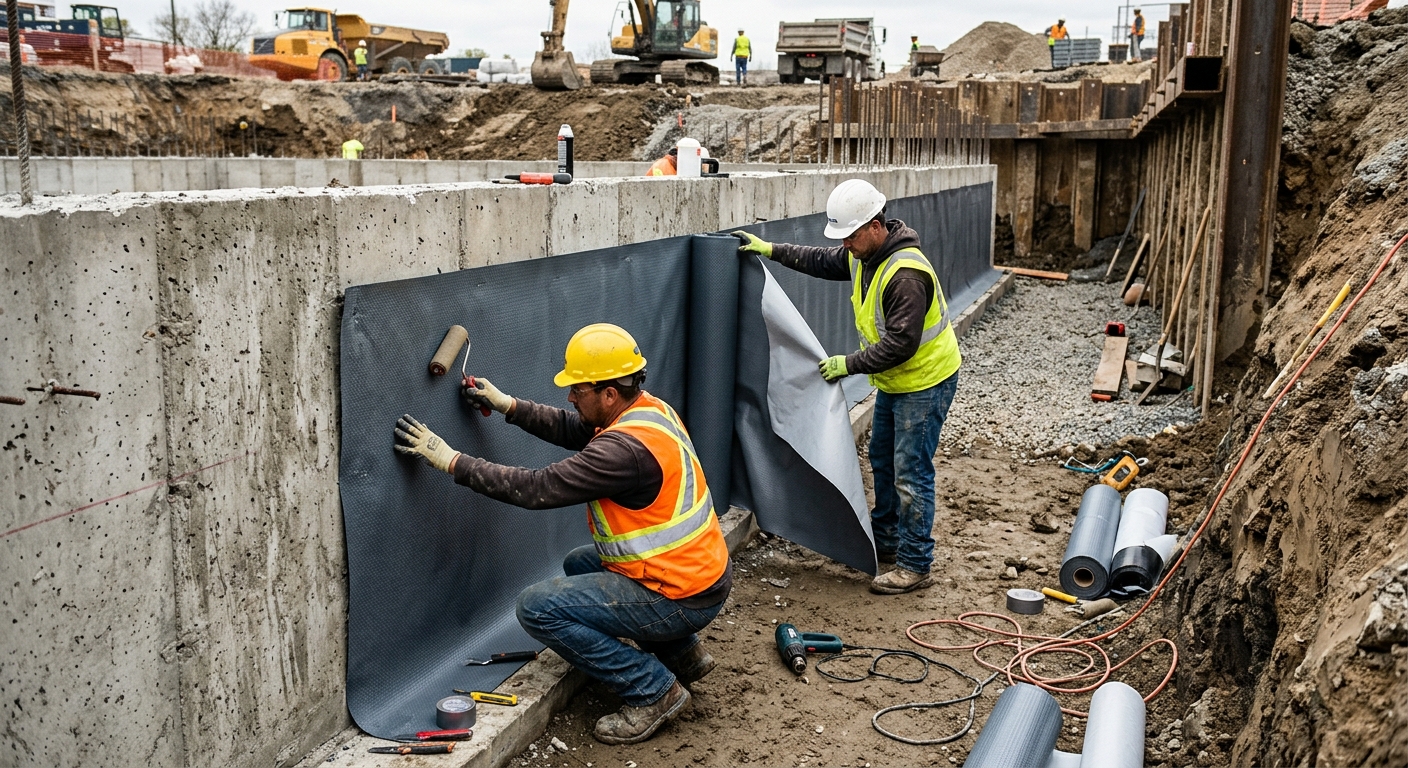
In Ajax, the choice between interior and exterior waterproofing is fundamentally about source control versus water management. Exterior waterproofing involves full excavation, new membrane, drainage tile, and backfill. It targets the problem at the foundation line and reduces hydrostatic pressure before water reaches the wall. However, it’s more expensive and disruptive because excavating around the foundation can require removing landscaping, stepping around decks, and restoring driveways or interlocking brick.
Interior waterproofing typically uses a perimeter drain channel, sump pit, and sump pump. It’s less invasive because it works from inside the basement to capture water after it enters and relieve pressure at the floor perimeter. The trade-off is that interior methods don’t stop the wall from being exposed to lateral pressure; they reduce the resulting seepage. This matters in Ajax because clay soils can hold water and expand when saturated, so a “symptom-only” system can still be effective—especially if the foundation is stable—but it must be correctly sized and paired with surface drainage fixes.
Given Toronto’s housing mix, poured concrete basements often respond well to targeted crack injection (when cracks are stable and properly prepared). Block foundations, by contrast, frequently benefit from interior drainage as a practical complement, because moisture pathways around block cores and mortar joints can continue even after localized sealing. If you’re budgeting, an exterior project commonly sits in the $7,000–$25,000 band, while interior perimeter drainage with sump systems often falls in $3,500–$15,000. The price difference is justified when clay pressure is clearly driving recurring seepage, not just when a single isolated crack is causing dampness.
Finally, consider sump pump backup systems. During spring flooding and high-water periods, outages do happen, and a battery backup (or equivalent) can prevent a “pump failure = basement flooding” scenario—especially for families finishing basements or storing valuables.
| Method |
Best For |
Addresses Source? |
Disruption |
Lifespan |
Price Band |
| Full exterior excavation + membrane |
Chronic seepage with clay pressure or failing exterior drainage; visible exterior water pathways |
Yes |
High |
Long (when drainage tile and backfill are done correctly) |
$7,000–$25,000 |
| Interior French drain + sump system |
Basements with recurring seepage; when excavation access is limited or homeowner prefers interior work |
No (manages after entry) |
Medium |
Medium to long (pump reliability and maintenance matter) |
$3,500–$15,000 |
| Crack injection — epoxy (structural) |
Stable, non-moving cracks where water penetration is through a fixed pathway |
Partially (targets a specific leak path) |
Low to medium |
Medium (depends on crack stability and prep) |
$600–$3,000 |
| Crack injection — polyurethane (active leak) |
Active seepage and cracks that show ongoing moisture during wet periods |
Partially (targets the leak, not external water source) |
Low to medium |
Medium (often improved when paired with drainage/grading) |
$700–$3,200 |
| Interior drain channel only (no sump) |
Limited dampness where water can be collected and removed without a full sump setup |
No |
Medium |
Short to medium (risk increases in high-water seasons) |
$2,500–$9,000 |
| Re-grading + downspout extensions |
Surface water issues (roof runoff near foundation) with minimal interior seepage |
Yes for surface-water causes only |
Low |
Short to medium (depends on ongoing maintenance) |
$800–$6,000 |
How to choose a waterproofing contractor in Ajax
To choose a waterproofing contractor you can trust in Ajax, start by verifying the three essentials: Ontario licensing/registration (where applicable), liability insurance, and WSIB/WCB coverage. Ask for a certificate of insurance that shows active liability coverage and the correct company name (not a subcontractor only), then request WSIB/WCB clearance documentation for the workers who will be on site. You should be able to view these documents before work begins, and a reputable contractor will provide them without pressure.
Next, get 2–3 itemised written quotes, not lump sums. You want a breakdown that separates labour and materials, and clearly lists what’s included: membrane type, drainage tile specification, sump pit and pump model (if applicable), disposal fees, concrete removal limits, and whether restoration (asphalt/stone/landscaping) is included. Pay attention to exclusions—common ones include “dry conditions at start of job,” permit fees, or additional excavation if the drainage line isn’t reachable. If a permit is needed, confirm whether it’s included.
For warranty, ask for two layers: workmanship warranty length and any product/manufacturer warranty. Confirm whether warranties are transferable if you sell your home, and whether workmanship coverage includes call-backs for the same issue.
On payment schedule, never pay more than 10–15% upfront. Hold back a portion until completion and final clean-up. Finally, require a written timeline with a start date and a completion estimate that reflects excavation and curing times in Ontario’s spring/fall conditions.
- Request proof of liability insurance (and confirm it matches the contractor’s legal name).
- Request WSIB/WCB clearance for workers and ask how subcontractors are covered.
- Ask if engineering support is available for structural cracks (horizontal/major step cracking).
- Insist on an itemised scope: excavation limits, disposal, drainage materials, membrane system, and restoration.
- Confirm permit responsibility: who pulls it and whether it’s included in the quote.
- Ask for crack diagnosis: how they determine epoxy vs polyurethane.
- Verify pump spec: primary pump + backup type, discharge routing, and alarms.
- Get a written warranty: workmanship duration, product warranty, and transferability.
- Agree on payment milestones aligned to measurable progress (not “progress payments” with vague work).
- Check their cleanup standard and restoration plan (especially around decks and driveways).
- Confirm they consider Toronto freeze–thaw: cure times and material choices for cold-season durability.
- Ask for photos of similar local jobs and references from the Ajax area.
Red flags in Ajax include: a quote that won’t describe the water entry pathway; claiming “one-size-fits-all” waterproofing without inspection; refusing to provide insurance/WSIB/WCB proof; suggesting exterior work without checking existing drainage condition; and offering only verbal warranties or vague “up to” pricing without an itemised scope.
Frequently asked questions — waterproofing in Ajax
Can I waterproof my basement from the inside only?
Yes, in many Ajax basements you can waterproof from the inside, especially when leaks are limited to seepage through cracks or when excavation access is constrained. Interior perimeter drains and sump systems manage water after it enters, which can be effective on clay soils when the system is properly sized for the local water conditions. If you’re comparing options, interior waterproofing often falls around $3,500–$15,000, while full exterior excavation can be higher at $7,000–$25,000.
That said, inside-only work doesn’t eliminate hydrostatic pressure against the wall. Homes in Ajax with recurring seepage tied to high lateral water pressure and failing exterior drainage usually perform better with exterior membrane and new drainage tile. A contractor should identify whether you have an “active leak” crack versus broader perimeter pressure before recommending an interior-only plan.
What causes foundation cracks in Ajax?
In Ajax, foundation cracks are often a combination of age, soil moisture movement, and freeze–thaw cycling. Many basements here are in homes built before 1981, when original materials and drainage details were different from today; the more years pass, the more likely small cracks become active leaks. Clay-heavy pockets in the area can saturate during wet periods, then expand slightly as water conditions change, adding lateral pressure to foundation walls.
Freeze–thaw also plays a role: water that gets into a hairline crack can freeze, expand, and widen that crack over multiple winters. If you’re seeing efflorescence or dampness near tie holes, cold joints, or along a perimeter seam, the crack may be acting as a water pathway rather than only a cosmetic issue. That’s why the repair approach matters—epoxy injection is usually for stable cracks, while polyurethane is chosen when there’s active seepage.
How do I compare waterproofing quotes?
Start by comparing the scope, not just the price. Ask each Ajax contractor for an itemised quote that separates labour and materials and lists what’s included: drainage tile type, membrane system, number of sump pits, pump/backup model, discharge routing, and whether concrete floors will be cut and how much. Make sure disposal, restoration, and—if applicable—permit handling are clearly stated. Quotes can differ by 30–50% because access constraints and the actual diagnosis (surface water vs. lateral pressure vs. failed weeping tile) change the amount of work.
Also compare the warranty terms. A lower price with a shorter workmanship warranty may cost more over time if the system needs repeated repairs. Finally, confirm whether they’re addressing the cause: interior drainage for seepage management versus exterior membrane and drainage tile for source control.
How long does basement waterproofing take in Ajax?
Timelines vary by approach and by weather conditions, but you can plan around a few typical ranges. Interior perimeter drains and sump system installs often take about 2–5 working days depending on how much concrete removal and interior prep is required, plus additional time for curing and final finishing. Exterior excavation is more weather-dependent and can take about 5–10 working days, sometimes longer on tight lots where excavation, membrane work, drainage tile installation, and backfill must be completed in a sequence that protects the structure.
Ajax’s freeze–thaw cycles affect scheduling. Contractors may avoid certain steps when soils are saturated and the ground is too wet, or when freezing conditions impact curing. Ask for a written start date and completion estimate that includes curing time, and confirm how they handle delays due to rain.
What is a weeping tile and does my Ajax home have one?
A weeping tile is a perimeter drainage system installed around or near the foundation footing to collect and redirect groundwater away from the basement. In many older Ajax homes—especially those built decades ago—this may have been clay tile or early plastic drain that collected water and routed it to a sump or daylight outlet. In newer builds, drainage is still common, but the materials and layout can differ.
Whether your home has one depends on the era and original design. A contractor may identify it by locating the discharge line, inspecting accessible cleanouts, or checking where interior dampness patterns concentrate. Because 23.1% of Ajax homes were built before 1981 (Statistics Canada, 2021 Census), the odds are higher that an original system may be partially collapsed or clogged, which can lead to recurring seepage, efflorescence, or basement flooding rather than a clearly defined exterior wall failure.
Can I waterproof my basement in winter in Ajax?
You can sometimes do parts of waterproofing in winter in Ajax, but it depends on what needs to be done. Interior work like sump pump installation, pump pit modifications, and certain crack injection tasks may proceed if the basement can be kept workable and surfaces can be prepared properly. However, exterior excavation and membrane work can be limited during deep cold or when soils are frozen, because backfill and drainage tile performance depend on proper compaction and placement.
In spring and fall, Ajax’s freeze–thaw cycles can affect how active the leak is. In cold weather, you may be able to treat specific active cracks; crack injection often targets the leak path and can be completed with fewer site access issues than a full excavation. If you’re budgeting, interior solutions are commonly in the $3,500–$15,000 range, while full exterior work is typically $7,000–$25,000 and is best scheduled when excavation conditions are manageable.