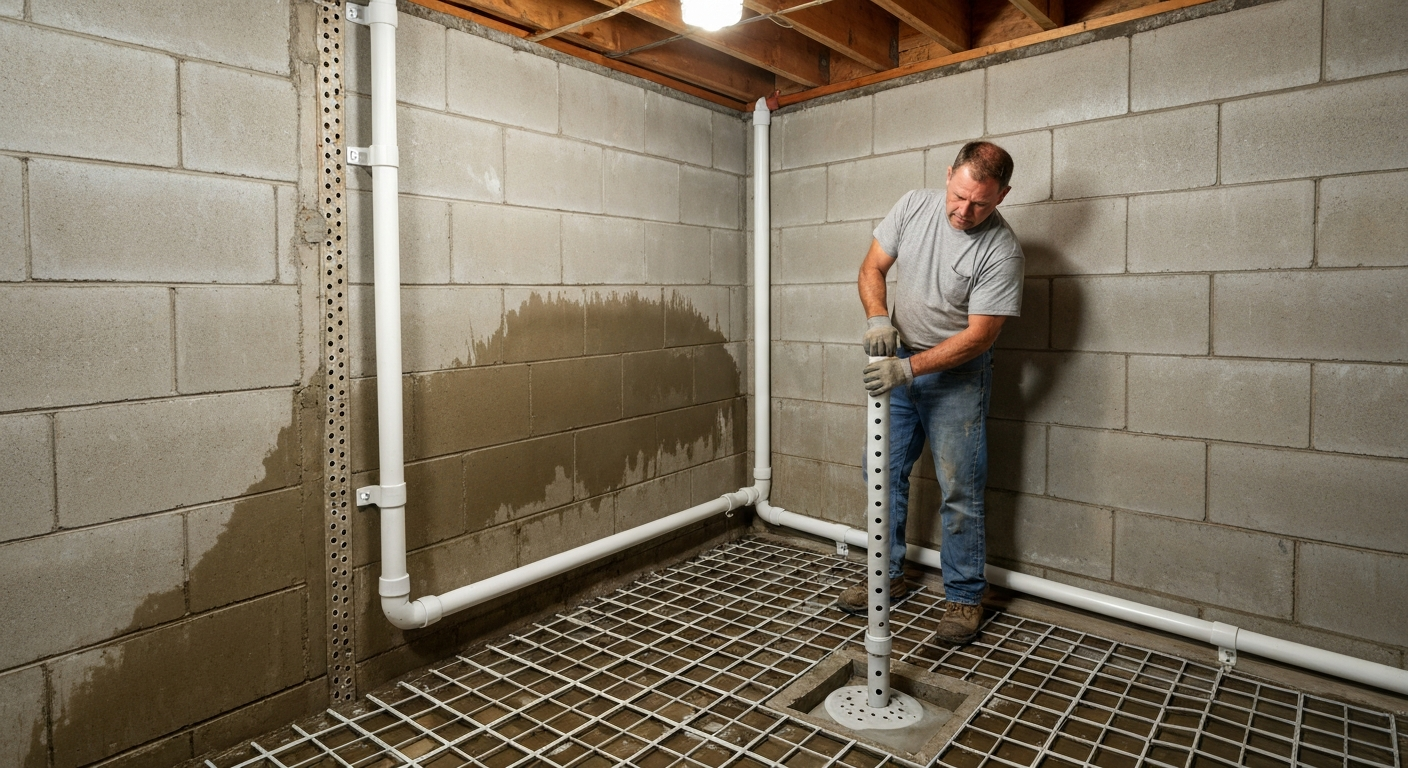
Basement waterproofing options and costs in College Park
Basement waterproofing in College Park is shaped by the mix of older homes and local soil behaviour. With a population of 4,072 (Statistics Canada, 2021 Census), you’ll still see plenty of resale demand, and that typically drives a steady pace of waterproofing work as basements age and original drainage systems fail. Many College Park foundations were built in the post-war and 1960–1980s eras; those basements are more likely to have older tar-and-paper or early membrane systems, plus weeping tile that’s now partially collapsed or clogged.
In the Toronto region, mixed glacial till and clay soils can hold water against foundation walls. When saturated, clay expands during freeze–thaw cycles, which increases lateral pressure and can turn hairline cracks into active leaks. That pressure also makes “patch fixes” less reliable—especially at cold joints, around tie holes, and where past repairs didn’t fully address water movement. As a result, exterior waterproofing tends to cost more but targets the source; interior systems are often chosen when landscaping, decks, or driveways make full excavation difficult.
Contractor availability and pricing can also shift depending on access constraints common to tight urban lots—hand-digging near additions, working below deck footings, and dealing with shared-driveway setbacks. If you’re in the more established pockets of College Park where basements have chronic dampness, you’ll usually find higher demand for interior drainage plus targeted crack repair.
Below are the most common options and typical cost ranges. Use this table to compare scopes before you request itemised quotes.
| Method |
What It Addresses |
Disruption Level |
Durability |
Price Range |
| Exterior excavation + new membrane + drainage tile |
Primary water entry (hydrostatic pressure), failed weeping tile, saturated soils against foundation |
High (excavation, landscaping restoration, spoil removal) |
High (source control when properly detailed) |
$7,500 – $25,000 |
| Interior perimeter drain channel + sump pit |
Chronic seepage, efflorescence, water accumulating at the wall line |
Medium (floor cutting in affected areas) |
Medium-High (depends on discharge and maintenance) |
$4,000 – $14,500 |
| Foundation crack injection (epoxy or polyurethane) |
Isolated cracks and leak pathways through concrete/block |
Low (localized drilling) |
Medium-High (best for the right crack type) |
$600 – $3,000 |
| Sump pump installation (primary + battery backup) |
Basement water management during heavy rain/spring melt and power interruptions |
Low-Medium (pit/grout work and electrical) |
High (with verified backup power) |
$1,000 – $3,500 |
| Window well drain installation |
Water infiltration at egress wells, splashback, clogged weep paths |
Medium (excavation around well) |
Medium (often paired with exterior drainage) |
$1,200 – $4,800 |
| Lot re-grading / downspout extension |
Surface water control to reduce load on drainage system |
Low-Medium (yard work) |
Medium (helps, but may not stop wall seepage alone) |
$1,000 – $6,500 |
Prices are estimates only and vary by project scope, site access and material selection.
What affects the price of waterproofing in College Park
In College Park, two homeowners can receive quotes that differ by roughly 30–50% for the same “basement leak” if the underlying water path and access constraints aren’t identical. In the Toronto area, that gap is often caused by three local drivers—soil type, water table, and freeze–thaw—which can push costs above (or sometimes below) a national baseline. Clay-heavy soils common around the GTA expand when saturated, exerting lateral pressure on foundation walls. That pressure can worsen existing cracks over a few winters, increasing labour for crack prep and sometimes the number of injection ports required.
High local water levels in many neighbourhoods can also increase sump run times, meaning a sump-only solution may need more robust discharge routing and a backup system. In contrast, if a basement leak is mainly from surface water (poor grading or downspouts discharging near the foundation), costs can be lower because work is simpler and less invasive—sometimes moving you toward the lower end of the price bands (for example, $3,500 – $15,000 interior drainage work) rather than full exterior excavation.
Concrete examples that commonly change the price in College Park include: (1) excavating beside a deck or near tight side yard—hand-digging increases labour and delays; (2) basements with efflorescence or mouldy conditions that require remediation before membranes or coatings can be installed; and (3) homes with older drainage around the perimeter where original weeping tile is 60+ years old and completely failed, pushing many homeowners from “interior only” toward a higher exterior scope (often in the $7,000 – $25,000 band when the full wall line must be treated).
Because many College Park homes are older than modern build standards for drainage detailing, the same crack repair can also shift in price depending on whether it’s isolated vertical cracking or a longer, active leak pattern linked to hydrostatic pressure.
| Price Factor |
Why It Matters |
Cost Impact |
| Interior vs. exterior approach — interior is less disruptive but addresses symptoms |
Exterior is source control; interior manages water after it enters |
Interior often costs less upfront; exterior can add significant excavation and restoration (commonly 2–4x depending on access) |
| Foundation type — poured concrete vs. block vs. stone vs. ICF |
Different wall materials move and respond differently to leaks and sealing products |
Block foundations often require more interior drainage coordination; poured concrete can take crack injection more predictably |
| Soil type — clay expands more than sand, adding pressure |
Saturated clay increases lateral pressure and leak frequency over freeze–thaw cycles |
More labour for drainage detailing and, in some cases, exterior scope expansion |
| Crack type and length — hairline vs. structural horizontal cracks |
Horizontal/structural cracks can indicate movement and need engineered assessment |
Can shift from an injection-only repair to engineering/structural work; higher end of crack repair band |
| Sump pump backup system — battery or water-powered backup needed |
Backup reduces risk during power interruptions during spring flooding |
Adds cost but can prevent a “no-pump” failure mode; often increases total sump budget |
| Access — landscaping, decks, or driveways must be removed for exterior |
Excavation is more expensive when restoration is larger |
Direct labour increase and added reinstatement costs; often the biggest reason for 30–50% quote spreads |
| Weeping tile age — original tile (60+ years) may be completely failed |
Failed tile increases water load on interior systems |
May require replacing drainage or moving toward exterior excavation for full repair |
| Mould or efflorescence remediation required before sealing |
Sealers and membranes won’t bond well to active contamination or salt deposits |
Adds remediation labour and prep materials before waterproofing can proceed |
Permits & regulations in Ontario
In Ontario, foundation excavation, structural crack repair, and changes to lot drainage typically require a building permit. If your plan includes altering how storm or groundwater is directed, the municipality may also require approval—especially where work affects drainage patterns near the curb or connects to municipal infrastructure. For sump pump installations that discharge to the storm or sanitary sewer, municipal approval is commonly required before a contractor proceeds, and contractors should confirm the correct discharge method for College Park conditions.
For structural crack repair, particularly horizontal cracks in block walls, major step cracks, or signs of wall movement, a structural engineer’s assessment is often necessary. That assessment determines whether underpinning or additional structural work is needed, rather than relying on waterproofing alone. Before signing a contract, ask whether the contractor has engineering support for structural repairs, and confirm they carry liability insurance and WSIB/WCB coverage.
Step-by-step homeowner verification in Ontario:
- Ask for the contractor’s licence information and company details; verify legitimacy using the provincial online registry where contractors and trades are listed.
- Request a certificate of insurance (liability) and confirm it’s current and matches the business entity that will perform the work.
- Ask for WSIB/WCB clearance details; if work involves labour coverage, ensure your contractor is eligible and insured.
- For structural scope, request the engineer’s involvement in writing (who assesses, when, and what the report covers).
- Confirm permit responsibility: who pulls the permit, what inspections are expected, and who schedules them.
- If discharge is involved (sump to storm/sanitary), ask for the municipal approval route before installation.
Interior vs exterior waterproofing — what does College Park need?
Exterior waterproofing is the “source control” approach: excavation along the foundation, removal of failing materials, installation of a proper membrane system, and replacement of drainage tile before backfilling. Done correctly, it addresses the hydrostatic pressure pushing water through tie holes, cold joints, and cracks—an especially important issue in the GTA where freeze–thaw cycles can widen defects over time. The trade-off is that excavation and restoration are disruptive and can be costly due to yard access constraints common in College Park (hand-digging near additions, deck footings, and limited working space).
Interior waterproofing manages water after it enters. Typically that means a perimeter drain channel, a sump pit, and a sump pump designed to handle recurring groundwater seepage. Interior systems are less invasive and can work well when the exterior isn’t feasible or when leaks are mainly from localized wall seepage. However, interior work alone does not prevent the wall from experiencing hydrostatic pressure; it reduces the risk of water accumulating by capturing it at the base.
In College Park, the practical choice often depends on foundation type and the age of drainage. Poured concrete walls generally respond well to crack injection when the leak is isolated and properly prepped. Block foundations frequently benefit from interior drainage as a complement, because water can find pathways at mortar joints and irregularities along the wall line. For chronic seepage, pair interior drainage with crack injection where needed—rather than expecting injections to “outperform” a poor drainage environment.
Price justification example: if you have recurring seepage and failing weeping tile, interior drainage plus sump backup may land in the $4,000 – $14,500 range, but a full exterior approach addressing the source can move into the $7,500 – $25,000 band. The higher cost is usually justified when the majority of the wall line is under pressure, when access allows proper membrane detailing, or when you want to reduce future leak frequency rather than just manage it.
| Method |
Best For |
Addresses Source? |
Disruption |
Lifespan |
Price Band |
| Full exterior excavation + membrane |
Widespread seepage, clay-heavy soil pressure, failed drainage systems, chronic dampness across multiple wall sections |
Yes |
High |
Long (when detailed with drainage and proper backfill) |
$7,000 – $25,000 |
| Interior French drain + sump system |
Recurring water accumulation, efflorescence, basements where exterior excavation is impractical |
No (captures water after entry) |
Medium |
Medium-Long (maintenance + pump reliability matter) |
$3,500 – $15,000 |
| Crack injection — epoxy (structural) |
Non-moving or properly assessed structural cracks in poured concrete where leak is isolated |
Partially (seals the path; doesn’t stop wall pressure) |
Low |
Medium-Long (depends on crack activity) |
$600 – $3,000 |
| Crack injection — polyurethane (active leak) |
Active seepage where water is moving through the crack |
Partially (seals active pathway) |
Low |
Medium (often needs monitoring and may be paired with drainage) |
$700 – $3,500 |
| Interior drain channel only (no sump) |
Minor seepage with manageable flow and where discharge is reliable |
No (still manages entry) |
Medium-Low |
Medium (suitable for limited conditions) |
$2,500 – $8,500 |
| Re-grading + downspout extensions |
Surface-water related dampness, wet windowsills, gutters discharging near foundation |
No (reduces external water load) |
Low-Medium |
Short-Medium (improves conditions but may not stop seepage) |
$1,000 – $6,500 |
How to choose a waterproofing contractor in College Park
Choosing the right contractor matters as much as the method. Start by verifying Ontario licence/trade standing where applicable, and confirm they carry liability insurance and WSIB/WCB coverage. Here’s how: (1) ask for a current certificate of liability insurance and ensure the insured company name matches the one on your contract; (2) request WSIB/WCB clearance details for the people working on site; and (3) if any structural assessment is part of the plan, confirm who supplies engineering support and that it’s included in the scope—not “as needed.” You’re looking for documentation you can keep for your records.
Next, get 2–3 itemised written quotes. Don’t accept a single lump sum without a breakdown of labour and materials (membrane type, drainage tile specs, sump basin components, discharge method, excavation depth assumptions, disposal/restoration items). Carefully read exclusions: is permit pulling included, are spoil removal and landscaping reinstatement included, and what happens if they discover additional failing drainage along the wall line?
Warranty should be clear. Ask for the workmanship warranty length and what it covers (crack sealing, membrane installation, drain performance). Also ask whether the product/manufacturer warranty applies to you and whether it’s transferable if you sell the home.
Payment schedule is another safeguard: never pay more than 10–15% upfront. Use a holdback until substantial completion and post-job documentation are delivered (inspection notes, photos, pump test results). Finally, require a start date and completion estimate in writing, including weather-dependent milestones because waterproofing schedules often shift during deep freeze or heavy rain periods.
- Request licence/registration details and verify the company matches the contract.
- Confirm liability insurance with a certificate and current dates.
- Verify WSIB/WCB clearance for the crews performing work.
- Get an itemised quote: excavation, membrane, drainage tile, sump components, labour hours, and disposal/restoration.
- Ask whether permits are included and who pulls them.
- Confirm discharge method for sump water and whether approvals are required.
- Require a written warranty: workmanship term, coverage details, and transferability.
- Check that pump backup is explicitly listed (battery or other approved backup).
- Look for site photo documentation before and after (especially around crack injection and discharge routing).
- Confirm how they test/verify performance (pump test, discharge verification, leak re-checking).
- Negotiate payment milestones: small deposit, progress payments, and a holdback.
- Ask about schedule risks: access constraints, curing times, and freeze-thaw limitations.
Red flags to watch in College Park: contractors who won’t provide itemised scopes; vague “lifetime” language without workmanship terms; no proof of insurance/WSIB/WCB; pushing exterior work without confirming soil/water conditions or drainage failure; and skipping remediation (mould/efflorescence) before sealing. If you hear “we can stop it no matter what” without investigating the source pathway, slow down and ask for a site-specific plan.
Frequently asked questions — waterproofing in College Park
How much does basement waterproofing cost in College Park?
In College Park, costs usually depend on whether you’re treating the source with exterior work or managing water with interior drainage. As a ballpark, interior waterproofing and weeping tile-related solutions commonly fall within the $3,500 – $15,000 range when a perimeter drain channel, sump pit, and sump pump are included. If you need full exterior excavation—membrane plus new drainage tile—the budget typically lands in the $7,000 – $25,000 band, especially where tight access requires hand-digging and more landscaping restoration. Foundation crack repairs (when the leak is isolated) often run $600 – $3,000. Your contractor should base pricing on soil conditions, freeze–thaw risk, and the actual leak path found during inspection.
Interior vs exterior waterproofing — which is better?
Exterior waterproofing is usually better for long-term source control because it treats water pressure before it enters the basement. In College Park, clay-heavy pockets and freeze–thaw can keep driving water through defects over multiple winters, so a proper exterior membrane and drainage tile system is the most direct fix when excavation is feasible. Interior waterproofing is often the better choice when access constraints or landscaping make excavation expensive or impractical; it manages water after it enters using a drain channel and sump system. For poured concrete walls with isolated leakage, crack injection can complement interior work. For chronic seepage tied to older drainage, homeowners often find that interior systems work best when they’re matched to sump reliability (including backup) rather than used as a one-time patch.
Why is my basement leaking in College Park?
Basement leaks in College Park commonly come from groundwater pressure against the foundation, not just from visible cracks. In this Toronto area, mixed glacial till and clay can hold water and expand when saturated, which increases lateral pressure and can activate cracks around tie holes and cold joints. Freeze–thaw cycles then widen minor defects, turning earlier hairline issues into active seepage after a few winters. Another frequent cause is failing drainage—older clay weeping tile or early plastic drains may be clogged or partially collapsed, so water doesn’t move away from the foundation. Sometimes the problem is surface water: downspouts or grading that discharge toward the foundation can add load, especially during spring melt.
How do I know if a foundation crack is serious?
A crack’s severity depends on its pattern, size, and whether it’s actively leaking. In College Park basements, hairline vertical cracks can be non-structural, while horizontal cracks in block walls or step cracks that look like they’re “walking” can indicate movement and often require an engineer’s assessment before you rely on waterproofing alone. You should also treat cracks as serious if they show moisture, staining, or ongoing seepage after freeze–thaw. Efflorescence (white salt deposits) around the crack can be a sign water is migrating through the wall. If water is tracking into the basement repeatedly, injection alone may not solve the underlying pressure—your contractor should evaluate soil moisture and drainage condition first.
How much does foundation crack repair cost in College Park?
Foundation crack repair typically runs $600 – $3,000 in the Toronto tier, depending on the crack type, the length/number of injection points, and whether it’s an epoxy (structural) or polyurethane (active leak) situation. Isolated leaks that need a limited injection run toward the low end, while longer cracks, multiple ports, or repairs that require careful prep (including surface cleaning and sealing) land nearer the high end. If the crack is horizontal or suggests movement, costs can increase because engineering assessment and any structural remedial work may be needed before waterproofing products are applied. Always ask your contractor to explain why they selected epoxy vs polyurethane based on how the crack behaves in wet conditions.
Do I need a sump pump in College Park?
You may need a sump pump if your basement experiences recurring seepage or groundwater accumulation that can’t be handled by crack sealing or surface grading alone. In College Park and the broader Toronto area, freeze–thaw and clay soils can keep water pressures higher during spring melt, and chronic dampness often leads to floor-line water that a sump is designed to collect and discharge. Many interior systems include a sump pit so the perimeter drain has a reliable outlet. If you install a sump, it’s also wise to discuss backup power—battery or another approved backup—because power interruptions can happen during severe spring weather. If the leak is truly isolated and doesn’t accumulate at the base, you may be able to avoid a sump and use targeted crack injection or window well drainage instead, but the site inspection is key.