Basement waterproofing options and costs in Tecumseh
Tecumseh basements leak for different reasons than homeowners in drier parts of Ontario, and that’s why your “best option” depends on the water source—roof runoff, groundwater, or failing drainage around the perimeter. In Windsor–Sarnia, a large share of homes are older (about 40.2% were built before 1981, according to the Statistics Canada, 2021 Census), which matters because original damp-proofing and weeping tile are often aged out. When those systems clog or fail, seepage develops slowly at first and then accelerates when freeze–thaw cycles widen cracks and joints.
In Tecumseh, pricing is shaped primarily by soil type and the water table. Much of the Essex–Lambton corridor has fine-textured, poorly drained soils that hold moisture near foundations, increasing seepage risk and the likelihood of hydrostatic pressure pushing water through hairline cracks. Many older lots also have limited exterior access due to mature landscaping or tight setbacks, so contractors often blend approaches—excavation where possible, and interior drainage where access is constrained.
You’ll feel this demand in neighbourhoods with older housing stock and established lots such as areas near Tecumseh Road East and the Centennial neighbourhood area, where renovations often uncover clogged weeping tile and damp wall staining. If you’re comparing quotes, use the table below to match the method to the likely water entry path, then pressure-test the scope details (what’s included, what’s excluded, and how the contractor handles cold-weather backfill and detailing).
| Method |
What It Addresses |
Disruption Level |
Durability |
Price Range |
| Exterior excavation + new membrane + drainage tile |
Stops water at the foundation wall and collects it before it enters (best for hydrostatic pressure) |
High (yard excavation, backfill, landscaping restoration) |
Long-term when properly detailed to frost and sealed penetrations |
$12,000–$25,000 |
| Interior perimeter drain channel + sump pit |
Captures water after it enters and manages hydrostatic pressure through active drainage |
Medium (floor/ceiling access near walls) |
Very good with quality weeping tile, liner, and sump discharge routing |
$8,000–$18,000 |
| Foundation crack injection (epoxy or polyurethane) |
Seals cracks to prevent seepage; epoxy suits stable/non-moving cracks, polyurethane suits active leakage |
Low to Medium (small wall access; limited patching) |
High for properly selected product and crack type |
$600–$2,500 |
| Sump pump installation (primary + battery backup) |
Keeps the sump pit from filling during high-water periods and reduces failure risk |
Low to Medium (minor wall/floor disruption and discharge routing) |
Good when protected from freezing and paired with backup power |
$1,800–$4,500 |
| Window well drain installation |
Prevents water pooling around egress/window wells and reduces localized seepage |
Low to Medium (window well excavation and liner work) |
Good for localized water control when graded correctly |
$1,200–$3,000 |
| Lot re-grading / downspout extension |
Redirects roof runoff away from the foundation and slows surface water intrusion |
Low (yard and downspout adjustments) |
Good when site drainage is maintained seasonally |
$700–$2,000 |
Prices are estimates only and vary by project scope, site access and material selection.
What affects the price of waterproofing in Tecumseh
In Tecumseh and across the Windsor–Sarnia corridor, it’s common to see waterproofing quotes for the “same-looking” basement job vary by 30–50%. The difference usually isn’t about contractor marketing—it’s about the water source, foundation construction details, and how much of the perimeter must be exposed or repaired to create a durable drainage path. Across Ontario, labour rates and disposal/haul costs are similar in principle, but site conditions can change the amount of excavation, the type of drainage needed, and the cold-weather detailing required for an effective installation.
The three cost drivers that separate local pricing from a national average are: soil type, water table, and freeze–thaw. First, fine-textured clay-heavy soils expand during freeze–thaw and can exert lateral pressure on foundation walls, worsening cracking and pushing water through joints. Second, elevated groundwater levels increase sump runtime and the size/capacity of drainage components. Third, repeated winter cycling widens existing cracks in older concrete or block, meaning a simple “patch” often fails and the correct crack injection system becomes essential.
Two concrete examples from Tecumseh: (1) A homeowner with clogged, original weeping tile often ends up needing either exterior footing drains or an interior French drain system—either way, the drainage scope grows, which pushes many projects into the interior band of about $8,000–$18,000 when excavation is limited. (2) A home with accessible exterior walls and straightforward regrading can justify moving into the exterior band of $12,000–$25,000 because excavation allows a true membrane + drainage tile system rather than managing water after it enters. Also, because about 40.2% of homes were built before 1981, contractor availability and demand are highest where weeping tile retrofits and drainage upgrades are frequently discovered during renovations.
In short: if the contractor treats it like a “water stain” problem instead of a “water path” problem, you’ll pay less upfront and often more later.
| Price Factor |
Why It Matters |
Cost Impact |
| Interior vs. exterior approach — interior is less disruptive but addresses symptoms |
Interior drainage manages water after entry; exterior addresses the source by stopping seepage at the wall |
Interior often cheaper initially; exterior typically adds excavation and restoration costs |
| Foundation type — poured concrete vs. block vs. stone vs. ICF |
Different wall materials crack differently and respond differently to injection and sealing systems |
Block/stone often needs more comprehensive drainage; ICF may need different detailing |
| Soil type — clay expands more than sand, adding pressure |
Clay retains water and can increase hydrostatic/lateral pressure during thaw and freeze cycles |
In clayier sites, contractors size drainage and may increase sealing/injection scope |
| Crack type and length — hairline vs. structural horizontal cracks |
Active, moving cracks need flexible systems and more preparation; structural movement may require engineering |
Structural issues can trigger added labour, engineering time, and/or underpinning discussions |
| Sump pump backup system — battery or water-powered backup needed |
Power outages during heavy spring conditions raise risk if only a single pump is installed |
Backup increases material and labour but often reduces long-term failure risk |
| Access — landscaping, decks, or driveways must be removed for exterior |
Exterior work depends on how much can be excavated safely and restored neatly |
More restoration time can move a “mid” scope into a “high” scope |
| Weeping tile age — original tile (60+ years) may be completely failed |
Old systems clog, collapse, or discharge improperly, causing persistent seepage |
Failed drainage often requires partial/complete replacement or interior capturing systems |
| Mould or efflorescence remediation required before sealing |
Salt deposits and active moisture-related issues need cleaning and drying before sealing |
Additional remediation time and materials can add days to schedule and cost |
Permits & regulations in Ontario
In Ontario, foundation excavation and many waterproofing-related repairs are treated as work that may require a building permit—especially when structural elements are altered or when drainage and grade around the foundation are changed. For Tecumseh homeowners, typical permit-triggering work includes exterior excavation that exposes the foundation wall, structural crack repair where the scope involves more than sealing hairline seepage, and changes to lot drainage that affect how water is managed near the house. If your contractor is planning to redirect or connect sump discharge to municipal services, municipal approval is often required before the connection is made.
Structural cracks deserve extra care. If you’re dealing with horizontal cracking in block walls, significant step cracking, or signs of movement, the contractor should coordinate a structural engineer’s assessment to determine whether underpinning or other structural measures are needed—not just sealing. Ask whether they have engineering support in their process, and verify their insurance coverage and worker protection compliance.
To verify a contractor properly in Ontario, use a simple checklist: (1) request their Ontario business licence details if applicable and confirm they are eligible to do the work they’re quoting; (2) ask for an active certificate of liability insurance—ensure the policy covers construction activities; (3) confirm WSIB/WCB coverage for their workers (or the appropriate clearance documentation if they operate under the same compliance structure). Only after you’ve checked these should you sign a contract. If the contractor can’t provide documents quickly, that’s a sign to pause and re-check the scope with another firm.
Interior vs exterior waterproofing — what does Tecumseh need?
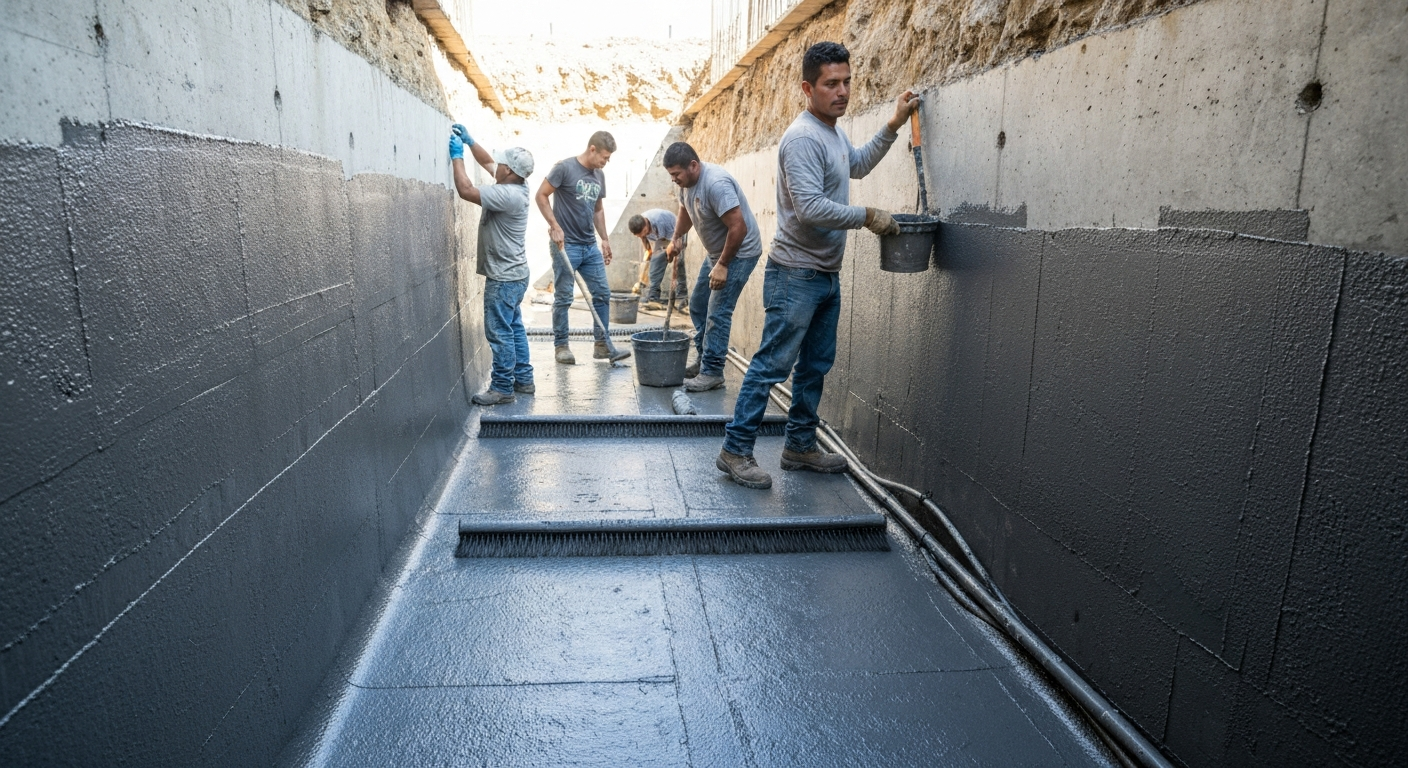
The fundamental difference is source control versus water management. Exterior waterproofing (full excavation, new membrane, new drainage tile, and proper backfill) targets the entry point by reducing or stopping seepage through the foundation wall before it reaches your basement. It’s the more permanent solution when water pressure is driven by high groundwater or poorly drained soils, but it requires excavation that disrupts landscaping, patios, or driveways.
Interior waterproofing (perimeter drain channel, sump pit, and sump pump) doesn’t prevent hydrostatic pressure from reaching the wall—it captures water after it enters and then actively removes it. This is often the better fit when exterior access is limited, when the foundation is partially obstructed by additions, or when the homeowner wants a less invasive solution. In Tecumseh’s Windsor–Sarnia conditions—fine-textured soils, freeze–thaw cracking, and aging drainage—interior systems can be highly effective when designed as a complete drainage path (proper slope, discharge location, and sealed penetrations).
Local matching matters by foundation type. Poured concrete walls often respond well to targeted crack injection because the wall can be treated with proper preparation and an appropriate injection product. Block foundations more commonly benefit from interior drainage as a practical complement, especially when mortar joints or voids allow intermittent seepage. Where sump pumps are used, backup systems (battery or water-powered backup) become a real value in Ontario because heavy spring runoff can coincide with short power disturbances and long recovery times when a single pump fails or can’t run.
For example: if your contractor proposes an exterior excavation job at around $12,000–$25,000 but you only have localized dampness that’s primarily from surface runoff, you might instead be able to fix it with drainage corrections plus selective interior drainage in the $8,000–$18,000 band, with crack injection as needed. The key is that the quote must match the water path—not just the symptoms.
| Method |
Best For |
Addresses Source? |
Disruption |
Lifespan |
Price Band |
| Full exterior excavation + membrane |
High groundwater seepage, hydrostatic pressure, and persistent wall leakage where exterior access is workable |
Yes (stops seepage at the foundation wall) |
High |
Long-term when detailed for frost and discharge is correct |
$12,000–$25,000 |
| Interior French drain + sump system |
Limited exterior access, recurring seepage, and basements that need active water removal |
No (manages water after entry) |
Medium |
Very good with proper sump sizing and discharge |
$8,000–$18,000 |
| Crack injection — epoxy (structural) |
Stable, non-moving cracks in poured concrete or sound masonry where the crack is not actively leaking |
Partial (seals the pathway, assumes crack stability) |
Low to Medium |
High for the right crack type and prep |
$600–$2,500 |
| Crack injection — polyurethane (active leak) |
Active seepage and flexible sealing where water is still moving through the crack |
Partial (seals the pathway despite active moisture) |
Low to Medium |
High when applied to the correct crack and properly cleaned |
$900–$3,200 |
| Interior drain channel only (no sump) |
Light seepage that can be managed without active pumping and where discharge can be gravity-assisted |
No (manages water after entry) |
Medium to Low |
Good only when site conditions allow reliable gravity discharge |
$5,500–$11,000 |
| Re-grading + downspout extensions |
Surface water issues and roof runoff pouring toward the foundation |
Sometimes (reduces the source of water intrusion) |
Low |
Good if maintained seasonally |
$700–$2,000 |
How to choose a waterproofing contractor in Tecumseh
Choosing the right waterproofing contractor in Tecumseh comes down to verifying credentials, comparing itemized scopes, and making sure the plan fits your water path—not just the latest product. In Ontario, start by verifying Ontario compliance for licensing/eligibility (as applicable to the trade), then confirm liability insurance and WSIB/WCB coverage. Ask for certificates directly: liability insurance documents should list the insured company and policy dates; WSIB/WCB can be verified through clearance documentation or the applicable proof of coverage. If they can’t provide these quickly, it’s a major risk for you and your property.
Next, get 2–3 written, itemised quotes. The best quotes break down labour and materials separately (excavation/disposal, membrane system components, drainage tile and filter fabric, sump and piping, labour for crack injection preparation, and restoration). Avoid “lump sum with exclusions” because waterproofing often depends on site conditions discovered during work. Make sure you understand what’s excluded: additional crack footage, mould remediation, concrete patching, sump discharge routing, and landscaping reinstatement are common add-ons.
Warranty matters too. Look for a workmanship warranty and confirm the product/manufacturer warranty terms. Clarify whether warranties are transferable if you sell the home. Payment should be staged—never more than about 10–15% upfront; hold back a portion until completion and walkthrough. Finally, get the start date and completion estimate in writing, including winter detailing expectations if work happens close to freezing temperatures.
- Ask for itemised labour/material breakdown (not only a single total).
- Confirm whether a permit is required and whether the contractor coordinates it.
- Request proof of liability insurance and WSIB/WCB coverage.
- Verify warranty length for workmanship and how it’s applied to your specific scope.
- Ask which injection product they use (epoxy vs. polyurethane) and why.
- Require a written plan for sump discharge location and freeze protection.
- Confirm disposal/haul is included if exterior excavation is part of the scope.
- Request details on backfill type and compaction method (frost-resistant approach).
- Check how they handle mould/efflorescence before sealing or injecting.
- Ensure they include slope/grading details for regrading or downspout work.
- Get a photo or inspection report of foundation condition before work begins.
- Use a holdback clause and don’t pay the bulk amount until the walkthrough.
In Tecumseh, some common red flags include: contractors who promise a “one-size-fits-all” crack injection without identifying active leaks; proposals that omit sump discharge routing/freeze protection when a sump is included; vague warranty terms (no workmanship duration or no product-specific coverage); and quotes that exclude critical restoration items like patching, drainage tie-ins, or landscape reinstatement without clarifying pricing.
Frequently asked questions — waterproofing in Tecumseh
Why is my basement leaking in Tecumseh?
Basement leaks in Tecumseh are usually caused by a water path that’s different from what homeowners expect. In the Windsor–Sarnia area, soil that holds moisture near foundations and a seasonally rising water table can push water toward basement walls, especially during spring thaw and heavy rain. Freeze–thaw cycles then widen cracks and joints in older poured concrete or block foundations, giving water a pathway. If your home is from an older build era—about 40.2% of Tecumseh homes were built before 1981 (Statistics Canada, 2021 Census)—you may also be dealing with aged or clogged weeping tile and limited exterior damp-proofing. Finally, roof downspouts or down-grade from the lot can add surface water that worsens seepage.
How do I know if a foundation crack is serious?
Not every crack means structural failure, but you should treat certain patterns as higher risk in Ontario basements. Step cracks or horizontal cracks, especially in block walls, can indicate movement or pressure that may require more than sealing. Look for signs of water: dampness, mineral staining, or a crack that grows after freeze–thaw. Also note whether the crack is wider over time or changes seasonally—active leakage often points to a need for flexible injection (commonly polyurethane) rather than a hard seal. If you’re unsure, ask for a basic assessment that includes crack mapping and water source evaluation before a contractor commits to epoxy or polyurethane.
How much does foundation crack repair cost in Tecumseh?
In Tecumseh, crack repair cost depends on crack type, length, and whether it’s actively leaking. Hairline seepage that’s properly prepared can often be addressed with injection work in the general band of about $600–$2,500. If the crack is active and needs a flexible product system, the scope can climb (often still within a similar range depending on footage and access), but the key is the correct selection: epoxy tends to be used for stable cracks, while polyurethane is used where water is actively moving. Your quote should state how many linear feet are included, what the contractor will do for surface prep, and how they’ll verify the crack pathway is sealed.
Do I need a sump pump in Tecumseh?
You may need a sump pump when water table conditions or failed drainage mean groundwater regularly reaches the basement floor or perimeter. In Tecumseh’s Windsor–Sarnia soils, many homes require active drainage once interior water management is designed—particularly when a perimeter drain system is installed. If your contractor is proposing interior French drains but no sump, ask how they’ll guarantee the system can keep up during high-water periods. Also consider backup: a battery or water-powered backup reduces risk when spring conditions coincide with power issues. In Tecumseh, sump pump installation commonly falls around $1,800–$4,500, with backup increasing the total based on the chosen system and discharge details.
How does Tecumseh's soil affect my foundation?
Tecumseh’s foundation risk is strongly influenced by soil moisture behaviour. Much of the Windsor–Sarnia corridor has fine-textured, poorly drained soils that can keep water pressed against foundation walls. Clayier soils tend to expand and move more during freeze–thaw cycles, which increases lateral pressure and can widen existing cracks over time. When drainage systems fail—like aged weeping tile—water can remain trapped near the foundation rather than draining away. That’s why comprehensive waterproofing in this area often focuses on managing lateral pressure (robust footing/collector drains where needed) and ensuring proper cold-weather backfill and sealing detail. Homes built before 1981 are also more likely to have older drainage components that no longer perform as intended (Statistics Canada, 2021 Census).
Do I need a permit for foundation work in Ontario?
In Ontario, you typically need permits for work that involves foundation excavation, structural crack repair where structural elements may be impacted, and changes that affect how lot drainage is managed. Many sump-related installations also require municipal approval if the plan connects to storm or sanitary infrastructure. For crack sealing alone, a permit may not always be required, but if the scope expands to excavation, drainage tie-ins, or anything that could affect structural integrity, your contractor should confirm permitting requirements before work starts. If structural cracks are involved, an engineer’s assessment is often needed to decide whether underpinning or other structural measures are required. Your best protection is to ask the contractor to clearly state what requires permits in your specific Tecumseh situation.