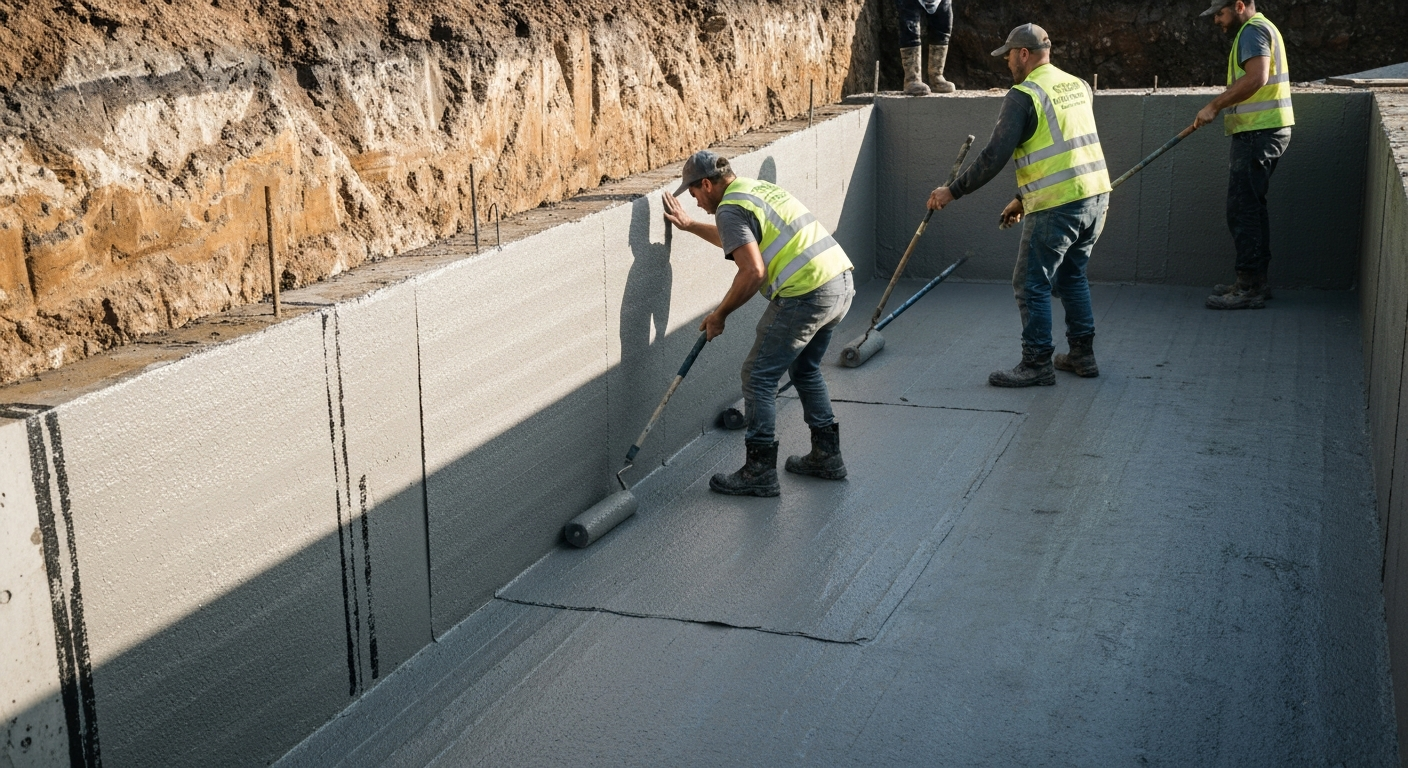
Basement waterproofing options and costs in Whitchurch-Stouffville
Basement waterproofing in Whitchurch-Stouffville is rarely a one-size-fits-all fix. With 49,864 residents (Statistics Canada, 2021 Census) and a housing mix where 74.3% of dwellings are single-detached, many homeowners in the GTA outer suburbs end up dealing with older drainage systems and foundation stress that shows up as damp corners, efflorescence, and recurring seepage after spring melt. That’s especially true for homes built before 1981—22.4% of the local stock (Statistics Canada, 2021 Census)—because early weeping tile and tar-based systems are more likely to have failed or become partially blocked over time.
In Toronto and nearby areas like Whitchurch-Stouffville, pricing and scheduling are also shaped by access constraints (tight lots, landscaping, decks, or driveways) and by the soil–water behaviour. We often see mixed glacial till and clay pockets that hold water against foundation walls, then expand when saturated. Add freeze–thaw cycling and small cracks can widen, turning “dry” basements into active leaks over multiple winters. This combination is why exterior excavation with a proper membrane and drainage tile costs more, but it’s also why interior solutions (drain channels, sums, and targeted crack injection) remain popular for partial fixes or when excavation is difficult.
Demand is especially high in neighbourhoods with established post-war properties where drainage weepers are no longer reliable and where homeowners want to stop interior moisture before finishing renovations—commonly around the older residential pockets near Stouffville’s core. From there, the best next step is comparing the practical options and their typical cost ranges.
| Method |
What It Addresses |
Disruption Level |
Durability |
Price Range |
| Exterior excavation + new membrane + drainage tile |
Water entry from hydrostatic pressure; replaces failed drainage system; installs exterior waterproofing and cleanout access |
High (excavation, landscape/driveway impacts, regrading) |
Long-term (often the most comprehensive solution when access allows) |
$7,000 – $25,000 |
| Interior perimeter drain channel + sump pit |
Chronic seepage and damp walls after water enters; relieves hydrostatic pressure inside |
Medium (break concrete at perimeter, sump basin install) |
Good (depends on drainage path and pump maintenance) |
$3,500 – $15,000 |
| Foundation crack injection (epoxy or polyurethane) |
Targeted crack leaks; epoxy for structural-level stability, polyurethane for active water flow |
Low to Medium (localized access; minimal concrete removal) |
Moderate to long-term when leak path is correctly identified |
$600 – $3,000 |
| Sump pump installation (primary + battery backup) |
Controls water level during spring melt and periods of high water-table pressure |
Low to Medium (sump pit and discharge routing) |
Good with backup and proper discharge location |
$800 – $3,500 |
| Window well drain installation |
Water intrusion at egress/window areas; prevents pooled water and damp carpeting |
Low to Medium (localized excavation, well drain/gravel work) |
Good for localized moisture control |
$1,000 – $4,500 |
| Lot re-grading / downspout extension |
Redirects roof runoff away from foundation; reduces saturation around footing line |
Low (landscape adjustments, minor restoration) |
Variable (best as part of a broader plan) |
$1,000 – $6,000 |
Prices are estimates only and vary by project scope, site access and material selection.
What affects the price of waterproofing in Whitchurch-Stouffville
In Whitchurch-Stouffville and the wider Toronto region, two homeowners can receive quotes for what looks like the “same” basement problem and still see a 30–50% difference. The reason is that waterproofing is driven less by the visible symptom and more by the root cause: where the water comes from, how it moves through soil, and how the foundation wall responds under freeze–thaw. When contractors price by labour, materials, and risk, those unknowns become real dollars.
Three local drivers separate Toronto-area costs from the national average: soil type, water table, and freeze–thaw cycling. Clay-heavy soils (common in pockets around the region) hold water against foundations; as they saturate and then fluctuate, they expand and can exert lateral pressure on walls, worsening cracks over time. High local water tables increase sump run times and may require a more robust drainage plan (and often backup power). In contrast, a colder climate isn’t the only issue—rapid freeze–thaw turns minor defects into active leakage paths because concrete and masonry move.
Concrete examples from Whitchurch-Stouffville that change pricing include: (1) a home with original weeping tile partially collapsed often needs interior perimeter drainage plus sump upgrades, which pushes projects closer to the $3,500 – $15,000 band; (2) a basement with widespread wall seepage and an accessible exterior perimeter can justify excavation and membrane work that fits the $7,000 – $25,000 band; and (3) where there’s heavy landscaping, a deck, or a tight driveway access, excavation labour and restoration increase even if the waterproofing “system” is the same.
Finally, housing age matters. With 22.4% of homes built before 1981 (Statistics Canada, 2021 Census), more basements begin with failing older drainage, meaning contractors may spend extra time locating water entry points and deciding whether to inject isolated cracks or install interior drainage first.
| Price Factor |
Why It Matters |
Cost Impact |
| Interior vs. exterior approach — interior is less disruptive but addresses symptoms |
Exterior works upstream (prevents water entry); interior manages water after it enters |
Interior can be materially cheaper, but may require ongoing pump reliance |
| Foundation type — poured concrete vs. block vs. stone vs. ICF |
Different wall materials crack and leak differently; joint detailing varies |
Block and older poured walls often need more assessment and targeted solutions |
| Soil type — clay expands more than sand, adding pressure |
Saturated clay increases lateral pressure and accelerates crack growth |
More robust drainage/membrane detailing may be required |
| Crack type and length — hairline vs. structural horizontal cracks |
Structural cracks may indicate movement and need engineer input or different repair systems |
Structural repairs increase labour and verification time |
| Sump pump backup system — battery or water-powered backup needed |
Backup reduces risk during spring storms and outages |
Adds cost but prevents catastrophic flooding in high water events |
| Access — landscaping, decks, or driveways must be removed for exterior |
Exterior excavation requires space and restoration work |
Can push projects from the low end into the mid/high range |
| Weeping tile age — original tile (60+ years) may be completely failed |
Old tile may be crushed or clogged, requiring replacement or alternate drainage |
Replacement increases both excavation and material scope |
| Mould or efflorescence remediation required before sealing |
Moisture problems can be tied to contamination and surface salt deposits |
Remediation and prep work add labour before waterproofing |
Permits & regulations in Ontario
In Ontario, many basement waterproofing jobs are handled with trade permits or no permit at all—but there are important exceptions. Foundation excavation, structural crack repair that could affect load paths, and changes to lot drainage typically require a building permit. If the work involves structural repair (for example, major horizontal cracks in block walls, significant step cracking, or any repair that suggests movement), a structural engineer’s assessment is often required to confirm whether underpinning or other structural modifications are necessary.
Sump pump installations are another common permit question. If you’re connecting discharge to municipal storm or sanitary systems (rather than discharging to an approved on-lot location), municipal approval is commonly required. Even when a direct municipal connection isn’t planned, the discharge route still needs to be laid out to avoid nuisance conditions and icing near walkways or neighbouring properties.
Step-by-step, a Whitchurch-Stouffville homeowner can verify an Ontario contractor before work starts:
- Request the contractor’s business details and confirm their work authorization for the scope (especially if structural repairs are proposed).
- Ask for a Certificate of Insurance (general liability) and ensure it matches the project address and includes waterproofing/excavation activities where applicable.
- Confirm WSIB coverage (or applicable WCB clearance) for workers on site.
- If structural repairs are part of the scope, ask whether they provide engineering support and whether engineer sign-off is included before proceeding.
- Verify any permits will be pulled by the contractor or coordinated through them, and that the permit responsibilities are stated in the written contract.
For structural crack injection, localized sealing, and most interior drainage systems without municipal connections, permits may be minimal or not required—but the moment you get into excavation that alters drainage patterns or structural conditions, you should expect permits.
Interior vs exterior waterproofing — what does Whitchurch-Stouffville need?
The fundamental difference is source control versus water management. Exterior waterproofing—full excavation, new membrane, upgraded drainage tile, and careful backfill—targets the water entry point. It’s typically the most permanent approach when the exterior perimeter is accessible and when soil conditions (clay pockets and higher water pressure) are pushing water laterally against foundation walls. The trade-off is cost and disruption: digging around the house, handling landscaping/driveway impacts, and then restoring the grade.
Interior waterproofing focuses on what happens after water gets in. Interior perimeter drain channels, sump pits, and sump pump systems relieve pressure inside the basement by capturing seepage and moving it away. This approach is less invasive and can cost less, which matters when homeowners want to avoid major yard disruption. However, interior systems do not stop hydrostatic pressure from acting on the wall. That’s why crack injection is often paired with drainage—because if you only “catch the water,” cracks can continue to widen under clay-driven pressure.
For Whitchurch-Stouffville, poured concrete walls often respond well to correct crack injection (especially when a leak path is identified and sealed with appropriate material), while block foundations frequently benefit from interior drainage as a practical complement due to joint detailing and mortar permeability. In spring melt and high groundwater periods, backup sump systems become more than optional: during outages, unbacked systems can’t move water fast enough, and Toronto-area basements are well positioned to see water rise quickly.
A useful pricing example: if you’re seeing localized leaks at a couple of cracks plus damp corners, crack injection plus an interior perimeter drain/sump may land in the $3,500 – $15,000 range. If, instead, you have broad seepage along multiple wall sections with failed exterior drainage and accessible perimeter, an exterior membrane and drainage tile plan can be justified in the $7,000 – $25,000 band because you’re removing the underlying pressure source.
| Method |
Best For |
Addresses Source? |
Disruption |
Lifespan |
Price Band |
| Full exterior excavation + membrane |
Chronic seepage, high water pressure, failed exterior drainage, accessible perimeter |
Yes (upstream water control) |
High |
Long-term |
$7,000 – $25,000 |
| Interior French drain + sump system |
Basements with active dampness, recurring seepage, or when exterior access is limited |
No (manages after-entry water) |
Medium |
Good with proper maintenance |
$3,500 – $15,000 |
| Crack injection — epoxy (structural) |
Stable, non-moving cracks where structural integrity needs restoring |
Partially (stops water in the crack path) |
Low to Medium |
Moderate to long-term |
$600 – $3,000 |
| Crack injection — polyurethane (active leak) |
Cracks with active seepage/water flow that needs an elastic sealant |
Partially (stops the active leak) |
Low to Medium |
Moderate to long-term (best when leak source is correctly targeted) |
$600 – $3,000 |
| Interior drain channel only (no sump) |
Intermittent dampness and slower seepage where pumping is not required |
No (captures water inside) |
Medium to Low |
Variable with conditions |
$2,000 – $8,000 |
| Re-grading + downspout extensions |
Moisture driven by roof runoff or near-surface saturation |
Sometimes (reduces water load around foundation) |
Low |
Variable |
$1,000 – $6,000 |
How to choose a waterproofing contractor in Whitchurch-Stouffville
Choosing the right waterproofing contractor in Whitchurch-Stouffville starts with proof, not promises. First, verify Ontario licensing/authorization for the work they’ll perform (especially if excavation or any structural repair is proposed). Next, confirm liability insurance—ask for a current Certificate of Insurance showing coverage amounts and that it applies to work at your address. Then check WSIB/WCB: request the clearance letter or coverage proof so you know workers are properly covered if an incident happens on site.
Get 2–3 itemised written quotes. You want line items for labour and materials (membrane type, drainage tile components, sump pump model, disposal, concrete removal limits), not just a lump sum. Scope clarity matters: ask what’s included for disposal of excavated material, permit pulling (if applicable), restoration to landscaping/grade, and how long the site will be in partial disruption.
Warranty should be specific. Ask how many years are provided for workmanship, whether the product/manufacturer warranty is separate, and whether the warranty is transferable to future owners. Payment scheduling matters too: never pay more than 10–15% upfront. Hold back the remainder until the work is complete, inspected, and any housekeeping/restoration is finished.
Finally, require a timeline in writing: a start date or earliest start window and an estimated completion date. In the GTA, weather and excavation scheduling affect waterproofing sequencing, so you want milestones (inspection, membrane install, backfill) clearly outlined.
- Request proof of insurance and WSIB/WCB coverage before signing.
- Confirm permit responsibilities in writing (who pulls it, what work triggers it).
- Ask for an itemised scope: products, quantities, and disposal/restoration responsibilities.
- Verify they perform a water-source assessment (not just “sealing cracks” blindly).
- Check whether they recommend sump backup for your risk level.
- Confirm crack injection material type (epoxy vs polyurethane) matches the leak behaviour.
- Ask what they do if they find more failures than expected during excavation.
- Ensure warranty is in the contract (workmanship length, exclusions, and transferability).
- Request documentation of product specifications and compatibility with your foundation type.
- Confirm discharge location and routing details for sump and downspouts.
- Review payment schedule: keep upfront at 10–15%, with holdback until completion.
- Ask for a completion checklist and final photos/inspection notes.
Red flags to watch for in Whitchurch-Stouffville: contractors who won’t provide a written, itemised scope; who advise “one product fits all” without explaining whether your issue is active leakage vs stable cracking; who cannot produce a current Certificate of Insurance and WSIB/WCB coverage proof; who avoid discussing permit triggers and discharge routing; or who push large upfront payments and won’t commit to a start/completion timeline.
Frequently asked questions — waterproofing in Whitchurch-Stouffville
How much does foundation crack repair cost in Whitchurch-Stouffville?
Foundation crack repair in Whitchurch-Stouffville typically depends on crack type (hairline versus structural horizontal/step cracks), length, wall material (poured concrete vs block), and whether the crack is actively leaking. For many homeowners, targeted crack injection is the lowest-disruption option when the leak path is well defined. As a baseline, you’ll often see crack injection work quoted within the $600 – $3,000 band. If cracks are widespread or if the contractor determines movement that needs engineering review, the overall cost can rise because additional assessment and possibly different repair methods are required. Always ask what sealant will be used (epoxy versus polyurethane) and whether they’ll address the cause of water reaching the crack, not only the surface symptom.
Do I need a sump pump in Whitchurch-Stouffville?
You may need a sump pump in Whitchurch-Stouffville if you have recurring seepage, water accumulating in a sump basin area, or dampness that worsens during spring melt and heavy rain. In clay-heavy soil pockets, water can build up against foundation walls and create higher internal water levels. A sump is often recommended when interior drainage alone can’t reliably keep the basement dry. If a sump is part of the plan, many homeowners add backup for spring flooding risk; in practical terms, sump systems with backup commonly land in the $800 – $3,500 range depending on pump type and installation complexity. That said, if your issue is limited to surface runoff near the footing (for example, poor downspout discharge), re-grading and downspout extensions might reduce the need for pumping.
How does Whitchurch-Stouffville's soil affect my foundation?
Whitchurch-Stouffville’s foundation risk is strongly tied to soil behaviour, especially in areas with dense clay and glacial till. Clay holds water and, when it saturates, can expand and exert lateral pressure on foundation walls. That pressure contributes to crack widening over multiple freeze–thaw cycles, turning earlier hairline cracks into active leakage paths. It also influences drainage performance—original weeping tile or older drains can clog or fail, and then water seeks other routes, leading to damp corners, efflorescence, and sometimes basement flooding. This is why contractors may prioritize exterior excavation and membrane + drainage tile when access allows, or interior perimeter drains and sump control when excavation is constrained.
Do I need a permit for foundation work in Ontario?
Ontario permitting depends on what you’re doing and how it affects structure and drainage. In general, foundation excavation, changes to lot drainage, and many structural crack repairs typically require a building permit. If a crack repair suggests structural movement (such as major horizontal cracks in block walls or significant step cracks), a structural engineer’s assessment is often needed before repair design is finalized. Also, if a sump pump discharge connects to municipal storm or sanitary systems, municipal approval is commonly required. For homeowners in Whitchurch-Stouffville, the best verification step is to ask the contractor to state—on paper—what permits will be pulled for your specific scope, and who is responsible. Confirm the contractor has the appropriate approvals and can provide permit-related documentation if requested.
How long does waterproofing last?
Waterproofing lifespan varies by system, foundation type, and whether the underlying water source is truly addressed. Exterior waterproofing (membrane + drainage tile) is generally the most comprehensive long-term approach because it reduces water pressure at the source. Interior drainage and sump systems can last many years, but performance depends on maintenance, pump reliability, discharge routing, and whether backup power is included. Crack injection solutions can also perform well for years when the crack is correctly evaluated—epoxy is used for stable cracks, while polyurethane is used for active leak conditions. In Whitchurch-Stouffville, freeze–thaw cycling and clay-driven water pressure can accelerate failure if the root cause isn’t addressed, which is why contractors often recommend pairing crack injection with appropriate drainage. Ask your contractor for the workmanship warranty length and whether product warranties are separate and transferable.
Can I waterproof my basement from the inside only?
Yes, many basements in Whitchurch-Stouffville can be waterproofed from the inside only—especially when access for exterior excavation is limited or when the goal is to manage chronic seepage. Interior solutions like perimeter drain channels, sump pits, and sump pump installation can be very effective at keeping basements dry during spring melt. The limitation is that inside work usually manages water after it enters; it doesn’t fully stop hydrostatic pressure from acting on the foundation wall. For poured concrete walls with discrete, well-identified cracks, crack injection from the interior can be a practical complement. For block foundations, interior drainage is often a key component because wall/joint permeability can let moisture migrate even when the exterior is harder to correct. Cost can still be reasonable—many interior systems fit within the $3,500 – $15,000 range—but the right choice depends on whether your exterior drainage is failing and how much pressure is building against the foundation.