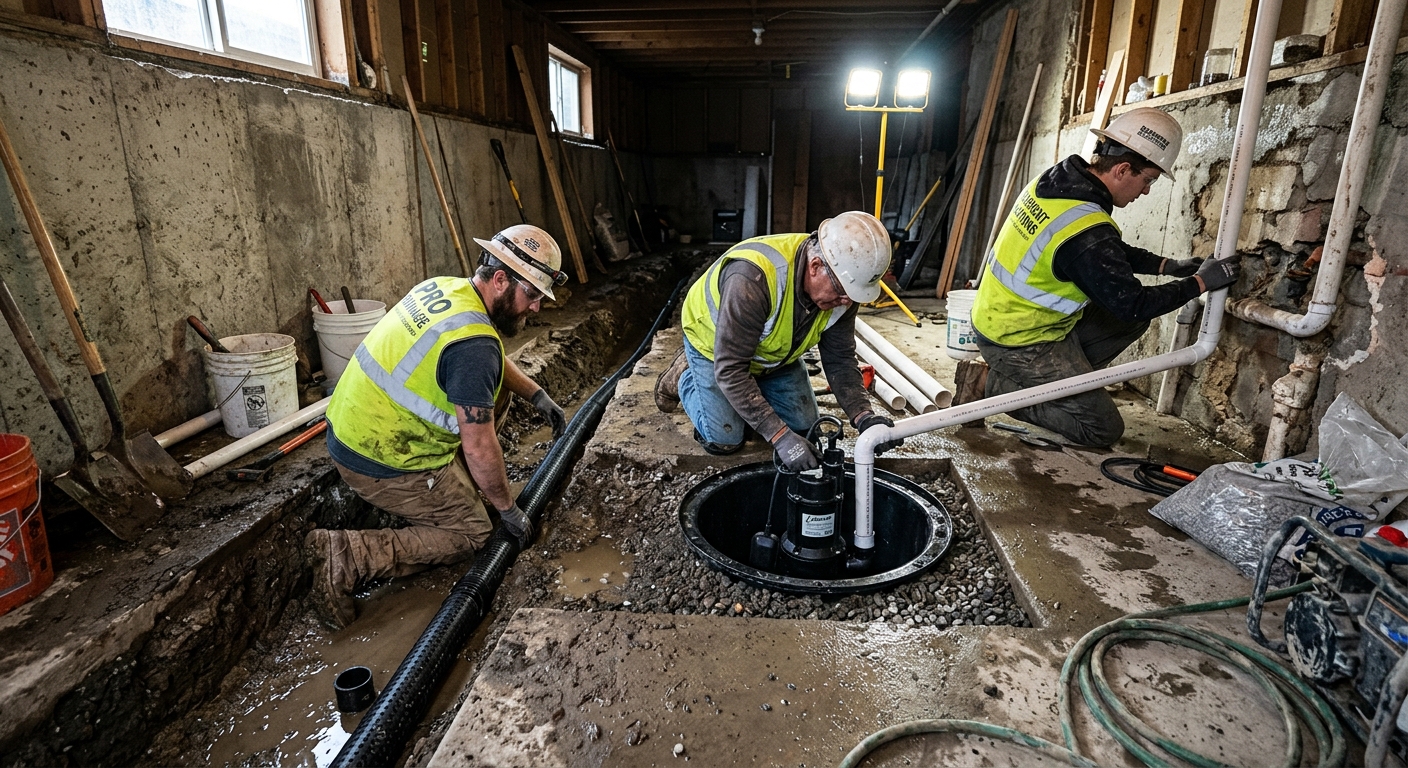
Basement waterproofing options and costs in New Dundee
Basement waterproofing in New Dundee has a few clear paths forward, and the right one usually depends on whether water is getting in from outward hydrostatic pressure or simply collecting after it leaks. With a small population of 1,174 residents (Statistics Canada, 2021 Census), homeowners here are often dealing with older housing systems—especially in the Toronto economic region where many 1960–1980s homes were built with early drains that are now clogged or partially collapsed. In practice, that means you can have dampness, efflorescence, and musty odours even when the exterior foundation wall looks “okay” from the street.
Toronto-area winter conditions drive repeat failure: mixed glacial till and clay soils can hold water against foundation walls, then expand during freeze–thaw cycles and push laterally, widening hairline cracks. Those cycles also expose weak spots at cold joints, tie holes, and patch repairs. Costs rise when contractors must hand-dig around additions, work below deck footings, or excavate through landscaping and driveway tie-ins—common in mature residential pockets where access is tight.
In New Dundee, exterior work is especially in demand on properties backing onto lower spots where yard drainage directs water toward the foundation, as well as homes with older clay weeping tile lines that can’t keep up with current rainfall and snowmelt. The comparison below breaks down typical methods, what they address, and realistic budget ranges so you can talk shop with contractors before you sign anything.
| Method |
What It Addresses |
Disruption Level |
Durability |
Price Range |
| Exterior excavation + new membrane + drainage tile |
Water entry from exterior walls; replaces failing weeping tile and provides a drainage plane |
High (excavation, landscaping reinstatement) |
Long-term (often the most complete fix when access and soil conditions allow) |
$7,000–$25,000 |
| Interior perimeter drain channel + sump pit |
Intercepts water that gets past the wall and relieves basement flooding risk |
Medium (floor/slab and wall removal at perimeter) |
Very good for chronic seepage when properly designed for your water conditions |
$3,500–$15,000 |
| Foundation crack injection (epoxy or polyurethane) |
Localized leaks through cracks and pressure points; improves water tightness |
Low to medium (surface preparation; limited demolition) |
Good when crack type and movement are correctly matched to the product |
$600–$3,000 |
| Sump pump installation (primary + battery backup) |
Manages collected groundwater and reduces flooding during power interruptions |
Low to medium (pit excavation and electrical work) |
Strong when paired with a proper drainage path (and backup is included when needed) |
$800–$3,500 |
| Window well drain installation |
Stops gutter runoff and surface water from entering basement window wells |
Low to medium (excavation around window wells) |
Good for targeted wet areas when grading and weeping connections are correct |
$900–$4,200 |
| Lot re-grading / downspout extension |
Reduces water pooling near foundation; improves how water sheds during melt events |
Low (often no foundation demolition) |
Moderate (must be maintained; best as part of a bigger drainage plan) |
$1,200–$6,500 |
Prices are estimates only and vary by project scope, site access and material selection.
What affects the price of waterproofing in New Dundee
Even when two homeowners request “basement waterproofing,” quotes in the Toronto area can legitimately swing by 30–50% because the work is driven by site conditions, not marketing. In New Dundee, a contractor’s cost position is shaped by soil, water table behaviour, and freeze–thaw impacts—three factors that often push regional pricing away from a simple national average. For example, mixed glacial till and dense clay pockets can expand when saturated, increasing lateral pressure and turning a dormant crack into an active seep. That matters for pricing because crack injection alone can be insufficient if water pressure is still finding a path.
High water tables in many Toronto-region neighbourhoods can increase sump run times and require a more robust interior drainage layout (including pump sizing and, sometimes, backup). Meanwhile, Ontario’s freeze–thaw cycles can widen defects in concrete and block foundations, which increases the number of leak points discovered once floors are opened. Where original clay weeping tile is older and partially collapsed, interior symptoms can appear without obvious exterior failure, which can change the scope from “targeted” to “system-wide.”
Concrete examples from projects I commonly see in the New Dundee area: (1) a house with clay-heavy backfill often needs exterior drainage improvements rather than only sealing, increasing budgets toward the exterior band (for example, $7,000–$25,000), while (2) a basement with localized corner seepage may be solvable with crack injection in the $600–$3,000 band if the crack is stable and properly prepped. (3) Tight access—deck footings, side-yard landscaping, or a shared driveway—can raise labour and disposal costs even when the waterproofing “system” is the same.
| Price Factor |
Why It Matters |
Cost Impact |
| Interior vs. exterior approach — interior is less disruptive but addresses symptoms |
Exterior targets water entry; interior manages water after it enters |
Often shifts budgets by thousands; exterior can be far more labour-intensive |
| Foundation type — poured concrete vs. block vs. stone vs. ICF |
Crack behaviour and water pathways differ by foundation material |
Block/stone commonly require more internal drainage work than poured walls |
| Soil type — clay expands more than sand, adding pressure |
Clay saturation increases lateral load on walls and crack movement |
May push you from small repairs toward full drainage solutions |
| Crack type and length — hairline vs. structural horizontal cracks |
Stable, vertical cracks may seal; horizontal/step cracks may indicate movement |
Major cracks can expand scope and require engineering recommendations |
| Sump pump backup system — battery or water-powered backup needed |
Flooding risk rises during outages around spring wet periods |
Backup can add cost but prevents costly re-damage |
| Access — landscaping, decks, or driveways must be removed for exterior |
Excavation and reinstatement take time and increase disposal/material needs |
Common reason quotes diverge by 30–50% |
| Weeping tile age — original tile (60+ years) may be completely failed |
Old drains clog, break, or disconnect from outlets |
May convert a “repair” into a replacement scope |
| Mould or efflorescence remediation required before sealing |
Moisture and salts must be controlled so coatings and injections bond properly |
Can add steps before waterproofing products are applied |
Permits & regulations in Ontario
In Ontario, many waterproofing-related tasks are handled under permit rules because they can affect structural safety or drainage flow. As a rule of thumb for New Dundee homeowners: excavation work that changes the foundation system, structural crack repair where movement is suspected, and modifications to lot drainage often require a building permit. If you’re installing or changing systems that connect to municipal sewers, a permit and municipal approval are typically required—especially when a discharge route changes.
For structural crack repair, such as horizontal cracking in block walls or step cracks that suggest movement, a structural engineer’s assessment is frequently needed before any repair plan (and sometimes before any underpinning or related work). That’s why you should confirm the contractor has engineering support for structural scopes—not just general waterproofing experience. Also ensure the company carries current liability insurance and WSIB/WCB coverage where applicable so you’re not exposed if a worker is injured on-site.
To verify Ontario compliance step-by-step: (1) ask for the contractor’s Ontario business information and licence/registration reference (many trades will have a searchable record online); (2) request a certificate of insurance and confirm the coverage is valid for the job dates; (3) obtain WSIB/WCB clearance documentation or proof of registration; and (4) when structural elements are involved, ask whether they will coordinate with an engineer and provide that assessment in writing for the permit file when required. Keep copies with your contract package.
Interior vs exterior waterproofing — what does New Dundee need?
The fundamental difference is source control versus symptom control. Exterior waterproofing—full excavation, membrane, and new drainage tile—targets the water entry path from the outside. That’s the most complete approach in New Dundee when clay backfill and high lateral soil pressure are pushing water toward the foundation and into cold joints. Interior waterproofing—perimeter drain channel, sump pit, and sump pump—assumes water already entered through cracks or weeps and then intercepts it before it collects and floods.
In the Toronto market, poured concrete foundations often respond well to targeted crack injection because poured walls are typically more continuous and less prone to multiple block-to-block water pathways. Epoxy or polyurethane injection can be effective when the crack is properly evaluated and prepped. Block foundations, however, commonly benefit from interior drainage as a practical complement, because water can travel through porous mortar joints, hairline fractures, and tie holes even after surface sealing.
Sump pump backup matters more in Ontario than many homeowners expect. Power interruptions around spring wet periods can coincide with peak seepage, and a battery backup helps keep the system running long enough to prevent a basement from re-wetting. If you’re paying for an interior system, it’s usually cheaper to include backup during the initial installation rather than trying to add it later after the first flooding incident.
Here’s a real-world pricing justification example: if you have only one localized, stable seep through a vertical crack, crack injection in the $600–$3,000 band may be justified. But if the basement keeps collecting water after heavy rain and snowmelt, you’re often looking at a perimeter drain and sump solution closer to $3,500–$15,000, because stopping the source pressure is usually not possible from inside alone.
| Method |
Best For |
Addresses Source? |
Disruption |
Lifespan |
Price Band |
| Full exterior excavation + membrane |
Widespread seepage, high lateral soil pressure, failing original drains, accessibility permitting |
Yes (best source control) |
High (excavation and landscaping reinstatement) |
Long service life when drainage and backfill are done correctly |
$7,000–$25,000 |
| Interior French drain + sump system |
Chronic seepage, basement dampness and active water collection, when exterior access is limited |
No (manages water after entry) |
Medium (perimeter floor/wall work at drainage line) |
Very good with correct pump sizing and discharge |
$3,500–$15,000 |
| Crack injection — epoxy (structural) |
Non-moving or stable cracks with confirmed suitability for epoxy |
Partial (seals a specific entry path) |
Low to medium |
Good when crack movement is not ongoing |
$600–$3,000 |
| Crack injection — polyurethane (active leak) |
Cracks with active seepage or pressure where a flexible/sealing approach is needed |
Partial (seals a specific entry path) |
Low to medium |
Good for ongoing seep control when properly chosen |
$700–$3,000 |
| Interior drain channel only (no sump) |
Light seepage scenarios where water can be safely managed without pump cycling |
No (still symptom control) |
Medium |
Moderate to good if site discharge conditions remain stable |
$3,000–$10,000 |
| Re-grading + downspout extensions |
Surface water problems, pooling near foundation, window well runoff |
No (reduces water load; doesn’t replace failed drainage systems) |
Low |
Moderate; effectiveness depends on ongoing maintenance |
$1,200–$6,500 |
How to choose a waterproofing contractor in New Dundee
Choosing a waterproofing contractor in New Dundee should start with proof, not promises. In Ontario, confirm the contractor is properly licensed/registered for the work they’re proposing (and that the scope matches their trade coverage). Ask for liability insurance and verify the certificate is current and covers the project location. Also request WSIB/WCB clearance or proof of coverage before work begins—this is especially important for exterior excavation where crews are working below grade and near foundation edges.
Next, get 2–3 itemised written quotes, not lump sums. The best quotes break labour and materials down into line items such as excavation, membrane and accessory components, drainage tile/filter fabric, sump pit and pump, electrical work, crack injection product and number of injection points, disposal, and reinstatement. Read exclusions carefully: is permit pulling included, is soil hauling included, and does the contractor include reinstatement of topsoil, sod, or stone work? A clear scope is the easiest way to avoid budget surprises.
Warranty matters too. Ask for a workmanship warranty length and what it covers (common leak points, pump failures not caused by misuse, product application conditions). Confirm whether the product/manufacturer warranty applies to you directly and whether it’s transferable if you sell your home.
Finally, use a sensible payment schedule. Never pay more than 10–15% upfront, and hold back payment until the job is complete, tested (where applicable), and cleaned. Get a start date and completion estimate in writing.
- Provide a written scope with quantities (linear feet for drains, number of crack injection ports, sump discharge details).
- Confirm who pulls permits (if required) and list permit costs in the estimate.
- Verify liability insurance certificate and the project address is covered.
- Request WSIB/WCB clearance/proof before crews mobilize.
- Ask how they assess water entry (inspection method, dye tests, crack mapping, probing drain performance).
- Match the crack type to the product (epoxy for stable cracks, polyurethane for active seep).
- Ask what happens if the weeping tile outlet is blocked—do they replace/clean, or only seal?
- Confirm sump pump model and discharge route; ask about check valves and pump cycling controls.
- Include battery backup details if outages are a concern.
- Spell out reinstatement standards for landscaping, patios, or driveways removed for exterior work.
- Look for a clear warranty certificate with conditions and exclusions.
- Ensure they include disposal/haul-away of excavated material in the price breakdown where applicable.
Red flags I see in the New Dundee area include contractors who (1) offer only “paint and patch” sealing without identifying the drainage path, (2) can’t explain why they’re choosing epoxy vs polyurethane for your crack, (3) provide a lump-sum quote with no quantities or exclusions, (4) won’t show insurance/WSIB/WCB proof before starting, or (5) dismiss the need for proper slope/downspout drainage when exterior water loading is the likely cause.
Frequently asked questions — waterproofing in New Dundee
How long does waterproofing last?
In New Dundee and the broader Toronto region, service life depends on whether the system controls the water source or only manages water after entry. Exterior excavation with a proper membrane and new drainage tile is typically the most durable because it creates a drainage plane and reduces hydrostatic pressure against the foundation. Interior perimeter drains and sump systems can also last many years, but their performance depends on pump condition, discharge setup, and whether the drainage pathway stays clear in clay-heavy backfill. Crack injection can last a long time when the crack is stable—yet freeze–thaw can worsen movement if the underlying pressure continues. As a reference point, projects starting around $7,000–$25,000 often reflect broader source-control work, while symptom-focused interior solutions commonly sit around $3,500–$15,000.
Can I waterproof my basement from the inside only?
Yes, many New Dundee homes do use interior-only waterproofing, especially when excavation access is difficult or the symptoms are localized. Interior drains and sump pits are designed to intercept water once it enters, which is effective for chronic seepage, musty basements, and recurring dampness. However, interior work does not fully relieve hydrostatic pressure against the wall itself. In areas with clay-heavy soil and repeated freeze–thaw, walls may continue to see pressure, which can increase the chance of new leak points appearing if the external drainage system is still failing. If your quote is only interior sealing or injection with no drainage plan and you have active seepage after heavy rains, ask the contractor how they expect water pressure to be controlled. Typical interior scopes fall around $3,500–$15,000, depending on how extensive the drain and pump setup must be.
What causes foundation cracks in New Dundee?
Foundation cracks in New Dundee are usually linked to soil and seasonal movement rather than one single event. In the Toronto region, mixed glacial till and dense clay pockets can expand when saturated, creating lateral pressure against foundation walls. When freezing begins and thaw cycles repeat, small defects widen, turning earlier hairline cracks into active seep points over time. Settlement can also contribute, especially around additions, decks, or where drainage improvements have changed runoff patterns. Older drainage systems—like original clay weeping tile that has been in place for decades—can increase moisture around the foundation, making movement worse. If you’re seeing step cracks in block walls or a horizontal crack line, the cause can be more complex and may require engineering review before repair. For isolated vertical crack leaks, targeted injection (often in the $600–$3,000 band) can help, but it should match the crack type and whether movement is ongoing.
How do I compare waterproofing quotes?
When comparing quotes in New Dundee, don’t compare only the total price—compare the scope and the “water plan.” Start by checking whether each estimate lists specific quantities and line items: excavation length, membrane and drainage components, drain channel size, sump pump model, battery backup, crack injection product type, disposal, and reinstatement. Confirm whether permit pulls are included where required and whether the discharge route is defined. A good quote explains why it’s choosing exterior source control versus interior interception based on soil behaviour and your foundation type. Also look for warranty terms: workmanship duration, product/manufacturer warranty, and whether warranties are transferable. Quotes that sit near $3,500–$15,000 can be excellent interior systems or incomplete symptom-only fixes—so insist on clarity about what they will test, what they will expose during installation, and what happens if additional leak points are found.
How long does basement waterproofing take in New Dundee?
Typical timelines vary by approach and site access in the Toronto region. Interior perimeter drainage and sump work often takes less time than exterior excavation because there’s no full backfill reinstatement cycle. For many average-size homes, interior projects can be completed in days to a couple of weeks depending on how much concrete or slab cutting is needed, how drying/curing is managed, and whether crack injection is included. Exterior waterproofing can take longer due to excavation, membrane detailing, drainage tile installation, and landscaping restoration. Weather and soil conditions also matter—excavation is slower when clay backfill is saturated. If your site has tight access or must be hand-dug near deck footings, planning ahead becomes important. A contractor should give you a start date and completion estimate in writing, with allowances for product curing and any permit milestones required by Ontario.
What is a weeping tile and does my New Dundee home have one?
A weeping tile is a drainage line installed around or near the foundation perimeter to collect groundwater and direct it away from the basement. Many Toronto-area homes built in earlier eras used clay tile (often replaced or failing decades later), while later homes may have older plastic or partial systems. In New Dundee, whether you have one depends on your home’s age and what’s been renovated. Signs include a history of interior dampness, efflorescence patterns near the perimeter, or previous sump/cleanout modifications. If you have a sump already, it may indicate that a weeping tile once fed a drainage pathway. The only reliable way to confirm is an inspection: contractors can locate cleanouts, probe lines, or remove portions of the perimeter drain area to check condition. If the weeping tile is completely failed, interior-only crack sealing may not solve the problem; system upgrades commonly shift budgets into the interior range of $3,500–$15,000 or the exterior excavation band when source control is required.