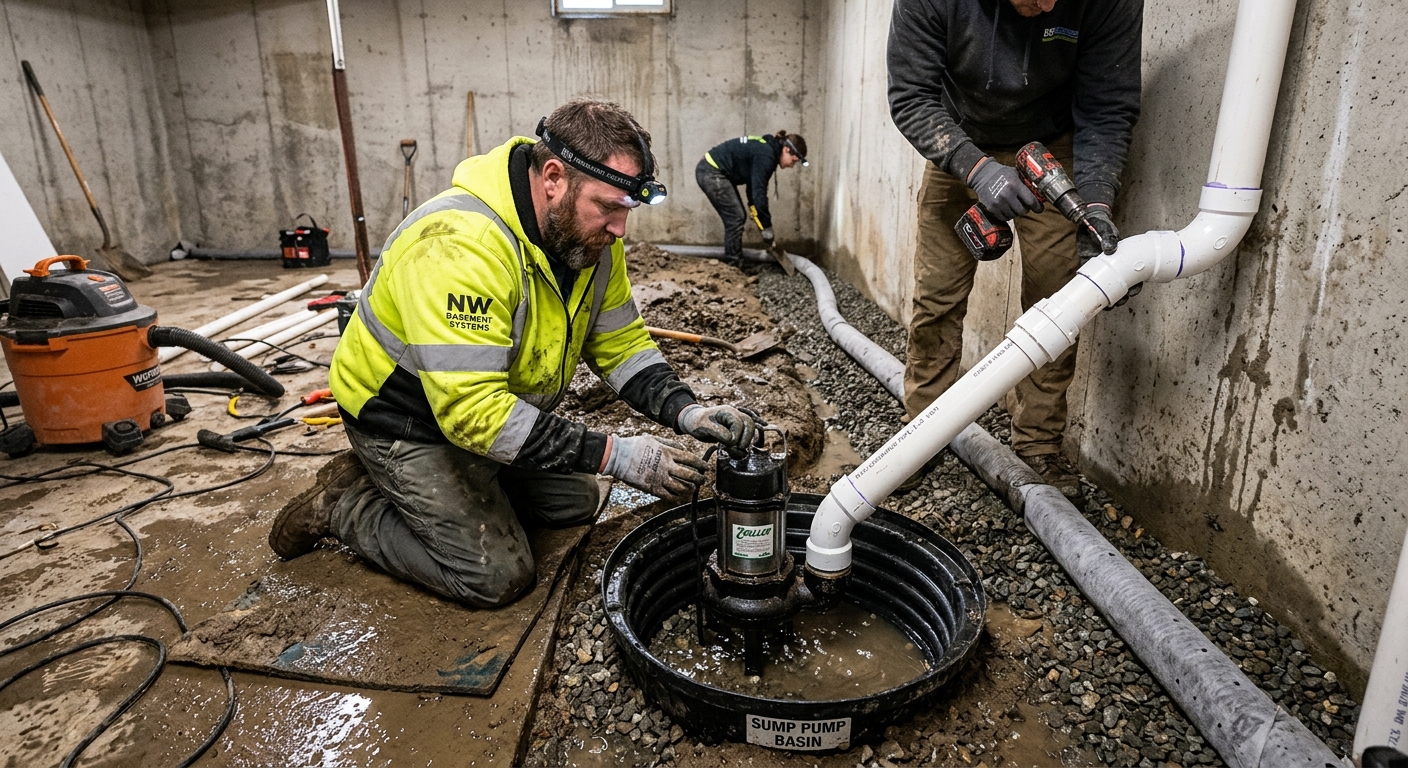
Basement waterproofing options and costs in Country Hills
In Country Hills, Alberta, waterproofing typically comes down to whether you’re stopping water before it gets into the basement or managing it after entry. With a local population of 3,660 (Statistics Canada, 2021 Census), smaller neighbourhoods like these tend to see repeat work on homes with aging drainage—especially in pockets of older housing stock. If your basement is from an era when tar-and-paper systems and earlier weeping tile runs were common, you’re more likely to find clogged, collapsed, or completely failed weeping tile and stain pathways that reappear every spring.
Cost is also shaped by Calgary-area conditions and access. Southern Alberta’s freeze–thaw cycles widen joints and existing cracks, and Calgary’s clay-heavy soils can hold moisture and push laterally on foundation walls when saturated. That means excavation, membrane installs, and perimeter drainage are not just “material jobs”—they’re planning and labour-heavy, particularly where concrete patios, retaining walls, or tight lot lines restrict machine access.
Contractor availability can affect pricing too: the trades that handle deep excavation and full perimeter drainage are booked quickly in spring and early summer. In demand areas in Country Hills often include older street blocks where lots are narrower and downspouts discharge closer to the foundation.
Below is a practical comparison of the most common basement waterproofing methods homeowners choose in Country Hills, along with typical disruption and budget ranges to help you compare quotes before you meet the crew.
| Method |
What It Addresses |
Disruption Level |
Durability |
Price Range |
| Exterior excavation + new membrane + drainage tile |
Hydrostatic pressure and bulk water entry through foundation walls/footings; rebuilds perimeter drainage |
High (excavation, backfill, landscaping restoration) |
Long-term when installed to spec (often decades) |
$9,000–$25,000 |
| Interior perimeter drain channel + sump pit |
Manages water that enters through cracks/weep routes; reduces seepage and floor saturation |
Medium (interior demo and concrete work) |
Strong performance with properly sized sump and discharge |
$5,000–$15,000 |
| Foundation crack injection (epoxy or polyurethane) |
Seals cracks to stop seepage pathways; stops water migration along control joints |
Low to Medium (minor surface prep; depends on number of cracks) |
Varies by crack type; structural cracks require correct product selection |
$500–$1,800 |
| Sump pump installation (primary + battery backup) |
Prevents basement flooding during heavy meltwater or storm events; improves resilience during outages |
Low to Medium (pit excavation and minor concrete cutting) |
High, when paired with reliable discharge and backup power |
$900–$3,000 |
| Window well drain installation |
Stops water pooling around egress windows and reduces wet drywall below basement windows |
Low to Medium (yard work near wells; limited excavation) |
Good for localized entry points |
$1,200–$3,500 |
| Lot re-grading / downspout extension |
Redirects surface water away from the foundation to reduce seepage risk and saturation |
Low to Medium (landscaping touch-ups) |
Helps prevent reoccurrence; effectiveness depends on drainage discharge |
$800–$2,800 |
Prices are estimates only and vary by project scope, site access and material selection.
What affects the price of waterproofing in Country Hills
In Country Hills, homeowners often see the same “waterproofing” described in very different ways, which is why two quotes for similar-looking basements can diverge by 30–50% across Calgary and Alberta. The spread isn’t just pricing—it’s differences in how contractors address water pathways, how much excavation is required, and whether the work includes full drainage correction (not only surface sealing). Labour rates and disposal costs for heavy clay spoils can also swing budgets when the job needs deeper digging or multiple trips.
The three most important drivers that separate Calgary-area costs from national averages are soil type, water table conditions, and freeze–thaw. Calgary and the surrounding area can sit on clay and clay-till that expand when saturated, increasing lateral pressure on foundation walls and worsening cracks over time. In low-lying pockets near river valleys and coulees, seasonal groundwater and storm events can elevate hydrostatic pressure—meaning a simple patch often fails and a continuous exterior membrane/perimeter drain becomes more cost-effective long-term. Freeze–thaw cycles then widen those cracks and joints, letting meltwater find its way into basements in spring. In older neighbourhoods, clogged weeping tile and undersized interior drainage make seepage and efflorescence common failure points rather than rare events.
Concrete examples from Country Hills: if your basement shows wall seepage but the weeping tile is likely over 60 years old, expect higher scope than “interior only,” because the water entry route is probably still active. If there’s access trouble from a concrete patio or tight lot lines, excavation costs rise quickly; conversely, basements with fewer cracks and accessible exterior walls may come in closer to interior bands of $5,000–$15,000 rather than pushing into exterior ranges like $9,000–$25,000. When the foundation is block, interior drainage is commonly necessary as a practical complement to any sealing.
| Price Factor |
Why It Matters |
Cost Impact |
| Interior vs. exterior approach — interior is less disruptive but addresses symptoms |
Exterior targets the source of water entry; interior typically controls water after entry |
Exterior often adds major excavation/landscaping cost (frequently the biggest swing) |
| Foundation type — poured concrete vs. block vs. stone vs. ICF |
Different wall materials react differently to water and crack movement |
Block and older stone often require interior drainage add-ons; poured walls may seal better with correct injection |
| Soil type — clay expands more than sand, adding pressure |
Clay saturation increases lateral pressure on walls and can overload perimeter drainage |
More robust drainage/membrane work can be required, increasing labour and materials |
| Crack type and length — hairline vs. structural horizontal cracks |
Structural cracks need engineered assessment and different repair strategy |
Structural repair/engineering can add time and cost beyond injection alone |
| Sump pump backup system — battery or water-powered backup needed |
Reduces flood risk during Alberta power interruptions in spring events |
Backup adds equipment and commissioning cost, but can prevent expensive clean-up |
| Access — landscaping, decks, or driveways must be removed for exterior |
Equipment reach and disposal volume affect excavation cost |
Tight urban lots and hardscapes can push exterior jobs toward the upper end |
| Weeping tile age — original tile (60+ years) may be completely failed |
Old tile can be clogged/collapsed, shifting water pathways |
More exploratory drainage work or full perimeter replacement can be required |
| Mould or efflorescence remediation required before sealing |
Sealers often fail if salts and contamination aren’t addressed first |
Additional prep increases labour and may require controlled drying/ventilation |
Permits & regulations in Alberta
In Alberta, foundation excavation, structural crack repair, and changes to lot drainage typically require a building permit. If you’re planning work that alters foundation elements or addresses potential structural movement—like repairing major horizontal cracks in block walls, step cracking, or any situation that suggests load movement—permits are common. Sump pump installations that connect discharge to municipal infrastructure (storm or sanitary systems) also typically need municipal approval, so a contractor should confirm routing and approvals before starting. For localized re-grading and downspout extensions that simply redirect surface water, permits may not always be required, but the contractor should still verify whether your specific discharge plan triggers review.
For structural crack repair, an engineer’s assessment is often needed when cracks appear structural (horizontal block wall cracks, significant step cracking, or wider/buckled sections). Before signing, ask whether the contractor provides engineering support for structural scope and has liability insurance plus WSIB/WCB coverage.
To verify a contractor in Country Hills, Alberta step-by-step: (1) confirm their business/contractor registration status using the relevant provincial online registry resources; (2) request a current certificate of insurance (liability) listing the correct legal name and address—verify dates and coverage; (3) ask for WSIB/WCB account clearance or documentation and confirm it’s active; and (4) for any structural scope, request the engineer letter/report or a written confirmation of how they coordinate engineering.
Interior vs exterior waterproofing — what does Country Hills need?
Exterior waterproofing is the “source control” approach. It involves excavating around the foundation, installing a continuous exterior membrane, adding or rebuilding perimeter drainage tile, then backfilling and restoring landscaping. When it’s done correctly, it reduces the hydrostatic pressure that drives water through cracks and joints. The trade-off is cost and disruption—expect removed patios, yard rework, and more labour because you’re working around the entire perimeter that needs attention.
Interior waterproofing focuses on “intercepting and managing” water once it enters. Common systems include a perimeter drain channel, a sump pit, and a sump pump that collects seepage and pumps it away. This is usually less invasive than exterior work and can be the right fit when excavation access is limited (tight lots, finished yards, mature landscaping) or when you want to stabilize the basement quickly. However, interior systems do not stop hydrostatic pressure from acting on the wall itself; they rely on drainage capacity and an adequately sized sump and discharge.
In Country Hills, clay-heavy soils and spring melt make exterior drainage correction especially valuable when you’re seeing recurring wall seepage, efflorescence, or saturation at the floor line. Poured concrete walls typically respond well to correctly specified crack injection (when the crack movement and water pathway are understood). Block foundations often benefit from interior drainage as a practical complement because block joints and seep routes can continue to sweat even after localized sealing.
For budget clarity: if your project is mainly interior floor moisture with limited wall cracking, interior options often sit around $5,000–$15,000. If you need full perimeter excavation and membrane due to persistent hydrostatic pressure, exterior scope typically lands around $9,000–$25,000—and that extra cost is justified when the water entry route is external and ongoing. Backup pumping matters in Alberta: spring flooding and short outages can turn a “single pump” into a failure point if the system can’t keep running.
| Method |
Best For |
Addresses Source? |
Disruption |
Lifespan |
Price Band |
| Full exterior excavation + membrane |
Recurring seepage from walls/footings, high pressure areas, failed exterior drainage |
Yes (targets entry and hydrostatic pressure) |
High (yard and hardscape disturbance) |
Long-term |
$9,000–$25,000 |
| Interior French drain + sump system |
Basement wetting after snowmelt/storms; limited exterior access |
No (controls water after entry) |
Medium (interior demo) |
Long-term with correct pump/discharge |
$7,000–$15,000 |
| Crack injection — epoxy (structural) |
Non-moving cracks where the goal is to bond and restore integrity |
Partial (stops water pathway in the crack) |
Low to Medium |
Good to long-term when crack movement is confirmed minimal |
$500–$1,800 |
| Crack injection — polyurethane (active leak) |
Cracks actively weeping during wet seasons; joints with ongoing seepage |
Partial (seals the pathway during active conditions) |
Low to Medium |
Good for ongoing leaks when applied correctly |
$700–$2,400 |
| Interior drain channel only (no sump) |
Light seepage that can drain by gravity; rarely for heavy pressure basements |
No (manages water, doesn’t control high pressure) |
Medium |
Moderate (depends on discharge route and capacity) |
$5,000–$10,000 |
| Re-grading + downspout extensions |
Surface water runoff contributing to dampness; gutters discharging near foundation |
No (addresses surface drainage) |
Low to Medium |
Moderate (works best as prevention/support) |
$800–$2,800 |
How to choose a waterproofing contractor in Country Hills
Start by verifying Alberta credentials properly. Ask for the contractor’s proof of liability insurance (certificate of insurance) and confirm the coverage is current and matches the legal business name. Next, verify WSIB/WCB coverage—request documentation or clearance that shows the account is active and in good standing. For waterproofing projects that touch structural crack repairs or foundation-related work, confirm the contractor has engineering support when needed and understands permitting/approval steps for drainage changes and sump discharge routing.
Then protect yourself with good quoting. Get 2–3 itemised written quotes (labour and materials breakdown, not a single lump sum). The scope should clearly list what’s included and what’s excluded: permit pull included or not, disposal included, saw-cut and concrete replacement included or not, and whether downspout extensions or re-grading are part of the plan. If they’re proposing interior work only, ask how they’ll handle the water pathway they expect (and whether a sump battery backup is recommended). Ensure warranties are documented: workmanship warranty length, product/manufacturer warranty, and whether the warranty transfers to a new homeowner if you sell.
Finally, use a sensible payment schedule—never more than 10–15% upfront, and hold a portion (often tied to final inspection and documentation). Get your timeline and expected start/completion dates in writing.
- Request written scope with quantities (linear feet of drain, number of injection ports/cracks, sump basin dimensions).
- Confirm excavation depth assumptions and disposal plan for clay spoils.
- Ask how they test/verify water source (dye testing, discharge observation, crack mapping).
- Check that the sump discharge route is specified and approved where required.
- Confirm membrane product type and thickness, plus installation details (seams, overlaps, protection board).
- Verify sump pump model and discharge sizing to match expected spring melt loads.
- Ask if battery backup or water-powered backup is included for outage resilience.
- Confirm crack injection method/product selection matches crack type (structural vs active leak).
- Make sure mould/efflorescence remediation steps are in the proposal before sealing.
- Ensure restoration is itemised: backfill, grading, topsoil, and landscaping rework expectations.
- Require permits/approvals responsibilities stated clearly (who applies, who pays).
- Ask for warranty terms in writing, including transferability.
In Country Hills, four to five common red flags include: quoting “epoxy injection” only for visibly weeping or active cracks without offering polyurethane or drainage correction; omitting sump pump discharge and backup power when the basement history shows spring wetting; failing to describe excavation access limits or disposal expectations for clay soils; providing an all-in lump sum with no line-item scope (especially around membrane and drain components); and refusing to provide proof of active liability insurance and WSIB/WCB coverage.
Frequently asked questions — waterproofing in Country Hills
How long does basement waterproofing take in Country Hills?
Typical timelines in Country Hills depend on whether you’re doing interior work or full perimeter excavation. Interior perimeter drains and sump setups often take about 3 to 7 working days for a standard single-level basement, assuming concrete cutting and dry time are scheduled properly. Full exterior waterproofing is longer—commonly 1 to 3 weeks—because excavation, membrane installation, perimeter drainage tile connection, backfill compaction, and exterior restoration all have to be completed in sequence.
Weather and cure times also matter in Alberta’s freeze–thaw cycle. Contractors plan around workable temperatures and drying time, especially where cementitious products or sealants are involved. If your foundation has older drainage failure and the system must be rebuilt, expect additional time for exploratory work. Cost-wise, interior scopes often land in the $5,000–$15,000 band, while exterior projects are frequently closer to the $9,000–$25,000 band and therefore take longer to complete.
What is a weeping tile and does my Country Hills home have one?
A weeping tile is the buried drainage system around (or near) a foundation that collects groundwater and seepage and directs it to a sump pit or an outlet. In older Calgary-area homes, original weeping tile may still exist, but it’s often clogged, broken, or undersized—especially after decades of clay soils retaining moisture and freeze–thaw widening joints. If you have basement dampness along a wall, recurring stains at the same locations each spring, or efflorescence at block seams, that often points to drainage issues.
Whether your Country Hills home has one can’t be confirmed without a review of your home’s records or an inspection plan. A contractor can map past drain locations, check exterior downspout discharge patterns, and use camera inspection if accessible. Even if there is a weeping tile, it may not be performing—so the decision becomes whether to clean/repair, reconnect, or switch to interior perimeter drainage. As a ballpark, interior waterproofing and weeping-tile-based drainage improvements commonly sit in the $5,000–$15,000 range.
Can I waterproof my basement in winter in Country Hills?
It’s possible, but it depends on site conditions and the exact method. In winter Alberta conditions, excavation can be limited by frozen ground and working temperatures. Interior waterproofing is often more feasible in cold months because the work is inside: perimeter drain channels, sump pits, and crack injection can proceed if concrete cutting and curing conditions are controlled.
Exterior waterproofing is more challenging in winter, primarily because you need to excavate to install membranes and drainage tile, then backfill and compact properly. Cold temperatures and frozen backfill can affect adhesion and long-term performance. A good contractor will tell you whether they can meet material cure requirements safely, or whether to schedule exterior work for spring.
If you’re budgeting, interior options often align with $5,000–$15,000, while full exterior scopes are closer to $9,000–$25,000. The key is choosing a plan that addresses active water pathways now, without compromising the materials’ ability to cure and bond.
What is the difference between waterproofing and damp-proofing?
Waterproofing is designed to resist or manage significant water pressure and recurring seepage, especially during Alberta spring melt and storm events. Damp-proofing generally refers to a lower level of protection—often meant for minor moisture control and early dampness, not for hydrostatic pressure. The difference matters in Country Hills because clay-heavy soils can saturate and create lateral pressure, and freeze–thaw cycles widen cracks and joints, turning “dampness” into active seepage.
Practically, true waterproofing scope usually includes a drainage strategy (perimeter drain and/or sump system), and it may include a continuous exterior membrane if the exterior water entry route is active. Interior systems that combine perimeter drainage with a sump are typically considered waterproofing because they manage collected water reliably. Simple sealants without a drainage plan often behave like damp-proofing—useful for superficial issues, but prone to recurrence when the real pathway is ongoing.
If you’re comparing quotes, ask whether the contractor includes a drain/sump plan and how they’ll address repeated spring wetting. For many homes, interior waterproofing lands around $5,000–$15,000, while exterior source control may be closer to $9,000–$25,000.
Will basement waterproofing affect my property value in Country Hills?
Yes, it often helps—especially when it’s documented correctly. In Country Hills, buyers care about basement usability and the absence of active moisture signs: recurring staining, efflorescence, musty odours, wet carpet pads, or visible seepage at cracks. Waterproofing that includes a clear scope, warranties, and (ideally) a sump and documented discharge plan can reduce perceived risk and make the home easier to insure and live with.
That said, the increase in value is not guaranteed, and the biggest factor is whether the system matches the actual water entry pathway. If you only address symptoms (like sealing) while the underlying drainage is failing, moisture problems can return and hurt resale confidence. On the other hand, properly executed exterior source control—especially where older weeping tile has failed—provides stronger long-term confidence.
Budget-wise, interior waterproofing often falls in the $5,000–$15,000 range, while full exterior projects frequently sit in $9,000–$25,000. Even if you don’t recoup all costs dollar-for-dollar, well-documented waterproofing typically improves buyer comfort because it tackles the issues that show up during spring melt and freeze–thaw.
What drainage issues are most common in Country Hills homes?
In Country Hills and the wider Calgary area, the most common drainage issues are linked to clay-heavy soils, freeze–thaw cycles, and aging drainage systems. Many homeowners notice wetness along foundation wall seams or near corners where water pathways concentrate. Efflorescence on block or poured walls often indicates moisture movement through the wall assembly. Another frequent issue is clogged or failing weeping tile—sometimes partly functioning, sometimes completely blocked—leading to water backing up toward the basement.
Surface water problems are also common: downspouts that discharge too close to the foundation, low spots in landscaping, and poor lot grading can allow meltwater and spring runoff to saturate the backfill. In low-lying pockets near river valleys and coulees, seasonal groundwater and storm events can increase hydrostatic pressure, making functioning perimeter drains and reliable sump systems critical.
Whether your home has mostly interior symptoms or active seepage, a correct plan should address both the water entry pathway and the water management strategy. When needed, sump pump installations (often with backup) can fall in the $900–$3,000 range, and full interior systems typically sit in the $5,000–$15,000 band.