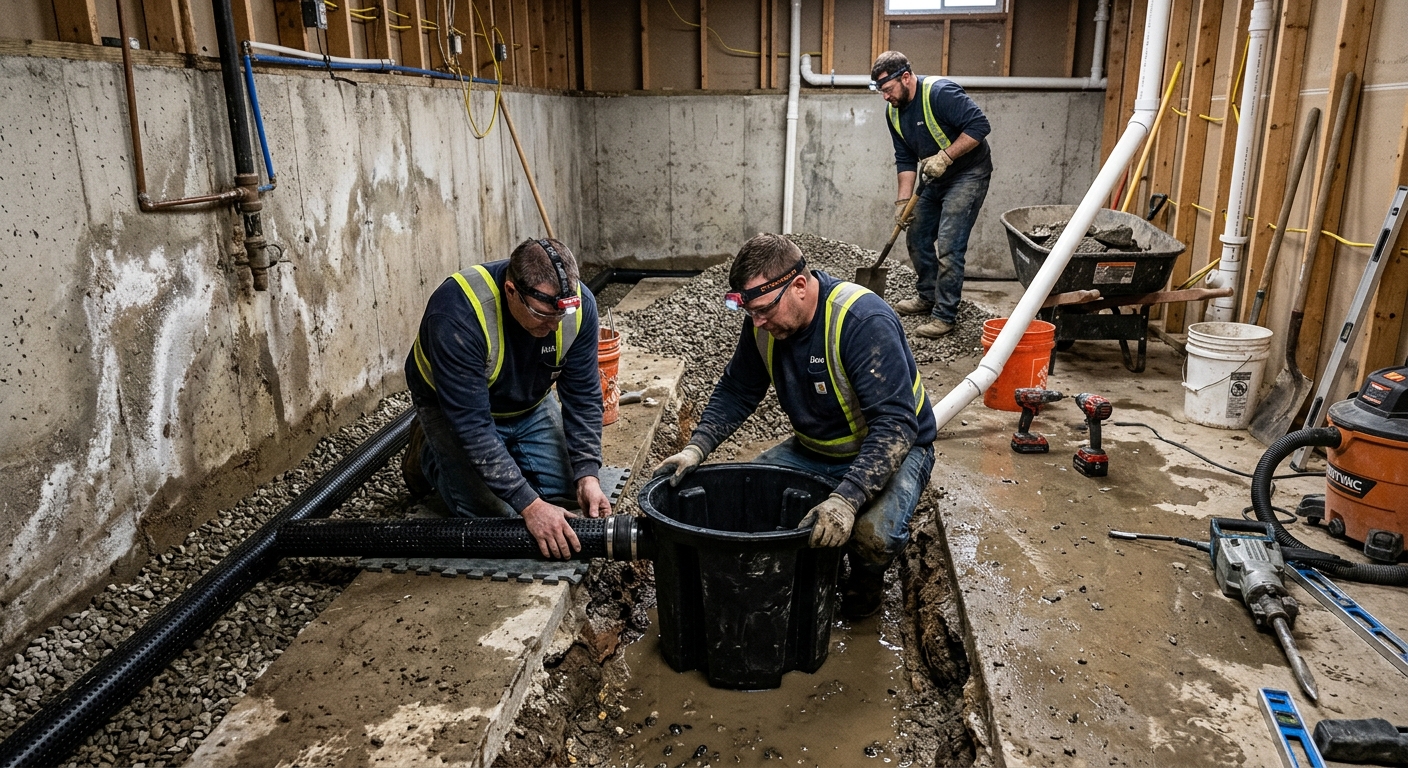
Basement waterproofing options and costs in Lee Ridge
Basement waterproofing in Lee Ridge typically starts with understanding how your site sheds water and how your foundation was built, because Lee Ridge is part of the Calgary market where clay-heavy ground and freeze–thaw cycles put real pressure on foundations. With Lee Ridge’s population of 2,741 (Statistics Canada, 2021 Census), trades are available, but schedules can tighten during spring turnaround when lots of older basements are showing seepage. In neighbourhoods built earlier, failed original waterproofing and older, corroded weeping tile are common failure points, especially where poured-concrete walls or masonry block meet joints that widened over time.
In Calgary and the surrounding Rocky View area, pricing is shaped by three local realities: clay soils that expand when saturated, seasonal freeze–thaw that widens cracks, and the practical labour of excavating in tight access conditions. Excavation depth, disposal fees for heavy clay spoils, and whether patios, decks, and landscaping need to be removed can swing your budget substantially. This is why exterior work often falls toward the higher end of the local band, while interior drainage tends to be a more budget-friendly “symptom control” option when the wall is already sealed from the inside.
Homeowners in Lee Ridge often ask for help in the older pockets near the established residential areas where drainage systems are long past their design life. If that sounds like your place, the table below compares the main waterproofing methods and what each one addresses so you can align scope with your symptoms before you request quotes.
| Method |
What It Addresses |
Disruption Level |
Durability |
Price Range |
| Exterior excavation + new membrane + drainage tile |
Stops water entry at the source by rebuilding the exterior waterproof barrier and providing a functioning perimeter drain |
High (excavation, backfill, re-landscaping) |
High (long service life when installed to full perimeter with proper drainage) |
$9,500 – $24,500 |
| Interior perimeter drain channel + sump pit |
Collects seepage water inside the basement and relieves hydrostatic pressure through pumping |
Medium (floor and wall chases; typically less than excavation) |
Medium to high (depends on sump quality and discharge management) |
$6,000 – $14,500 |
| Foundation crack injection (epoxy or polyurethane) |
Seals cracks to stop leakage; epoxy is best for stable cracks, polyurethane can manage active or moving leaks |
Low to medium (some drilling and surface restoration) |
Medium to high (best when paired with correct drainage strategy) |
$500 – $1,800 |
| Sump pump installation (primary + battery backup) |
Relieves water accumulation during spring storms and power events |
Low to medium (pit and electrical; minor finishes) |
Medium to high (improves reliability with backup) |
$1,200 – $3,000 |
| Window well drain installation |
Prevents rain and snowmelt from pooling around egress wells and leaking into bedrooms |
Low (targeted excavation around window wells) |
Medium (depends on tie-in to proper drainage route) |
$600 – $2,000 |
| Lot re-grading / downspout extension |
Redirects roof runoff away from foundation and reduces how much water reaches soil adjacent to the wall |
Low (topsoil/landscape adjustments) |
Low to medium (works best as prevention or alongside other work) |
$450 – $2,200 |
Prices are estimates only and vary by project scope, site access and material selection.
What affects the price of waterproofing in Lee Ridge
Even when homeowners in the Calgary region want the “same” waterproofing job, quotes can vary by 30–50% because contractors are pricing different site realities: excavation conditions, the actual water entry pathway, and how far the repair must go to be durable through Alberta’s freeze–thaw seasons. In Lee Ridge, clay-heavy ground holds moisture and can expand when saturated, increasing lateral pressure on foundation walls and worsening cracks over time. That alone can change the cost of a repair from a simple crack sealing to a combined crack injection plus full drainage strategy.
Three drivers consistently separate local costs from a national average. First, soil type: clay expands more than sand, so walls see more movement as seasons change; that means more preparation and more robust sealing. Second, water table and runoff: while pockets vary around Calgary’s river valleys and low spots, spring storm runoff often increases sump run times and requires reliable perimeter drainage and pump redundancy. Third, freeze–thaw: repeated wetting and freezing can widen joints, so a method that looks adequate in summer may fail to hold through winter.
Concrete examples in Lee Ridge that raise costs include a buried patio or tight side yard that forces careful shoring during exterior excavation, and heavy clay spoils that increase disposal and backfill effort. Costs can be lower when the seepage is localized to a single wall segment with accessible window wells or when you’re working from the inside only—projects often land closer to interior bands like $5,000 – $15,000 when no full perimeter excavation is required. When excavation is needed, exterior waterproofing in this area often ranges into $9,000 – $25,000 depending on depth and access, especially where full-perimeter drains must be rebuilt.
| Price Factor |
Why It Matters |
Cost Impact |
| Interior vs. exterior approach — interior is less disruptive but addresses symptoms |
Interior systems can’t stop water entry; they manage it after it enters |
Interior often costs less (commonly $5,000–$15,000), but exterior can be higher ($9,000–$25,000) when source control is needed |
| Foundation type — poured concrete vs. block vs. stone vs. ICF |
Different materials crack and leak differently; block walls often need interior drainage as a practical complement |
Foundation compatibility affects prep, crack mapping, and membrane selection |
| Soil type — clay expands more than sand, adding pressure |
Saturated clay increases hydrostatic and lateral pressure |
Higher likelihood of active leaks means more robust systems and longer prep |
| Crack type and length — hairline vs. structural horizontal cracks |
Active/moving cracks require different injection products and more labour |
Large structural crack work can push pricing toward crack repair plus drainage upgrades |
| Sump pump backup system — battery or water-powered backup needed |
Ensures pumping during power interruptions common in spring weather |
Backup typically adds meaningful cost but reduces risk of flooding during outages |
| Access — landscaping, decks, or driveways must be removed for exterior |
Excavation requires working space and safe staging |
Restricted access increases labour and restoration costs |
| Weeping tile age — original tile (60+ years) may be completely failed |
Old tile systems often collapse, clog, or are disconnected |
May require full perimeter rebuild rather than patching |
| Mould or efflorescence remediation required before sealing |
Sealers and membranes require clean, dry substrates for adhesion |
Extra remediation time can add cost before waterproofing products are applied |
Permits & regulations in Alberta
In Alberta, foundation excavation, structural crack repair, and changes to lot drainage typically require a building permit, especially when work could affect load paths, drainage patterns that influence neighbouring property, or when the repair involves structural elements. If your waterproofing includes underpinning, work on major structural cracks, or any alteration that changes how the foundation is supported, expect permit requirements and documentation expectations.
As a homeowner in Lee Ridge, it’s also important to treat sump work correctly. A sump pump installation that discharges to a municipal sewer system (storm or sanitary) generally needs municipal approval before connection. For the practical side of your waterproofing: if a contractor plans to route discharge, install a new discharge route, or tie into existing services, ask them to specify what approvals are included in their scope.
For structural crack repair—commonly horizontal cracks in block walls, significant step cracking, or cracks showing signs of movement—an engineer’s assessment is often required to confirm whether underpinning, reinforcement, or other structural remediation is needed. Before you sign, verify the company carries engineering support for structural repairs, along with current liability insurance and WSIB/WCB coverage. That way, you’re protected if conditions change once excavation starts or if an engineer specifies a different repair method.
To verify: (1) check the contractor’s credentials through the provincial licence registry they reference in their quote; (2) request a certificate of insurance and verify expiry dates and coverage limits; (3) request a WSIB/WCB clearance letter or equivalent proof of clearance; and (4) confirm in writing which permits/approvals are pulled by the contractor versus by you.
Interior vs exterior waterproofing — what does Lee Ridge need?
The fundamental difference is that exterior waterproofing addresses the source by creating a continuous barrier and functioning drainage system around the foundation. That means full excavation, new membrane, new perimeter drainage tile, and careful backfill and re-grading. Exterior systems typically cost more and disrupt landscaping, but in Lee Ridge’s clay-heavy conditions and freeze–thaw cycles, they tend to perform best for long-term water control because they reduce how much water enters the soil-to-wall interface.
Interior waterproofing, on the other hand, manages water after it enters. A perimeter drain channel and sump pit can relieve hydrostatic pressure and keep floors drier, but it doesn’t stop water from pressing on the foundation wall itself. That’s why it’s often the right fit when access for excavation is difficult or when seepage is being controlled in a localized way. For poured-concrete walls with stable cracks, crack injection can be a practical complement, while block foundations frequently benefit from interior drainage as a realistic supplement because joint behaviour differs and moisture paths can be harder to eliminate from the outside in retrofit situations.
In Alberta spring conditions, power outages and heavy melt events are key. Pairing an interior sump with a backup system helps you maintain pumping through outages. Where the difference is justified: if you’re seeing repeating seepage along multiple basement wall segments after spring storms, paying for exterior waterproofing can prevent repeated interior interventions. For example, a homeowner choosing exterior work in the $9,000 – $25,000 band may avoid multiple seasons of sump reliance that would otherwise sit in the $5,000 – $15,000 interior range, plus the risk of ongoing wall efflorescence. If symptoms are limited and the site can’t be excavated safely, interior systems can be the smarter choice—but the scope should be designed around actual water entry, not just aesthetics.
| Method |
Best For |
Addresses Source? |
Disruption |
Lifespan |
Price Band |
| Full exterior excavation + membrane |
Widespread seepage, failed exterior systems, clay-saturated sites where you need source control |
Yes |
High |
High (when drainage discharge route and membranes are continuous) |
$9,000 – $25,000 |
| Interior French drain + sump system |
Homes with limited exterior access, localized interior wetness, or as a practical retrofit plan |
No (relieves after-entry water) |
Medium |
Medium to high (depends on pump reliability and backup) |
$6,000 – $14,500 |
| Crack injection — epoxy (structural) |
Stable, non-moving cracks where water entry is limited and the substrate is prepared correctly |
Partial (can stop leaks through the crack) |
Low to medium |
Medium to high (best when cracks are stable) |
$500 – $1,800 |
| Crack injection — polyurethane (active leak) |
Active seepage or cracks that show signs of movement, especially after spring melt |
Partial (targets active leakage pathway) |
Low to medium |
Medium to high (when paired with proper drainage and drying) |
$700 – $2,200 |
| Interior drain channel only (no sump) |
Minor moisture management where gravity drainage is truly feasible and water is minimal |
No |
Medium |
Low to medium (sumpless systems are less reliable during heavy events) |
$5,000 – $10,000 |
| Re-grading + downspout extensions |
Preventative work, roof runoff issues, or homes with early-stage dampness only |
Yes (reduces water reaching the wall) |
Low |
Low to medium |
$450 – $2,200 |
How to choose a waterproofing contractor in Lee Ridge
Start by verifying Alberta coverage and credentials before you compare prices. Ask for the contractor’s current Alberta licence details (as applicable for the work they’re performing), then confirm liability insurance with a certificate of insurance showing coverage limits and expiry dates. For WSIB/WCB, request proof of clearance so you’re not stuck with liability if someone is injured on site. In waterproofing, the work is often performed around excavations, electrical tie-ins, and concrete cutting—so proper coverage isn’t optional.
Get 2–3 itemised written quotes with a labour and materials breakdown, not a single lump sum. A good quote spells out exclusions (for example, demolition, landscaping restoration quality, and any mould removal scope), whether permits are included or separately billed, and whether disposal of excavated clay is included. Confirm warranty details: workmanship warranty length (often several years), product/manufacturer warranty terms, and whether the warranty transfers if you sell your home. Also use a payment schedule that reflects risk—never pay more than about 10–15% upfront, and hold back a portion until the job is complete and punch list items are addressed. Finally, require a written start date and completion estimate; spring timelines in the Calgary region can change quickly when multiple crews target the same windows.
- Request proof of liability insurance and verify the certificate is current.
- Request WSIB/WCB clearance documentation for the company and any subcontractors.
- Ask how they identify the water entry path (video inspection, crack mapping, drainage testing).
- Require an itemised quote: excavation, membrane, drainage tile, pump, discharge route, and backfill.
- Confirm whether disposal fees for heavy clay spoils are included.
- Clarify what site restoration includes (topsoil, seed/sod, patio/deck rebuild scope).
- Ask if mould or efflorescence remediation is included when present.
- Get specifics on sump discharge direction and whether municipal approval is needed.
- Confirm the sump includes backup (battery or alternative) if spring events are a concern.
- Require product names and specifications (membrane type, drainage board, injection materials).
- Ensure warranty terms are written and include transferability.
- Check payment terms: small deposit only, with holdback until final completion.
In Lee Ridge, common red flags include: a contractor who won’t provide insurance/WSIB documents up front; vague scope language like “we’ll waterproof it” with no method-by-method details; skipping a discharge plan and leaving you to guess where water will go; offering only crack injection while ignoring perimeter drainage and sump reliability; and pushing for large upfront deposits or cash-only payments instead of a staged schedule.
Frequently asked questions — waterproofing in Lee Ridge
How long does basement waterproofing take in Lee Ridge?
For many Lee Ridge basements, timelines range from a few days for targeted work (like window well drainage or localized crack injection) up to one to two weeks or more for full interior systems. Exterior waterproofing is longer because excavation, membrane installation, drainage tile placement, backfill, and re-grading all have to be sequenced safely—clay soils often slow progress when they hold water and need workable conditions. Contractors in the Calgary area also manage weather windows to avoid sealing over wet substrates. If you’re doing interior perimeter drains and a sump, plan for concrete cutting, drying, and finishing time. A typical interior scope may fit into a spring schedule, but ask your contractor to state start date and completion estimate in writing, since crews often overlap in the same high-demand months.
What is a weeping tile and does my Lee Ridge home have one?
Weeping tile is the perimeter drainage line installed around your foundation footing to collect groundwater and seepage and move it away—either to a sump or a discharge point. In many older Lee Ridge homes, weeping tile was installed as part of the original design, but over time tile lines can clog, crack, collapse, or become disconnected, which is when seepage, efflorescence, and localized wall dampness start to show up more. You can’t confirm from the basement floor alone, but a contractor can often identify it by checking access points, basement floor edges, and discharge locations, or by inspecting where the original tile ties in. If you’re seeing recurring spring wetness, plan to assume older systems may be failing and discuss whether a perimeter drain rebuild is needed.
Can I waterproof my basement in winter in Lee Ridge?
Yes, it can be possible to waterproof in Alberta winters, but conditions matter. Interior work like crack injection and installing a perimeter drain channel can often be completed when the basement is accessible and substrate preparation is achievable. Exterior waterproofing is more challenging because excavation in cold weather increases risk, and sealing over damp or frozen soil can lead to adhesion problems and reduced performance. For Lee Ridge specifically, spring melt is when symptoms often intensify, so many homeowners schedule exterior work before the worst thaw period. If your main issue is active seepage through cracks or joints, an interior approach may still help immediately, while exterior source control is planned for a warmer window. Always ask your contractor how they handle cold substrate conditions and what drying/curing requirements they follow.
What is the difference between waterproofing and damp-proofing?
In homeowner terms, waterproofing is designed to stop or manage bulk water entry and seepage so your basement stays dry under higher water conditions—particularly during Alberta’s freeze–thaw seasons and spring storms. Damp-proofing typically refers to controlling minor moisture or “resisting dampness” rather than fully managing water pressure and active leaks. In Lee Ridge basements, if you’re seeing recurring wet spots, water staining, or efflorescence after melt events, you usually need true waterproofing thinking: drainage pathways, reliable collection, and ideally a source-control strategy for long-term results. Pricing reflects this difference—solutions that manage water pressure (like interior perimeter drains with sump) often fall into the $5,000 – $15,000 range, while exterior source-control work typically sits higher, often $9,000 – $25,000 depending on excavation and access.
Will basement waterproofing affect my property value in Lee Ridge?
Often, yes—especially when the work is documented and targeted to an identifiable problem. In Lee Ridge and the broader Calgary area, buyers know that recurring damp basements can lead to ongoing maintenance costs, odours, and finish damage. A properly installed interior drainage system with a reliable sump, or a full exterior membrane and perimeter drain rebuild, reduces the risk of future water claims and helps protect finished areas. The strongest value signal is transparency: itemised scope, written warranty terms, product names, and photos of drainage pathways and crack repairs (where applicable). Keep in mind that not every method adds equal confidence—crack injection alone may help in stable cracks, but if hydrostatic pressure is ongoing due to failed weeping tile or drainage, a buyer may ask how water is managed. Proper documentation and a practical solution matched to Calgary’s clay and freeze–thaw conditions are what support value.
What drainage issues are most common in Lee Ridge homes?
The most common issues in Lee Ridge typically fall into two categories: (1) water reaching the foundation from roof runoff and surface grading, and (2) groundwater and seepage pressure where perimeter drainage has failed or never performed as intended. In Calgary-area homes on clay soils, saturated ground can expand during freeze–thaw cycles, widening joints and letting meltwater penetrate more easily. For older housing stock, corroded or clogged weeping tile and disconnected drainage routes are common failure points, leading to seepage and localized wall leaks. Interior symptoms you might notice include damp corners near the slab edge, rising moisture after spring storms, and white efflorescence where salts migrate through porous concrete. When symptoms are consistent, the fix is usually a combination of drainage management—sometimes re-grading and downspouts plus an interior perimeter drain and sump, and in tougher cases, exterior source control.