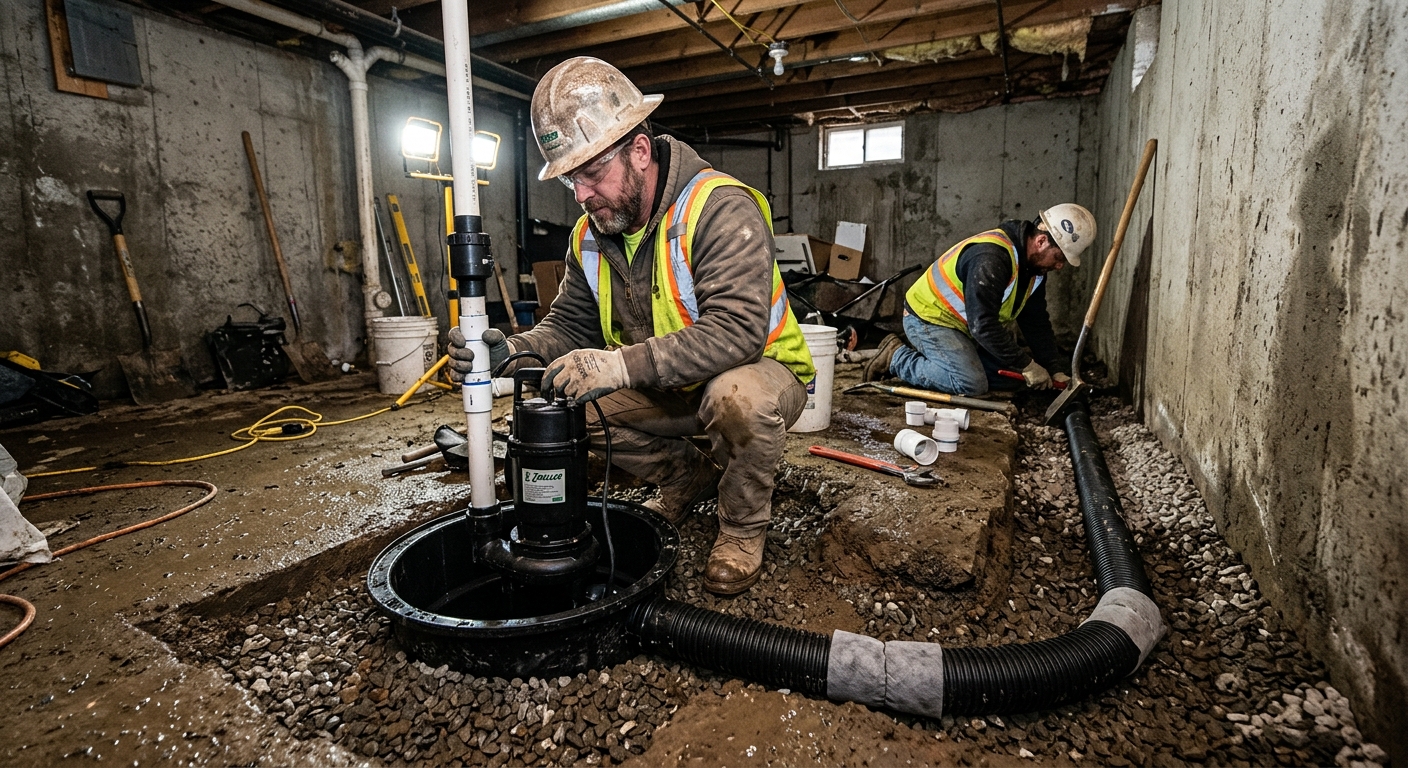
Basement waterproofing options and costs in Penhold
Penhold homeowners typically choose between exterior excavation and interior drainage solutions, and the right answer usually depends on how water enters and how your foundation is holding up. With 26.8% of Penhold homes built before 1981 (Statistics Canada, 2021 Census), you’ll often find older tar-and-paper waterproofing systems and perimeter weeping tile that’s long past its service life—so leaks that look “small” can still involve widespread rework around the footing.
In the Red Deer region, pricing is also strongly shaped by variable glacial/till soils and localized clay content. Clay-heavy soils tend to hold and press water against foundation walls, while freeze-thaw cycles in central Alberta can widen hairline cracks and loosen older mortar or joints over time. That’s why exterior work in Penhold can range widely, especially if excavation is deep or if groundwater management is needed during the job.
Contractor availability matters too: when demand is high around family neighbourhoods like downtown Penhold and the newer edges of town where access is tighter, crews may prioritize the jobs with the clearest access route and quickest material staging—raising scheduling pressure and sometimes labour costs. If you’re comparing options, use the methods below as a starting point, then tailor the approach to your foundation type and observed water path. Next, review the table to see what each method addresses and what it typically costs in this area.
| Method |
What It Addresses |
Disruption Level |
Durability |
Price Range |
| Exterior excavation + new membrane + drainage tile |
Direct water entry at the foundation exterior; replaces failed perimeter drainage and waterproofing system |
High (excavation to footing, landscaping/driveway impacts possible) |
High (source control; rebuilds full perimeter system) |
$10,000–$22,000 |
| Interior perimeter drain channel + sump pit |
Relieves hydrostatic pressure after water enters; captures seepage and routes it to sump |
Medium (interior floor/wall disturbance near perimeter) |
Medium to High (depends on sump reliability and maintenance) |
$3,500–$12,000 |
| Foundation crack injection (epoxy or polyurethane) |
Stops seepage through cracks; helps restore wall integrity for the right crack type |
Low to Medium (surface prep, selective drilling) |
Medium (best when cracks are non-structural or properly sealed to stop water) |
$450–$1,800 |
| Sump pump installation (primary + battery backup) |
Maintains dry conditions during high groundwater periods; backup reduces risk during outages |
Medium (pit excavation, discharge routing, electrical work) |
High (when paired with a properly sized basin and backup) |
$1,800–$4,500 |
| Window well drain installation |
Controls localized water around basement egress wells; reduces seepage and pooling |
Low to Medium (small exterior/interior adjustments) |
Medium (site and grading dependent) |
$750–$3,000 |
| Lot re-grading / downspout extension |
Stops roof and surface water from directing toward foundation; supports drainage performance |
Low to Medium (soil movement, grading adjustments) |
Medium (works best when combined with a drainage system) |
$600–$2,500 |
Prices are estimates only and vary by project scope, site access and material selection.
What affects the price of waterproofing in Penhold
In Penhold and the broader Red Deer region, two quotes for the “same” basement can differ by 30–50% because waterproofing is a system, not a single product. The scope changes once contractors confirm where water is coming from (roof runoff vs. soil pressure vs. crack seepage), what foundation materials you have, and how difficult excavation or interior access will be in your specific yard.
Three drivers separate regional costs from a national average: soil type, water-table behaviour, and freeze-thaw stress. Clay-heavy soils (common across parts of central Alberta’s glacial till landscapes) expand and move during freeze-thaw, increasing lateral pressure on walls and making previously “sealed” cracks re-open. When groundwater management is required, sump capacity and discharge routing can raise costs quickly, especially if the water table is high during spring recharge. In older homes, failing weeping tile and aging perimeter systems lead to repeated seepage failures—so contractors often need interior drainage even if the visible crack repairs seem minor.
Concrete examples from local job conditions: (1) If your basement has active seepage and the footing is partially undermined by poor drainage, exterior excavation + membrane and drainage tile can land in the $10,000–$22,000 range. (2) If water is already entering below slab elevation and you need an interior perimeter drain plus sump, a typical scope often falls into the $3,500–$12,000 band. (3) If you have small, non-structural hairline cracking with no signs of hydrostatic pressure, crack injection is usually a lower-cost fix in the $450–$1,800 range, but only after confirming the water path.
| Price Factor |
Why It Matters |
Cost Impact |
| Interior vs. exterior approach — interior is less disruptive but addresses symptoms |
Exterior targets the water source; interior controls water after entry |
Interior typically costs less and avoids full excavation; exterior can add major labour/excavation and drainage works |
| Foundation type — poured concrete vs. block vs. stone vs. ICF |
Different wall materials and joints respond differently to pressure and crack injection |
Block and jointed walls often require more detailed drainage planning and may need complementary interior systems |
| Soil type — clay expands more than sand, adding pressure |
Clay holds moisture and increases lateral pressure during freeze-thaw cycles |
Can push you toward sump capacity upgrades and/or exterior re-build of drainage performance |
| Crack type and length — hairline vs. structural horizontal cracks |
Structural cracks may indicate movement and require engineering before sealing |
Structural assessment and possible underpinning increase costs substantially |
| Sump pump backup system — battery or water-powered backup needed |
Outages during heavy spring conditions can turn a manageable leak into a major event |
Battery backup adds cost but reduces risk; can be critical if you’ve had prior nuisance flooding |
| Access — landscaping, decks, or driveways must be removed for exterior |
Excavation depth and staging drive labour and disposal time |
Tighter lots increase labour hours and restoration scope |
| Weeping tile age — original tile (60+ years) may be completely failed |
Failed perimeter tile can shift water to the foundation wall and slab edges |
Often upgrades the job from “small repair” to full perimeter replacement |
| Mould or efflorescence remediation required before sealing |
Sealing over contamination without remediation can trap moisture and worsen air quality |
Adds steps (containment, cleaning, and sometimes drying time) before coatings and membranes |
Permits & regulations in Alberta
In Alberta, homeowners should assume permits may be required when the work crosses into foundation excavation, structural crack repair, or changes that affect lot drainage. In practice, foundation excavation and structural crack repair (for example, where there are signs of horizontal cracks in block walls or other movement concerns) commonly trigger the need to check permit requirements before the job begins. Also, altering drainage patterns—such as redirecting roof runoff and changing how downspouts discharge—can require review depending on how it impacts services and the lot. If a sump pump discharge connects to municipal storm or sanitary infrastructure, municipal approval is typically part of the process.
For structural repairs, a structural engineer’s assessment is often required to determine whether underpinning or another structural solution is needed before any sealing or membrane work. Ask your contractor whether they have engineering support for structural scenarios, and confirm they carry proper liability insurance plus WSIB/WCB coverage where applicable.
How Penhold homeowners verify a contractor: (1) Look up the contractor’s Alberta licence/registration details using the relevant online registry; (2) request a current certificate of insurance showing liability coverage and ensure the effective dates are valid; (3) ask for WSIB/WCB clearance documentation (or a relevant exemption letter if that applies); (4) confirm the scope includes permit pull where required and who is responsible for it; and (5) get everything in writing before work starts.
Interior vs exterior waterproofing — what does Penhold need?
Exterior waterproofing is the “source control” option. It involves full excavation to the footing, replacement of the exterior membrane system, installation of drainage board, and new weeping tile (or connection into a functional perimeter drainage layout), then re-backfilling and restoring grade. In Penhold, this approach is usually best when the original perimeter drainage has failed, when you have persistent seepage around multiple wall sections, or when you’re dealing with older homes where the weeping tile system is likely compromised. The trade-off is disruption: excavation can affect landscaping, walkways, and sometimes driveways.
Interior waterproofing focuses on what happens after water enters the basement. Typical systems include a perimeter drain channel at the slab edge, a sump pit with a properly sized pump (often with battery backup), and discharge routing. This is generally less invasive and can be easier to schedule, but it does not eliminate hydrostatic pressure on the wall itself—so performance depends on a reliable pump setup and well-designed drainage pathway inside.
In Penhold’s climate and soil conditions, exterior solutions tend to hold up best where clay-rich, water-retentive soils and freeze-thaw have increased lateral pressure. Poured concrete walls can often be successfully addressed with crack injection paired with drainage improvements, while block foundations frequently benefit from interior drainage as a practical complement due to how water can travel through joints and along the perimeter. If your issue is primarily active leakage through a specific crack path, crack injection can be a targeted step, but it should be paired with drainage corrections.
For example, if you’re deciding between options and you’ve got widespread perimeter seepage, an exterior scope in the $10,000–$22,000 range may be justified because it restores the full drainage/perimeter waterproofing system. If the basement already has localized seepage and you want to minimize disturbance, an interior perimeter drain and sump scope in the $3,500–$12,000 band can be the better value—provided you include a backup strategy.
| Method |
Best For |
Addresses Source? |
Disruption |
Lifespan |
Price Band |
| Full exterior excavation + membrane |
Ongoing seepage, failed weeping tile, multiple wet wall sections, or when you want the most permanent source control |
Yes |
High |
High (when drainage and backfill are done correctly) |
$10,000–$22,000 |
| Interior French drain + sump system |
Limited exterior access, basement already finished, or water is entering and pooling below/near slab edge |
No (controls after entry) |
Medium |
Medium to High (pump reliability is key) |
$3,500–$12,000 |
| Crack injection — epoxy (structural) |
Non-moving cracks where you need a “structural-capable” seal and the crack is compatible with epoxy injection |
Helps stop seepage through the crack |
Low to Medium |
Medium to High (depends on crack behaviour) |
$700–$1,800 |
| Crack injection — polyurethane (active leak) |
Cracks with active moisture seepage where flexible sealing is beneficial |
Helps stop seepage through the crack |
Low to Medium |
Medium (best when combined with drainage control) |
$450–$1,600 |
| Interior drain channel only (no sump) |
Mild seepage where gravity drainage or limited water presence makes sump unnecessary |
No (still manages water after entry) |
Low to Medium |
Lower to Medium (depends on water pressure and ability to manage discharge) |
$1,200–$6,000 |
| Re-grading + downspout extensions |
Roof runoff and surface water issues where water is being directed toward foundation |
Partial (prevents source of surface water) |
Low to Medium |
Medium (works best with existing drainage improvements) |
$600–$2,500 |
How to choose a waterproofing contractor in Penhold
Choosing the right waterproofing contractor in Penhold is mostly about proof: proof they can legally work, proof they understand local failure patterns, and proof they will build the right scope for your basement—not just sell a standard package. Start by verifying Alberta licensing/registration where applicable for the trade involved in excavation, drainage work, and any structural-related repairs. Next, request their liability insurance certificate and confirm it’s current and appropriate for property work. Finally, ask for WSIB/WCB clearance documentation—then check that the names match the company doing the work. If they can’t provide documentation quickly, that’s a warning sign.
Get 2–3 itemised written quotes, not just a lump sum. You want a breakdown of labour versus materials (membrane, drainage board, tile, geotextile, pump, discharge, interior drain components), plus clearly stated exclusions such as disposal, restoration, permit pulls, or concrete coring/repair. Good scopes specify how they’ll address water path and failure mode (for example, whether they’ll assess weeping tile, crack type, and whether a sump pit and backup are required). Ask about warranty details: workmanship warranty length, product/manufacturer warranty, and whether the warranty transfers to future owners. Payment schedules should be staged—never more than about 10–15% upfront—with a holdback until key milestones are complete. Also get a start date and estimated completion timeline in writing.
- Confirm current liability insurance and ensure it’s for property damage coverage.
- Verify WSIB/WCB clearance (or relevant exemption paperwork) before work begins.
- Ask which Alberta permits apply to your scope and whether they pull them or you do.
- Request an itemised breakdown of materials and labour—especially for membrane, drainage components, and pump system.
- Ensure the quote states disposal and backfill handling (and any restoration allowances).
- Demand a written warranty for workmanship and product, including start date and coverage limits.
- Confirm whether the warranty is transferable to you and/or future owners.
- Ask how they diagnose the water source (cracks vs. perimeter tile failure vs. surface runoff).
- For interior systems, confirm sump basin sizing, pump model, discharge route, and whether backup is included.
- For crack work, confirm crack type assessment (hairline vs structural) and injection material choice.
- Check that they include surface prep and drying time before any sealing or coating.
- Require a written timeline with start date, inspections/hold points, and final completion steps.
Red flags in Penhold include: contractors offering “one-size-fits-all” waterproofing without inspecting cracks or drainage pathways; refusing to show proof of insurance/WSIB/WCB clearance; quotes that exclude permit pulls/disposal/restoration without stating so clearly; basing decisions solely on visible damp patches without checking exterior grading or perimeter drainage performance; and payment requests that ask for large upfront deposits with no written milestones.
Frequently asked questions — waterproofing in Penhold
How long does basement waterproofing take in Penhold?
In Penhold, timelines depend on whether you’re doing interior drainage, exterior excavation, or both. A typical interior perimeter drain and sump scope often takes several working days, because prep and floor/edge work can progress in sections and then the system is tested before finishing. Exterior waterproofing generally takes longer due to excavation to the footing, membrane application, drainage tile installation, and proper backfill and curing time; it also depends heavily on weather and soil conditions during freeze-thaw transitions.
If your basement needs crack injection only, that’s usually the quickest path—often a day or two for inspection, drilling, and cure time. For budgeting, plan around the scope rather than a single number: smaller targeted work might be completed quicker than a full exterior rebuild. If your quotes are around $10,000–$22,000 for exterior excavation, expect more days for excavation and reinstatement than an interior job in the $3,500–$12,000 range.
What is a weeping tile and does my Penhold home have one?
A weeping tile (also called a weeping drain) is a perforated drainage pipe system placed along the foundation perimeter—typically near the footing—designed to collect groundwater and direct it away from the basement. In many Penhold homes (especially those with older builds), the original perimeter tile may have been installed as part of a basement drainage strategy, but it can fail with age due to clogging, shifting backfill, or general wear over decades.
With 26.8% of Penhold homes built before 1981 (Statistics Canada, 2021 Census), it’s common to find older drainage systems that are partially blocked or completely failed. Signs include recurring dampness along the same foundation line, mineral staining, or water collecting near specific wall sections after spring melt. The only reliable way to confirm is through a contractor’s inspection: camera/sound testing of accessible lines, probing at cleanouts, or exposing sections during drainage work.
Can I waterproof my basement in winter in Penhold?
You can often do certain waterproofing work in winter in Penhold, but the feasible scope depends on temperature, moisture conditions, and what’s being installed. Interior crack injection and sump pump installation can sometimes proceed as long as the surfaces can be prepared and the contractor can maintain suitable working conditions for adhesives, injections, and electrical connections. Exterior excavation in winter is much more limited because frost depth, frozen soil, and logistical staging can increase costs and slow progress.
Also, Alberta freeze-thaw stress means stopping water effectively still requires correct drainage performance, not just surface repairs. A winter schedule may be ideal for targeted work—like injection on $450–$1,800 crack repairs—while saving exterior excavation for a period when excavation and backfill can be managed correctly. A good contractor will explain what can be done immediately versus what should wait for soil thaw so the drainage system performs as intended.
What is the difference between waterproofing and damp-proofing?
“Damp-proofing” is generally a lighter-duty approach intended to reduce minor moisture through walls and floors, often using coatings meant to handle small seepage. It does not reliably stop water under hydrostatic pressure. “Waterproofing” is broader and typically means a system designed to manage water entry and/or pressure—such as full exterior membrane and drainage tile, or an interior perimeter drain and sump designed to capture seepage and prevent accumulation.
In Penhold basements where older drainage systems may have failed, simple damp-proofing may slow symptoms but can still leave hydrostatic pressure unaddressed, leading to recurring leaks during spring melt. That’s why interior drainage systems (commonly in the $3,500–$12,000 band depending on scope) often perform better than coating-only solutions when the water source is groundwater. If you’re seeing active leakage through cracks, injection can be a waterproofing step too—especially when the correct material is chosen for active leaks versus non-moving cracks.
Will basement waterproofing affect my property value in Penhold?
Yes—usually in a positive way—because buyers in Penhold and the Red Deer region expect basements to stay dry, especially with Alberta’s seasonal freeze-thaw cycles and spring melt. Waterproofing can reduce moisture odours, stop recurring seepage, and lower the risk of damage to finished areas, which helps maintain livability and potentially supports resale confidence.
That said, value impact depends on doing the right work. A properly installed system backed by a workmanship warranty tends to be viewed more favourably than a quick cosmetic fix. Exterior waterproofing, often priced in the $10,000–$22,000 range, can be a stronger selling point when it rebuilds the perimeter drainage and membrane. Interior systems in the $3,500–$12,000 range can also add value when they’re clearly designed for the actual water path, such as a perimeter drain plus sump with proper backup.
For homeowners, keep documentation: contract scope, warranty terms, and any permit/inspection records where applicable.
What drainage issues are most common in Penhold homes?
In Penhold and the Red Deer region, common drainage issues usually fall into three buckets: failed perimeter drainage/weeping tile, surface water management problems, and foundation crack seepage that’s worsened by freeze-thaw. Older homes (including the 26.8% built before 1981) are more likely to have aging perimeter systems that can clog or shift, causing water to migrate laterally and then seep through cracks or along wall joints.
Clay content and local groundwater behaviour can also contribute. Where soils hold water, you can get increased lateral pressure on foundation walls, so small cracks become pathways during spring recharge. Downspout discharge and re-grading issues are another frequent cause—roof runoff can direct water toward the foundation when grading isn’t set to carry it away.
When quoting solutions, many homeowners end up choosing either an exterior excavation approach (often $10,000–$22,000) if the perimeter system is truly failed, or an interior drain plus sump (often $3,500–$12,000) if the plan is to control seepage after entry. A proper site inspection is what separates those choices.