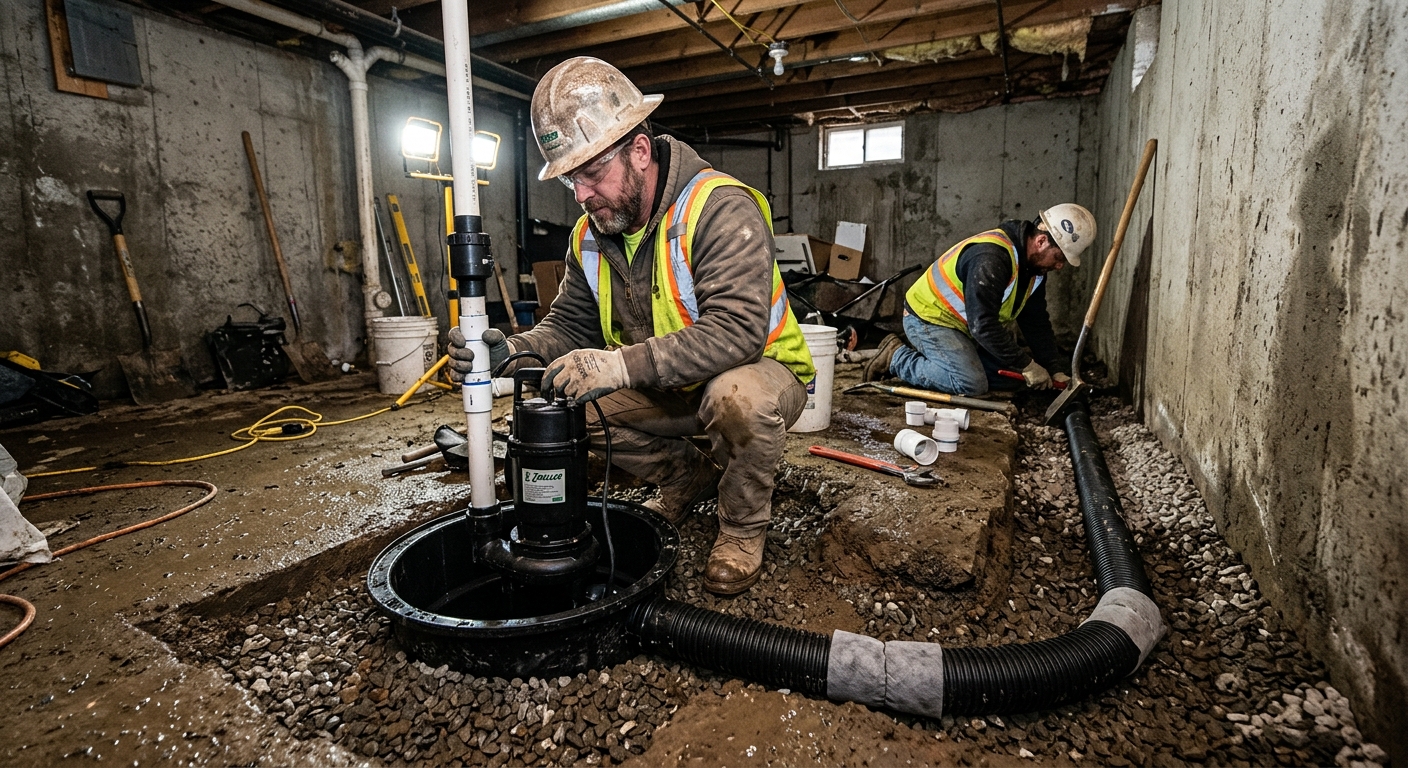
Basement waterproofing options and costs in Rosscarrock
Rosscarrock homeowners often notice basement seepage only after a wet spring or a hard freeze–thaw run, when clay soils hold water and then swell against foundation walls. With Rosscarrock’s population at 3,490 (Statistics Canada, 2021 Census), trades tend to service a broader Calgary-area customer base, so scheduling can vary when multiple crews are running exterior excavations at the same time. In older Calgary-area neighbourhood pockets built around earlier foundation details, original tar-and-paper type systems and corroded weeping tile are far more likely to be the underlying issue than a single “mystery leak.”
In southern Alberta, freeze–thaw cycles widen existing cracks and joints. That means a “spot fix” may slow water but not stop the seasonal pressure. Costs are therefore shaped less by product choice and more by excavation depth, whether existing weeping tile is failing, and whether your site requires full-perimeter membrane plus functioning perimeter drains. In Rosscarrock, demand is especially strong where lots have mature landscaping or narrow access along driveways—customers in areas near major transit and older infill streets frequently need exterior work coordinated around fences, patios and tight equipment access.
Below is a practical side-by-side of common approaches, what they address, and realistic cost ranges you’ll see in Calgary-area proposals before comparing contractors.
| Method |
What It Addresses |
Disruption Level |
Durability |
Price Range |
| Exterior excavation + new membrane + drainage tile |
Hydrostatic pressure at the source; replaces failed perimeter drainage |
High (excavate full perimeter, landscaping disruption) |
Long-term when drainage is continuous and backfill is properly managed |
$9,000–$25,000 |
| Interior perimeter drain channel + sump pit |
Water after it enters; reduces wall wetting and helps manage seepage |
Medium (interior floor/footing access) |
Very good for seepage control; depends on sump reliability and maintenance |
$5,000–$15,000 |
| Foundation crack injection (epoxy or polyurethane) |
Stops specific crack pathways; improves water tightness |
Low to medium (surface prep, small openings) |
Good for correctly identified crack type and proper prep/cleaning |
$500–$1,800 |
| Sump pump installation (primary + battery backup) |
Controls collected groundwater to prevent backup into the basement |
Low to medium (pit cut, discharge line, power/sump controls) |
Best when paired with adequate discharge and backup power |
$900–$3,000 |
| Window well drain installation |
Stops localized water entry at window wells and footing edges |
Low to medium (window well excavation/liner work) |
Good for targeted areas; depends on grading and downspout control |
$1,200–$4,500 |
| Lot re-grading / downspout extension |
Reduces runoff and helps keep surface water away from foundation |
Low (minor excavation/landscaping adjustments) |
Moderate (can help a lot, but won’t replace failed drainage behind walls) |
$1,000–$6,000 |
Prices are estimates only and vary by project scope, site access and material selection.
What affects the price of waterproofing in Rosscarrock
In Rosscarrock and across the Calgary economic region, quotes for the “same” basement can differ by 30–50% because the real problem is often behind walls: failed drainage, blocked weeping tile, deteriorated backfill, or cracks that react differently under seasonal moisture. Contractors may also price differently based on excavation risk, disposal fees for heavy clay spoils, and whether the scope includes permit support, camera inspection, or full re-establishment of drainage.
The three biggest drivers that separate Calgary-area costs from the national average are soil type, water table conditions, and freeze–thaw. Clay-heavy soils common around the prairies (and in parts of Ontario) hold water longer and can expand during freeze–thaw, increasing lateral pressure and worsening cracks over time. Where seasonal groundwater is higher—especially in low pockets near river valleys and storm runoff pathways—sump systems can run longer and require robust discharge and backup. In neighbourhoods with older housing stock, failing weeping tile is frequently the trigger for localized wall leaks, efflorescence, and seepage through joints.
Concrete examples in Rosscarrock: (1) a basement with a poured concrete wall and a few vertical cracks often responds well to targeted crack injection plus drainage fixes, keeping costs closer to the $500–$1,800 crack-repair band; (2) if interior inspections show recurring water line staining across multiple wall segments, you’re more likely into the $5,000–$15,000 interior perimeter drain + sump range; and (3) if the property requires full exterior excavation because drainage behind the foundation is collapsed or unavailable, pricing quickly moves into the $9,000–$25,000 exterior waterproofing band.
| Price Factor |
Why It Matters |
Cost Impact |
| Interior vs. exterior approach — interior is less disruptive but addresses symptoms |
Exterior treats water entry; interior manages water after entry |
Exterior often adds excavation, membrane, and drainage tile labour/materials (higher end of bands) |
| Foundation type — poured concrete vs. block vs. stone vs. ICF |
Wall composition changes crack behaviour and sealing strategy |
Poured concrete may be easier for targeted injection; block often needs interior drainage as a practical complement |
| Soil type — clay expands more than sand, adding pressure |
Clay holds and releases moisture, increasing lateral pressure |
Higher risk of recurring seepage if drainage is undersized; may push work toward full exterior fixes |
| Crack type and length — hairline vs. structural horizontal cracks |
Wrong resin selection can fail under active water flow |
Structural/horizontal cracks can require engineering assessment and extra scope beyond injection |
| Sump pump backup system — battery or water-powered backup needed |
Power interruptions during spring storms can cause basement flooding |
Adding backup can add cost but reduces risk of loss during outages |
| Access — landscaping, decks, or driveways must be removed for exterior |
More teardown increases time and restoration labour |
Can significantly increase exterior project cost in tight lots |
| Weeping tile age — original tile (60+ years) may be completely failed |
Undersized or broken tile leads to chronic seepage |
Replacement and camera-led troubleshooting increases labour and materials |
| Mould or efflorescence remediation required before sealing |
Sealers won’t bond well to contaminated surfaces |
Expect additional time, cleaning, and controlled drying before waterproofing |
Permits & regulations in Alberta
In Alberta, foundation excavation, structural crack repair, and changes to lot drainage typically require a building permit. Sump pump installations that connect to the storm or sanitary sewer generally need municipal approval, because the discharge method must comply with local rules and avoid backflow or surcharge into municipal systems. If you’re dealing with water-management changes near the foundation (for example, reconfiguring downspouts, altering grading, or modifying how water leaves the lot), it’s wise to assume permit review may apply—your contractor should tell you what they intend to file and what you’ll need to sign.
For structural crack repair—especially horizontal cracks in block walls or major step cracks—a structural engineer’s assessment is often required to determine whether underpinning or other structural work is needed. When structural work is in the scope, verify the contractor has access to engineering support and carries appropriate liability coverage.
Step-by-step verification you can do in Rosscarrock: first, ask for the contractor’s Alberta business registration details and confirm the correct licence/class for the work they’re doing (your contractor should provide their licence number; you can cross-check online). Second, request a certificate of insurance showing general liability (and, where applicable, any relevant endorsements) with policy dates that cover the project period. Third, ask for WSIB/WCB clearance documentation (or the current equivalent proof of coverage) and verify it matches the contractor’s legal name. Finally, if an engineer is involved, request the written assessment plan or confirmation of the engineer’s scope before injection or membrane work begins.
Interior vs exterior waterproofing — what does Rosscarrock need?
The fundamental difference is simple: exterior waterproofing (full excavation, membrane, new drainage tile, controlled backfill) addresses water entry at the source, while interior waterproofing (perimeter drain channel, sump pit, sump pump) manages water after it has entered. In Rosscarrock’s southern Alberta conditions—clay-till soils holding moisture and freeze–thaw widening joints—exterior systems typically perform best when the exterior drainage is failing or when hydrostatic pressure is consistently pushing water through multiple wall segments.
However, exterior work can be difficult and expensive where tight lot lines, existing patios, retaining walls, or mature landscaping limit access. In those cases, interior drainage can still be effective, especially for poured concrete foundations where crack injection and careful interior drainage reduce the overall wetting cycle. Poured concrete walls often seal better with properly selected crack injection materials after surface prep; block foundations more commonly benefit from interior drainage as a practical complement because joints and voids can behave differently under seasonal pressure.
Power reliability matters in Alberta spring flooding. A sump pump is a lifesaver, but during outages a basement can quickly collect water. That’s why many Rosscarrock homeowners choose battery backup or other backup systems rather than relying on the grid alone.
Price example: if a short, vertical crack path is the main issue and inspection supports it, injection work may fit within the $500–$1,800 foundation crack repair band. But if inspections show widespread seepage and failed perimeter drainage, you may be choosing between an interior system (often $5,000–$15,000) and an exterior system ($9,000–$25,000). The higher exterior cost is justified when the source water path is outside the foundation and the exterior drainage can’t be trusted.
| Method |
Best For |
Addresses Source? |
Disruption |
Lifespan |
Price Band |
| Full exterior excavation + membrane |
Chronic seepage, high hydrostatic pressure zones, failed exterior drainage |
Yes |
High |
Long (typically decades with correct drainage design and backfill) |
$9,000–$25,000 |
| Interior French drain + sump system |
Interior wetting, weeping along walls, homes where exterior access is limited |
No (manages water after entry) |
Medium |
Good when sump is sized correctly and maintained |
$5,000–$15,000 |
| Crack injection — epoxy (structural) |
Non-moving, dry-to-hydrophobic crack pathways (often poured concrete) |
Partial (targets a crack pathway) |
Low to medium |
Good if the crack is stable and prep is thorough |
$500–$1,800 |
| Crack injection — polyurethane (active leak) |
Active seepage or cracks with water movement |
Partial (targets a crack pathway) |
Low to medium |
Good for active leaks when correctly selected and installed |
$800–$2,500 |
| Interior drain channel only (no sump) |
Light seepage that can be safely managed without pumping |
No |
Medium |
Moderate (risk increases if flow rate rises during spring storms) |
$3,000–$8,000 |
| Re-grading + downspout extensions |
Surface-water problems and poor foundation runoff control |
Indirect (reduces load on the foundation perimeter) |
Low |
Moderate (helps, but doesn’t replace failed weeping tile/drainage behind walls) |
$1,000–$6,000 |
How to choose a waterproofing contractor in Rosscarrock
Start with licensing and coverage. In Alberta, confirm the contractor has the correct authorization for the work they’re proposing (ask for their licence number and verify it using provincial online resources). Next, request a certificate of insurance that shows current general liability, with the policy period covering your project dates; if they perform higher-risk work, ask whether any specialized endorsements apply. Then get WSIB/WCB clearance documentation (or the applicable proof of coverage) and confirm it matches the contractor’s legal business name. If a contractor can’t produce these documents quickly, treat that as a warning.
When you request quotes, avoid lump sums. Ask for 2–3 itemised written estimates showing labour and materials line-by-line: excavation and disposal, membrane systems, drainage tile and filter fabric, sump pit and pump model, discharge method, prep and crack treatment materials, and any restoration (backfill, landscaping, patio/steps reinstatement). Also check exclusions: is permit pull included, is CCTV inspection included, and is plumbing re-routing part of the scope if a discharge line is encountered? A clear scope protects you from “change order” surprises.
Warranty matters in Calgary-area freeze–thaw. Confirm workmanship warranty length, product/manufacturer warranty, and whether the warranty is transferable if you sell your home. Payment schedules should follow common best practice: never pay more than 10–15% upfront, and hold back a portion until key milestones and cleanup are complete. Finally, require a written timeline with a start date and completion estimate.
- Ask whether they’ll inspect existing weeping tile with a camera or by exposing sections, not just guess.
- Require written confirmation of the exact drainage outlet method (and whether municipal approvals are needed).
- Get the sump pump model and specs (including discharge diameter and basin size).
- Confirm whether they include sump backup (battery or other) and what triggers it.
- Ensure crack injection includes crack cleaning/prep steps (not “inject and walk away”).
- Ask who supplies engineering support if cracks appear structural.
- Verify disposal fees and backfill/compaction testing are included when exterior excavation is part of the plan.
- Request a site-access plan: protection for decks, fences, and patios during excavation.
- Clarify what they will restore (grading, sod, gravel, eavestrough downspouts connections).
- Confirm warranty terms in writing: workmanship duration and manufacturer coverage details.
- Insist on permit responsibility spelled out: what the contractor files vs what you must approve.
- Review the quote for “allowances” that are vague—those often cause cost drift.
Red flags to watch for in Rosscarrock: (1) a contractor who won’t provide written scope and warranty details; (2) claims that “one method fixes all” without inspection of weeping tile/drainage pathways; (3) promising structural crack stability without engineering assessment for horizontal or major step cracks; (4) insisting on high upfront deposits; and (5) vague discharge language that doesn’t address municipal approval needs where applicable.
Frequently asked questions — waterproofing in Rosscarrock
What causes foundation cracks in Rosscarrock?
In Rosscarrock, the most common causes are soil movement and seasonal moisture change. Clay-till soils hold water and expand when saturated; during freeze–thaw, that expansion can increase lateral pressure on foundation walls and widen hairline joints over time. Poor drainage at the surface (short downspouts, missing extensions, or grading that directs runoff toward the house) can add to the problem by keeping the perimeter soil wet. Over time, seepage through joints can also contribute to efflorescence and localized weakening at weak points. Older foundations are more likely to have aging weeping tile (sometimes originally installed decades ago), meaning water pressure builds behind the wall rather than being relieved.
How do I compare waterproofing quotes?
Compare quotes the way you’d compare roofing: scope first, then price. Ask each contractor for an itemised breakdown (materials and labour) and confirm whether they include excavation, drainage tile, membrane, sump pit and pump, discharge routing, permit support, disposal fees, and any restoration. In Rosscarrock, the difference between interior-only work and true source control can be several thousand dollars, so look for whether they’re treating the entry point or only managing symptoms. Use the local price bands as a reality check: crack injection often falls around the $500–$1,800 range, interior perimeter drain plus sump commonly aligns with $5,000–$15,000, and exterior excavation with membrane can range $9,000–$25,000. If a quote is “cheap,” verify what it excludes.
How long does basement waterproofing take in Rosscarrock?
Timelines depend mainly on whether you’re doing exterior excavation or interior work. Interior perimeter drains and sump systems are often the faster path because they avoid full perimeter excavation, but they still require careful prep, concrete cutting or floor access, drainage installation, and drying time before finishing. Exterior waterproofing typically takes longer because of excavation, membrane placement, drainage tile routing, backfill and compaction, plus restoration of landscaping and any hardscapes. In Calgary-area freeze–thaw conditions, contractors also need to plan around weather windows to keep membrane installation and curing predictable. Expect the process to involve at least a few site visits: inspection/camera review (if included), then the main work, then verification steps. Ask for a written start date and completion estimate tied to your scope.
What is a weeping tile and does my Rosscarrock home have one?
Weeping tile is the perimeter drainage system installed around the foundation, designed to collect groundwater and relieve pressure by directing it to a sump (or discharge route). Many older homes in Calgary-area neighbourhoods—some built around earlier basement drainage standards—were fitted with original perimeter tile that can last a long time but may fail due to clogs, breakage, or offset joints. In Rosscarrock, whether your home has weeping tile usually depends on your foundation era and basement history (visible discharge points, old sumps, or records from past renovations). The safest way to know is to have a contractor expose a section near a corner or inspect with camera where access allows. If the weeping tile is failed, interior drainage or full exterior source control may be necessary.
Can I waterproof my basement in winter in Rosscarrock?
Yes, but it depends on the method and the temperature. In Alberta winters, freezing ground and cold foundation surfaces can complicate excavation, membrane work, and curing of some materials. Many contractors can still perform interior work—like crack injection and installing sump components—because they don’t require large exterior excavation or exposed backfill curing. Exterior waterproofing is more sensitive to weather: wet clay spoils and frozen subgrade can affect membrane adhesion, drainage grade, and backfill performance. If you’re planning winter repairs, ask the contractor how they manage temperature control and curing timelines and whether they can test and confirm the water condition (for example, that the crack is actively leaking vs only damp). For interior seepage during winter, you may also focus on sump reliability to prevent spring flooding losses.
What is the difference between waterproofing and damp-proofing?
Waterproofing is designed to stop bulk water and manage hydrostatic pressure or active seepage paths. Damp-proofing generally focuses on resisting moisture for mild conditions—often suitable for preventing minor dampness rather than handling sustained water pressure against foundation walls. In Rosscarrock, where clay soils expand and freeze–thaw can widen cracks, damp-proofing alone often isn’t enough when water is actively entering during spring runoff. If you have staining, efflorescence, recurring wet corners, or a basement that worsens after heavy rains, you’re typically in “water entry” territory where interior drainage, sump control, or exterior membrane and drainage tile are more appropriate. A reputable contractor should match the approach to the actual source, not just the appearance of moisture.