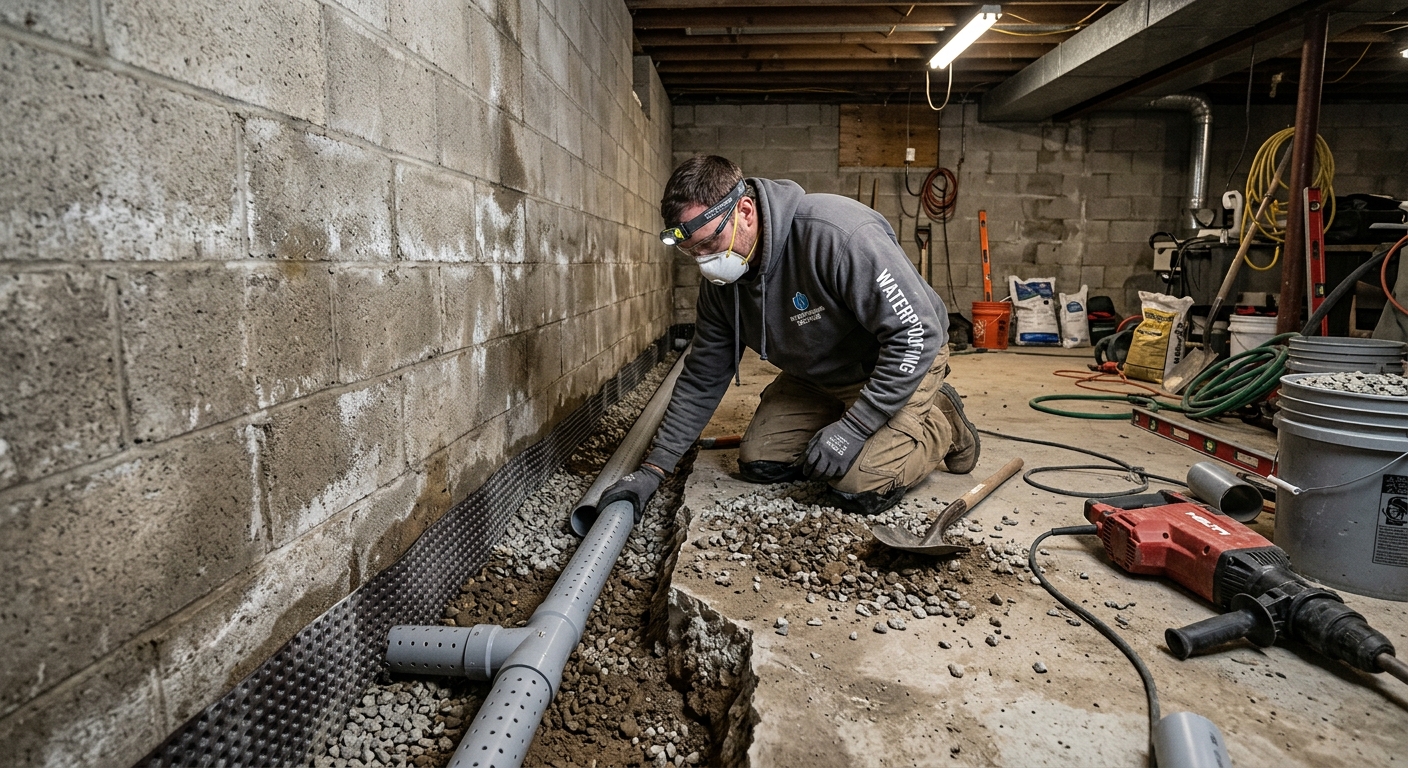
Basement waterproofing options and costs in Smoky Lake
Basement waterproofing in Smoky Lake is usually about managing water pressure from the outside first, then controlling what gets past the wall. With 1,127 residents (Statistics Canada, 2021 Census) and a housing profile where 70.5% of homes were built before 1981, many basements still depend on original drainage systems that can be long past their useful life. In older single-detached neighbourhoods around the town core, it’s common to see failing weeping tile, brittle mortar at joints, and dampness that worsens during spring melt and freeze-thaw cycles.
In the Wood Buffalo–Cold Lake region, costs tend to track three practical realities: soil that holds water (loamy to clayey glaciolacustrine and morainal mixes), drainage pressure against below-grade walls, and seasonal freeze-thaw that can widen existing cracks. That combination means exterior work often requires more excavation time, additional drainage layers, and careful backfill. Interior approaches can be quicker where excavation access is limited, but they often perform best as a complement to crack repair and improved downspout/grade drainage.
Contractor availability and pricing in Smoky Lake are also influenced by access constraints—snow storage, driveways, decks, and mature landscaping can force longer setup and more selective excavation. For homeowners near downtown services and older residential blocks where lot layouts are tight, exterior digs can be more expensive, while interior drainage upgrades are frequently the value-focused option.
Below is a comparison of the main waterproofing routes and what they typically cost in Smoky Lake.
| Method |
What It Addresses |
Disruption Level |
Durability |
Price Range |
| Exterior excavation + new membrane + drainage tile |
Stops water entry at the source; redirects groundwater away from the foundation |
High (excavation, landscaping restoration) |
Long-term (typically 20+ years with proper drainage) |
$10,000–$22,000 |
| Interior perimeter drain channel + sump pit |
Collects seepage after it enters and reduces hydrostatic pressure at the basement floor/wall line |
Medium (minor interior demolition) |
Good (often 15+ years; depends on sump cycling and power reliability) |
$7,000–$14,000 |
| Foundation crack injection (epoxy or polyurethane) |
Seals cracks to restore water-tightness; type depends on whether crack is active or structural |
Low (small surface prep) |
Moderate to long-term (commonly 10–20 years depending on conditions) |
$500–$1,800 |
| Sump pump installation (primary + battery backup) |
Moves collected water away; battery backup helps during outages or pump failures |
Medium (pit + electrical work) |
High (when paired with proper drainage and backup) |
$1,800–$4,500 |
| Window well drain installation |
Prevents water pooling around egress windows and redirects it away from the wall |
Low to medium (localized excavation and drainage) |
Good (typically 10–15 years with sound grading) |
$2,000–$5,000 |
| Lot re-grading / downspout extension |
Reduces runoff and surface water near the foundation |
Low to medium (yard work) |
Moderate (works best with functioning gutters and ongoing maintenance) |
$1,200–$3,800 |
Prices are estimates only and vary by project scope, site access and material selection.
What affects the price of waterproofing in Smoky Lake
Homeowners in Smoky Lake often see quote differences of 30–50% for what sounds like the “same” job, even within the same month. Across the Wood Buffalo–Cold Lake region versus some broader Alberta benchmarks, the gap comes down to the three biggest drivers: soil conditions, groundwater behaviour, and freeze-thaw movement. National averages can look lower because many projects are in areas with different soil makeup or more predictable drainage, while Alberta projects frequently require extra excavation time, deeper drainage layers, and more coordination with power/electrical upgrades for sump systems.
In clay-heavy or water-holding soils, freeze-thaw cycling expands and contracts moisture in the ground and can exert lateral pressure on foundation walls, accelerating crack growth over time. In locations with a higher effective water table or persistent seepage, sump pumps run longer, and contractors must design around cycling rates and backup power. By contrast, good surface drainage and coarse, fast-draining soils can reduce how much water reaches the foundation, sometimes allowing targeted repairs rather than full perimeter work.
Concrete examples from Smoky Lake: (1) An exterior job on a tight lot near the sidewalk often costs more because excavation is limited and materials must be staged carefully—this can push exterior waterproofing toward the upper end of the $10,000–$22,000 band. (2) A basement with a few active cracks and no standing water may fit the foundation crack repair band of $500–$1,800, especially when injection is done before water intrusion expands the damage. (3) If we find original drainage tile that has collapsed, expect the plan to shift from “seal and forget” to interior perimeter drainage and sump upgrades in the $7,000–$14,000 range, because stopping the source is harder when exterior access is constrained.
Because 70.5% of local homes are older than 1981 (Statistics Canada, 2021 Census), failing weeping tile and aging concrete surfaces show up frequently, and that increases labour time for prep, patching, and sealing.
| Price Factor |
Why It Matters |
Cost Impact |
| Interior vs. exterior approach — interior is less disruptive but addresses symptoms |
Exterior targets the water path at the wall; interior manages water after entry |
Interior is usually cheaper up front (often $7,000–$14,000), exterior can add $10,000–$22,000 depending on access and depth |
| Foundation type — poured concrete vs. block vs. stone vs. ICF |
Crack behaviour and sealing method differ by material |
Poured concrete may respond better to crack injection; block often needs interior drainage as a practical complement |
| Soil type — clay expands more than sand, adding pressure |
Freeze-thaw movement worsens cracks and increases seepage pressure |
Clays typically require more comprehensive drainage design and more crack prep |
| Crack type and length — hairline vs. structural horizontal cracks |
Structural cracks may indicate movement and need engineered assessment |
Structural issues can raise costs beyond standard injection pricing |
| Sump pump backup system — battery or water-powered backup needed |
Prevents basement flooding during outages or pump failure |
Backup increases the sump scope; installed sums often land in the $1,800–$4,500 band |
| Access — landscaping, decks, or driveways must be removed for exterior |
Excavation depth and staging affect labour hours and restoration |
Restricted access can shift exterior jobs toward the top of the $10,000–$22,000 range |
| Weeping tile age — original tile (60+ years) may be completely failed |
Old tile collapse increases seepage and undermines partial repairs |
If exterior tile must be replaced or interior drainage is needed, total cost rises |
| Mould or efflorescence remediation required before sealing |
Moisture must be controlled before sealing; contamination affects prep and product choice |
Adds remediation time and may require additional floor/wall prep |
Permits & regulations in Alberta
In Alberta, foundation excavation, structural crack repair, and changes to lot drainage typically require a building permit. If the work involves structural crack repair—particularly for horizontal cracks in block walls, major step cracks, or anything that suggests movement—an assessment by a structural engineer is often needed to confirm whether underpinning or other structural measures are required before sealing. Also note that sump pump installations that connect to the storm or sanitary sewer require municipal approval, so you should expect questions about where discharge will go and whether any approvals are needed before the first discharge test.
What generally DOES require a permit: excavation near a foundation, replacement of drain tile, structural crack repairs (including work that may affect load paths), and significant changes to grading intended to redirect surface water away from the foundation. What typically does NOT require a permit: interior cosmetic drywall removal (without structural changes), basic gutter cleaning, and localized downspout extensions on private property that don’t tie into municipal infrastructure.
How to verify a contractor in Smoky Lake, step-by-step: (1) Check the contractor’s Alberta licence/registration information using the appropriate online registry listing for their trade, then confirm the legal business name matches the quote. (2) Ask for a certificate of insurance and confirm it includes liability coverage and the job address. (3) Request WSIB/WCB clearance (proof that the company has coverage for workers). (4) For structural crack work, confirm whether they engage engineering support—ask who provides the assessment and whether it’s included in the scope or billed separately.
Interior vs exterior waterproofing — what does Smoky Lake need?
Exterior waterproofing is the “source control” approach: it excavates around the foundation, installs a new waterproofing membrane, replaces or adds drainage tile, and re-establishes backfill and grading. Interior waterproofing manages water after it enters: it creates a perimeter drain channel, installs a sump pit and sump pump, and keeps the basement floor line drier. In Smoky Lake’s soil and freeze-thaw conditions, exterior work often performs best when the foundation has recurring seepage and when we suspect pressure build-up from groundwater or drainage failure. Interior systems can be the right plan when excavation is difficult, when you’re seeing localized seepage, or when homeowners want less landscape disruption.
Wood Buffalo–Cold Lake soil conditions commonly hold moisture (loamy to clayey mixes), which can create drainage pressure against below-grade walls. For poured concrete walls, crack injection can be a strong complement to improved drainage because the wall often holds up better when sealed; for block foundations, the practical reality is that water can migrate through joints and hairline paths, so an interior perimeter drain with a sump may provide the reliable “second line of defence.”
Alberta’s power reliability during spring melt and ice-jam conditions is another reason to consider sump pump backup. A primary sump without backup can leave a basement vulnerable if power flickers or a pump fails during peak seepage.
Dollar-wise, the difference can be justified. For example, if your assessment shows failed exterior drainage tile and persistent seepage, an exterior scope in the $10,000–$22,000 range can be cheaper over time than repeated interior interventions. But if you have a few wet spots tied to active cracks, you may start with crack injection around $500–$1,800 and add interior collection only where needed.
| Method |
Best For |
Addresses Source? |
Disruption |
Lifespan |
Price Band |
| Full exterior excavation + membrane |
Recurring seepage, groundwater pressure, failed exterior drainage, long-term solution |
Yes (targets water entry at the wall) |
High (excavation and restoration) |
20+ years with correct drainage |
$10,000–$22,000 |
| Interior French drain + sump system |
Seepage after entry, limited exterior access, persistent dampness at the perimeter |
Partial (manages water after it enters) |
Medium (floor/wall line work) |
15+ years with proper pump maintenance |
$7,000–$14,000 |
| Crack injection — epoxy (structural) |
Non-active structural cracks where water entry is limited and crack edges are stable |
Yes (seals pathway, if crack is stable) |
Low (surface prep and ports) |
10–20 years depending on movement |
$500–$1,800 |
| Crack injection — polyurethane (active leak) |
Active leaks, weeping cracks, flexible sealing needs during seasonal movement |
Yes (seals active water paths) |
Low (targeted injection) |
Moderate to long-term (commonly 10–20 years) |
$900–$2,400 |
| Interior drain channel only (no sump) |
Minor perimeter dampness with gravity drainage potential |
No (it still relies on how water migrates) |
Medium to low (depends on floor conditions) |
Often shorter if water volume increases |
$3,500–$8,000 |
| Re-grading + downspout extensions |
Surface water issues, gutter runoff pooling near the foundation |
No (prevents extra water load, doesn’t waterproof the wall) |
Low to medium (yard work) |
Moderate (works with ongoing maintenance) |
$1,200–$3,800 |
How to choose a waterproofing contractor in Smoky Lake
Start with verification. For Alberta waterproofing and foundation work, confirm the contractor’s Alberta licence/registration for their trade, then ask for a certificate of liability insurance that lists the jobsite address (or your name/contractor entity) and includes adequate coverage. Next, request WSIB/WCB clearance or proof of coverage for workers—this matters for jobsite safety and to protect you from liability if an incident occurs. If the scope includes structural crack repair, ask who provides engineering support and whether it’s included.
Get 2–3 itemised written quotes instead of a single lump sum. You want line items separating excavation (if exterior), membrane and drainage tile materials, sump pit and discharge components, crack injection product type, disposal/restoration, and electrical work. Read exclusions carefully: is permit pulling included, is backfill and compaction specified, and is landscape restoration included or “best effort”? Ask how they handle saturated soil—do they use drainage layers and proper grading to prevent re-accumulation?
Warranty matters. A good workmanship warranty should be specific (often 2–10 years depending on scope) and aligned to the system being installed. Clarify the product/manufacturer warranty and whether it transfers to a new owner if you sell. For payment scheduling, never pay more than 10–15% upfront; hold back until the job is complete and you’ve verified drainage testing and cleanup. Finally, insist on a written start date and realistic completion timeline—weather and excavation depth can affect schedules in Alberta, but the estimate should still be documented.
- Ask for an itemised breakdown (labour vs materials) and unit quantities for key components.
- Confirm whether disposal of excavated material is included.
- Verify compaction method and backfill specification (not just “we’ll refill”).
- For exterior work, ask about drainage gravel gradation and filter fabric use.
- Require a written scope for crack injection ports and product type (epoxy vs polyurethane).
- Ask how they test discharge and sump cycling before closing walls/floors.
- Request sump pump specs and discharge routing details (including backup if quoted).
- Confirm permit responsibilities and whether they include permit pull paperwork.
- Check warranty length for workmanship and for the product system installed.
- Review payment schedule: maximum 10–15% deposit; holdback until completion.
- Ask about cleanup and restoration of landscaping or driveways.
- Get everything in writing: scope, warranty, timeline, and exclusions.
Red flags in Smoky Lake: (1) contractors who won’t put the product type (epoxy vs polyurethane) and method in the contract, (2) promises of “no excavation required” for recurring exterior seepage without an inspection, (3) no proof of WSIB/WCB clearance or insurance certificate, (4) vague warranties (“covers everything”) without workmanship terms, and (5) asking for large upfront payments or avoiding a written schedule.
Frequently asked questions — waterproofing in Smoky Lake
How do I know if a foundation crack is serious?
In Smoky Lake, crack “seriousness” isn’t just width—it’s whether the crack is active and how water behaves around it. Hairline cracks that stay dry may be cosmetic, but cracks that weep during spring melt, develop damp drywall, or show staining/efflorescence are more urgent. Horizontal cracks in block walls and step cracking patterns can indicate movement that shouldn’t be sealed blindly; those cases often require an engineer’s assessment before any structural repair plan is chosen. If the basement is built on older materials—most local homes pre-date 1981—expect more variable crack movement from freeze-thaw and aging concrete. A pro should check crack edges, look for differential movement, and match the repair type (epoxy for stable cracks vs polyurethane for active leaks) to avoid repeat intrusion.
How much does foundation crack repair cost in Smoky Lake?
Foundation crack repair in Smoky Lake typically falls in the $500–$1,800 range when the job is a targeted injection for a limited number of cracks and access is straightforward. If multiple cracks require extensive surface prep, longer runs, or if the crack is active and needs a polyurethane approach, pricing may trend higher within the broader estimate bands—especially if there’s additional patching and sealing after injection. The key cost driver is whether the crack is stable or moving; active leak repairs often require more careful prep and sometimes additional measures to stop ongoing moisture pressure. If your assessment suggests you also need a sump pump or an interior drain channel, total project costs usually move into the $7,000–$14,000 interior range rather than staying at injection-only pricing.
Do I need a sump pump in Smoky Lake?
You may need a sump pump in Smoky Lake when the basement experiences recurring seepage, especially where exterior drainage is failing or where interior perimeter drainage collects water that can’t reliably drain by gravity. Sump pumps are also commonly included when soil and groundwater behaviour create consistent hydrostatic pressure at the foundation floor line during spring melt. If power outages are a concern (which can happen during heavy weather), many homeowners choose a primary sump plus battery backup. Installed sump pump solutions in this area often land in the $1,800–$4,500 range depending on whether backup is included and how electrical work is handled. If you’re only seeing occasional dampness tied to gutter runoff, you might start with re-grading and downspout extensions instead of adding a sump—an approach that can be less disruptive than full interior systems.
How does Smoky Lake's soil affect my foundation?
In the Wood Buffalo–Cold Lake region, soil conditions often play a major role in basement moisture. Alberta soil surveys for the area describe loamy to clayey glaciolacustrine and morainal soils that can hold water, increasing drainage pressure against below-grade walls. During winter, freeze-thaw movement can expand moisture in the soil and widen existing cracks, which makes older foundations more vulnerable over time. If drainage is poor—whether from compacted backfill, failed weeping tile, or surface runoff pooling near the foundation—water is more likely to migrate into joints and cracks. For many Smoky Lake homes built before 1981 (Statistics Canada, 2021 Census), original drainage systems are often aged, so the soil’s water-holding tendency becomes a bigger contributor to seepage and must be addressed either through exterior drainage upgrades or interior collection.
Do I need a permit for foundation work in Alberta?
In Alberta, permits are commonly required for foundation excavation, structural crack repairs, and changes to lot drainage. If you’re installing or replacing drainage tile, excavating around a foundation, or doing work that may affect structural integrity, expect a permit process. For sump pump installations that connect to storm or sanitary sewer infrastructure, municipal approval is typically required—so your contractor should confirm the discharge route before work starts. If a crack repair involves potential structural movement (for example, major step cracks or horizontal cracks in block walls), a structural engineer’s assessment is often needed to determine whether underpinning or additional structural work is required. For Smoky Lake homeowners, the practical step is to ask your contractor what permit(s) are required, who pulls them, and to ensure it’s clearly stated in your written scope.
How long does waterproofing last?
“Lasts how long” depends on what kind of waterproofing you install and whether you address the water path—not just the symptoms. Exterior waterproofing systems designed for the region’s freeze-thaw and drainage pressure are often intended for long-term service and commonly last 20+ years when drainage tile and membrane are installed correctly and grading is maintained. Interior perimeter drains and sump systems typically aim for 15+ years, but performance depends on pump maintenance, battery/backup readiness, and whether seepage increases over time. Crack injection repairs can last 10–20 years, but active leaks and ongoing soil pressure can shorten life if the wrong product is used or if exterior drainage problems remain unresolved. For older Smoky Lake homes (70.5% built before 1981, Statistics Canada, 2021 Census), longevity is improved when crack sealing is paired with drainage corrections and routine downspout/grade maintenance.