Basement waterproofing options and costs in Central Saanich
In Central Saanich, basement waterproofing costs depend on how water is reaching your foundation and how much excavation is required to stop it. With 17,385 residents and 5,680 owner households (79.9% of households own), a large share of homes are maintained and repaired as issues surface, especially in older neighbourhoods. Importantly, 46.4% of homes were built before 1981, which often means the original systems—like tar-and-paper style membranes and older weeping tile—may no longer handle today’s rainfall intensity or long wet stretches. When a basement shows recurring dampness, a small crack can become a leak path once hydrostatic pressure builds against the wall.
On Vancouver Island and the Coast, the main cost driver is water movement around the foundation. Heavy rainfall, higher local groundwater, and drainage failures commonly force contractors to do exterior work—excavation, membrane replacement, and perimeter drainage—because managing water after it enters (from the inside) doesn’t relieve pressure against the wall. Labour demand is also concentrated around areas like Brentwood Bay and the waterfront corridor, where older housing stock meets tighter access and landscaping, pushing exterior projects toward the higher end of typical ranges.
The table below compares common approaches so you can match the method to the source of the problem, not just the symptom. Use it as a starting point before you request itemised quotes.
| Method |
What It Addresses |
Disruption Level |
Durability |
Price Range |
| Exterior excavation + new membrane + drainage tile |
Water at the foundation perimeter (source control), perimeter drainage and hydrostatic pressure management |
High (landscaping removal, excavation, regrading/backfill) |
High (best long-term source protection when detailed correctly) |
$7,000–$18,000 |
| Interior perimeter drain channel + sump pit |
Water after it enters; captures seepage and relieves indoor water accumulation |
Medium (partial interior work, cutting/patching) |
Medium-to-high (depends on wall condition and pump reliability) |
$3,000–$10,000 |
| Foundation crack injection (epoxy or polyurethane) |
Specific crack paths; epoxy generally for non-moving leaks, polyurethane for active leaks |
Low-to-medium (select areas, patching) |
Medium-to-high (best when the crack’s movement cause is addressed) |
$250–$800 |
| Sump pump installation (primary + battery backup) |
Moves collected seepage out reliably during wet periods and outages |
Medium (interior sump pit/piping, electrical work) |
High (with backup system and correct discharge routing) |
$800–$2,500 |
| Window well drain installation |
Water intrusion at window wells and grading areas |
Low-to-medium (excavation at openings) |
Medium-to-high (when connected to proper drainage) |
$1,000–$3,200 |
| Lot re-grading / downspout extension |
Reduces roof and surface water hitting the foundation perimeter |
Low (minor groundwork, reconnecting leaders) |
Low-to-medium (often preventative/complementary) |
$500–$2,000 |
Prices are estimates only and vary by project scope, site access and material selection.
What affects the price of waterproofing in Central Saanich
In Central Saanich, two contractors can price the “same” basement waterproofing job with a 30–50% difference because the real work is in assessing water pathways and providing a system that can handle Vancouver Island and Coast conditions year-round. The biggest separators versus the national average are soil type, water table and freeze-thaw effects, which in turn influence excavation depth, drainage sizing, and how long pumps or drains must operate after storms. Even in a milder coastal climate, moisture still expands and contracts with temperature swings, and freeze-thaw can worsen small cracks over time—especially where water is trapped near the foundation.
Soil matters: clay-heavy soils can hold water longer and exert more lateral pressure on foundation walls, which can turn a hairline crack into a recurring leak. Water table and drainage control matter even more here: high local groundwater and heavy coastal rainfall saturate backfill quickly when original drainage fails, increasing seepage and sometimes requiring a sump with sufficient capacity. Housing age also changes the labour profile—regions with 46.4% pre-1981 homes commonly see failed weeping tile and older, deteriorated membranes that must be replaced if exterior source control is the goal. If you’re replacing membrane and drainage on exterior walls, the excavation and perimeter work are labour-intensive and usually push toward the upper end of exterior ranges, such as the $7,000–$18,000 band.
Concrete examples from Central Saanich: (1) A waterfront-adjacent lot with consistently wet lower ground and a prior drain that’s blocked typically requires more excavation and longer discharge runs, moving interior work from closer to $3,000–$10,000 toward the high end; (2) a poured-concrete foundation with stable, narrow cracks often gets cost-effective results with crack injection (within the $250–$800 range per repair location), but only if combined with grading/downspout corrections; and (3) a property with decks, mature landscaping, or a tight driveway access can add removal and restoration labour to exterior excavation projects.
| Price Factor |
Why It Matters |
Cost Impact |
| Interior vs. exterior approach — interior is less disruptive but addresses symptoms |
Interior systems manage water after it enters; exterior systems stop water at the perimeter |
Interior typically lower upfront; exterior often higher due to excavation and membrane work |
| Foundation type — poured concrete vs. block vs. stone vs. ICF |
Crack behaviour and adhesion requirements vary by material and wall construction |
Poured concrete may respond better to targeted injection; block often needs broader drainage strategy |
| Soil type — clay expands more than sand, adding pressure |
Clay holds water and can increase hydrostatic pressure against the wall |
Can shift scope toward exterior source control or stronger interior drainage + pump specs |
| Crack type and length — hairline vs. structural horizontal cracks |
Moving/structural cracks require assessment and sometimes engineered work |
Structural or long cracks increase material, labour and potential engineering costs |
| Sump pump backup system — battery or water-powered backup needed |
Ensures pumping during outages during wet seasons |
Adds cost but can prevent flood damage and recurring moisture problems |
| Access — landscaping, decks, or driveways must be removed for exterior |
Determines how much excavation and restoration is required |
Major access constraints can push exterior projects toward the top of the range |
| Weeping tile age — original tile (60+ years) may be completely failed |
Old perimeter drains can be clogged, disconnected, or collapsed |
If failed, contractors must replace drainage runs, increasing labour and excavation time |
| Mould or efflorescence remediation required before sealing |
Moisture source must be addressed and surfaces cleaned for coatings/injection to bond |
Adds prep time, materials, and drying requirements |
Permits & regulations in British Columbia
In British Columbia, foundation-related work can trigger permit requirements, especially when you’re changing drainage patterns or addressing structural concerns. In most cases, foundation excavation, structural crack repair, and changes to lot drainage typically require a building permit. If a sump pump installation connects to storm or sanitary sewer systems, municipal approval is commonly required to confirm discharge routing and prevent backflow or drainage conflicts.
For structural crack repair, particularly horizontal cracks in block walls or major step cracks, it’s often necessary to bring in a structural engineer to assess whether underpinning or other structural measures are needed—not just sealing the crack. That’s why a reputable contractor should be able to explain whether the work is “water control only” or “structural capacity plus waterproofing.”
Step-by-step, here’s how a homeowner in Central Saanich can verify a contractor in British Columbia before work starts:
- Ask for the contractor’s business licence/registration details and confirm they’re listed in the appropriate online registry.
- Request a current Certificate of Insurance and check that liability coverage matches the project scope (including excavation and drainage work).
- Ask for proof of WSBC coverage (workers’ compensation) and verify it’s active for their employees.
- For structural repairs, confirm they provide engineering support (engineer letter/specification) or work under an engineer’s direction.
- Get a clear statement in writing on whether they will pull any required permits and who is responsible for inspections.
Interior vs exterior waterproofing — what does Central Saanich need?
The fundamental difference is that exterior waterproofing targets the source of water entry, while interior waterproofing controls water after it enters the basement. Exterior systems typically involve full excavation, new membrane, and new perimeter drainage tile with proper backfill and regrading. That approach is more disruptive and expensive because it needs labour-intensive excavation around the foundation, but it’s the most reliable way to reduce hydrostatic pressure against the wall—exactly what coastal rainfall and higher water tables can create on Vancouver Island and the Coast.
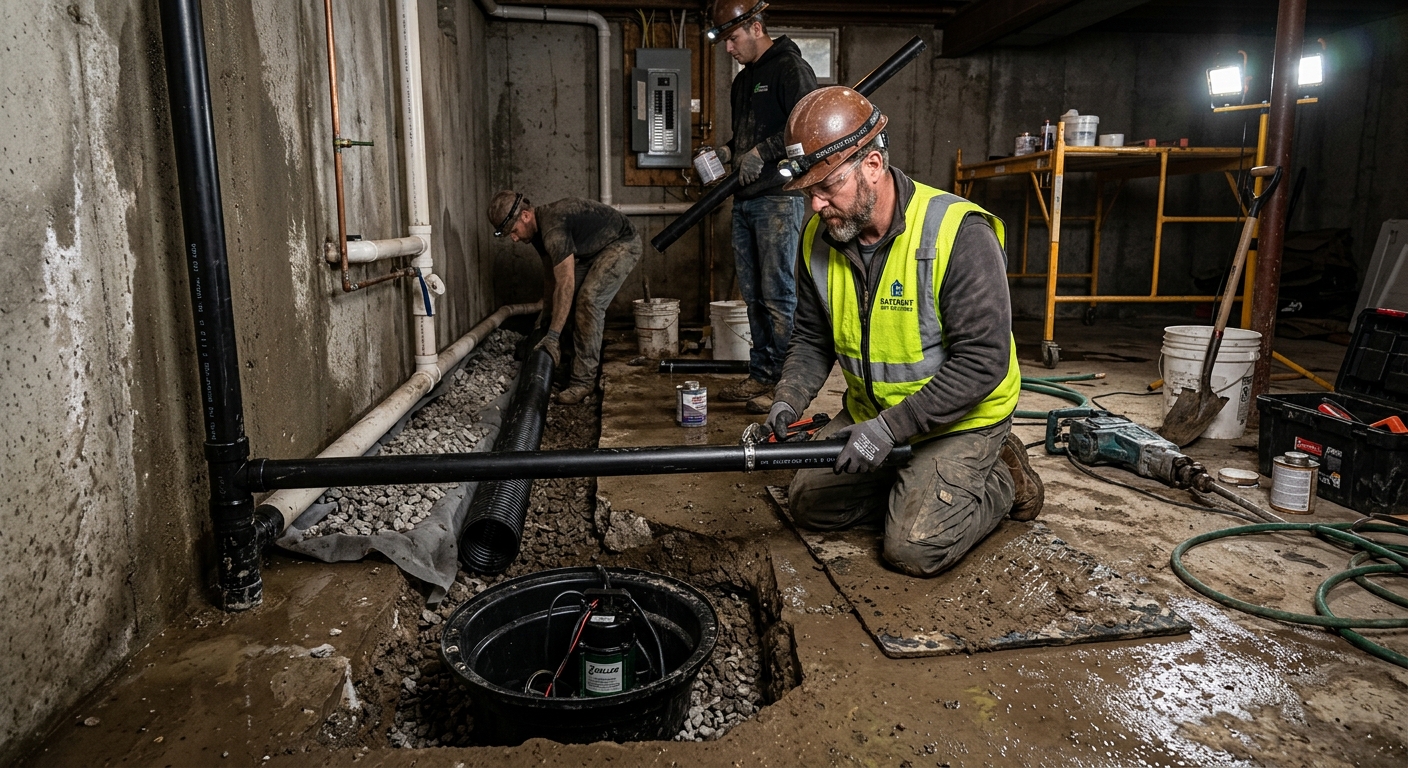
Interior waterproofing—often a perimeter drain channel with a sump pit and sump pump—captures seepage once it reaches the basement floor/wall interface. It’s less invasive and generally less disruptive, but it doesn’t stop water pressure building behind the wall. In Central Saanich, this matters because many older homes (46.4% built before 1981) have weaker perimeter drainage systems; if the exterior source control is failing, interior work alone may require a dependable pump system for years. For poured concrete walls, crack injection can be an effective complement because concrete cracks are often more stable and respond well to targeted injection (when movement is minimal). For block foundations, interior drainage is commonly necessary as a practical complement because block can allow moisture passage through voids and joints even when crack sealing is done.
Power reliability is another factor. A sump pump with battery or water-powered backup is often justified during spring flooding or extended outages. As a dollar example: if your contractor recommends exterior excavation near the higher end—up to the $7,000–$18,000 exterior band—consider whether you’re seeing frequent wetting across multiple foundation sections. If the problem is localized to one or two cracks, a combination of crack injection within the $250–$800 repair band plus re-grading/downspout corrections may be a better first step. If you’re consistently getting seepage after heavy storms, the higher exterior cost can be justified to reduce recurrence.
| Method |
Best For |
Addresses Source? |
Disruption |
Lifespan |
Price Band |
| Full exterior excavation + membrane |
Widespread seepage, failed perimeter drains, high groundwater conditions, and recurring damp basements after storms |
Yes (best source control) |
High |
Long (often the most durable when properly detailed) |
$7,000–$18,000 |
| Interior French drain + sump system |
Basements where excavation isn’t feasible or where the priority is preventing indoor water accumulation |
Partial (manages seepage after entry) |
Medium |
Medium-to-long (depends heavily on pump performance) |
$3,000–$10,000 |
| Crack injection — epoxy (structural) |
Non-moving cracks in poured concrete where leakage is through a defined crack plane |
Yes for that crack path (not for broader drainage failure) |
Low-to-medium |
Medium-to-long when cracks are stable |
$250–$800 |
| Crack injection — polyurethane (active leak) |
Cracks showing active seepage or where flexible sealing is needed |
Yes for that crack path |
Low-to-medium |
Medium (often depends on continued pressure management) |
$300–$950 |
| Interior drain channel only (no sump) |
Minor dampness with low water volume or where discharge is gravity-based and reliable |
No (only collects and channels) |
Medium-to-low |
Short-to-medium if groundwater is high |
$1,800–$6,000 |
| Re-grading + downspout extensions |
Preventative water shedding, roof leader management, and surface water control |
Indirect (reduces water hitting the foundation) |
Low |
Medium if drainage failures are corrected |
$500–$2,000 |
How to choose a waterproofing contractor in Central Saanich
Choosing a waterproofing contractor in Central Saanich starts with proof of the right credentials and coverage. In British Columbia, verify the contractor’s licence/registration status and request a current Certificate of Insurance showing liability coverage. Then confirm WSBC coverage is active for their workers—don’t accept a screenshot from an old policy. If your project includes structural crack repair or any work that could involve engineering recommendations, ask whether they can provide engineering support and work in line with an engineer’s direction where needed. For homeowner confidence, ask for documentation before signing anything.
Next, demand 2–3 itemised written quotes, not lump sums. A good quote breaks labour and materials by scope: excavation and disposal, membrane and protective board, drainage tile and pipe, filter fabric, sump pit/pump and backups, and patching/finishing. Read the exclusions carefully: is permit pull included? Is disposal of excavated soil included? Is backfill and compaction included? If the contractor expects additional costs later, they should state the triggers.
Warranty matters. Ask for a workmanship warranty length (and what it covers, such as pump performance exclusions), plus any manufacturer warranty on membranes or products. Also ask whether the warranty is transferable if you sell the home. On payment schedule, never pay more than 10–15% upfront; use a holdback until the job is complete and any restoration is finished. Get the start date and a realistic completion estimate in writing, tied to site access conditions.
- Confirm their BC licence/registration is current before any mobilization.
- Request a Certificate of Insurance and verify expiry dates.
- Verify WSBC coverage for their crew (active, not past).
- Get 2–3 itemised quotes with labour/material breakdowns.
- Ask what permits they pull and what inspections are expected.
- Clarify disposal, dump fees, and site restoration responsibilities.
- Confirm drainage discharge routing (no “mystery outlets”).
- Ask for pump model specs and whether a backup is included.
- Require crack injection details: material type (epoxy vs polyurethane) and crack prep steps.
- Confirm surface prep and drying requirements for sealing and coatings.
- Get a written workmanship warranty and product/manufacturer warranty terms.
- Use a payment schedule with a holdback until completion and cleanup.
Red flags I see locally in Central Saanich include contractors who won’t provide itemised scopes, quote only “interior sealing” when you have active seepage after heavy storms, avoid discussing permit responsibility, pressure you for large upfront payments, or promise “guaranteed waterproofing” without documenting the water source and drainage plan.
Frequently asked questions — waterproofing in Central Saanich
What causes foundation cracks in Central Saanich?
In Central Saanich and across Vancouver Island and the Coast, foundation cracks can be caused by settlement, seasonal moisture changes, and pressure from water-saturated soils. Even when freeze-thaw isn’t as severe as in colder parts of Canada, repeated wetting followed by cooler nights can still stress concrete and masonry. Clay or water-retentive soils can hold moisture longer, increasing hydrostatic pressure against basement walls during heavy rainfall. In older homes—46.4% of homes were built before 1981—failed original drainage systems (like older weeping tile) can keep the perimeter saturated and worsen cracking over time. If you notice dampness that increases after storms, the crack may be acting as a leak pathway rather than the original cause.
How do I compare waterproofing quotes?
Start by comparing scope, not totals. Ask each contractor to explain the water pathway: is it perimeter seepage from hydrostatic pressure, surface water and downspouts, or a single crack line? Request itemised quotes showing excavation and membrane details (if exterior), drainage tile specifications, sump pit/pump models and backup plan, and crack injection material choice. If you’re choosing between interior and exterior, ensure you’re comparing systems that actually address the source. For example, exterior excavation projects typically land in the $7,000 – $18,000 band, while interior waterproofing and weeping tile approaches often fall around $3,000 – $10,000. A lower interior quote can make sense if the issue is localized and water volume is low—but if the basement stays wet after storms, the “cheaper” approach may not hold.
How long does basement waterproofing take in Central Saanich?
Timelines vary based on excavation, access, and whether you’re doing exterior source control or interior water management. Exterior waterproofing often takes longer because excavation requires careful working room, membrane installation, drainage tile layout, and then proper backfill/compaction and restoration. Many projects on Vancouver Island run over multiple days due to drying/curing needs and coordination for landscaping restoration. Interior jobs (like a perimeter drain channel, sump pit, and sump pump installation) can often be faster because there’s no full perimeter excavation, though cutting and patching still take time. Crack injection projects can sometimes be completed quickly, but only after confirming crack type and active leak behaviour. In Central Saanich, rainy weather can also affect excavation scheduling, so build flexibility into your written schedule.
What is a weeping tile and does my Central Saanich home have one?
Weeping tile is a perimeter drainage system installed at or near the foundation footing. It collects groundwater that migrates toward the foundation and routes it to a discharge point (gravity drain or a sump). Many older Central Saanich homes do have some form of weeping tile, especially in pre-1981 builds, but it may be disconnected, clogged, broken, or buried in saturated backfill. The question isn’t just “do you have it,” but whether it’s functioning. A contractor should be able to identify signs like indoor seepage after heavy rainfall, efflorescence, or a historically wet perimeter. If you’re seeing repeated dampness, an interior perimeter drain or exterior replacement may be needed depending on how far perimeter drainage has failed. The presence of a weeping tile doesn’t automatically prevent leaks if the system is no longer carrying water.
Can I waterproof my basement in winter in Central Saanich?
You can sometimes do waterproofing in winter in Central Saanich, but it depends on what work is required. Interior work like sump pump installation, interior drain channels, and crack injection is often still feasible, especially when floors/walls are accessible and surfaces aren’t frozen solid. Exterior excavation is more challenging in cold snaps because trenches can be harder to excavate safely, backfill and compaction can be less reliable, and membrane detailing can be affected by moisture and temperature. On Vancouver Island, winter is often wet rather than deeply frozen, but freeze-thaw cycles can still widen small cracks and move moisture around. A practical approach is to schedule exterior work when excavation is manageable and conditions support correct installation, while doing diagnostic and interior leak-path repairs sooner. Always confirm with the contractor what’s safe and what conditions they require.
What is the difference between waterproofing and damp-proofing?
Waterproofing means you’re designing a system to prevent bulk water and hydrostatic pressure from causing seepage—typically by combining source control (membrane and drainage) with reliable collection and discharge if water enters. Damp-proofing is usually a more limited approach focused on moisture control rather than stopping pressure-driven water. In Central Saanich, where heavy coastal rainfall and higher groundwater can keep basements wet longer, “damp-proofing” can be inadequate when interior walls repeatedly show moisture after storms. That’s why exterior excavation plus membrane and drainage is often priced in the $7,000 – $18,000 range, while interior solutions fall around $3,000 – $10,000 for perimeter drainage and sump systems. The right choice depends on whether your problem is source water entry or manageable seepage volume.