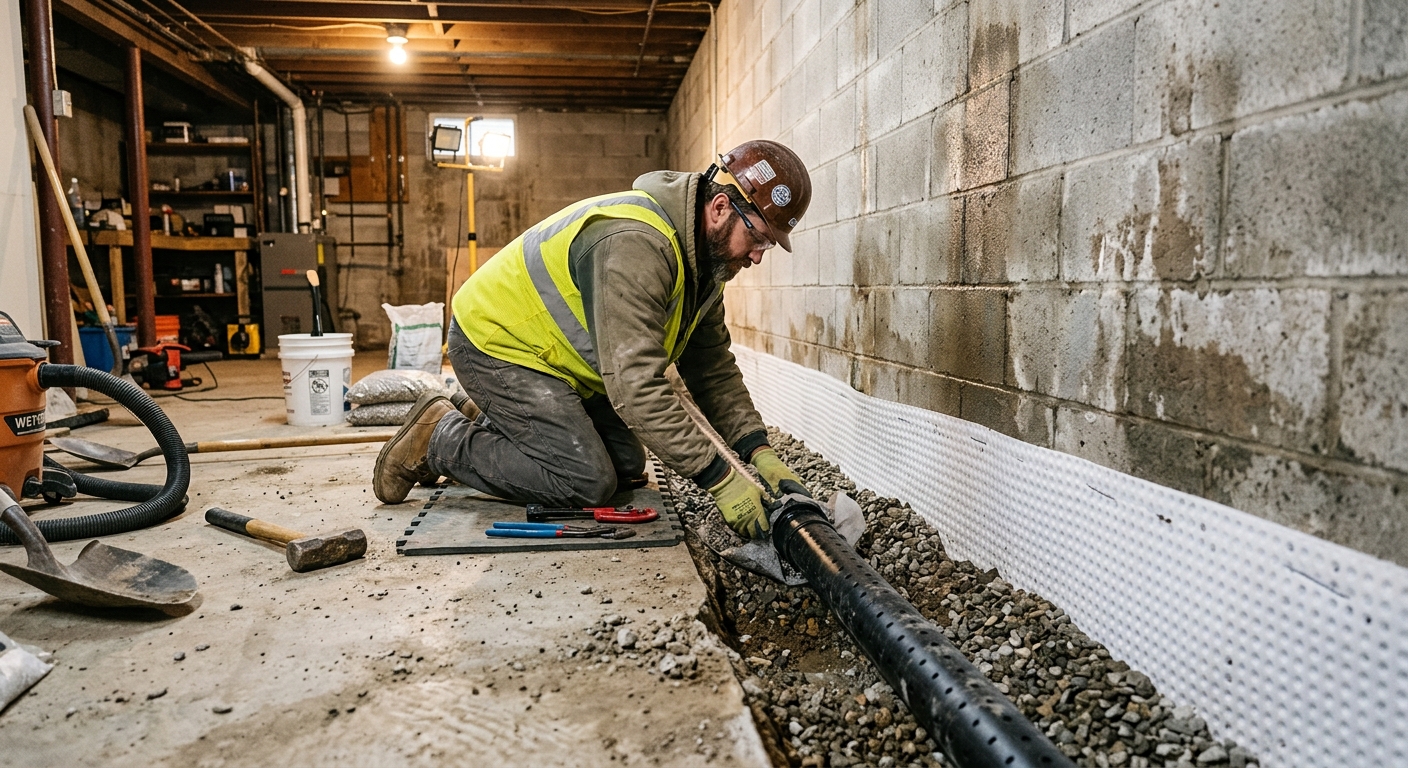
Basement waterproofing options and costs in North Kamloops
In North Kamloops, basement waterproofing decisions start with one question: where is the water actually coming from—at the exterior soil line, through foundation cracks, or after it has already entered the basement? With a population of 10,995 people (Statistics Canada, 2021 Census), we see steady demand from homeowners in the older, service-established areas where original drainage systems are often undersized or long past their service life. Many basements here were built when tar-and-paper style approaches were common, and the weeping tile (if it was installed) may be 60+ years old—meaning it can be clogged or have collapsed in clay/silt pockets, leading to seepage along slab edges and cold joints.
The Thompson–Okanagan’s semi-arid valleys and variable soils also mean costs swing more than most provinces. In glacial and alluvial deposits, localized clay pockets can hold water longer than freely draining sandy/gravelly areas, increasing lateral pressure against foundation walls. On top of that, repeated freeze-thaw cycles widen existing cracks and joints, turning minor dampness into active leaks over a few seasons. That’s why exterior excavation + new drainage tile is often priced higher in neighbourhoods like Juniper Heights, where access is tight and we frequently deal with older drainage patterns and deeper excavations.
Below is a practical comparison of the most common waterproofing approaches in North Kamloops, with typical price bands to help you compare quotes before you book site visits.
| Method |
What It Addresses |
Disruption Level |
Durability |
Price Range |
| Exterior excavation + new membrane + drainage tile |
Primary water entry from soil-side hydrostatic pressure; replaces failing drainage and adds full waterproofing system |
High (excavation, removing landscaping/concrete, reinstating) |
High (often longest-lasting when properly detailed) |
$18,000 – $40,000 |
| Interior perimeter drain channel + sump pit |
Water after it enters; reduces hydrostatic pressure by collecting seepage and pumping it out |
Medium (cutting interior perimeter line, floor work, limited excavation) |
Medium to high (depends on wall condition and discharge details) |
$9,000 – $22,000 |
| Foundation crack injection (epoxy or polyurethane) |
Stops leakage through cracks; epoxy for structural/hairline containment, polyurethane for active seepage |
Low to medium (drilling ports; limited interior patching) |
Medium to high (good for properly prepared, stable cracks) |
$800 – $3,500 |
| Sump pump installation (primary + battery backup) |
Automatic removal of collected water; backup reduces risk during power outages |
Low to medium (core cutting/pit installation, discharge routing) |
Medium to high (excellent when paired with interior drainage) |
$2,500 – $5,500 |
| Window well drain installation |
Redirects localized surface water and reduces seepage near basement window openings |
Low to medium (excavation near windows; regrading around wells) |
Medium (strong when tied into proper drainage) |
$1,800 – $4,000 |
| Lot re-grading / downspout extension |
Reduces roof runoff and directs water away from foundation perimeter |
Low (site adjustments; minimal demolition) |
Low to medium (best as prevention or a complement) |
$2,000 – $6,500 |
Prices are estimates only and vary by project scope, site access and material selection.
What affects the price of waterproofing in North Kamloops
In North Kamloops and across the Thompson–Okanagan, two quotes for the “same” waterproofing job can easily differ by 30–50% because the real scope isn’t just the waterproofing system—it’s the site conditions you discover once we probe for leaks, test drainage, and assess foundation performance. Nationally, contractors price around assumptions; locally, we price around facts.
The biggest three regional drivers separating local costs from the broader national average are soil type, water table, and freeze-thaw. Clay-heavy or silty pockets (common where glacial deposits mix with localized clay) don’t drain as quickly, so they hold moisture longer and can increase lateral pressure against the wall during wet spells. Freeze-thaw then works like a wedge: small movements widen hairline cracks, so repairs sometimes start as “surface seepage” and become “active leak” work after a few seasons. Finally, where seepage pockets or higher-water areas exist, sump discharge capacity and run times increase—meaning more pump controls, backup options, and detailed discharge routing.
Concrete examples that commonly move prices in North Kamloops: (1) if your exterior drain is clogged, exterior excavation + drainage tile typically shifts from “standard” to labour-intensive removal and reinstatement, pushing projects toward the upper end of $18,000 – $40,000; (2) if a basement shows dampness primarily at slab edges and cold joints, a perimeter drain + sump often becomes the most cost-effective path, commonly landing in $9,000 – $22,000; (3) if you have a structural horizontal crack, we often add a more extensive crack preparation and injection scope, which can increase your crack repair budget beyond “quick patch” expectations.
On the housing-stock side, many older homes in established neighbourhoods are more likely to have failing weeping tile and chronic seepage, so the frequency of prep work (mould/efflorescence remediation, crack widening, and debris removal) is higher—directly affecting labour hours and materials.
| Price Factor |
Why It Matters |
Cost Impact |
| Interior vs. exterior approach — interior is less disruptive but addresses symptoms |
Exterior targets the water entry point; interior manages water after it arrives |
Interior often saves on excavation, but may require ongoing drainage maintenance planning |
| Foundation type — poured concrete vs. block vs. stone vs. ICF |
Different wall behaviour and crack patterns affect prep, injection depth, and drainage detailing |
Poured concrete may respond well to crack injection; block/stone often needs staged drainage |
| Soil type — clay expands more than sand, adding pressure |
Clay/silt retains water and increases hydrostatic/lateral pressure on walls |
More robust exterior drainage detail and longer prep time increases cost |
| Crack type and length — hairline vs. structural horizontal cracks |
Active water flow and structural movement require different materials and techniques |
Structural cracks typically increase injection labour and may require engineered review |
| Sump pump backup system — battery or water-powered backup needed |
Power outages during wet/spring events can turn a minor leak into a flooded basement |
Backup adds equipment and controls, but reduces catastrophic risk |
| Access — landscaping, decks, or driveways must be removed for exterior |
Tight access increases excavation time and increases reinstatement work |
Exterior projects climb in cost where restoration is extensive |
| Weeping tile age — original tile (60+ years) may be completely failed |
Collapsed/clogged tile means water has nowhere to go and may saturate backfill |
Often drives higher excavation and reinstallation scope |
| Mould or efflorescence remediation required before sealing |
Sealers and membranes won’t bond well to contaminated or actively wet surfaces |
Adds drying time, remediation labour, and verification steps |
Permits & regulations in British Columbia
In British Columbia, foundation excavation and many waterproofing-related changes typically require a building permit. In practice, the work that most often does require a permit includes: excavation/reconstruction around a foundation, structural crack repair where walls may be compromised (for example, horizontal or step cracks), and changes to lot drainage that alter how surface water is managed near a foundation. If your project includes connecting a sump pump discharge to a municipal system (storm or sanitary), municipal approval is commonly needed before any tie-in.
For structural crack repair—especially where cracks suggest more than simple water movement—a structural engineer’s assessment is often required. That review determines whether additional structural steps (such as underpinning or other reinforcement) are needed before sealing and waterproofing proceed. When contractors plan structural repairs, you should confirm they have engineering support (either in-house or via a licensed engineering partner) and that the design work aligns with permit requirements.
To verify a contractor’s compliance in North Kamloops, take three steps: (1) confirm the contractor’s BC licence/registration status using the appropriate online registry; (2) request a current certificate of insurance (liability) showing coverage amounts and effective dates; and (3) verify WSIB/WCB coverage where applicable and ask for a clearance letter or current account documentation. A legitimate team will provide these documents quickly before you sign a contract.
Interior vs exterior waterproofing — what does North Kamloops need?
Exterior waterproofing and interior waterproofing solve two different problems. Exterior waterproofing involves full excavation, installing a membrane system, adding or replacing drainage tile, and then carefully backfilling and grading to move water away from the foundation. Done correctly, it targets the source of water entry—so it’s the most complete long-term fix. The trade-off is disruption: exterior work generally requires removing landscaping, dealing with concrete/asphalt where present, and then reinstating finishes.
Interior waterproofing (perimeter drain channel, sump pit, and sump pump) is different: it manages water after it enters, by collecting seepage and lowering pressure against the wall. In North Kamloops, this approach can be a strong fit when exterior access is limited or when your main symptoms are dampness at slab edges and cold joints. It’s also commonly used as a practical complement to exterior drainage, especially with block foundations where crack patterns and leak paths don’t always respond as cleanly to injection alone.
Foundation type matters. Poured concrete walls often benefit from crack injection when cracks are stable, because epoxy or polyurethane systems can stop water movement through the crack plane. Block foundations more frequently need interior drainage to keep bulk water out of the basement space, particularly where localized clay pockets hold moisture. And because spring snowmelt and heavy rain events can drive short-duration spikes, sump pump backup systems are a worthwhile safeguard in British Columbia—power interruptions are one of the quickest ways a “controlled seepage” situation becomes a flooded basement.
Example: if your assessment shows widespread exterior water entry, an exterior excavation system may come in around $18,000 – $40,000. If instead the issue is localized seepage along the interior perimeter after water enters through a few trouble points, interior drainage plus a sump can often be justified in the $9,000 – $22,000 band—especially when you can avoid major excavation and reinstatement. The right choice is the one that matches where the water is getting in, not the most expensive option.
| Method |
Best For |
Addresses Source? |
Disruption |
Lifespan |
Price Band |
| Full exterior excavation + membrane |
Broad exterior seepage, failing weeping tile, higher seepage risk from clay/silt backfill |
Yes (targets water entry point) |
High |
Longest when detailed correctly |
$18,000 – $40,000 |
| Interior French drain + sump system |
Limited exterior access, basement dampness along walls/slab edges, recurring seepage |
No (manages water after entry) |
Medium |
Medium to high |
$9,000 – $22,000 |
| Crack injection — epoxy (structural) |
Stable cracks and containment needs in poured concrete or properly assessed wall conditions |
Partial to yes (stops crack leakage if crack is stable) |
Low to medium |
Medium to high |
$800 – $3,500 |
| Crack injection — polyurethane (active leak) |
Active seepage through cracks where water pressure is pushing through |
Partial to yes (stops active leak through crack) |
Low to medium |
Medium to high |
$1,000 – $4,000 |
| Interior drain channel only (no sump) |
Low-grade seepage where gravity drainage is workable and water volumes are small |
No (manages minor intrusion) |
Medium (floor/perimeter cutting) |
Medium (depends on site discharge and seasonality) |
$6,500 – $14,000 |
| Re-grading + downspout extensions |
Prevention and minor perimeter wetting driven by roof runoff and poor slope away from foundation |
Prevention only (reduces incoming water) |
Low |
Low to medium |
$2,000 – $6,500 |
How to choose a waterproofing contractor in North Kamloops
Choosing the right waterproofing contractor in North Kamloops is mostly about proof: proof they can do the work, proof they can carry the risk, and proof they understand your specific water path. Start with licensing/credentials in British Columbia—ask for their current business licence/registration information, then confirm it through the appropriate provincial online registry. Next, request a certificate of liability insurance and verify it’s current (effective dates and coverage limits visible). Finally, confirm WSIB/WCB coverage where applicable; a professional contractor will provide a clearance letter or documentation rather than “we have it” assurances.
Get 2–3 itemised written quotes. You want a labour + materials breakdown, not a lump-sum. The scope should clearly list: what’s being removed, how cracks are prepared, what membrane/drainage materials are included, how disposal is handled, and whether permits are pulled (if required) or excluded. Pay attention to exclusions like “weeping tile tie-in only” or “backfill restoration not included”—those are where budget creep happens.
Warranty matters too. Ask for two layers: a workmanship warranty (how many years and what it covers) and product/manufacturer warranty details. Confirm whether the warranty is transferable if you sell the home. For payment, never allow more than 10–15% upfront; hold back until the job is complete and inspected. In your timeline request, ask for a start date and estimated completion window in writing, including curing/drying time assumptions so the schedule is realistic in Thompson–Okanagan weather.
- Ask how they identify water entry (hose test, moisture mapping, drain inspection) and how that shapes the method.
- Require an itemised quote with labour, materials, equipment, and disposal clearly separated.
- Confirm whether permits are included and who is responsible for inspections if needed.
- Ask what happens if mould/efflorescence is found after demo (remediation steps included or extra?).
- Confirm foundation crack strategy: epoxy vs polyurethane and how they confirm crack stability/active flow.
- Request details for drainage tile installation (pipe grade, daylighting/discharge plan, filter fabric).
- Check whether sump pumps include primary + backup, and how backup is powered/controlled.
- Verify discharge routing complies with municipal requirements (especially tied-in or near-surface discharge).
- Ask about reinstatement scope: landscaping topsoil, concrete/asphalt repairs, and grade/slope verification.
- Get warranty terms in writing: workmanship duration, exclusions, and what “failure” means.
- Use a payment schedule with a holdback until photos, documentation, and final sign-off are complete.
- Confirm insurance and coverage before any excavation begins, not after you’ve paid deposits.
In North Kamloops, watch for red flags like: (1) “one-size-fits-all” proposals that don’t investigate whether the water is exterior-driven or crack-driven; (2) quotes that omit disposal, backfill compaction, or reinstatement details; (3) no written warranty on labour workmanship; (4) refusing to provide a current certificate of liability insurance and WSIB/WCB documentation; and (5) promising structural crack repair without discussing whether engineering assessment is needed.
Frequently asked questions — waterproofing in North Kamloops
How much does foundation crack repair cost in North Kamloops?
In North Kamloops, foundation crack repair usually lands in the $800 – $3,500 range, depending on crack type, length, and whether it’s an active leak. Hairline, stable cracks in poured concrete often require less prep and can be handled efficiently with epoxy injection. If the crack is actively weeping under hydrostatic pressure, polyurethane injection typically adds extra labour and material time, pushing the cost toward the upper end. Thompson–Okanagan freeze-thaw is another reason not to delay—small cracks can expand and become more expensive once water is flowing through a larger pathway.
Do I need a sump pump in North Kamloops?
You may need a sump pump in North Kamloops if your basement has recurring seepage or if water levels in the collection system rise during spring snowmelt and heavy rain. Interior perimeter drains are designed to funnel seepage to a sump pit; without a sump, water may not be able to drain away reliably, especially where discharge conditions are limited. Many projects that include sump systems are in the $9,000 – $22,000 band when paired with a perimeter drain channel, while the pump component itself often comes around $2,500 – $5,500. Because power interruptions can happen during wet weather, backup systems (battery or other approved backup approach) are often recommended for peace of mind in BC.
How does North Kamloops's soil affect my foundation?
North Kamloops sits over mixed glacial and alluvial deposits, so soil conditions can change block-to-block. Where sand and gravel are more free-draining, water typically doesn’t build pressure as long. In clay pockets or dense silts, moisture holds longer and exerts more lateral pressure on foundation walls, which can worsen cracking over time—especially through freeze-thaw cycles. That’s why one exterior drain can fail in one area and not another. If your basement symptoms match wall locations with known clay/silt areas, you may need more robust drainage detail and crack strategies. This is also why two “similar” homes can price differently.
Do I need a permit for foundation work in British Columbia?
Often, yes. In British Columbia, foundation excavation, structural crack repair in situations where walls may be compromised, and changes to lot drainage commonly require a building permit. Work that ties sump pump discharge into storm or sanitary systems typically needs municipal approval before connections are made. For North Kamloops homeowners, the practical approach is to confirm permit requirements during your contractor’s site visit and ensure your scope matches what’s being permitted. If structural cracks suggest movement (for example, horizontal or step cracks), a structural engineer’s assessment is frequently required before any major repair plan. A reputable contractor should be able to explain what is permitted and provide documentation for licensing and coverage.
How long does waterproofing last?
It depends on the method and the cause. Exterior waterproofing systems—membrane plus proper drainage tile and backfill/grading—are designed to be the longest-lasting option when installed and detailed correctly for Thompson–Okanagan conditions. Interior systems can also last many years, but their performance depends heavily on pump reliability, discharge routing, and whether the exterior drainage is truly addressed or only managed indoors. Crack injection can last for a long time when cracks are stable and properly prepared; however, if freeze-thaw continues to move a crack or if hydrostatic pressure remains high due to failed exterior drainage, the underlying issue can return. That’s why matching the repair to your water entry path matters.
Can I waterproof my basement from the inside only?
Often you can waterproof from the inside only, but it depends on the source of the water. Interior approaches like a perimeter drain channel and sump pit are effective at reducing water accumulation after it enters and are commonly chosen where exterior excavation is difficult or where symptoms are localized along slab edges and cold joints. If the main water entry is from the exterior soil side and weeping tile failure is significant, interior-only work may reduce seepage but may not fully eliminate hydrostatic pressure on the wall. In those cases, exterior excavation paired with a membrane and new drainage tile can provide the more complete solution and is commonly priced in the $18,000 – $40,000 band. Interior-only projects often fall around the $9,000 – $22,000 range when a proper drainage system is installed.