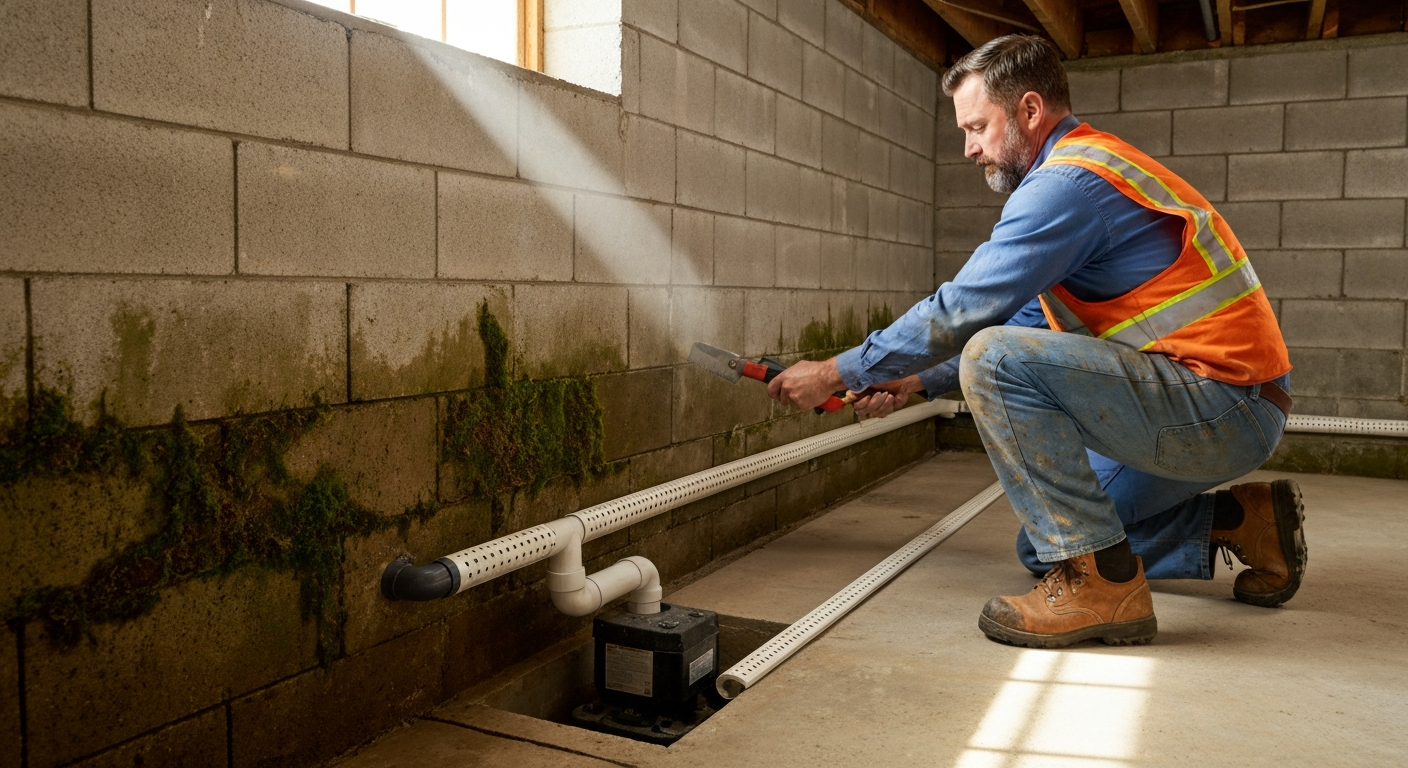
Basement waterproofing options and costs in Denman Island
Waterproofing in Denman Island is typically driven by persistent moisture around foundations, not just a one-time leak. With a population of 1,020 residents (Statistics Canada, 2021 Census), the market is smaller than the Mainland, so scheduling and material availability can affect lead times. Just as importantly, older housing is common on Vancouver Island and often arrives with foundations that already have decades-old tar-and-paper systems and early generations of weeping tile that may be fully failed—especially once the drainage path backs up during prolonged wet weather.
In the Lower Mainland–Southwest, soil conditions and water table levels are the primary cost drivers for basement work. Coastal BC rainfall saturates backfill quickly when perimeter drainage fails, maintaining hydrostatic pressure against basement walls and slabs. Add mild winters with frequent freeze-thaw cycles, and you get widening cracks at joints, faster deterioration, and higher demand for both exterior excavation systems and interior retrofits. Labour and access constraints also matter on the island—more yards are accessed by smaller equipment, and rocky sections can require mechanical breaking during excavation.
On Denman Island, the work is especially in demand around the Denman Island Village area where lots are tighter and landscape removal/replacement is often more visible. When you’re comparing solutions, the table below shows typical methods, what they address, disruption, durability expectations, and realistic price bands for this city tier—then you can decide which scope best matches your leak pattern and budget.
| Method |
What It Addresses |
Disruption Level |
Durability |
Price Range |
| Exterior excavation + new membrane + drainage tile |
Primary source control (water entry) by rebuilding the drainage path and waterproof layer |
High (yard excavation, regrading, landscaping restoration) |
Long-term, typically 20+ years with proper membrane + drainage detailing |
$15,000–$30,000 |
| Interior perimeter drain channel + sump pit |
Hydrostatic water after it enters (intercepts seepage and relieves pressure) |
Medium (interior floor/edge work, temporary dehumidification) |
Good to long-term, commonly 15–25 years depending on sump performance and discharge |
$8,000–$18,000 |
| Foundation crack injection (epoxy or polyurethane) |
Seals cracks; epoxy is typically for dry/actively non-leaking cracks, polyurethane for active leaks |
Low to Medium (drilling and surface prep; localized disruption) |
Variable; often 10–20 years, longer when crack movement is stabilized |
$500–$2,000 |
| Sump pump installation (primary + battery backup) |
Prevents flooding by moving collected water to discharge (and maintains operation during outages) |
Low to Medium (sump pit excavation, wiring/plumbing tie-in) |
Good when protected and serviced; backup adds resilience in wet seasons |
$1,000–$5,000 |
| Window well drain installation |
Stops localized water entry at basement windows (common during prolonged rainfall) |
Medium (window well access, minor concrete/landscape adjustments) |
Typically 10–20 years with clear discharge path and routine checks |
$1,500–$4,500 |
| Lot re-grading / downspout extension |
Redirects roof and surface water away from foundation to reduce saturation pressure |
Low to Medium (topsoil/finish grade changes) |
Moderate; depends on ongoing maintenance of slopes and eavestroughs |
$2,000–$7,000 |
Prices are estimates only and vary by project scope, site access and material selection.
What affects the price of waterproofing in Denman Island
It’s common to see quotes for the “same” basement waterproofing project vary by 30–50% across the Lower Mainland–Southwest and British Columbia. The difference usually isn’t the headline method—it’s the site conditions, what’s failing (and why), and how much of the drainage system the contractor has to rebuild to get the hydrostatic pressure under control.
Three drivers separate Lower Mainland–Southwest costs from the national average: soil type, water table, and freeze-thaw. In Denman Island’s coastal BC context, high groundwater and intense, prolonged rainfall keep soils saturated, so the foundation is under constant pressure when drainage fails. During mild winters, freeze-thaw cycles still widen existing cracks and joints, which increases seepage and forces more extensive surface preparation or crack treatment. While clay-rich soils in parts of Ontario and the Prairies can expand aggressively, in the Lower Mainland–Southwest the bigger issue is prolonged saturation and drainage challenges—so you still pay for drainage reconstruction, not just crack sealing.
Concrete examples of cost swings you’ll see on Denman Island include: exterior excavation in tight yards near Denman Island Village, where decking or stairs must be removed and later rebuilt; homes with older weeping tile that are completely clogged, requiring more extensive interior drainage even when the goal seems “small”; and foundation wall conditions where structural horizontal cracks may need engineered assessment before injection. In practice, a simple crack repair may fall toward $500–$2,000, but when combined with interior perimeter drainage and a sump, budgets often land in the $8,000–$18,000 range—because the job needs both sealing and water control.
| Price Factor |
Why It Matters |
Cost Impact |
| Interior vs. exterior approach — interior is less disruptive but addresses symptoms |
Interior solutions reduce water at the wall/under-slab level; exterior reduces water entry at the source |
Interior often 40–60% lower for access, but may cost more over time if exterior source control is needed |
| Foundation type — poured concrete vs. block vs. stone vs. ICF |
Different wall materials react differently to moisture and crack patterns |
Poured concrete frequently suits crack injection; block may require interior drainage as a complement |
| Soil type — clay expands more than sand, adding pressure |
Soils can intensify lateral pressure and keep water against walls |
Clay/over-saturated soils increase crack repair scope and drainage detailing |
| Crack type and length — hairline vs. structural horizontal cracks |
Active or structural cracks need different materials and sometimes engineering |
Structural cracks can shift a job from injection-only to broader waterproofing and monitoring |
| Sump pump backup system — battery or water-powered backup needed |
BC spring storms and occasional outages can stop a primary pump |
Backup adds cost but reduces risk of interior flooding during peak wet periods |
| Access — landscaping, decks, or driveways must be removed for exterior |
Excavation costs rise with restricted access and restoration requirements |
More demo/restoration can push exterior work toward the upper end of the band |
| Weeping tile age — original tile (60+ years) may be completely failed |
Failed perimeter systems divert water into basements |
Rebuilding drainage often increases labour and disposal costs |
| Mould or efflorescence remediation required before sealing |
Moisture damage must be treated to ensure coatings/injections bond properly |
Can add days and specialty materials; delaying remediation often reduces warranty effectiveness |
Permits & regulations in British Columbia
In British Columbia, foundation excavation, structural crack repair, and changes to lot drainage typically require a building permit. Sump pump installations that connect to the storm or sanitary sewer generally need municipal approval and appropriate drainage detailing. For structural crack repair—particularly horizontal cracks in block walls or step cracks that may indicate movement—an assessment by a structural engineer is often required to determine whether underpinning or other structural work is needed. Before you approve a scope, ask your Denman Island contractor whether they include engineering support for structural repairs, and confirm they carry liability insurance and valid WSIB/WCB coverage where applicable.
What DOES typically require a permit (examples): exterior excavation that alters drainage around a foundation; major foundation crack repair that could be structural; installing or modifying systems that change how water is discharged off-site; and work that affects load-bearing components. What typically does NOT require a permit (examples): small cosmetic sealing in non-structural areas, minor window well maintenance, or routine downspout cleaning—though a permit may be required if the work is part of a plan to change drainage pathways.
Step-by-step: (1) Ask for the contractor’s BC licence/registration details and verify them using the online registry for the applicable trade category. (2) Request a current certificate of insurance showing liability coverage; confirm it matches the legal entity on the quote. (3) Ask for WSIB/WCB clearance or proof of coverage—then verify the coverage status if the provider offers a clearance letter or confirmation method. (4) If engineering is required, get the engineer’s letter of scope before injection or underpinning work begins.
Interior vs exterior waterproofing — what does Denman Island need?
The fundamental difference is that exterior waterproofing (full excavation, new membrane, new drainage tile, and properly engineered backfill) addresses water at the source—reducing the hydrostatic pressure pushing into the basement. It costs more and disrupts landscaping, but it’s the most complete way to control persistent coastal water conditions. Interior waterproofing (perimeter drain channel, sump pit, and sump pump) manages water after it enters. It can be less invasive and faster to implement, but it doesn’t stop water from pressing through walls—it only captures it and keeps the space dry.
On Denman Island, where Lower Mainland–Southwest moisture conditions are sustained by rainfall and high saturation, many homes benefit from either a full exterior system or a well-designed interior retrofit—especially when the original exterior drainage has failed. Poured concrete walls often respond well to crack injection when cracks are stable; however, injection alone rarely solves ongoing hydrostatic pressure if perimeter drainage is clogged. Block foundations frequently need interior drainage as a practical complement because moisture migration can be harder to fully stop without rebuilding the exterior drainage plane.
For sump pump systems, British Columbia’s wet-season surges and occasional power issues make backup planning important. A primary sump paired with battery backup is often the difference between minor seepage and a basement cleanup after a storm-driven outage. As a dollar example, a localized crack injection might fit around $500–$2,000, but if you’re seeing recurring wall seepage after heavy rain, the “right” interior scope with a perimeter drain and sump commonly lands in the $8,000–$18,000 band—because you’re solving water entry at a different stage of the problem.
| Method |
Best For |
Addresses Source? |
Disruption |
Lifespan |
Price Band |
| Full exterior excavation + membrane |
Widespread seepage, recurring flooding, failed perimeter drainage, long wet seasons |
Yes (primary source of water entry) |
High (yard excavation and restoration) |
20+ years with correct installation and drainage detailing |
$15,000–$30,000 |
| Interior French drain + sump system |
Basements with persistent dampness, active seepage, or when exterior excavation is impractical |
No (captures water after entry) |
Medium (interior edge and sump work) |
15–25 years with proper pump sizing and discharge maintenance |
$8,000–$18,000 |
| Crack injection — epoxy (structural) |
Dry or stable non-actively leaking cracks in poured concrete or structurally stable walls |
Partial (seals the crack pathway but doesn’t rebuild exterior drainage) |
Low to Medium |
10–20 years when movement is controlled |
$500–$2,000 |
| Crack injection — polyurethane (active leak) |
Active seepage where water is currently entering through cracks |
Partial (stops the crack pathway while interior systems relieve ongoing pressure) |
Low to Medium |
Often 10–20 years with correct prep and compatible system design |
$800–$2,500 |
| Interior drain channel only (no sump) |
Minor dampness or situations where gravity drainage is feasible and water volume is low |
No (manages water after entry) |
Medium (floor/edge excavation along perimeter) |
Typically shorter risk profile if discharge path clogs or water levels rise |
$6,000–$12,000 |
| Re-grading + downspout extensions |
Surface water and roof runoff issues that saturate soil near the foundation |
Yes for surface causes (not for groundwater/hydrostatic pressure) |
Low to Medium |
Maintenance-dependent; slopes must stay true |
$2,000–$7,000 |
How to choose a waterproofing contractor in Denman Island
Start by verifying British Columbia trade licensing (where applicable for the work), liability insurance, and WSIB/WCB coverage. The homeowner should ask for documentation before any excavation begins: (1) licensing/registration details—confirm the contractor is listed for the scope they’re proposing using the online registry; (2) certificate of insurance—ensure the policy is current and the named insured matches the company on your quote; and (3) WSIB/WCB—request proof of clearance or coverage, then verify the status using whatever method the insurer/board provides (clearance letter or confirmation process).
Next, get 2–3 itemised written quotes. A solid quote breaks labour and materials (membrane type, drainage components, sump model, discharge method, disposal, and restoration) rather than presenting a single lump sum. Read exclusions carefully: is permit pulling included, is excavation disposal included, and are landscape reinstatement items (topsoil, sod, grading, walkways) clearly listed? Ask whether mould or efflorescence remediation is included if the contractor finds it during inspection.
Warranty matters. Confirm the workmanship warranty length, what it covers, whether it’s tied to the product system, and if it’s transferable to future owners. For payment, don’t pay more than 10–15% upfront; hold back the final amount until the job is complete and the system is tested/cleaned up. Finally, demand a written timeline with a start date and completion estimate—Denman Island schedules can slip due to weather windows and material delivery.
- Ask for a site-specific plan: where water enters, where it migrates, and how it will be collected/discharged.
- Confirm the discharge destination (and that it complies with BC drainage rules and municipal requirements if applicable).
- Require a full scope checklist: excavation limits, disposal, membrane specs, and drainage component brands/model numbers.
- Get the permit stance in writing: permit pull included or excluded, and who is responsible.
- Ensure pre-work moisture steps are covered (drying, cleaning, and mould/efflorescence remediation if needed).
- Check that crack injection includes surface prep and correct product selection for active vs non-active cracks.
- Ask how they protect the system: backfill type, compaction approach, and how they prevent filter cloth clogging.
- Verify sump plan details: pump capacity, float switches, discharge line size, and check valve strategy.
- If quoting exterior work, ask how they handle landscaping and regrading—what’s included, what’s not.
- Review warranty wording: workmanship coverage period, exclusions, and whether it’s transferable.
- Confirm safety and compliance: liability insurance and WSIB/WCB coverage before work begins.
- Don’t accept vague “typical” scopes—ask for measurements or photos during discovery.
Red flags to watch in Denman Island: contractors who promise “one-size-fits-all” crack sealing; quotes that omit discharge details for sump or drainage tile; no written warranty terms (or workmanship warranty that’s shorter than the product lifecycle claims); asking for large deposits (well above 10–15%); and refusing to list exclusions for permits, disposal, dehumidification, or restoration.
Frequently asked questions — waterproofing in Denman Island
Can I waterproof my basement in winter in Denman Island?
In Denman Island and across British Columbia, winter work is possible, but it depends on what you’re doing. Interior waterproofing (perimeter drain channels, sump pit excavation, and sump pump installs) is often the most workable in cold months because it’s more controlled and less dependent on long exterior excavation windows. Exterior excavation and membrane work is more affected by weather and ground conditions: frozen soil can slow digging, and prolonged rain/freeze-thaw can complicate backfill and surface drainage. A contractor should confirm they can manage drying and comply with the intended installation conditions (surface prep, curing, and grading). If you need urgent leak control, interior drainage plus a sump—often in the $8,000–$18,000 range—can be a practical winter solution while you plan exterior work for a better weather window.
What is the difference between waterproofing and damp-proofing?
Damp-proofing generally means controlling minor moisture and improving how a foundation resists damp conditions, often without fully rebuilding the water-entry and drainage system. Waterproofing, in contrast, is designed to stop or manage water under conditions like sustained rainfall and higher groundwater levels—exactly the situation many Denman Island homes face during long wet periods. In Lower Mainland–Southwest conditions, hydrostatic pressure can persist against basement walls and slabs when perimeter drainage fails. That’s why interior perimeter drain systems with sump pumps (typically $8,000–$18,000) and exterior membrane + drainage tile systems (often $15,000–$30,000) are considered true waterproofing solutions, whereas a superficial sealant approach usually treats symptoms rather than the source of water entry.
Will basement waterproofing affect my property value in Denman Island?
It often improves market confidence, especially in coastal BC where buyers are alert to recurring moisture and foundation concerns. Waterproofing typically reduces damp odours, mould risk, and visible efflorescence, which can make a home feel more usable and maintainable. On Denman Island, where homes are smaller and seasonal occupancy is common, a dry basement can be a meaningful selling advantage. That said, value impact depends on whether the scope matches the cause: a properly installed exterior system (often $15,000–$30,000) can be a strong “source control” story, while interior-only solutions (commonly $8,000–$18,000) can still be valuable when they’re correctly designed for hydrostatic conditions. Keep your paperwork: invoices, warranty details, and photos of the drainage installation help buyers verify the work.
What drainage issues are most common in Denman Island homes?
On Denman Island, common issues usually involve saturated soils and failed or undersized drainage paths around the foundation. Many older basements show signs tied to ageing weeping tile systems (often decades old), clogged discharge routes, or drainage that no longer directs water away from the perimeter. Heavy coastal rainfall can quickly saturate backfill, and freeze-thaw cycles can widen cracks at joints, allowing water to enter where it previously didn’t. You may notice seepage after storms, damp corners, recurring window well problems, or efflorescence on poured concrete or block walls. In some cases, the “fix” is mainly surface water—like re-grading or downspout extensions (often $2,000–$7,000)—but if the basement stays wet during prolonged rain, interior perimeter drainage and a sump pump become more likely to address the true hydrostatic pressure.
How do I choose a waterproofing contractor in Denman Island?
Choose a contractor who explains the water pathway and proposes a scope that matches it, not just a standard package. In British Columbia, verify licensing/registration for the work they’ll perform, request a current certificate of liability insurance, and confirm WSIB/WCB coverage using proof or clearance. Ask for 2–3 itemised quotes that separate labour and materials, and insist that exclusions are clear (permit pull, disposal, dehumidification, restoration). A reputable Denman Island crew should also outline the warranty: workmanship coverage length, product/manufacturer coverage, and whether it’s transferable. Finally, be cautious with deposits—don’t pay more than about 10–15% upfront—and get a written start date and completion timeline. If someone tries to steer you away from permits when foundation drainage is being changed, that’s a major warning sign.
What is a battery backup sump pump and do I need one in Denman Island?
A battery backup sump pump keeps the sump system operating during power outages. In Denman Island and across British Columbia, spring storms and wet-season conditions can coincide with outages, and a failed pump during peak wet hours can turn seepage into flooding. A battery backup is especially useful when your sump is critical to preventing water accumulation, or when you’ve already seen basement water rise during outages or very heavy rainfall. Whether you “need” it depends on risk tolerance, basement history, and whether your discharge system and drainage design can handle peak flow. Many homeowners choose it because it’s relatively low disruption compared to redoing drainage later, and it complements a properly installed primary sump system. Typical sump installations with backup commonly fall in the $1,000–$5,000 range, depending on pump selection and system complexity.