Basement waterproofing options and costs in Spallumcheen
Spallumcheen homeowners typically start waterproofing decisions when they notice musty odours, damp slab edges, or recurring seepage after spring melt—exactly the kind of pattern we see across the Thompson–Okanagan. In this area, the age of housing matters: about 49.4% of homes were built before 1981 (Statistics Canada, 2021 Census), and that vintage is far more likely to have original tar-and-paper systems and older weeping tile that have outlived their design life. With 81.1% of homeowner households owning their homes (Statistics Canada, 2021 Census), long-term repairs are common, but so is comparing options to control cost and disruption.
Local soil and water behaviour are what drive pricing. The Thompson–Okanagan’s semi-arid valleys don’t mean “dry basements”; instead, glacial and alluvial soils can include pockets of clay or dense silt that hold water longer and increase lateral pressure. Add Thompson–Okanagan freeze-thaw cycles, and small cracks and joint failures can become active leaks over a few seasons. Excavation also costs more when access is tight—deck and landscaping removal, concrete/asphalt cutting, and limited truck access on older lots can affect labour hours and disposal fees. Contractors are especially in demand around the more established residential areas near the Spallumcheen Valley corridor, where 1960s–1990s foundation systems are most frequently retrofitted.
Below are common waterproofing approaches, what they address, and the typical cost bands Spallumcheen homeowners budget for—then you can match the method to your symptoms and site conditions.
| Method |
What It Addresses |
Disruption Level |
Durability |
Price Range |
| Exterior excavation + new membrane + drainage tile |
Hydrostatic pressure at the source; replaces failing weeping tile and waterproofing layer |
High (excavation, removal/reinstatement of landscaping and hardscape) |
Long-term (often 20+ years with proper backfill and drainage) |
$18,000–$40,000 |
| Interior perimeter drain channel + sump pit |
Captures seepage after it enters; reduces hydrostatic conditions near the slab/wall line |
Medium (minor interior concrete work) |
Long-term (commonly 15–25 years depending on pump and water loads) |
$9,000–$22,000 |
| Foundation crack injection (epoxy or polyurethane) |
Sealing non-moving cracks (epoxy) or stopping active seepage (polyurethane) |
Low to medium (access to crack line; limited patching) |
Variable (often 10–20+ years if the crack is stable and water path is managed) |
$800–$3,500 |
| Sump pump installation (primary + battery backup) |
Prevents water accumulation during power interruptions and high inflow events |
Low to medium (penetrations and discharge line routing) |
Medium to long-term (depends on pump quality and maintenance) |
$2,500–$5,500 |
| Window well drain installation |
Stops surface runoff and directs water away from basement window areas |
Low (localized exterior work) |
Medium (10–20 years; depends on downspout discipline and grading) |
$1,500–$4,500 |
| Lot re-grading / downspout extension |
Reduces surface water loading by correcting slope and directing roof drainage away |
Low to medium (soil reshaping and minor excavation) |
Medium (5–15 years; can fail if settlement/landscaping changes) |
$1,200–$3,800 |
Prices are estimates only and vary by project scope, site access and material selection.
What affects the price of waterproofing in Spallumcheen
In Spallumcheen and across the Thompson–Okanagan, quotes for the “same” basement waterproofing problem can still vary by 30–50% once you account for soil conditions, water flow paths, and the amount of demolition and reinstatement required. The reason this gap exists is that national average pricing often assumes straightforward access and freely draining sandy sites, while local projects regularly involve tight lots, partial excavation, and water that persists longer due to clay pockets or dense silts. That’s why the Thompson–Okanagan’s cost curve can sit above a simplistic national benchmark.
The three biggest drivers are soil type, water table, and freeze-thaw. Clay-heavy soils expand during freeze-thaw and exert greater lateral pressure on foundation walls, which can worsen cracks over time; this can push a “crack-only” solution into a broader scope (or lead to repeat callbacks). High-water-table pockets increase sump run times and enlarge the drainage strategy—adding a battery backup, larger discharge routing, or additional interception can be essential. In areas with heavy rainfall influence in BC valleys, backfill can saturate quickly when original drainage fails, meaning interior solutions alone may be overwhelmed.
Concrete examples from Spallumcheen that change costs: (1) a poured concrete wall with stable hairline cracking often responds well to targeted crack injection plus localized grading; (2) a block foundation with earlier weeping tile failure often needs interior perimeter drainage, and that can push you into the $9,000–$22,000 interior band rather than the smaller crack repair band; (3) excavating around a finished patio or retaining wall can turn the exterior scope into the $18,000–$40,000 range because of demolition, disposal, and reinstatement.
Finally, older housing stock (nearly half built before 1981) frequently means failing original drainage systems and more unknowns behind the foundation—so careful site investigation is what keeps pricing realistic.
| Price Factor |
Why It Matters |
Cost Impact |
| Interior vs. exterior approach — interior is less disruptive but addresses symptoms |
Exterior targets the water source; interior manages water after entry |
Interior often saves money short-term; exterior typically increases cost but reduces recurrence risk |
| Foundation type — poured concrete vs. block vs. stone vs. ICF |
Different wall behaviour affects crack sealing and drainage strategy |
Poured concrete may suit crack injection; block/stone commonly needs interior drainage add-ons |
| Soil type — clay expands more than sand, adding pressure |
Freeze-thaw expansion increases hydrostatic and lateral forces |
More prep/drainage and wider scope if clay pockets are found |
| Crack type and length — hairline vs. structural horizontal cracks |
Active or structural cracking may require engineering review and deeper repair |
Structural cracks push pricing toward larger scopes, not just injection |
| Sump pump backup system — battery or water-powered backup needed |
Long runoff and pump reliance during spring events make power continuity critical |
Backup adds cost but can prevent flooding during outages |
| Access — landscaping, decks, or driveways must be removed for exterior |
Excavation time and reinstatement labour increase significantly on tight sites |
Access constraints can move a project toward the top end of the excavation band |
| Weeping tile age — original tile (60+ years) may be completely failed |
Blocked or collapsed tile means water won’t discharge as intended |
Often requires replacement or interior intercept strategy; increases scope uncertainty |
| Mould or efflorescence remediation required before sealing |
Moisture-related contamination can affect coatings/membranes adhesion and indoor air quality |
Adds remediation labour and delays sealing until surfaces are properly treated |
Permits & regulations in British Columbia
In British Columbia, foundation excavation, structural crack repair, and changes to lot drainage typically require a building permit. If the work changes how water is managed around the foundation—especially where grading, drainage discharge, or tie-ins are involved—you should expect permit steps. Sump pump installations that connect to the storm or sanitary sewer generally require municipal approval, since routing and discharge location must meet local requirements.
For structural crack repair (for example, horizontal cracks in block walls or major step cracks that suggest movement), a structural engineer’s assessment is often required. The engineer determines whether underpinning or other structural work is needed before waterproofing proceeds, because sealing alone won’t correct active movement. A reputable contractor should tell you whether your situation triggers engineering and how they coordinate it.
Here’s how a Spallumcheen homeowner can verify a contractor’s British Columbia credentials, step-by-step:
- Confirm the correct licence for building envelope, excavation, or related trade scope (use the online public registry for the trade/contractor category).
- Request a current certificate of liability insurance showing coverage amounts and effective dates.
- Ask for proof of WSIB/WCB coverage (whichever applies to the contractor’s work) and verify it’s active for the duration of the job.
- For structural work, request written confirmation that engineering support is available when needed.
- Get the permit responsibilities in writing: who pulls the permit, who schedules inspections, and what the homeowner must sign.
Doing these checks early prevents delays and ensures your waterproofing solution won’t be held up by missing approvals.
Interior vs exterior waterproofing — what does Spallumcheen need?
In Spallumcheen, the fundamental difference is that exterior waterproofing permanently addresses the water entry point, while interior waterproofing manages water after it gets in. Exterior systems involve full excavation, installation of a continuous waterproof membrane, new drainage tile, and backfill methods that help water drain away instead of building pressure against the foundation. The trade-off is cost and disruption: excavation, concrete/asphalt removal, grading reset, and landscaping reinstatement are common.
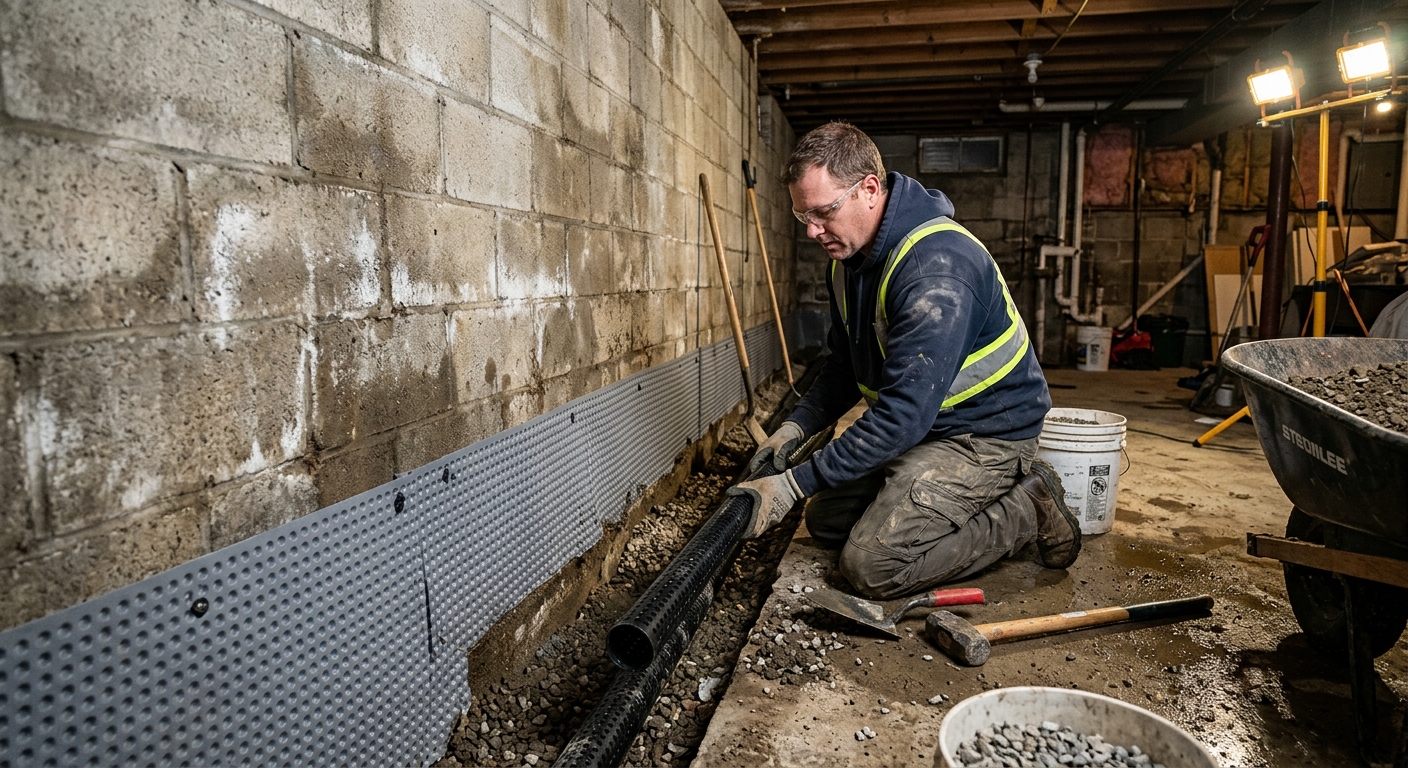
Interior waterproofing—perimeter drain channel, sump pit, and sump pump—captures seepage at the foundation line and reduces how much water accumulates near the slab or basement floor. Interior work is less invasive and can be the right choice when access for exterior excavation is limited, the foundation is difficult to expose, or when you need a controlled, faster solution. But interior work does not stop hydrostatic pressure on the wall itself; it’s best when combined with crack sealing and proper roof/downspout drainage to reduce inflow.
Local fit matters. Poured concrete walls in the Thompson–Okanagan often respond well to crack injection (especially for stable hairline cracks) because the wall can be sealed effectively. Block foundations more commonly benefit from interior perimeter drainage as a practical complement, particularly when original weeping tile is failing or when clay pockets hold water longer. If your basement sees recurring wetness after spring snowmelt, a sump pump backup system is worth budgeting for because power reliability becomes important during high inflow periods in BC.
To see when the price difference is justified: if you can’t confirm the exterior drainage is functional, a homeowner may spend toward the $18,000–$40,000 exterior band to replace membrane and drainage tile, rather than paying $9,000–$22,000 for interior drainage now and risking repeated wet areas along wall lines when water pressure stays high. In other cases—like isolated dampness near a window area—re-grading and targeted drainage can be the more efficient path.
| Method |
Best For |
Addresses Source? |
Disruption |
Lifespan |
Price Band |
| Full exterior excavation + membrane |
Chronic seepage, suspected weeping tile failure, high water load sites, exterior access is available |
Yes (source-level hydrostatic control) |
High |
20+ years typical with proper drainage/backfill |
$18,000–$40,000 |
| Interior French drain + sump system |
Basements with slab-edge seepage, limited exterior access, clay pockets causing persistent interior moisture |
No (manages after entry) |
Medium |
15–25 years (pump performance is critical) |
$9,000–$22,000 |
| Crack injection — epoxy (structural) |
Stable, non-moving cracks where water is not an ongoing jet |
Partial (seals crack path) |
Low to medium |
10–20+ years when the crack is stable |
$800–$3,500 |
| Crack injection — polyurethane (active leak) |
Active seepage/hydraulic pressure through cracks |
Partial (stops active path) |
Low to medium |
10–20 years depending on water load and crack movement |
$900–$3,800 |
| Interior drain channel only (no sump) |
Minor seepage where inflow is low and a full sump is unnecessary |
No (relies on intermittent drainage) |
Medium |
10–20 years depending on inflow |
$6,500–$14,000 |
| Re-grading + downspout extensions |
Surface runoff issues, localized dampness after storms, poor discharge routing |
Yes for surface water control (not sub-surface pressure) |
Low to medium |
5–15 years until re-settlement/landscaping changes |
$1,200–$3,800 |
How to choose a waterproofing contractor in Spallumcheen
Choosing the right contractor in Spallumcheen starts with verifying the basics: British Columbia licensing, liability insurance, and WSIB/WCB coverage. Ask for the contractor’s licence information and check it online in the relevant registry for the trade category tied to the scope (excavation, concrete repair, drainage, or building envelope waterproofing). Next, request a certificate of liability insurance and confirm it covers the work you’re hiring for. Then ask for proof of WSIB/WCB coverage—ensure it’s active and aligned with the contractor’s workforce.
Get 2–3 itemised quotes rather than one lump sum. The best quotes break down labour and materials (membrane/drainage components/crack injection products, disposal, reinstatement, and any pump/backup equipment). Read the scope line-by-line: what’s included for permit pulls, what’s excluded, and who handles disposal and yard reinstatement. Confirm whether waterproofing will be preceded by necessary prep such as mould/efflorescence remediation, surface cleaning, and crack priming. Ask about warranty details: workmanship warranty length, product/manufacturer warranty terms, and whether the warranty is transferable to future owners.
On payment, never pay more than 10–15% upfront. Use a holdback schedule tied to milestones (for example, base membrane installation, drain tie-ins completed, and backfill/cleanup verified). Finally, get timeline commitments in writing: start date, inspection/permit milestones, and an estimated completion date.
- Ask for a written scope map showing crack locations, drain routing, and discharge points.
- Confirm whether they will test or inspect the existing drainage/walls before quoting.
- Verify they list product brands and model numbers for sump pumps and backup systems.
- Ensure disposal, compaction, and backfill specifications are stated (not vague “proper backfill”).
- Check that the quote states what will be removed and what will be reinstated (patios, steps, sod).
- Ask if they’ll include permit pulling and inspection scheduling—or state it clearly as a homeowner responsibility.
- Request proof of insurance and WSIB/WCB before signing.
- Confirm how they protect landscaping, windows, and nearby structures during excavation.
- Look for a workmanship warranty in writing (with start/end dates) and product warranty terms.
- Avoid contractors who won’t put key details (pump backup, discharge routing, backfill method) in the contract.
- Use milestone payments; hold back until waterproofing is complete and the site is cleaned.
- Be cautious with “one-size-fits-all” solutions that ignore soil/water observations.
Red flags in Spallumcheen include: (1) quoting exterior excavation without discussing existing weeping tile condition or local access limitations; (2) offering sump pumps without backup during spring inflow seasons; (3) vague scope language like “seal basement walls” without specifying crack injection type and prep; (4) skipping discussion of permits/municipal approval for discharge; and (5) refusing to provide written warranties and proof of WSIB/WCB and liability coverage.
Frequently asked questions — waterproofing in Spallumcheen
How long does waterproofing last?
In Spallumcheen, longevity depends on whether the system controls the water entry point or only manages water after it enters. Exterior waterproofing with new membrane and drainage tile is commonly planned as a 20+ year solution when correct backfill, drainage grading, and discharge routing are done properly. Interior perimeter drains and sump systems often last 15–25 years, but the weak link is the pump—especially during spring melt when inflow can surge. Crack injection typically has a shorter “scope risk” because it works best on stable cracks; stable hairline cracks may last 10–20+ years, while active or moving cracks can require broader drainage and monitoring. If your home is from the pre-1981 stock (Statistics Canada, 2021 Census), the original weeping tile may have already failed, making full or combined approaches more reliable.
Can I waterproof my basement from the inside only?
Yes—many Spallumcheen basements are successfully managed with interior waterproofing, especially when exterior excavation isn’t practical due to decks, finished landscaping, or tight access. Interior methods (perimeter drain channel and sump pit) can keep floors drier and reduce pooled water after it enters. However, interior work doesn’t stop hydrostatic pressure against the foundation wall, so it’s not always a “one-and-done” cure if the site has persistent water load, clay pockets, or failing exterior drainage. For moderate symptoms, interior solutions can fall in the $9,000–$22,000 range, while isolated issues may be addressed with smaller crack or localized drainage work. If you’re seeing dampness along multiple wall lines after heavy spring rain or snowmelt, discuss whether a combined strategy (interior drainage plus crack sealing and downspout corrections) is the right fit.
What causes foundation cracks in Spallumcheen?
Foundation cracks in Spallumcheen are usually caused by a mix of soil moisture movement, freeze-thaw cycling, and foundation settlement patterns over time. Thompson–Okanagan valleys can have variable glacial/alluvial soils—some lots include clay or dense silts that hold moisture longer. During winter freeze-thaw, water in or near soil expands, increasing lateral pressure on foundation walls and widening existing joints and hairline cracks. In older homes (nearly half built before 1981, Statistics Canada, 2021 Census), original drainage systems can be undersized or failed, allowing water to sit near the foundation longer. Heavy runoff from roof downspouts and yard grading issues can also concentrate water near wall lines. Importantly, crack type matters: stable hairline cracks often suit injection, while horizontal step or structural patterns may require a structural engineer assessment before sealing.
How do I compare waterproofing quotes?
Start by comparing the scope, not just the price. Ask each contractor to detail labour and materials: excavation extent (if exterior), membrane type (if applicable), drainage tile size and layout, discharge routing, pump model and backup system (if included), and interior work such as drain channel depth and sump pit placement. Confirm what’s included for disposal and reinstatement of landscaping, concrete, or asphalt. Also compare warranties and what they cover—workmanship duration and manufacturer warranty terms. In Spallumcheen, two quotes can differ by 30–50% because one addresses the source (exterior membrane and drainage) and another manages symptoms (interior drain). If one quote lands near the $18,000–$40,000 exterior band and another sits in the $9,000–$22,000 interior band, make sure you understand what water load risk remains after the work. A well-written quote should reduce unknowns with site observations and specific inclusions.
How long does basement waterproofing take in Spallumcheen?
Timelines vary based on foundation access, foundation type, and how much removal is required. Interior perimeter drainage and sump system projects typically take less time than exterior excavation because you’re not opening the full yard around the foundation. That said, the schedule depends on drying/curing times for patching, crack injection curing, and pump discharge line completion. Exterior projects often take longer due to excavation, membrane/drain installation, backfill compaction, and landscaping reinstatement. Weather also matters in British Columbia: wet site conditions can slow down excavation and backfill, and sealing operations may require specific surface conditions. Ask the contractor for a written start date, milestone dates (prep, installation, inspections/permits if needed), and a completion estimate. For many homeowners, getting the permit and engineering steps (where required for structural cracks) planned early prevents mid-project delays.
What is a weeping tile and does my Spallumcheen home have one?
A weeping tile is the foundation drainage system—typically a perforated pipe wrapped or surrounded by drainage material—that collects groundwater and directs it to a sump (or a discharge point) to reduce water pressure around the foundation. Many homes built before modern waterproofing standards were designed with some version of weeping tile, but in older Spallumcheen houses, those original systems may be blocked, collapsed, or undersized due to age and soil movement. With about 49.4% of homes built before 1981 (Statistics Canada, 2021 Census), there’s a decent chance your home has had a weeping tile at some point, but it may not be functioning reliably. You can confirm by looking for clues (sump presence, old inspection records, or prior repairs) and by having a contractor inspect during excavation or via targeted diagnostics. If your basement is damp near slab edges and cold joints, failing weeping tile is a common cause.