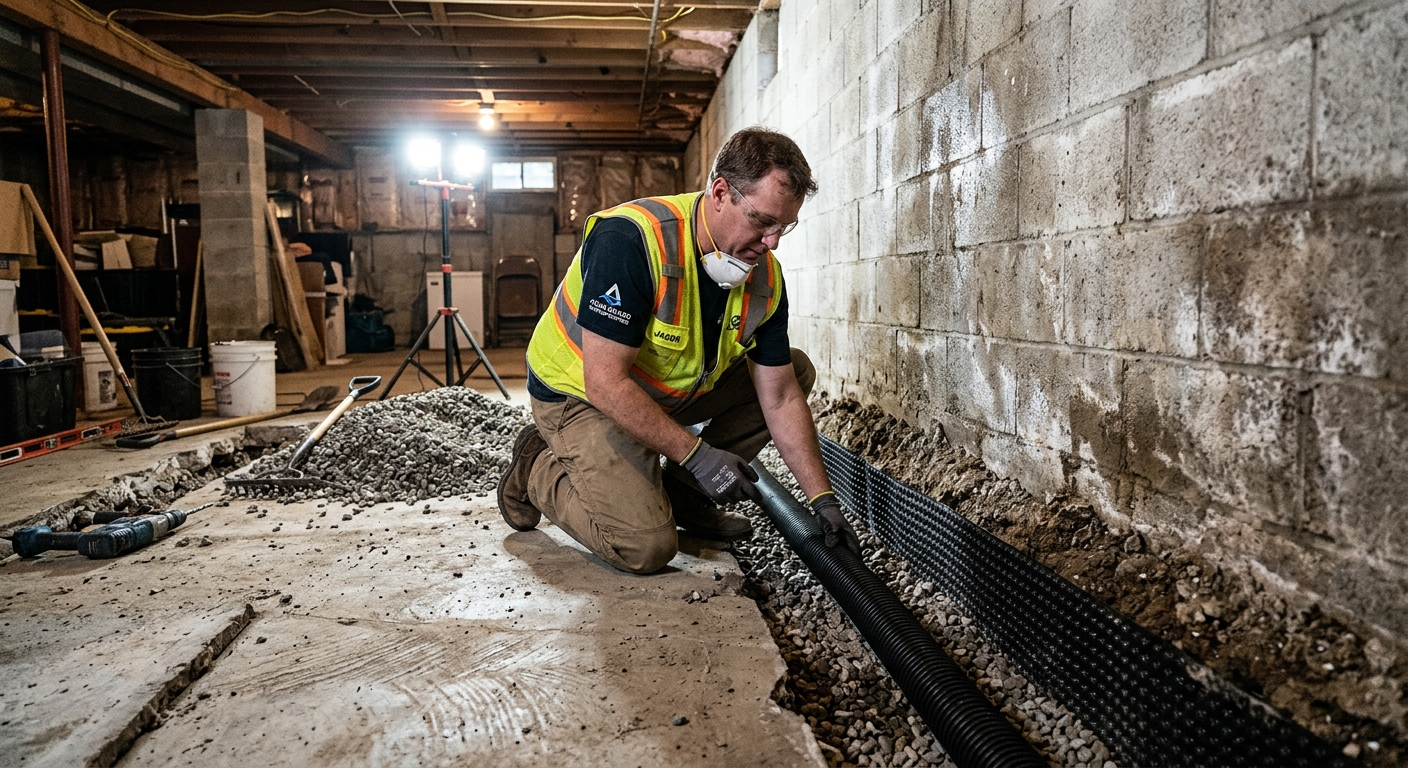
Basement waterproofing options and costs in South Surrey
South Surrey homeowners often need to think about waterproofing early because this area sits in the Lower Mainland–Southwest market, where persistent groundwater pressure and intense rainfall keep basements and crawl spaces under stress. With a population of 77,170 (Statistics Canada, 2021 Census), there’s steady demand for both exterior excavation work and interior retrofits—especially in established neighbourhoods where original drainage systems are aging. In many South Surrey homes built decades ago, the original tar-and-paper approach and older weeping tile are more likely to have failed or become undersized over time, so water finds the path of least resistance through wall joints, slab edges, and any cracked mortar lines.
Lower Mainland–Southwest pricing is shaped less by extreme seasonal swelling (like some clay-heavy regions elsewhere in Canada) and more by chronic saturation. High water tables maintain hydrostatic pressure against basement walls and slabs, while wet, mild winters and frequent freeze-thaw widen existing cracks and joints. That’s why full-perimeter exterior systems and comprehensive interior drainage installations tend to land at the higher end of Canadian price expectations. Contractors also face higher costs for tight-lot access in areas such as Morgan Creek and South Surrey’s older pocket streets near historic commercial corridors, where landscaping, hardscaping, and mechanical breaking during excavation can add time and disposal.
Below are the most common basement waterproofing options in South Surrey and what they typically address—then you can compare typical disruption, durability, and pricing for each approach.
| Method |
What It Addresses |
Disruption Level |
Durability |
Price Range |
| Exterior excavation + new membrane + drainage tile |
Primary water source by lowering/relieving hydrostatic pressure around foundation |
High (excavation, landscaping restoration) |
High (designed for long-term exterior control) |
$15,000 – $30,000 |
| Interior perimeter drain channel + sump pit |
Water after it enters; manages seepage and reduces interior moisture |
Medium (interior demolition, floor/sleeve work) |
Medium-High (excellent when exterior is impractical) |
$8,000 – $18,000 |
| Foundation crack injection (epoxy or polyurethane) |
Crack pathway control; epoxy for structural/hairline stability, polyurethane for active leaks |
Low-Medium (minor interior/exterior access) |
Medium-High (depends on crack type and cause) |
$500 – $2,000 |
| Sump pump installation (primary + battery backup) |
Reliable removal during high groundwater periods; reduces shutoff risk during outages |
Medium (pit, discharge lines, electrical work) |
Medium-High (best with backup system) |
$1,000 – $5,000 |
| Window well drain installation |
Surface/groundwater management around basement windows |
Low-Medium (localized excavation) |
Medium (often paired with perimeter strategy) |
$1,500 – $4,500 |
| Lot re-grading / downspout extension |
Moves roof runoff away from foundation; reduces infiltration at the source on-site |
Low (limited yard disruption) |
Low-Medium (maintenance dependent) |
$1,500 – $6,000 |
Prices are estimates only and vary by project scope, site access and material selection.
What affects the price of waterproofing in South Surrey
In the Lower Mainland–Southwest, homeowners can see quotes for the same basement waterproofing need that vary by 30–50% because the “water problem” is rarely one problem. Two contractors may both quote interior drainage, but one may include a proper perimeter drain layout, sump pump selection (including backup), and remedial steps for mould or efflorescence—while another focuses only on visible cracking. Scope differences, how much excavation is required, and whether the contractor is truly addressing hydrostatic pressure (not just symptoms) are the main reasons for the range.
Three drivers separate South Surrey costs from a national average: soil type behavior, water table pressure, and freeze-thaw. In clay-heavy areas elsewhere in Canada, expanding soils can push foundations laterally and worsen cracks; in South Surrey, the cost pressure comes more from sustained saturation. Here, a higher water table means sump pumps run longer and discharge piping and backflow prevention become more critical, which pushes interior systems toward the $8,000 – $18,000 band. Coastal BC rainfall saturates backfill quickly when original drainage fails, so exterior excavation and membrane systems can hit the $15,000 – $30,000 range due to longer labour and restoration time.
Concrete South Surrey examples: (1) homes with older weeping tile that’s partially collapsed typically need more demo and cleaning before the new drain can connect—adding hours and disposal; (2) a poured-concrete wall with hairline cracks often responds better to targeted crack injection (sometimes cheaper than full systems), but a block wall with mortar deterioration often requires interior drainage as a practical complement; (3) tight-lot access near lanes or with mature shrubs in South Surrey can increase excavation time because mechanical breaking is slower and restoration is more complex.
| Price Factor |
Why It Matters |
Cost Impact |
| Interior vs. exterior approach — interior is less disruptive but addresses symptoms |
Exterior treats the source (water outside the foundation); interior controls water after entry |
Interior often lands in the $8,000 – $18,000 band; exterior moves higher at $15,000 – $30,000 |
| Foundation type — poured concrete vs. block vs. stone vs. ICF |
Different cracking patterns and moisture pathways affect prep, sealing, and drain design |
Poured concrete + injection can be lower; block or stone often requires interior drainage as a complement |
| Soil type — clay expands more than sand, adding pressure |
Soil movement increases crack cycling and failure risk if drainage is inadequate |
More movement typically increases labour for crack prep and may shift scope toward exterior control |
| Crack type and length — hairline vs. structural horizontal cracks |
Active or structural cracks need different materials and sometimes structural review |
Structural/horizontal conditions usually increase cost and may trigger engineering/underpinning discussion |
| Sump pump backup system — battery or water-powered backup needed |
BC outages can coincide with wet weather; backup reduces “no pump” risk |
Can add a meaningful amount to the $1,000 – $5,000 sump band |
| Access — landscaping, decks, or driveways must be removed for exterior |
Restricted access increases excavation time and restoration costs |
Often pushes exterior quotes upward within the $15,000 – $30,000 range |
| Weeping tile age — original tile (60+ years) may be completely failed |
Failed original systems require replacement and confirm that exterior drainage is truly addressed |
Repairs and tie-ins add labour/disposal; failure can force a full perimeter rebuild |
| Mould or efflorescence remediation required before sealing |
Sealers and membranes perform poorly over contaminated, powdery, or biologically active surfaces |
Remediation adds scope before waterproofing materials can be applied effectively |
Permits & regulations in British Columbia
In British Columbia, certain waterproofing-related changes commonly require a building permit. Foundation excavation, structural crack repair, and changes to how lot drainage directs water away from the foundation typically fall under permit requirements. If you’re installing a sump pump and connecting it to a municipal storm or sanitary sewer system, municipal approval is often required before final connection and discharge.
For structural crack repairs—especially horizontal cracks in block walls, significant step cracking, or any crack that suggests movement—many homeowners will need a structural engineer’s assessment. The purpose is to confirm whether the repair is strictly waterproofing (sealing and stopping flow) or whether structural work (such as underpinning or reinforcement) is needed before or alongside waterproofing. Ask your contractor whether they can coordinate engineering support for structural scenarios, and confirm they carry liability insurance plus WSIB/WCB coverage where required for their workers.
To verify a South Surrey contractor’s compliance, do this step-by-step:
- Check their British Columbia business/contractor registration details through online provincial resources (use the exact legal business name on the quote).
- Request a certificate of insurance showing general liability (and confirm the limits).
- Ask for WSIB/WCB clearance evidence and verify it’s current.
- For structural crack work, request how engineering will be obtained (letter/report responsibility and timing).
- Confirm permit responsibility: who pulls the permit, what work is permitted, and what documentation you’ll receive.
Interior vs exterior waterproofing — what does South Surrey need?
The key difference in South Surrey is that exterior waterproofing targets the water source, while interior waterproofing manages water after it enters. Exterior excavation means exposing the foundation, installing a new membrane and drainage tile system, and then re-compacting/backfilling. Done correctly, this relieves hydrostatic pressure outside the walls, which is why it’s often the most permanent approach—but it’s also the most disruptive and expensive due to excavation, mechanical breaking in rocky sections, and landscaping restoration.
Interior waterproofing uses a perimeter drain channel, sump pit, and sump pump to collect seepage and keep the basement drier. It’s less invasive than full excavation and is often the practical choice when access is tight or when exterior excavation is unrealistic. However, it does not stop hydrostatic pressure against the wall itself; it reduces the impact by intercepting water inside. In South Surrey’s wet, mild winters and freeze-thaw conditions, this still performs well when paired with crack evaluation and proper sump pumping.
Foundation type matters. Poured-concrete basements often have better results with crack injection for certain crack patterns, provided the crack cause is addressed. Block foundations frequently benefit from interior drainage as a complement because moisture can travel through mortar lines and joints, even when surface cracks are treated. Because spring rainfall can be intense and power outages can occur during heavy wet spells, a sump pump backup (battery or water-powered) is commonly recommended for reliability.
Where the price difference is justified: if you have chronic seepage driven by failed perimeter drainage, exterior systems at $15,000 – $30,000 can be cost-effective long-term versus repeating interior-only measures. If the issue is localized to window wells, downspout overflow, or a limited crack pathway, interior options or crack injection in the $500 – $2,000 band (plus drainage where needed) may be the right first step.
| Method |
Best For |
Addresses Source? |
Disruption |
Lifespan |
Price Band |
| Full exterior excavation + membrane |
Chronic seepage, high groundwater pressure, and failed exterior drainage |
Yes (source outside the foundation) |
High (yard impact and restoration) |
High (long-term exterior control) |
$15,000 – $30,000 |
| Interior French drain + sump system |
When exterior access is limited or soil/backfill conditions make excavation impractical |
No (collects water after entry) |
Medium (floor and interior wall work) |
Medium-High (depends on pump/backup and maintenance) |
$8,000 – $18,000 |
| Crack injection — epoxy (structural) |
Non-moving hairline cracks and structural crack stabilization |
Partially (seals crack pathway if no active pressure continues) |
Low-Medium (surface prep and drilling) |
Medium-High (when crack cause is controlled) |
$500 – $2,000 |
| Crack injection — polyurethane (active leak) |
Active seepage where water is currently moving through the crack |
No (stops flow through the crack; may still require drainage for bulk water) |
Low-Medium (targeted injection) |
Medium (often paired with drainage and sump) |
$700 – $2,500 |
| Interior drain channel only (no sump) |
Light seepage or short-lived moisture management in low-risk basements |
No (collects and redirects without active pumping) |
Medium-Low (still involves some demo) |
Low-Medium (reliant on gravity and conditions) |
$6,000 – $12,000 |
| Re-grading + downspout extensions |
Roof runoff overshooting the foundation and localized surface water |
Partially (reduces water coming from site surfaces) |
Low (localized yard work) |
Low-Medium (maintenance dependent) |
$1,500 – $6,000 |
How to choose a waterproofing contractor in South Surrey
Start by verifying that your contractor is properly registered in British Columbia and that they can document coverage. Request their liability insurance certificate (confirm coverage limits and that your address/home is covered as appropriate). For worker coverage, ask for WSIB/WCB clearance information—don’t accept verbal assurances. Then confirm whether they have engineering support available for structural crack work so you aren’t left coordinating it mid-project.
Next, get 2–3 itemized written quotes. Ideally, the quote should break out labour and materials, including drainage components, membrane products (if exterior), sump pump model/backup option, discharge routing, and any prep/remediation steps such as mould removal or efflorescence treatment. Watch for exclusions: disposal, permit pull, reinstatement of landscaping, and electrical work for pumps should be clearly stated. In South Surrey, these items can add thousands if they’re missing from the quote.
Warranty and payment structure matter. A workmanship warranty should be in writing (length, what’s covered, and how it’s handled if you sell the home). Product/manufacturer warranties should be documented separately, including whether they’re transferable. Payment should be staged: never pay more than 10–15% upfront, and hold back a reasonable amount until the job is complete and surfaces are properly restored. Ask for a start date and a completion estimate in writing so weather and material lead times are transparent.
- Confirm BC registration details using the legal business name on the contract.
- Request proof of liability insurance and verify expiry date.
- Provide WSIB/WCB clearance evidence for workers.
- Ask who pulls permits and what permits apply to your exact work.
- Require itemized labour/materials (not one lump sum).
- Insist on details for drainage tile routing and discharge method.
- Clarify sump pump specifications and whether backup is included.
- Confirm whether mould/efflorescence remediation is included if present.
- Verify how cracked foundations will be assessed (crack type, length, and cause).
- Get warranty terms in writing (workmanship + product) and confirm transferability.
- Set a payment schedule with a holdback until clean completion.
- Ask for disposal/reinstatement coverage (topsoil, sod, landscaping restoration).
Common red flags in South Surrey: (1) vague scopes like “waterproof basement” without drainage design details; (2) no mention of sump pump discharge/routing or backup for a wet-weather problem; (3) missing insurance/WSIB/WCB documentation; (4) quotes that don’t address whether cracks are active vs structural; and (5) pressure to pay large deposits upfront or refusal to provide a written timeline.
Frequently asked questions — waterproofing in South Surrey
What is a weeping tile and does my South Surrey home have one?
A weeping tile is the perimeter drainage line (often installed around the foundation) designed to collect groundwater and direct it away—commonly into a sump basin or to a discharge point where permitted. In many older South Surrey homes, the “weeping tile” may be the original installation, and by now it can be partially collapsed, clogged with silt, or disconnected due to settlement or past repairs. You can sometimes find clues: a history of sump pump upgrades, old records from prior drainage work, or damp basement corners that line up with the exterior perimeter. If you’re unsure, a proper inspection and drain camera inspection (where accessible) can confirm the condition. If you’re seeing chronic moisture, interior perimeter drainage and sump work in the $8,000 – $18,000 band is often the practical retrofit when exterior systems can’t be fully restored right away.
Can I waterproof my basement in winter in South Surrey?
Yes, you can waterproof in winter in South Surrey, but the “how” matters. Wet, mild weather and freeze-thaw cycles can still allow meaningful work like crack injection, localized interior drainage modifications, or window well drainage repairs—especially when materials and curing conditions are managed correctly. For full exterior excavation, winter conditions can increase challenges: soil may be saturated, access can be muddy, and freezing can complicate backfilling and compaction. A contractor should provide a weather plan and confirm how they’ll protect open excavation areas, maintain safe working conditions, and achieve proper compaction for drainage backfill. Many homeowners choose winter for interior steps and then schedule exterior work for dryer windows. If your basement is experiencing active seepage, you may start with targeted interior controls and sump reliability (often within the $1,000 – $5,000 sump installation band, depending on backup requirements), then follow with larger scope later if needed.
What is the difference between waterproofing and damp-proofing?
Damp-proofing is generally a surface-level approach that reduces minor moisture transmission—think coatings or simple barriers used when water exposure is limited. Waterproofing is a system designed to manage water entry under conditions like hydrostatic pressure, which is common in South Surrey during prolonged rainfall and saturated soils. That’s why waterproofing often includes drainage components such as new perimeter drainage tile, membranes, weeping tile replacement, and/or interior perimeter drains tied to a sump pump. In British Columbia, where groundwater pressure and persistent wet weather can keep basements under stress, damp-proofing alone can fail to address the source of water. If your basement shows recurring seepage during storms, you’re typically looking at true waterproofing strategies rather than a coating-only fix. Depending on access and foundation conditions, solutions range from interior weeping tile/sump retrofits in the $8,000 – $18,000 range to exterior excavation systems up to $15,000 – $30,000.
Will basement waterproofing affect my property value in South Surrey?
Typically, yes—especially when the waterproofing addresses recurring moisture and reduces ongoing damage risk. In South Surrey, buyers often worry about mold, musty odours, wet carpets, and visible efflorescence or crack-related seepage, and those concerns can affect sale price and negotiating power. A documented waterproofing system—especially one with a written workmanship warranty and clear scope (drainage design, sump pump specifications, and crack repair method)—gives future buyers more confidence. The value impact is usually strongest when waterproofing prevents damage and provides reliable drainage rather than short-term cosmetic fixes. Exterior systems can be particularly compelling because they target the water source, though they’re the most disruptive. Interior systems are still valuable when designed for hydrostatic conditions and backed by proper sump pumping. Homeowners considering first steps often start by stabilizing cracks (commonly in the $500 – $2,000 range depending on length/type) or installing interior drainage where exterior access is difficult, then expand if needed.
What drainage issues are most common in South Surrey homes?
In South Surrey, the most common issues tend to be related to saturated backfill, aging perimeter drainage, and water that can’t escape quickly enough during prolonged wet periods. Many homes show moisture along foundation corners, near slab edges, and around basement windows—often because original weeping tile systems have clogged or failed, or because downspouts direct roof runoff toward the foundation. Freeze-thaw cycles can widen existing joints and hairline cracks, turning once-dry areas into active seepage paths. If your basement has efflorescence (white powder) or recurring musty odours, it’s often a sign that water is migrating through masonry joints or through a crack pathway. Where there’s localized window leakage, window well drainage can help, but when the overall perimeter is affected, interior French drain and sump retrofits (commonly in the $8,000 – $18,000 band) are frequently more effective. For ongoing high groundwater pressure, exterior excavation and membrane + drainage tile can be required, often in the $15,000 – $30,000 range.
How do I choose a waterproofing contractor in South Surrey?
Choose a contractor based on documented compliance, a clear written scope, and waterproofing systems that match your water source—not just what’s visible indoors. In British Columbia, ask the contractor to provide proof of liability insurance and WSIB/WCB coverage, and verify their registration through provincial online resources using the exact business name on the quote. Get 2–3 itemized written quotes that separate labour and materials, and check that they state what’s included for permits, disposal, and landscaping restoration. For South Surrey projects, confirm whether they address the likely hydrostatic driver (drainage tile/exterior membrane vs interior sump management) and whether they’ll handle crack type correctly (active leak vs structural crack). Warranty matters: require a workmanship warranty length in writing and ask about product/manufacturer warranties. A safe payment schedule is key—avoid large upfront payments (generally no more than 10–15%) and hold back until completion. If the quote is significantly cheaper than $15,000 – $30,000 for full exterior work without explaining scope differences, treat that as a red flag and ask for the missing details.