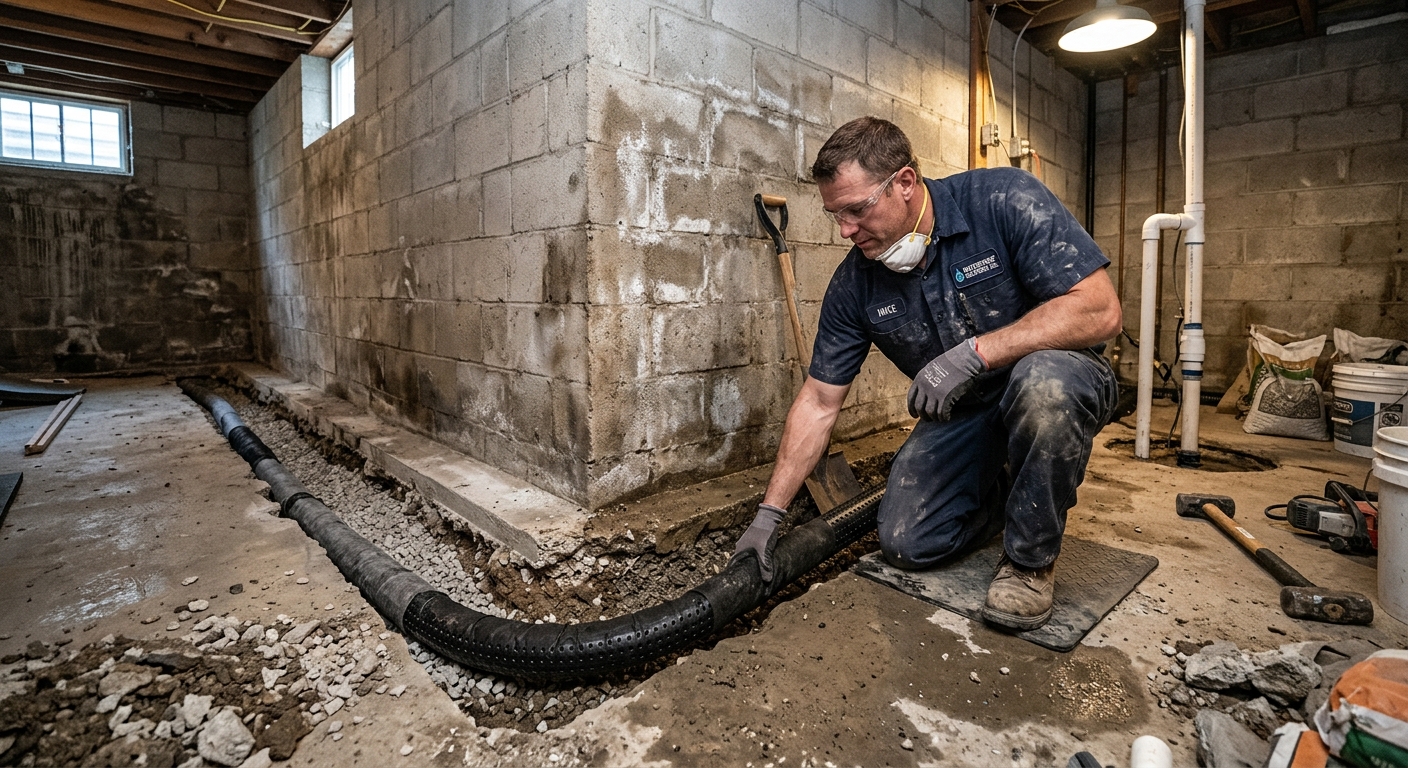
Basement waterproofing options and costs in Saanichton
Saanichton homeowners typically have several waterproofing paths to choose from, and the right one depends on where the water is coming in and how hard the site conditions push back. With Saanichton’s relatively small population of 1,565 residents (Statistics Canada, 2021 Census), many trades are local and scheduling can tighten during peak construction windows, which can affect turnaround time more than the pricing itself. Just as important is home age: on Vancouver Island, older basements often reflect earlier waterproofing methods, and the original drainage systems can be long past their service life, especially where historic weeping tile has failed or been disconnected.
In the Vancouver Island and Coast region, the main cost driver is water movement around the foundation. Heavy rainfall, higher local groundwater, and poor downspout-to-surface drainage increase seepage risk, and exterior work usually costs more because excavation, membrane detailing, and perimeter drainage are labour-intensive. In neighbourhood pockets such as Mount Newton and adjoining areas, demand for exterior excavation tends to spike because many lots have older foundations and mature landscaping that makes access tighter.
Below is a practical comparison of the most common options used in Saanichton, with realistic cost ranges for typical homes. After the table, you’ll find a short note on why every quote can shift based on access, foundation geometry, and whether you need full perimeter work or only targeted repairs.
| Method |
What It Addresses |
Disruption Level |
Durability |
Price Range |
| Exterior excavation + new membrane + drainage tile |
Stops water at the source; replaces perimeter drainage and waterproof coating system |
High (excavation, landscaping impacts) |
Long-term (often 15+ years when done as a full system) |
$7,000–$18,000 |
| Interior perimeter drain channel + sump pit |
Collects seepage that enters the basement; reduces hydrostatic pressure in the sump zone |
Medium (floor cutting, channel layout) |
Good (typically 10–15 years depending on maintenance and water load) |
$3,500–$10,000 |
| Foundation crack injection (epoxy or polyurethane) |
Seals cracks as a leak path; stops or reduces active seepage depending on product choice |
Low to Medium (patching and surface prep) |
Moderate to long-term when crack type is correctly matched to the material |
$250–$800 |
| Sump pump installation (primary + battery backup) |
Moves collected water away during high groundwater/rain events |
Medium (pit, plumbing, discharge route) |
Good to long-term with proper discharge and backup coverage |
$1,200–$2,500 |
| Window well drain installation |
Prevents water pooling around window wells and lateral seepage into window areas |
Low to Medium (excavation at the well) |
Good (often 10+ years with correct slope and discharge) |
$600–$2,000 |
| Lot re-grading / downspout extension |
Keeps roof runoff and surface water away from foundation; reduces saturation around the perimeter |
Low (site work without basement demolition) |
Short to medium-term unless paired with drainage fixes |
$500–$3,000 |
Prices are estimates only and vary by project scope, site access and material selection.
What affects the price of waterproofing in Saanichton
It’s common to see waterproofing quotes for the “same” basement come back 30–50% different in cost on Vancouver Island and the Coast. That gap usually isn’t about the contractor trying to upsell; it’s about the site water conditions, foundation details, and whether the proposed scope is a full water-management system or a partial symptom fix. In British Columbia, the biggest separators from national averages are soil type, water table, and freeze-thaw—because these determine how much hydrostatic pressure you’re actually fighting and how long moisture stays trapped against the wall.
For example, clay-heavy soils (more common in parts of Canada) can expand during freeze-thaw and exert lateral pressure on foundation walls, worsening cracks over time. Even though freeze-thaw severity varies across BC, any trapped moisture can still widen hairline cracks and convert them into recurring leak paths. In the Vancouver Island and Coast climate, heavy rainfall saturates backfill quickly when original drainage fails, and higher local groundwater can increase sump pump run times and drainage requirements. In older housing stock you often see repeated interior dampness tied to failing perimeter drains/weeping tile and seeping poured-concrete or block foundation walls; once water finds a crack, the repair method matters as much as the cost.
Concrete cost examples you’ll feel in Saanichton: if your only issue is active cracking, injection is usually closer to the $250–$800 crack repair band. But if excavation is required to replace perimeter drainage, exterior waterproofing often climbs into the $7,000–$18,000 exterior range because of excavation, membrane detailing, and disposal/discharge work.
| Price Factor |
Why It Matters |
Cost Impact |
| Interior vs. exterior approach — interior is less disruptive but addresses symptoms |
Exterior targets water at the source; interior manages water after entry |
Typically interior is $3,000–$10,000 while exterior can run $7,000–$18,000 |
| Foundation type — poured concrete vs. block vs. stone vs. ICF |
Wall permeability and crack behaviour differ by foundation material |
Poured concrete often responds well to crack injection; block frequently needs interior drainage support |
| Soil type — clay expands more than sand, adding pressure |
Water retention increases lateral forces and re-wetting cycles |
Clay-heavy sites often justify additional drainage and membrane complexity |
| Crack type and length — hairline vs. structural horizontal cracks |
Wrong product on structural movement won’t last; longer cracks mean more prep/injection |
Structural issues can push beyond the $250–$800 band and may require engineering |
| Sump pump backup system — battery or water-powered backup needed |
Backup prevents failure during power interruptions |
Adds cost to reach roughly the $800–$2,500 sump/battery range |
| Access — landscaping, decks, or driveways must be removed for exterior |
More removal and restoration increases labour and scheduling |
Can shift a project toward the top of the exterior band |
| Weeping tile age — original tile (60+ years) may be completely failed |
Collapsed or disconnected systems don’t route water away |
Often increases scope toward full perimeter drainage replacement |
| Mould or efflorescence remediation required before sealing |
Sealers don’t bond well on active salts or untreated contamination |
May add remediation and surface conditioning time |
Permits & regulations in British Columbia
In British Columbia, foundation excavation, structural crack repair, and changes to lot drainage typically require a building permit. In practice, the permit requirement is most likely when you’re altering how the foundation area functions—especially if you’re doing perimeter excavation, installing or modifying drainage systems around the footing, or making repairs that could affect the structure’s integrity. Sump pump installations are another common trigger: if the discharge ties into storm or sanitary sewer systems, municipal approval is generally required before work proceeds.
For structural crack repair—such as horizontal cracks in block walls, major step cracks, or any crack pattern suggesting movement—an engineer’s assessment is often required to confirm whether underpinning or other structural remedial work is needed. A reputable waterproofing contractor should either provide engineering support through their network or clearly coordinate it with you, and they should be able to show appropriate liability coverage and WSIB/WCB status (or the relevant provincial coverage arrangements for their workforces).
To verify a contractor for Saanichton work, do this step-by-step: (1) check the contractor’s British Columbia licence/registration using the provincial online registry page they provide or that you find through official searches; (2) ask for a certificate of insurance and confirm it names you appropriately as required, with current dates; (3) request proof of WSIB/WCB clearance or coverage documentation before scheduling; (4) confirm in writing whether the scope includes permit pulls or whether you, the homeowner, must apply; and (5) for structural work, ask whether engineering sign-off is included before they start drilling or sealing.
Interior vs exterior waterproofing — what does Saanichton need?
Exterior waterproofing and interior waterproofing both help, but they do different jobs. Exterior systems—full excavation, new membrane, new drainage tile, and re-grading/backfill—permanently address where water enters by managing it outside the foundation. The trade-off is higher cost and yard disruption because contractors must excavate around the perimeter and then restore landscaping. Interior systems—perimeter drain channels, a sump pit, and a sump pump—manage water after it has entered the basement. They are typically less invasive and may be the right choice when access is difficult, but they do not stop hydrostatic pressure building against the wall itself.
In Saanichton’s Vancouver Island and Coast conditions, where heavy rainfall can saturate backfill quickly and groundwater can stay high after storms, exterior work often delivers the most “source control.” That said, many homes here have poured concrete walls that respond well to correctly selected crack injection (especially when cracks are the main leak path). If you have block foundations, interior drainage is often a practical complement because block can be more prone to seepage and requires a reliable collection strategy.
Backup matters too: BC outages during spring flooding and stormy periods make a battery backup (or other proven backup approach) a smart add-on when you’re already investing in a sump system. As a simple budget example, if your main issue is one active seepage crack, you may be near the $250–$800 crack repair band. But if you’re seeing recurring dampness around multiple walls and the weeping tile is likely failed, exterior waterproofing commonly moves into the $7,000–$18,000 range because the system has to replace perimeter drainage and waterproofing as a whole.
| Method |
Best For |
Addresses Source? |
Disruption |
Lifespan |
Price Band |
| Full exterior excavation + membrane |
Chronic seepage, multiple leak points, failed perimeter drainage, exterior water management failures |
Yes |
High (excavation and landscaping restoration) |
Long-term when completed as a system |
$7,000–$18,000 |
| Interior French drain + sump system |
Interior dampness from groundwater seepage, limited yard access, basements that can’t be excavated |
No (collects water after entry) |
Medium (floor/channel work and pit installation) |
Good with maintenance and adequate discharge |
$3,000–$10,000 |
| Crack injection — epoxy (structural) |
Non-moving or properly assessed structural cracks where sealing is needed |
Partial (addresses crack leak path) |
Low to Medium |
Moderate to long-term if movement is ruled out |
$250–$800 |
| Crack injection — polyurethane (active leak) |
Active seepage through cracks where material flexibility helps manage ongoing water |
Partial (addresses active leak path) |
Low to Medium |
Moderate to long-term with correct diagnosis |
$250–$800 |
| Interior drain channel only (no sump) |
Light seepage where gravity drainage can handle the load |
No (collects but may not pump) |
Low to Medium |
Shorter if groundwater load rises during wet seasons |
$1,500–$5,000 |
| Re-grading + downspout extensions |
Surface water issues, roof runoff management problems |
Indirect (reduces saturation rather than sealing foundation) |
Low |
Moderate unless original drainage is also fixed |
$500–$3,000 |
How to choose a waterproofing contractor in Saanichton
Choosing the right contractor in Saanichton is mostly about verification and clarity. Start with British Columbia licensing/registration: ask for the contractor’s licence number and verify it using the official online registry resources available in BC. Next, confirm liability insurance—request a certificate of insurance showing current coverage dates and that the job is included. Then check WSIB/WCB coverage: request proof of clearance/coverage and ensure it covers the specific team expected on your project.
For pricing, get 2–3 itemised written quotes rather than a lump sum. You want labour + materials separated (excavation scope, membrane/drainage components, pipe sizing, sump pump model, and disposal/restoration). Read the scope line-by-line for exclusions: is mould or efflorescence remediation included before sealing? Is permit pull included, or is it your responsibility? Is excavation and restoration (backfill compaction, grading, and any deck/landscape reinstatement) part of the quoted work—or billed separately?
Warranty matters: ask for the workmanship warranty length, what products are covered, and whether the warranty transfers to future owners. Payment schedules should be conservative—never pay more than 10–15% upfront, and use a holdback until completion and final clean-up. Finally, ask for a written start date and a completion estimate that accounts for drying time and any weather-related delays common on the Vancouver Island and Coast during heavy rain cycles.
- Verify BC licensing/registration number before signing anything.
- Request certificate of insurance and confirm it covers your property address.
- Ask for WSIB/WCB clearance/coverage proof for the crew doing the work.
- Get 2–3 itemised quotes with labour and materials broken out.
- Confirm whether a permit is required and who pulls it.
- Check whether disposal/haul-away is included in excavation pricing.
- Make sure downspout extensions and grading are specified if surface water is suspected.
- Ask what they do if they find failed weeping tile or disconnected footing drains.
- Require written crack diagnosis: hairline vs active leak vs structural movement.
- Confirm sump pump discharge location and that backup is included if power interruptions are a concern.
- Review warranty: workmanship term, product warranty term, and transferability.
- Agree on payment schedule: keep upfront to 10–15% and hold back until completion.
Red flags in Saanichton to watch for: (1) a contractor quoting a full exterior system without discussing drainage tile discharge and access constraints; (2) refusing to provide insurance/coverage documentation or avoiding licence verification; (3) claiming one “universal” crack injection product works for every crack type; (4) skipping mould/efflorescence surface preparation before sealing; and (5) pushing large upfront payments or refusing to provide an itemised scope and written timeline.
Frequently asked questions — waterproofing in Saanichton
What causes foundation cracks in Saanichton?
In Saanichton and across Vancouver Island and the Coast, foundation cracks are often a mix of moisture movement, soil/water pressure, and normal settlement. Heavy rainfall can saturate backfill quickly, and if drainage (like perimeter drains/weeping tile) is failing, water can build pressure against the wall for longer periods. Freeze-thaw cycles can then contribute by expanding trapped moisture; even when extremes aren’t as severe as inland BC, repeated wetting can still worsen cracks over time. Older homes are also more likely to have earlier waterproofing details that don’t manage water as reliably, increasing the chance that hairline cracks become active leak paths.
How do I compare waterproofing quotes?
Compare quotes by scope and method, not just total price. Ask each contractor to itemise labour and materials and to state exactly what they’ll do for water control: exterior membrane and drainage tile replacement versus interior perimeter drainage and a sump system. Confirm what’s included for prep (for example, cleaning, crack surface preparation, and any mould/efflorescence remediation) and whether permits are pulled. Look for clarity on discharge and where water goes after collection. As a reality check, if one quote suggests only a crack seal for a basement that’s damp across multiple walls, it may under-address the source—whereas a full system may land in the $7,000–$18,000 exterior band depending on access. If the work is targeted, a crack repair line item might sit closer to the $250–$800 band.
How long does basement waterproofing take in Saanichton?
Timelines vary because exterior work depends on excavation access, restoration scheduling, and weather windows—heavy coastal rainfall can slow drying and membrane installation. As a baseline, smaller interior projects (like installing a perimeter drain channel with sump components) often take several days to a couple of weeks for complete rough-in and final finishes, assuming materials are on hand. Crack injection can be quicker, typically within a few days including prep and curing requirements. Full exterior excavation is more scheduling-intensive because excavation, membrane detailing, drainage tile placement, backfill compaction, and landscaping restoration all occur in sequence. Your contractor should provide a written start date, a realistic completion estimate, and a contingency plan for wet weather common on Vancouver Island.
What is a weeping tile and does my Saanichton home have one?
Weeping tile is a perimeter drainage system around the footing that routes groundwater and seepage away from the foundation to a discharge point. In older Saanichton homes, it may be original clay tile that has aged, become disconnected, or partially failed—leading to interior dampness and recurring seepage. Newer homes may use different perimeter drain configurations, but the function is similar: capture water before it presses into or saturates around the foundation wall.
To confirm whether yours exists, check for inspection points or older cleanouts outside near the foundation, look for signs of historical downpipe connections, and ask a contractor to camera-inspect where possible. If you have active seepage, a drainage assessment helps determine whether the issue is the drain system, the wall crack leak path, or both.
Can I waterproof my basement in winter in Saanichton?
Often you can, but it depends on the specific method and current site conditions. In winter, cold and persistent damp can make excavation and some membrane work harder, and interior work can be challenged if the basement stays actively wet while work is underway. Still, interior perimeter drainage, sump pit work, and crack injection can sometimes proceed when temperatures and curing conditions allow, and when products are compatible with the moisture conditions at the time.
On Vancouver Island and the Coast, winter is frequently about ongoing rainfall and high saturation rather than deep freeze, so contractors usually focus on diagnosis first: identify the active leak path, confirm drainage function, and then choose the system that can perform in wet conditions. If you’re deciding between interior and exterior approaches, your contractor should explain which steps are feasible in winter and what conditions must be met for durable results.
What is the difference between waterproofing and damp-proofing?
Waterproofing and damp-proofing are not the same standard of protection. In homeowner terms, damp-proofing generally reduces moisture penetration and is meant for dry conditions or minor seepage, while waterproofing is designed to handle higher water loads—especially when groundwater or hydrostatic pressure pushes against foundation walls. In Saanichton basements, where heavy rainfall can saturate backfill quickly and failed perimeter drainage can let water persist, true waterproofing systems typically include source control (exterior membrane and drainage tile) or robust interior collection (perimeter drain channel plus sump pump) tied to correct discharge.
You’ll also see this difference reflected in scope and durability: a basement that needs active management may not be fully addressed by a “damp-proof” treatment alone, whereas a system that replaces failed drainage and seals active crack paths is more consistent with waterproofing expectations. If you’re budgeting, crack injection might land near the $250–$800 band when the leak path is isolated, but larger waterproofing needs often run closer to $3,000–$18,000 depending on whether interior or exterior systems are required.