Basement waterproofing options and costs in Sparwood
Sparwood homeowners usually start with one question: “How do I stop the basement dampness without throwing money at the wrong fix?” The good news is you have clear options, and the right choice is closely tied to whether water is entering from the outside (hydrostatic pressure) or accumulating after it gets inside (surface seepage, interior drainage failures). In Sparwood, where 55.1% of homes were built before 1981, many basements still contend with aging damp-proofing and older drainage systems that don’t perform well once freeze–thaw cycles widen joints and hairline cracks. With 4,148 people in the town (Statistics Canada, 2021 Census), there’s also a smaller local contractor pool than larger centres, so scheduling and site access can influence pricing.
In the Kootenays, groundwater and weather are the main cost drivers. Around Sparwood, glacial and alluvial soils can range from well-drained gravels to moisture-holding silts and clays, meaning water may build up faster against the foundation on certain lots. Snowmelt and shoulder-season rain can increase hydrostatic pressure and sump pump run times, especially where perimeter drains are undersized. That’s why neighbourhoods along the flatter valley edges and older residential pockets—where water has historically been slower to disperse—tend to see higher demand for exterior excavation and drainage upgrades.
Below is a practical comparison of the most common waterproofing approaches in Sparwood, including typical disruption and the ranges you’ll see in Kootenay pricing. Use it as a starting point for your itemised quote review.
| Method |
What It Addresses |
Disruption Level |
Durability |
Price Range |
| Exterior excavation + new membrane + drainage tile |
Stops water at the source by rebuilding the perimeter waterproofing layer and drainage path |
High (excavation, landscaping restoration) |
Long-term (often the most complete solution) |
$18,000–$35,000 |
| Interior perimeter drain channel + sump pit |
Collects seepage after it enters and directs it to a sump pump |
Medium (inside wall/finish disruption) |
High when paired with proper drainage and pump plan |
$9,000–$20,000 |
| Foundation crack injection (epoxy or polyurethane) |
Seals and/or stabilizes cracks; polyurethane targets active leaks |
Low (localized drilling and patching) |
Good for suitable crack types and conditions |
$800–$2,500 |
| Sump pump installation (primary + battery backup) |
Reduces risk of flooding during power interruptions and high-water events |
Low to medium |
High reliability with backup |
$2,500–$5,500 |
| Window well drain installation |
Routes water away from egress/window wells and reduces localized seepage |
Low to medium |
Moderate to high (depends on discharge path) |
$1,200–$3,200 |
| Lot re-grading / downspout extension |
Controls surface water so it doesn’t feed perimeter pressure |
Low (minimal demolition) |
Moderate (works best combined with drainage) |
$2,000–$6,000 |
Prices are estimates only and vary by project scope, site access and material selection.
What affects the price of waterproofing in Sparwood
In the Kootenays, it’s common to see the “same” basement leak end up with quotes that vary by 30–50% across British Columbia and even within the region. The difference usually comes down to whether the contractor is treating the water source properly (exterior waterproofing and drainage design) versus managing symptoms (interior collection only). In Sparwood, three local drivers separate Kootenay costs from the national average: soil type, groundwater and freeze–thaw. Clay-heavy, moisture-holding soils can expand during freeze–thaw and exert more lateral pressure on foundation walls, worsening cracks over time. Higher local water tables can also mean longer sump run times and higher-spec pumps, check valves and discharge setups. And heavy spring rain and snowmelt can saturate backfill quickly if original drainage is undersized or disconnected.
Cost changes fast in Sparwood because many homes are mid‑20th‑century builds; with 55.1% built before 1981 (Statistics Canada, 2021 Census), failing weeping tile and older, corroded drains are common contributors to interior dampness. Two concrete examples that often move pricing: (1) a poured-concrete basement with stable, non-moving cracks is usually less labour-intensive than a block wall where mortar joints and multiple crack lines need a combined plan; (2) exterior work on a fenced yard with steep access can add excavation hours and restoration costs, even if the wall length is the same. When exterior excavation is feasible, you’re typically looking at $18,000–$35,000; when the homeowner needs a faster, less disruptive approach, interior drainage and weeping tile-style solutions often fall around $9,000–$20,000, but performance depends heavily on proper pump sizing and discharge routing.
| Price Factor |
Why It Matters |
Cost Impact |
| Interior vs. exterior approach — interior is less disruptive but addresses symptoms |
Exterior rebuild targets hydrostatic pressure; interior collects water after entry |
Exterior can add major excavation/restoration costs; interior is usually lower upfront |
| Foundation type — poured concrete vs. block vs. stone vs. ICF |
Different walls respond differently to injections, joints and crack patterns |
Block and mixed masonry often require more detailing and higher labour time |
| Soil type — clay expands more than sand, adding pressure |
More movement during freeze–thaw increases stress on seals and drains |
Can increase the need for robust exterior drainage layers and sealing systems |
| Crack type and length — hairline vs. structural horizontal cracks |
Stable hairlines may seal cleanly; horizontal cracks may indicate movement |
Structural cases can require engineering assessment and additional work |
| Sump pump backup system — battery or water-powered backup needed |
Backup reduces basement flood risk during outages and spring high-water periods |
Adds equipment and testing time; often worth it for Kootenay risk management |
| Access — landscaping, decks, or driveways must be removed for exterior |
Excavation safety and material handling drive labour and restoration |
Hard-to-access lots can push costs toward the top of the exterior band |
| Weeping tile age — original tile (60+ years) may be completely failed |
Old tile is often crushed, disconnected or permanently clogged |
May require replacement and more extensive outlet/discharge work |
| Mould or efflorescence remediation required before sealing |
Moisture residues can interfere with adhesion and seal system performance |
Can add abatement steps and surface prep before waterproofing |
Permits & regulations in British Columbia
In British Columbia, foundation excavation, structural crack repair, and changes to lot drainage commonly require a building permit, particularly when the work affects structural integrity or redirects drainage in a way that impacts services and neighbouring conditions. Sump pump installations can trigger municipal approval when the discharge connects to storm or sanitary systems—so you should confirm the intended discharge route before work starts. For structural crack repair (for example, major horizontal cracks in block walls or step cracks that suggest movement), an assessment by a structural engineer is often required to decide whether underpinning, reinforcement, or other structural measures are necessary.
Here’s how a Sparwood homeowner can verify a contractor’s compliance step-by-step. First, ask for their British Columbia licence information (and ensure they can legally perform the type of waterproofing/repair they’re proposing). Second, request a current certificate of liability insurance naming you as an additional insured where applicable, and confirm the coverage amount is appropriate for excavation and foundation work. Third, verify WSIB/WCB coverage (or the applicable coverage documents if subcontractors are involved) so you’re not left exposed if there’s an on-site injury. For structural repairs, confirm the contractor provides engineering support, not just “we’ll inject and see what happens.”
When you’re ready to proceed, keep copies of everything: permit application numbers (if applicable), contractor documentation, and the discharge plan. If anything is vague—especially around permits and discharge connections—pause and get clarity in writing.
Interior vs exterior waterproofing — what does Sparwood need?
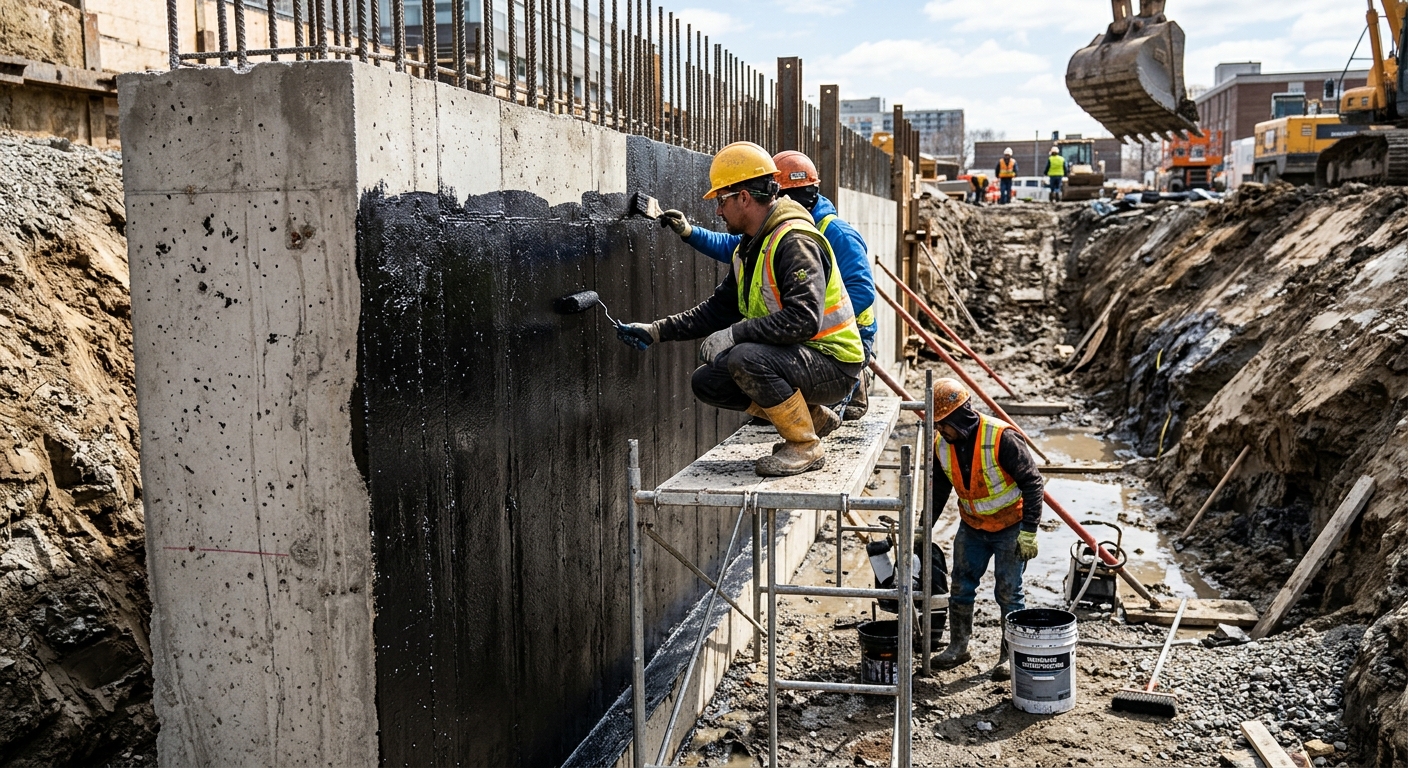
The fundamental difference is where the water is managed. Exterior waterproofing involves full excavation, rebuilding the waterproofing membrane, installing new perimeter drainage tile, then backfilling and restoring your landscaping. That directly addresses the source: hydrostatic pressure against the wall. It costs more and creates more site disruption, but in Sparwood it often delivers the longest-lasting outcome when the original drainage is failing or when soil conditions hold water against the foundation. Interior waterproofing—such as a perimeter drain channel, sump pit, and sump pump—collects water after it enters and reduces basement flooding risk. Interior systems are typically less invasive and can be done with fewer yard disruptions, but they don’t stop the pressure acting on the wall, which is why matching the system to crack behaviour and foundation type matters.
In Kootenay freeze–thaw conditions, poured concrete walls tend to be more forgiving for crack injection when cracks are stable; injection can be an effective part of a plan. Block foundations often need interior drainage as a practical complement because moisture can travel through mortar joints and multiple small leak paths. If your Sparwood basement shows recurring dampness during snowmelt and the sump pit runs frequently, backup pumping is worth considering—power interruptions during spring storms can turn “occasional seepage” into an emergency.
For a concrete example: an exterior rebuild may land around $18,000–$35,000. If your budget allows only interior work, interior perimeter drainage and a sump plan may be closer to $9,000–$20,000—but it’s justified only if your leak pattern is primarily seepage/water entry points that an interior collector can capture reliably. If the leak is driven by a failed perimeter drain and clay soil holds water against the wall, interior-only may reduce symptoms without eliminating the underlying pressure source.
| Method |
Best For |
Addresses Source? |
Disruption |
Lifespan |
Price Band |
| Full exterior excavation + membrane |
Active hydrostatic pressure, failed exterior drainage, long perimeter leaks |
Yes |
High |
Long-term |
$18,000–$35,000 |
| Interior French drain + sump system |
Seepage after water entry, inaccessible exterior, basement remains usable during planning |
No (manages water after entry) |
Medium |
High with proper pump design and maintenance |
$9,000–$20,000 |
| Crack injection — epoxy (structural) |
Non-moving cracks, stable structural cracks in suitable substrates |
Partially (seals crack path) |
Low |
Good when cracks are stable and drainage is adequate |
$800–$2,500 |
| Crack injection — polyurethane (active leak) |
Active leaks, water weeping from cracks/joints |
Partially (seals active path) |
Low |
Good to high when hydrostatic pressure is controlled |
$1,200–$3,200 |
| Interior drain channel only (no sump) |
Light seepage where gravity discharge is reliable |
No |
Medium to low |
Moderate (depends on discharge reliability and seasonality) |
$7,000–$14,000 |
| Re-grading + downspout extensions |
Surface water issues feeding the foundation |
No (reduces water load) |
Low |
Moderate when maintained and paired with drainage |
$2,000–$6,000 |
How to choose a waterproofing contractor in Sparwood
Choosing a contractor in Sparwood is about verifying they can do both the technical waterproofing and the paperwork/insurance side. In British Columbia, start by checking licensing details for the specific kind of work proposed, then request liability insurance and confirm WSIB/WCB coverage for anyone working on your site. Ask to see a current certificate of insurance (and have them explain how subcontractors are covered). Also request any clearance letter or proof of coverage they provide for their crews.
Next, get 2–3 itemised written quotes—not lump sums. The best quotes break down labour, materials (membranes, drainage tile, pipe size, backfill, sealants), and disposal/haul-off where excavation is involved. Read the exclusions carefully: What happens if groundwater is higher than expected? Is site restoration included (topsoil, base, seeding/sodding)? Is permit pull included, and who is responsible for the discharge plan if a sump connects to storm/sanitary? Ask whether the contractor is offering a workmanship warranty (often 1–5 years) and whether there’s also a manufacturer product warranty. Confirm if it’s transferable to you as the homeowner and keep it with your purchase/records.
For payment scheduling, never agree to more than about 10–15% upfront. Hold back the remainder until key milestones are verified (inspection/complete clean-up, final photos, and pump testing). Get a written start date and a completion estimate in the quote or contract—waterproofing projects can be delayed by excavation conditions and freeze–thaw scheduling, so clarity matters.
- Ask for references from similar Sparwood basements (poured vs block, crack injection vs drainage).
- Request an itemised scope: crack mapping, drainage layout, pipe sizes, discharge method.
- Confirm whether they will measure groundwater / seasonal conditions before design.
- Verify the permit responsibility in writing (who pulls it and what’s included).
- Check certificate of liability insurance and coverage limits; request “additional insured” if applicable.
- Verify WSIB/WCB for the crew and clarify subcontractors coverage.
- Ensure the quote includes disposal/haul-off for excavated soil (or states it clearly as an extra).
- Ask for product/manufacturer details (membrane type, adhesives, injection resin system).
- Confirm warranty terms: workmanship duration and product warranty conditions.
- Confirm backup pumping plan (battery or water-powered) if you’re adding a sump in spring flood risk.
- Use a payment schedule with a holdback after inspection and final testing.
- Require photo documentation before and after waterproofing, including pump/testing records.
Red flags to watch for in Sparwood: contractors who won’t discuss permits/discharge routing; quotes that skip site conditions and still promise “one-size-fits-all”; heavy reliance on interior-only fixes when exterior drainage is clearly failing; no written warranty terms; and vague payment terms asking for large upfront deposits.
Frequently asked questions — waterproofing in Sparwood
Can I waterproof my basement from the inside only?
Yes, in many Sparwood cases you can improve performance with interior-only work—especially when the exterior yard isn’t accessible or you’re dealing with localized seepage. An interior perimeter drain channel and sump system can capture water that enters during snowmelt and shoulder-season rains, which are common pressure times in the Kootenays. For some homeowners, crack injection also helps when the crack path is stable (for example, poured concrete hairline cracks). Interior approaches typically fall around $9,000–$20,000, and sump pump installation is often a separate line item (commonly $2,500–$5,500 with backup).
What causes foundation cracks in Sparwood?
In Sparwood and across the Kootenays, foundation cracks often result from a combination of freeze–thaw movement and water/soil pressure against the foundation. When moisture sits in soil and foundation contact zones, it expands during freezing and can widen joints and hairline cracks. Over repeated cycles, that pressure can turn small imperfections into more visible cracks—especially on older homes where original drainage and damp-proofing are often inadequate. Soil type matters too: moisture-holding clays tend to exert more lateral stress than well-drained gravels. In homes built before 1981 (55.1% in the area, Statistics Canada, 2021 Census), older block or poured-concrete foundations may also have more leak pathways through joints and earlier repair materials.
How do I compare waterproofing quotes?
Compare quotes like a contractor would: line-by-line. Ask each bidder to list methods (exterior membrane and drainage tile vs interior French drain and sump), the exact system components, and what’s included for site access, excavation, disposal, and restoration. For interior solutions, check whether they’re including a sump pit, pump, check valve, discharge route, and whether they recommend backup pumping—important in British Columbia spring high-water and outage risk. For exterior quotes, look for a clear drainage layout: where the weeping tile discharges and how the backfill and membrane tie together at corners. Pricing ranges can overlap, but a “low” quote can cost more later if it skips key steps. A typical exterior project often sits around $18,000–$35,000 while interior drainage solutions are commonly closer to $9,000–$20,000.
How long does basement waterproofing take in Sparwood?
The timeline depends on whether you’re doing interior or exterior work and what the site conditions allow. Interior perimeter drainage and sump upgrades are often faster to schedule, but you still need time for crack assessment, drilling/injection (if included), and drying/curing steps where sealants are used. Exterior waterproofing requires excavation, installation of membrane and drainage tile, then backfilling and restoration—so weather and access can extend the schedule, especially with Kootenay freeze–thaw conditions. Many projects proceed in phases: excavation and installs first, followed by inspections and backfill, then landscaping restoration. The biggest delays are usually groundwater management during excavation, concrete/block work needing set time, and delivery of drainage materials. Your contractor should provide a written start date and completion estimate that reflects these realities in Sparwood.
What is a weeping tile and does my Sparwood home have one?
Weeping tile (also called perimeter drain tile) is the drainage system that typically sits at the foundation perimeter to collect water and route it to a sump or discharge point. Many older homes—common in Sparwood given that 55.1% were built before 1981 (Statistics Canada, 2021 Census)—may have an original weeping tile, but it can be failed, disconnected, clogged, or undersized after decades. You can’t always confirm it visually because it’s below grade, but contractors usually locate it by camera inspection, test probes, or tracing the discharge route. If a home has persistent dampness or a sump that runs frequently during snowmelt, that can indicate either missing, failing, or incorrectly routed drainage. When inspecting, ask whether they plan to evaluate the existing tile before proposing interior drainage only.
Can I waterproof my basement in winter in Sparwood?
Sometimes, but it’s more limited in scope. In Sparwood, winter conditions can restrict exterior excavation because soils freeze and groundwater can behave differently—making it harder to install drainage tile properly and to achieve consistent membrane contact and curing. Interior work can often be done in winter because it avoids full yard excavation; crack injection and interior drain channel work are commonly feasible when the basement is accessible and conditions allow curing. That said, you still need to manage moisture and ensure the system captures water during the upcoming thaw period. In British Columbia, the best approach is usually to plan exterior work for workable weather windows while using interior measures as interim risk management. If you’re facing active leakage now, ask about an interior plan and whether a sump with backup is needed; sump pump installations commonly land in the $2,500–$5,500 range depending on the backup setup.