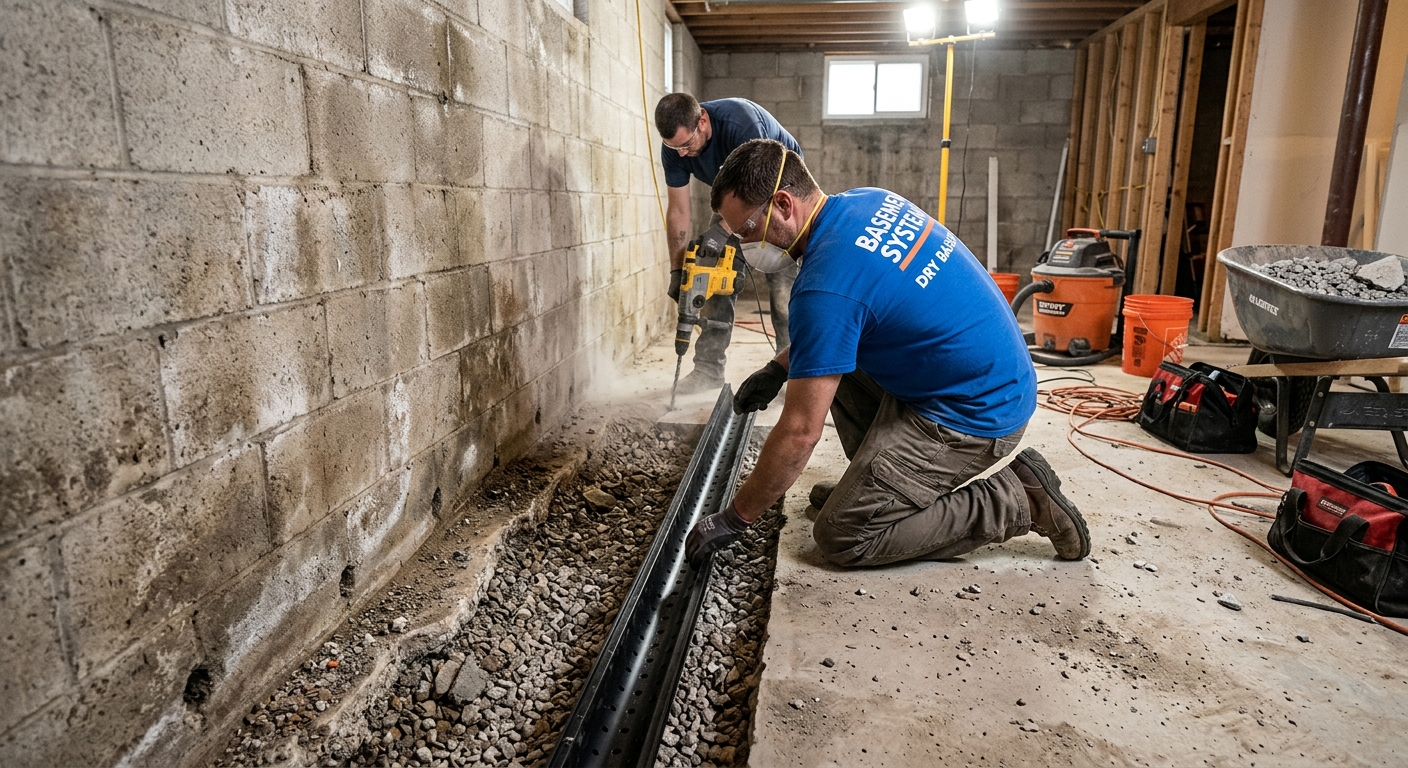
Basement waterproofing options and costs in Wellington
In Wellington, British Columbia, basement waterproofing costs and results depend on where the water is coming from and how hard it is to reduce the pressure behind your foundation. With a population of 3,935 people (Statistics Canada, 2021 Census), Wellington is a smaller market, so contractors often prioritize projects that clearly identify the water source—especially in neighbourhood pockets with older homes. In Lower Mainland–Southwest, older foundations are more likely to have outlived original waterproofing systems and failing perimeter drainage, which shows up as damp walls, musty odours, and recurring seepage after heavy rain.
Lower Mainland–Southwest pricing is shaped by persistent saturation and hydrostatic pressure. Coastal BC’s frequent, prolonged rainfall keeps backfill saturated and maintains pressure against basement walls and slabs, which is why even newer homes can leak when drain systems underperform. Wet, mild winters plus freeze-thaw cycles also widen existing joints, allowing water to move through cracks and accelerate material breakdown. Access constraints on tight lots and rocky sections that require mechanical breaking during excavation further raise labour and equipment costs.
In Wellington, demand is commonly higher around older residential areas and infill-adjacent streets where yard space is limited and drainage paths have been changed over the years. Contractors in these areas frequently see backyard grading issues, downspouts that discharge too close to foundations, and perimeter drains that are undersized or completely failed. That’s why many homeowners compare a source-focused exterior approach against symptom-focused interior drainage—then choose based on the leak pattern and budget. Use the table below to compare typical methods, disruption, and cost ranges.
| Method |
What It Addresses |
Disruption Level |
Durability |
Price Range |
| Exterior excavation + new membrane + drainage tile |
Primary water entry at foundation exterior; relieves hydrostatic pressure |
High (excavate perimeter, landscaping/disposal, re-grading) |
High (long-term source control when drainage is correctly designed) |
$15,000–$30,000 |
| Interior perimeter drain channel + sump pit |
Water that enters through walls/slab; routes to sump |
Medium (interior channel work; concrete cutting in affected areas) |
Medium-High (depends on sump capacity and discharge route) |
$8,000–$18,000 |
| Foundation crack injection (epoxy or polyurethane) |
Stops and seals specific cracks (active leaks vs non-moving cracks) |
Low-Medium (surface prep; drilling injection ports) |
Medium (best paired with drainage when water pressure persists) |
$500–$2,000 |
| Sump pump installation (primary + battery backup) |
Relieves collected groundwater risk; reduces interior moisture |
Low-Medium (pit, discharge plumbing, electrical tie-in) |
Medium-High (higher reliability with backup system) |
$1,000–$5,000 |
| Window well drain installation |
Directs water away from below-grade window openings |
Medium (window well access and minor concrete/soil work) |
Medium (can help substantially where bulk water funnels) |
$1,500–$4,500 |
| Lot re-grading / downspout extension |
Redirects roof and surface water away from foundation perimeter |
Low-Medium (re-grade, topsoil, sod, downspout relocation) |
Medium (effective when surface drainage is the primary issue) |
$1,000–$4,000 |
Prices are estimates only and vary by project scope, site access and material selection.
What affects the price of waterproofing in Wellington
Even when two homeowners describe the “same leak,” waterproofing quotes in Wellington, British Columbia can differ by 30–50% because the hidden drivers—soil conditions, water table behaviour, and freeze-thaw—determine both the scope and the risk. Across Lower Mainland–Southwest, contractors often price higher than the national baseline when exterior excavation is required, because tight lots, limited staging space, and labour-heavy mechanical breaking can make digging slow and expensive. In addition, older housing stock (common across the Lower Mainland–Southwest) increases the odds of failing weeping tile and saturated backfill, which can turn a “small crack fix” into a full drainage retrofit.
Soil type matters because clay-rich or compacted soils hold water and prolong saturation; that increases hydrostatic pressure against foundation walls. In Wellington’s coastal climate, high groundwater and persistent rainfall mean pumps can run longer, and discharge routing becomes more important. Freeze-thaw cycles then widen existing cracks and loosen joints, so repairs that rely on sealing alone often need an accompanying drainage plan to prevent recurrence. By contrast, when a home has good surface grading and functioning downspouts, the interior system may be enough—lowering costs toward the interior bands (for example, $8,000–$18,000 for interior perimeter drainage work).
Two practical Wellington examples: (1) a perimeter drain replacement can cost more if excavation requires rock-breaking and careful shoring on a narrow lot, pushing you toward the exterior backbone band ($15,000–$30,000). (2) if the leak is localized to a stair-step area or a single window well and inspections confirm the water source is surface routing, re-grading and drainage upgrades can be comparatively modest.
In short, the same waterproofing symptom (dampness) can have very different causes, and your quote usually reflects how much the contractor must do to control water before it presses into your foundation.
| Price Factor |
Why It Matters |
Cost Impact |
| Interior vs. exterior approach — interior is less disruptive but addresses symptoms |
Interior systems manage water after it enters; exterior reduces the source |
Interior often 30–60% less than full exterior on tight sites |
| Foundation type — poured concrete vs. block vs. stone vs. ICF |
Different walls respond differently to crack sealing and drainage |
Block walls often need stronger interior drainage + crack strategy |
| Soil type — clay expands more than sand, adding pressure |
Moist soil holds water and increases lateral pressure during wet periods |
Clay-heavy backfill increases drainage scope and durability requirements |
| Crack type and length — hairline vs. structural horizontal cracks |
Active leaks and structural movement require different repair methods |
Structural/horizontal cracks can trigger engineering and higher labour |
| Sump pump backup system — battery or water-powered backup needed |
Loss of power during wet weather can turn a “dry” basement into a flood |
Backup adds cost but reduces high-risk failure outcomes |
| Access — landscaping, decks, or driveways must be removed for exterior |
More removals and reinstatement increase time and disposal costs |
Limited access can push exterior work toward the top end of the band |
| Weeping tile age — original tile (60+ years) may be completely failed |
Old systems can collapse or become blocked, leaving saturated backfill |
Failure often expands work from “repair” to “replacement” |
| Mould or efflorescence remediation required before sealing |
Sealers often don’t bond properly over contaminated surfaces |
Additional cleaning and time can add several thousand dollars |
Permits & regulations in British Columbia
In British Columbia, foundation excavation, structural crack repair, and changes to lot drainage typically require a building permit. If your plan includes major exterior drainage adjustments, repairing or altering a perimeter drainage system connected to municipal infrastructure, or any work that affects structural elements, expect permit involvement. Sump pump installations can also require municipal approval when discharge connections are tied into storm or sanitary services—your contractor should clarify this during the site assessment.
For structural crack repair—especially horizontal cracks in block walls or step cracks that indicate possible movement—a structural engineer’s assessment is often needed to confirm whether underpinning or other structural measures are required before sealing. That’s not just paperwork: it protects you from paying for waterproofing that “seals over” movement that continues and reopens cracks.
To verify a Wellington contractor’s compliance, homeowners should check three things in order. First, verify licensing: use the contractor’s online presence and any provincial trade/contractor information that applies to the work scope, and ask the company directly for its licensing reference number. Second, confirm liability insurance: request a certificate of insurance showing coverage limits and coverage dates, and ensure the insurer lists your contractor correctly. Third, confirm WSIB/WCB coverage (or applicable clearance letter): ask for current evidence and confirm there are no exclusions that would impact labour on your job.
Finally, request the permit plan details in writing—whether the contractor pulls the permit, what they include, and who pays the municipal fees—so you don’t get surprised mid-project.
Interior vs exterior waterproofing — what does Wellington need?
The fundamental difference is source control versus water management. Exterior waterproofing—full excavation, new membrane, new drainage tile, and backfill—targets where water enters and reduces hydrostatic pressure against your foundation. It’s more disruptive, but in Lower Mainland–Southwest’s wet, mild winters it’s often the most permanent approach when perimeter drainage has failed. Interior waterproofing—perimeter drain channel, sump pit, and sump pump—captures water after it has penetrated and reduces the basement’s moisture load. It’s typically less invasive, and it can be a good fit when excavation is limited or when your primary issue is local seepage, but it does not stop pressure against the wall itself.
In Wellington, poured concrete walls usually respond well to crack injection when cracks are not actively moving, because the wall is more uniform and sealing can be effective as part of a broader drainage plan. Block foundations, however, often need interior drainage as a practical complement because water can track through mortar joints and voids more unpredictably, especially during prolonged saturation. Given BC’s heavy spring rain and occasional power instability, homeowners should also consider sump pump backup systems; a primary pump without backup can fall behind during outages, even if the system is properly sized.
To justify the cost difference: if your inspection shows a completely failed weeping tile and saturated backfill, an exterior system in the $15,000–$30,000 band can prevent recurring wetness and odour at the source. If, instead, a home has minor seepage from a known interior corner and good surface grading, interior perimeter drainage and sump work in the $8,000–$18,000 band may achieve a much better return by addressing symptoms without destroying landscaping.
| Method |
Best For |
Addresses Source? |
Disruption |
Lifespan |
Price Band |
| Full exterior excavation + membrane |
Failed perimeter drainage, persistent leaks around perimeter, saturated soils |
Yes |
High |
High (when drainage is properly designed and discharge is correct) |
$15,000–$30,000 |
| Interior French drain + sump system |
Interior moisture, seepage when excavation is limited, hydrostatic management |
No (manages after entry) |
Medium |
Medium-High (sizing and backup matter) |
$8,000–$18,000 |
| Crack injection — epoxy (structural) |
Non-moving cracks where water entry is minimal or controlled |
Partial (seals crack pathway) |
Low-Medium |
Medium (shorter if hydrostatic pressure persists) |
$500–$2,000 |
| Crack injection — polyurethane (active leak) |
Active weeping or water movement through cracks |
Partial (seals active pathway) |
Low-Medium |
Medium (best with drainage to control pressure) |
$700–$2,500 |
| Interior drain channel only (no sump) |
Light seepage where gravity drainage is reliable |
No |
Medium |
Low-Medium (risk if groundwater rises) |
$4,500–$10,000 |
| Re-grading + downspout extensions |
Surface water issues, recurring dampness after storms with good drainage below grade |
Partially (reduces water load) |
Low-Medium |
Medium (depends on grading staying correct) |
$1,000–$4,000 |
How to choose a waterproofing contractor in Wellington
Choosing a waterproofing contractor in Wellington starts with verifying they can legally do the work in British Columbia and that they’re properly insured for the risks involved. First, confirm licensing for the relevant scope: ask what trades/permits they hold for excavation, structural repairs, and any electrical work related to sump pump installation. Second, verify liability insurance: request a current certificate of insurance showing adequate limits and the policy’s effective dates. Third, confirm WSIB/WCB coverage (or a clearance letter where applicable). Homeowners can ask for these documents directly, then cross-check dates and names match the contractor bidding your project.
Next, request 2–3 itemised written quotes. A solid quote breaks labour and materials down (membrane type, drainage tile specs, pump model, discharge piping, disposal, concrete cutting/patching). Avoid “lump sum only” bids that don’t say what gets done when conditions change. Read the scope carefully for exclusions: is permit pulling included? Is disposal of excavated soil included? Are reinstatement costs (landscaping, sod, driveways, fencing) covered or quoted separately?
Warranty matters. Ask for a clear workmanship warranty length and whether the product/manufacturer warranty applies to the installed system. If you sell your home, confirm whether the warranty is transferable.
Payment terms should be conservative. Never pay more than 10–15% upfront; hold back a portion until the job is complete and inspected. Get start date and completion estimate in writing, along with what triggers change orders.
- Schedule a site visit and require an inspection before quoting
- Ask where the water is expected to come from (wall seepage vs slab vs surface runoff)
- Confirm sump pump specs (capacity and discharge route) if included
- Request details of drainage design: tile elevation, slope, and connection method
- Verify engineering support for structural crack work
- Ensure liability insurance certificate and WSIB/WCB clearance are current
- Require permit responsibility in writing (who pulls it and who pays fees)
- Get material specs listed (membrane type, injection system, pipe materials)
- Clarify exclusions for rock excavation or unexpected excavation obstructions
- Confirm how mould/efflorescence is remediated before sealing
- Use a warranty statement in the contract with transferability
- Set a realistic payment schedule with holdback until completion and walkthrough
In Wellington, common red flags include: a contractor who won’t discuss water-source diagnosis and only offers crack injection; quotes that skip sump pump capacity or backup when exterior saturation is expected; promises of “guaranteed dry basement” without mentioning drainage and monitoring; reluctance to provide itemised scope, insurance documents, or permit responsibility; and change orders written vaguely as “extra work as needed” without baseline drawings or elevations.
Frequently asked questions — waterproofing in Wellington
Why is my basement leaking in Wellington?
In Wellington, leaks are usually tied to water reaching the foundation and staying pressurized long enough to find pathways. In the Lower Mainland–Southwest, persistent rainfall can saturate backfill and maintain hydrostatic pressure, so even small cracks or mortar joints can “activate” after storms. Common triggers include failing weeping tile (often decades old), downspouts that discharge too close to the foundation, undersized or blocked sump discharge routes, and freeze-thaw widening of joints in wet seasons. If you see seepage after heavy rain but less in dry spells, that strongly points to a drainage or surface runoff issue rather than a one-off plumbing failure. With 3,935 residents (Statistics Canada, 2021 Census), Wellington’s housing mix often includes older basements where original drainage performance may have degraded.
How do I know if a foundation crack is serious?
Not all cracks are dangerous, but in British Columbia you should treat horizontal cracks, widening step cracks, and cracks that show clear water seepage as higher risk. A hairline crack that stays the same width and shows no staining is often less concerning, especially in poured concrete. By contrast, horizontal cracks in block walls, cracks that visibly offset masonry, or cracks with active water movement usually require deeper inspection because they may indicate ongoing movement or hydrostatic pressure pathways. Ask for a written assessment that includes crack type, approximate length, whether it’s actively leaking, and what repair method matches the movement. For active leaks, polyurethane injection is commonly used, while structural or non-moving cracks may be addressed with epoxy systems.
How much does foundation crack repair cost in Wellington?
Foundation crack repair in Wellington typically falls within the $500–$2,000 range, depending on how many cracks need injection, their length, and whether they are actively leaking. A short, accessible crack in a basement wall that’s not moving can be relatively straightforward. Costs rise when there’s significant surface prep, extensive crack mapping, multiple injection ports, or when remediation (like mould or efflorescence cleaning) is required before sealing. If the crack is part of a broader drainage failure—like saturated backfill against perimeter walls—crack injection alone may only be a partial fix, and you may also need interior drainage or other measures. That’s why contractors should recommend the right “layer”: seal plus drainage where needed.
Do I need a sump pump in Wellington?
A sump pump is often recommended when inspections show water is collecting at the lowest point of the basement and the foundation is under persistent saturation pressure—common during Lower Mainland–Southwest rainy periods. If your basement has recurring seepage along the perimeter, damp floor corners, or water that appears after sustained storms, a sump system can reduce moisture by actively removing collected groundwater. In many Wellington projects, interior perimeter drainage work is paired with a sump pump; the interior waterproofing band is often $8,000–$18,000 when drains, pump, and connections are included. Because BC spring flooding can coincide with power interruptions, many homeowners choose battery backup or another backup approach to reduce failure risk during outages.
How does Wellington's soil affect my foundation?
In Wellington and across the Lower Mainland–Southwest, the biggest soil-related issue is often not dramatic swelling (like you’d see in some clay-expansive regions) but sustained saturation and drainage behaviour. When soils stay saturated after heavy rain, hydrostatic pressure increases and can push water through crack pathways, mortar lines, and joints—especially where perimeter drainage has failed. Freeze-thaw cycles then help widen small openings by repeatedly expanding and contracting moisture in cracks. If your backfill is compacted, poorly drained, or the original weeping tile is blocked, the problem tends to recur after wet stretches. In practical terms, this can push projects from “spot repairs” toward comprehensive interior drainage or even exterior waterproofing where source control is needed.
Do I need a permit for foundation work in British Columbia?
In British Columbia, many homeowners should expect permits when the work affects foundation integrity, lot drainage, or involves structural crack repairs. Foundation excavation and changes to lot drainage typically require a building permit, and structural crack repairs—particularly for horizontal cracks in block walls or anything suggesting movement—often require an engineer’s assessment before permits and repair proceed. Sump pump installations that connect to storm or sanitary sewer systems typically need municipal approval for the discharge method. To stay compliant in Wellington, ask your contractor in writing: whether they will pull the permit, what municipal approvals are needed, and who pays fees. Also confirm they carry current liability insurance and WSIB/WCB coverage (or a clearance letter), and keep clearance/insurance documents on file for the project.