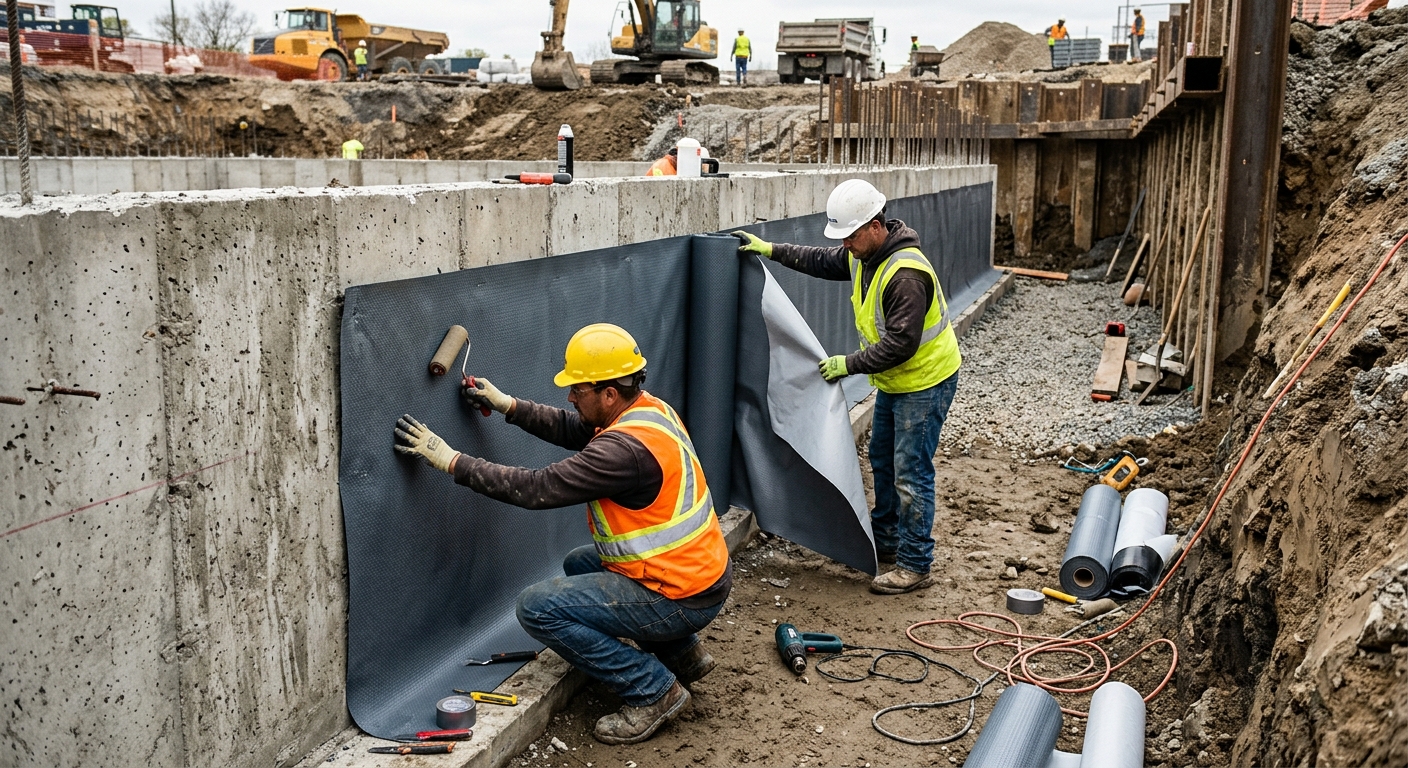
Basement waterproofing options and costs in White Rock
White Rock homeowners typically start with one question: “What’s actually going to stop the water?” In White Rock—where many homes are older than the waterproofing systems originally installed—this matters because 39.2% of homes were built before 1981. Older foundation walls and original drainage components (weeping tile/perimeter drains) are more likely to be undersized, disconnected, or completely failed, especially when the coastal backfill stays saturated for long periods. In practical terms, that means water isn’t just a surface problem; it can develop hydrostatic pressure against basement walls and slab edges, then enter through joints, cracks, or aging penetrations.
In the Lower Mainland–Southwest region, pricing is shaped by persistent groundwater and intense, prolonged rainfall. Even mild winters still bring wet freeze-thaw cycles that widen existing cracks and joints over time, so the “same” leak can evolve season to season. Access is also a cost driver: tight urban lots, retaining walls, and landscaped frontages in neighbourhoods such as Crescent Beach-adjacent areas and the downtown White Rock core often require careful excavation planning and more mechanical breaking to reach foundations. Availability and scheduling can affect labour pricing when multiple crews are booked for exterior excavation work after storm seasons.
Below is a homeowner-friendly comparison of the most common solutions we price in White Rock, so you can map your symptoms to a realistic scope and budget before you request quotes.
| Method |
What It Addresses |
Disruption Level |
Durability |
Price Range |
| Exterior excavation + new membrane + drainage tile |
Primary water entry at walls; replaces perimeter drainage and provides a new waterproofing barrier |
High (excavation, landscaping/driveway impacts, regrading) |
High (source-control approach) |
$15,000–$30,000 |
| Interior perimeter drain channel + sump pit |
Water after it enters; intercepts seepage along foundation perimeter and directs it to a sump |
Medium (interior floor/wall openings, limited exterior impacts) |
Medium to High (depends on drainage capacity and maintenance) |
$8,000–$18,000 |
| Foundation crack injection (epoxy or polyurethane) |
Crack sealing; stops leakage pathways (polyurethane for active leaks, epoxy for stable/structural) |
Low to Medium (access openings; minimal demo) |
Medium to High (best when combined with proper drainage) |
$500–$2,000 |
| Sump pump installation (primary + battery backup) |
Maintains basement dryness during heavy rainfall and power interruptions |
Low to Medium (electrical/GFCI work; sump pit excavation) |
High (when sized correctly with backup) |
$1,000–$5,000 |
| Window well drain installation |
Directs water away from window wells; prevents pooling and seepage |
Low to Medium (small exterior openings) |
Medium (improves localized performance) |
$1,500–$4,000 |
| Lot re-grading / downspout extension |
Reduces surface water load on the foundation perimeter |
Low (grading adjustments; minor landscaping) |
Low to Medium (support measure, not a full barrier) |
$600–$3,000 |
Prices are estimates only and vary by project scope, site access and material selection.
What affects the price of waterproofing in White Rock
In White Rock and across Lower Mainland–Southwest, it’s common to see bids for the “same” basement leak differ by 30–50% once you include site access, excavation difficulty, and whether the contractor is solving the source or only managing symptoms. The reason is simple: the three cost-separating drivers in this region are soil/water conditions, freeze-thaw action, and drainage system condition. Compared with Canada’s national average, White Rock often has higher ongoing hydrostatic pressure because groundwater and rainfall keep the soil saturated and pushing against basement walls and slab edges.
Soil type can be different from city to city. In Ontario and the Prairies, clay-rich soils can expand dramatically during freeze-thaw and exacerbate lateral pressure and crack growth. In coastal BC, the bigger cost driver is persistent saturation and drainage challenges: when original perimeter drains fail or are disconnected, backfill stays wet and the basement experiences more frequent seepage. Higher water tables also mean sump pumps must run longer, sometimes requiring upgraded discharge piping and more reliable backup capacity. And older housing stock drives repeat calls: homes built before 1981 are more likely to have failing weeping tile and older poured-concrete or block systems with joints that are no longer behaving well under wet freeze-thaw cycles.
Two concrete examples from White Rock help explain pricing. If a contractor can do an interior perimeter drain, costs may start around the $8,000–$18,000 band because disruption is limited and you avoid exterior excavation. If you truly need exterior excavation—new membrane plus drainage tile—the budget typically moves into the $15,000–$30,000 range because excavation, disposal, and backfill work are labour-intensive, especially on tight lots or where rocky sections require mechanical breaking. Finally, after major storms, mould or efflorescence remediation may be required before any sealing—adding time and controlled drying to the scope.
| Price Factor |
Why It Matters |
Cost Impact |
| Interior vs. exterior approach |
Interior systems intercept water after entry; exterior systems control the source by replacing membrane and drainage |
Typically +$7,000 to +$12,000 for exterior on many White Rock jobs |
| Foundation type |
Poured concrete often takes crack injection differently than block or stone; ICF has different sealing considerations |
Can shift labour and materials by roughly 15% to 30% |
| Soil type |
Clay expands more and holds moisture; sand drains faster but can still saturate with poor drainage |
Higher saturation increases drainage requirements and rehab time |
| Crack type and length |
Hairline seepage cracks are different from structural horizontal or step cracks requiring engineering input |
Structural/severe cracks often add assessment and additional repair steps |
| Sump pump backup system |
Battery backup (and sometimes an alternate power plan) protects during outages common in storm seasons |
May add $1,000–$3,000 depending on pump type and discharge setup |
| Access |
Landscaping, decks, driveways, and retaining walls can force extra removal/rebuild for exterior work |
Can add several thousand dollars on tight lots |
| Weeping tile age |
Original perimeter drains (often 60+ years) may be completely failed or disconnected |
Replacement scope can move interior-only plans toward exterior or combined retrofits |
| Mould or efflorescence remediation required before sealing |
Sealers won’t perform reliably on active contamination or uncontrolled moisture vapour |
Often adds 1–3 days of prep and drying, increasing labour and product cost |
Permits & regulations in British Columbia
In British Columbia, foundation excavation, structural crack repair, and changes to lot drainage typically require a building permit, particularly where the work affects structural integrity or involves alterations to drainage connections. If a sump pump discharge ties into a storm or sanitary sewer line, municipal approval is commonly required, and a contractor should coordinate the appropriate permits before installation. For structural crack repair—such as horizontal cracks in block walls, major step cracks, or any indication of movement—a structural engineer’s assessment is often needed to confirm whether underpinning or additional structural measures are required.
On waterproofing jobs, some work typically does not trigger a permit when it’s strictly non-structural and stays within standard interior drainage and sealing: replacing interior sump components (pit/pump) that do not alter foundation structural members, installing an interior drain channel that doesn’t modify structural load paths, or performing localized crack injection on stable, non-moving cracks. However, if your scope includes excavation near the foundation, changes to downspout routing, or any repair that addresses movement or structural concerns, plan on permitting.
Here’s how a White Rock homeowner can verify a contractor properly:
1) Check the contractor’s licensing through the appropriate provincial contractor registry/online search; confirm the correct trades/qualifications for waterproofing and related construction work. 2) Request a current certificate of insurance (liability) showing limits and job site coverage; ask for WSIB/WCB clearance or exemption documentation (as applicable). 3) For structural crack repairs, ask whether they include engineering support and whether they carry liability insurance that covers structural-related work. 4) Confirm who pulls permits and whether permit fees are included in the written quote.
Interior vs exterior waterproofing — what does White Rock need?
The fundamental choice is source control versus water management. Exterior waterproofing—full excavation, new membrane, and new drainage tile—addresses the entry point and reduces hydrostatic pressure by directing groundwater away from the foundation. It costs more and requires landscaping disruption, but for many White Rock basements it’s the most complete path to long-term dryness because it corrects the saturated soil condition pressing against walls. Interior waterproofing—perimeter drain channel, sump pit, and sump pump—intercepts water after it enters. This is usually less invasive and can be the right fix when exterior access is limited or when the foundation already has exterior constraints, but it does not stop water pressure from acting on the wall itself.
In White Rock’s wet coastal climate (Lower Mainland–Southwest), we often see interior systems succeed when cracks and seepage are minor to moderate and the pump system is correctly sized for ongoing rainfall. Poured concrete walls often respond well to crack injection when combined with reliable drainage, because sealed cracks reduce seepage pathways. Block foundations, however, can require interior drainage as a practical complement because mortar joints and block-to-block movement can allow continuous moisture migration—even when cracks are treated. Sump pump backup systems are particularly important here: British Columbia storm seasons and spring flooding can create power disruption risk, and battery backup helps protect your basement while the grid is down.
For example, if you’re comparing options for a typical White Rock leak scenario, interior perimeter drain and sump systems might land in the $8,000–$18,000 band. If inspection shows the perimeter drain is failed, the discharge route is wrong, and exterior excavation is feasible, shifting to exterior waterproofing at $15,000–$30,000 can be justified because you’re correcting the cause rather than cycling more water to the sump every storm.
| Method |
Best For |
Addresses Source? |
Disruption |
Lifespan |
Price Band |
| Full exterior excavation + membrane |
Widespread seepage, failed perimeter drains, high groundwater pressure, accessible lots |
Yes (most complete source control) |
High (excavation, regrading, landscaping) |
Long (often decades when built correctly) |
$15,000–$30,000 |
| Interior French drain + sump system |
Limited exterior access, localized leaks at perimeter, continuous seepage management |
No (manages water after entry) |
Medium (interior openings and sump pit work) |
Medium to Long (depends on pump capacity and backup) |
$8,000–$18,000 |
| Crack injection — epoxy (structural) |
Stable, non-moving cracks in poured concrete where structural integrity is the concern |
Partially (seals pathways but doesn’t replace drainage) |
Low to Medium |
Medium to Long for stable cracks |
$500–$2,000 |
| Crack injection — polyurethane (active leak) |
Active seepage or minor movement where a more flexible sealant is needed |
Partially (targets active pathways) |
Low to Medium |
Medium (best when water is controlled with drainage) |
$500–$2,000 |
| Interior drain channel only (no sump) |
Light seepage or seasonal moisture where pumping isn’t required |
No |
Medium |
Short to Medium (risk if water volumes increase) |
$6,000–$12,000 |
| Re-grading + downspout extensions |
Surface water issues where gutters/downspouts discharge too close to the foundation |
No (relieves load but doesn’t stop groundwater) |
Low to Medium |
Low to Medium (support measure) |
$600–$3,000 |
How to choose a waterproofing contractor in White Rock
Choosing the right waterproofing contractor in White Rock comes down to proof: proof they understand British Columbia conditions, proof they’re properly covered, and proof your scope is written clearly enough to price accurately. Start by verifying licensing: confirm the contractor is registered for the type of work being proposed and that any specialist support (for structural crack repairs) is included. Next, ask for a current certificate of insurance (liability) and job site coverage; the certificate should list the insured parties and coverage limits. For WSIB/WCB, request clearance documentation or an exemption letter where applicable—don’t accept “we’re covered” without paperwork.
Then get 2–3 itemised written quotes with a breakdown of labour and materials (membrane, drainage tile, geotextile, pumps, discharge piping, and any engineered crack repair support). Read exclusions line-by-line: are permits included or billed separately? Is disposal included for soil and concrete breaking debris? Are landscaping reinstatement and re-grading included, or treated as a separate allowance? A good waterproofing contractor will also show the product/manufacturer warranty, explain workmanship warranty length, and confirm whether the warranty is transferable to future owners.
Payment structure matters. Avoid paying more than 10–15% upfront; use a holdback until key waterproofing steps are complete (for example, after membrane and drainage are installed and tested, not just after demo). Finally, lock in a timeline: request a start date and an estimated completion date in writing, and ask how they handle rain delays—because coastal projects can’t be built on a perfect schedule.
- Confirm the exact waterproofing scope in writing (interior vs exterior, membrane type, drainage tile specs).
- Ask whether they will inspect and clean efflorescence/mould before sealing.
- Request evidence of liability insurance and job site coverage (certificate of insurance).
- Request WSIB/WCB clearance or exemption documentation.
- For structural crack repair, ask whether engineering assessment is included or required.
- Get an itemised breakdown: labour, materials, excavation/disposal, and pump/electrical components.
- Confirm what permits are needed and who pulls them.
- Verify disposal inclusion (excavation spoils and concrete debris).
- Ask how discharge will be routed (and whether municipal approvals are required).
- Ensure workmanship warranty is in writing with length and coverage details.
- Clarify product/manufacturer warranty terms and whether it’s transferable.
- Use a payment schedule with a holdback until waterproofing is fully complete.
Red flags we see in White Rock include: quotes that are purely “lump sum” with no scope details, skipping site drainage assessment and only offering crack injection, unclear warranty language (no workmanship term or product exclusions), promising exterior results without discussing access/disposal/landscape reinstatement, and refusing to provide insurance/WSIB/WCB clearance documentation in writing.
Frequently asked questions — waterproofing in White Rock
How much does basement waterproofing cost in White Rock?
In White Rock, basement waterproofing commonly falls into two budget ranges depending on whether you’re addressing the water source or installing an interior system. For exterior excavation with new membrane and drainage tile, typical estimates are around $15,000–$30,000 because excavation, disposal, and regrading are labour-intensive on tight coastal lots. If you’re managing seepage with an interior perimeter drain channel and sump pit, many homeowners budget around $8,000–$18,000. Foundation crack repair by injection can be lower at about $500–$2,000 for suitable stable cracks, but it should usually be paired with proper drainage if the soil remains saturated. Costs also rise if mould/efflorescence remediation is needed before sealing.
Interior vs exterior waterproofing — which is better?
Exterior waterproofing is usually “best” when the perimeter drainage is failing or when you want source control—excavation plus membrane and new drainage tile can reduce hydrostatic pressure at the foundation wall. That’s why many projects land in $15,000–$30,000 territory in White Rock, especially where access is constrained. Interior waterproofing can be the better choice when exterior work isn’t practical due to decks, driveways, or retaining walls, because it’s less disruptive and often budgets around $8,000–$18,000. In Lower Mainland–Southwest conditions (intense rainfall and high groundwater pressure), interior solutions work best when the sump pump is sized correctly, and a backup plan is included. Many basements ultimately need a combined approach: interior drainage plus crack sealing.
Why is my basement leaking in White Rock?
Basement leaks in White Rock are usually caused by persistent moisture pressure against foundation walls and slab edges—more than by a “single” rainstorm. Coastal BC winters bring wet freeze-thaw cycles, which widen cracks and joints over time, especially in homes that were built earlier (39.2% of dwellings were built before 1981, and older systems are more likely to have failed drainage components). Common triggers include failed or undersized weeping tile, disconnected downspouts, saturated backfill that can’t drain, and cracks around penetrations or along block wall joints. If you see water pooling near one area, it can also be surface water runoff. A contractor should confirm where the water is entering and whether it’s groundwater (hydrostatic pressure) or surface runoff, because the fix differs.
How do I know if a foundation crack is serious?
Not every crack is a structural emergency, but you should treat certain patterns as a “serious” indicator in White Rock. Hairline vertical cracks in non-critical locations may be non-structural, yet they can still leak if joints and drainage are failing. Horizontal cracks in block walls, major step cracking, and cracks that appear to widen over time are the ones that typically warrant a structural assessment. Also watch for signs that indicate active water movement: dampness at the crack during rain, efflorescence (white powder), or water tracking down the wall. If your crack coincides with failed drainage or seepage points, injection alone may not solve it. For any suspected movement, a structural engineer review is often required in BC before undertaking more extensive structural repair.
How much does foundation crack repair cost in White Rock?
Foundation crack repair by injection in White Rock often starts in a relatively modest range compared with full perimeter waterproofing, but the final number depends on how many cracks, their length, and whether the crack is stable or actively leaking. For suitable projects, typical injection work is around $500–$2,000. Epoxy injection is generally used for stable cracks, while polyurethane is used for active leaks where the material needs flexibility. If there’s ongoing seepage driven by high groundwater or failed perimeter drains, injection may still be part of the solution, but additional interior drainage (or sometimes exterior source control) is commonly needed. If the crack is associated with structural movement, expect added assessment costs and possibly a broader repair plan.
Do I need a sump pump in White Rock?
You may need a sump pump when water is consistently entering and accumulating at the foundation perimeter, especially in Lower Mainland–Southwest’s prolonged rainy seasons. A sump pump helps manage groundwater that your drainage system can’t fully control on its own. For many interior drain installations, sump pump work is a key component, commonly priced around $1,000–$5,000 depending on pump type and whether backup power is included. British Columbia storm seasons can increase the risk of outages during spring flooding, so backup (battery or an alternate plan) becomes an important safety net for homeowners. If your leak is purely surface runoff, re-grading and downspout extensions may reduce water without a sump. The right answer depends on whether the basement issue is groundwater hydrostatic pressure versus localized surface water.