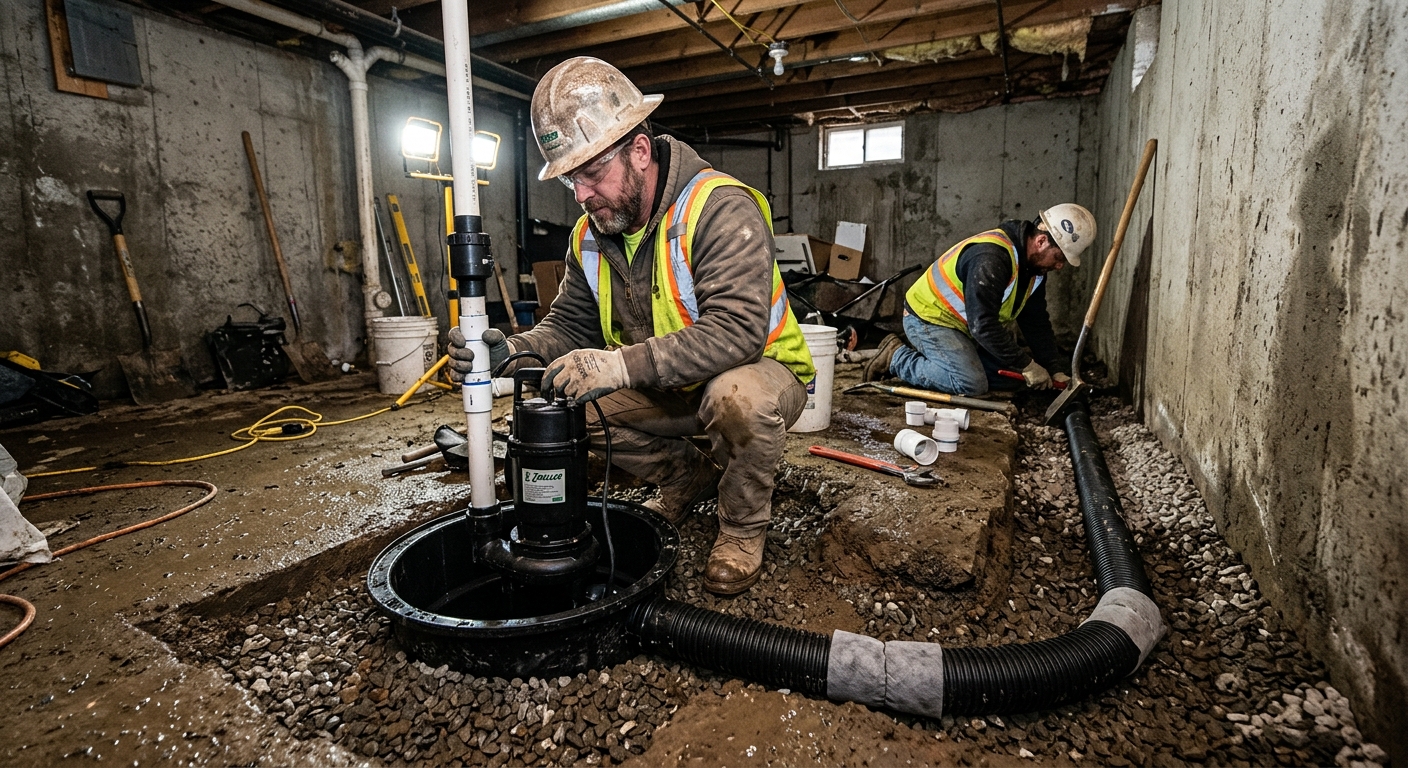
Basement waterproofing options and costs in Port Haney
Port Haney is a coastal community in British Columbia where groundwater and driving rain can keep pressure on basement walls and slabs for long stretches. That’s why, in homes around Hawthorne and the older pockets near Port Haney Village, we often see recurring moisture even when the basement “seems fine” most of the year. In the Lower Mainland–Southwest, costs are driven less by dramatic soil expansion than by persistent saturation: backfill stays wet when drainage and weeping tile systems are undersized or failing.
At the same time, many basements here are in older housing stock, and the most common cost surprises come from having to treat what was originally installed. In practical terms, a home built before early modern waterproofing details are standard is more likely to have aging tar-and-paper systems, corroded weeping tile, and joint seal failures that worsen once freeze-thaw opens micro-cracks. Lower Mainland projects also compete for labour, and excavation can be more involved on tight lots—meaning excavation and mechanical breaking can add hours even when the basement footprint is small.
For homeowners planning repairs, there’s a clear range between “source control” exterior work and “symptom control” interior drainage. Exterior excavation plus new membrane and a perimeter drainage system typically sits at the upper end of the market, while interior perimeter drainage and sump retrofits are often the best value when access is limited. The table below compares common solutions, what they address, and the usual disruption and price ranges for Port Haney.
| Method |
What It Addresses |
Disruption Level |
Durability |
Price Range |
| Exterior excavation + new membrane + drainage tile |
Hydrostatic pressure at the wall; failed perimeter drainage; sealing at source |
High (landscaping removal, excavation around perimeter) |
Long-term (typically 20–30 years with correct installation) |
$20,000–$32,000 |
| Interior perimeter drain channel + sump pit |
Water entry after it penetrates; reduces seepage to manageable drainage |
Medium (interior floor edge work, pump discharge setup) |
Long-term (often 15–25 years depending on sump capacity and maintenance) |
$9,500–$18,500 |
| Foundation crack injection (epoxy or polyurethane) |
Seepage through cracks (polyurethane) or sealing non-moving cracks (epoxy) |
Low to Medium (drilling, surface prep, limited interior disruption) |
Variable (can last 10–20 years; depends on crack activity and wall condition) |
$800–$2,400 |
| Sump pump installation (primary + battery backup) |
Controls standing water during wet weather; helps during power interruptions |
Low to Medium (pump pit work; discharge routing) |
Long-term (pump lifespan 7–12 years; backup extends critical protection) |
$1,800–$6,000 |
| Window well drain installation |
Surface runoff and groundwater entry at egress points |
Low to Medium (minor excavation around window well) |
Medium to long-term (often 10–20 years with proper grading) |
$1,200–$4,200 |
| Lot re-grading / downspout extension |
Reduces volume of water reaching foundation; improves roof drainage |
Low (outdoor work; minimal interior disruption) |
Medium-term (often 5–10 years depending on ongoing maintenance) |
$4,000–$10,000 |
Prices are estimates only and vary by project scope, site access and material selection.
What affects the price of waterproofing in Port Haney
In Port Haney and across the Lower Mainland–Southwest, two contractors can quote the “same” basement moisture problem and still be 30–50% apart. That gap usually comes down to soil and water behaviour outside the basement, not just the visible leak indoors. In coastal BC, water tables tend to stay high through prolonged rain, so sump run times, drainage capacity, and how much excavation is required become real cost drivers—especially when perimeter drainage has failed and backfill stays saturated.
Those same drivers are exactly why Lower Mainland–Southwest pricing often differs from a national average. In clay-heavy regions (more common elsewhere in Canada), freeze-thaw and expansive soils can push and worsen cracks through lateral pressure, and some contractors factor that into long crack repair scopes. In Port Haney, the separation is more about high groundwater and persistent saturation: heavy coastal rainfall quickly loads backfill when original drainage fails, and freeze-thaw still widens existing cracks and joints. Where older housing stock is involved, it’s common to find corroded or undersized weeping tile and dampness that reappears as soon as winter wet periods settle in.
Concrete examples: if we uncover a perimeter weeping tile that’s collapsed or disconnected, exterior excavation may be necessary to restore drainage capacity—pushing costs toward the $15,000–$30,000 exterior band. Conversely, if the exterior can’t be disturbed (deck, hardscape, tight lot lines), an interior perimeter drain and sump retrofit can keep you closer to the $8,000–$18,000 interior waterproofing band. Also, homeowners on steeply sloped lots sometimes pay less for exterior work because mechanical access is easier; tight flat pads or rocky sections can add breaking and disposal time. With Port Haney’s population sitting at 6,630 (Statistics Canada, 2021 Census), the local contractor pool is smaller than in bigger cities, so we also see scheduling constraints influence labour costs when multiple wet-weather projects overlap.
| Price Factor |
Why It Matters |
Cost Impact |
| Interior vs. exterior approach — interior is less disruptive but addresses symptoms |
Exterior controls water at the source; interior controls it after entry |
Exterior often costs ~1.5–2.5x more than interior for similar basement footprints |
| Foundation type — poured concrete vs. block vs. stone vs. ICF |
Crack behaviour and sealing method differ by wall material |
Block and stone often require more interior drainage complexity |
| Soil type — clay expands more than sand, adding pressure |
Expansive soils can widen cracks; saturated soils increase hydrostatic pressure |
In wetter, saturated soils, interior drainage and pump sizing increase costs |
| Crack type and length — hairline vs. structural horizontal cracks |
Active structural cracks need assessment and potentially larger scope |
Structural cracks can double repair time vs. cosmetic hairline sealing |
| Sump pump backup system — battery or water-powered backup needed |
BC winter/spring events can still trigger extended outages |
Backup adds cost but reduces risk of basement flooding |
| Access — landscaping, decks, or driveways must be removed for exterior |
Excavation boundaries and protection for surrounding improvements add labour |
Tight access can push exterior work toward the high end of its band |
| Weeping tile age — original tile (60+ years) may be completely failed |
Collapsed tile can force higher capacity and more excavation |
Replacement scopes often add thousands to the quote |
| Mould or efflorescence remediation required before sealing |
Sealers and membranes bond poorly over active salts/mould |
Remediation can add days and material handling costs |
Permits & regulations in British Columbia
In British Columbia, foundation excavation, structural crack repair, and changes to lot drainage typically require a building permit. If your sump pump discharge connects to a municipal service (storm or sanitary), the connection usually needs municipal approval rather than being treated as a simple “run a hose and go” project. For structural crack repair—particularly horizontal cracks in block walls or major step cracks—a structural engineer’s assessment is often required to determine whether underpinning, reinforcement, or other structural work is needed before waterproofing proceeds.
Here’s a homeowner-friendly way to verify your contractor in Port Haney, step by step. First, confirm the company is appropriately licensed for the work they’re proposing and that they can provide the permit-support paperwork (when required). Second, ask for a current certificate of liability insurance naming the homeowner (or providing proof the contractor is insured to do the work). Third, confirm WSIB/WCB coverage for the contractor and any subcontractors. Many reputable waterproofing firms in BC also carry engineering support access for crack/structural scenarios; ask how they handle engineered reports if you have suspected structural movement.
Where to look: use the province’s online licensing registry if applicable, request the insurance certificate directly from the contractor, and verify clearance documentation from their workers’ compensation coverage. If they can’t provide these documents quickly, that’s a sign to pause and get a second quote.
Interior vs exterior waterproofing — what does Port Haney need?
For Port Haney basements, the fundamental decision is whether you’ll treat water at the source or manage it after it enters. Exterior waterproofing (full excavation, membrane, new perimeter drainage tile, and re-backfill) is the most permanent approach because it addresses hydrostatic pressure where it originates. It’s also the most disruptive because it requires removing landscaping, breaking through driveway edges where applicable, and restoring the site.
Interior waterproofing—typically a perimeter drain channel connected to a sump pit and sump pump—manages water that has already worked its way into the basement. This is often the better choice when exterior access is constrained, or when only certain corners are affected. However, interior systems don’t “stop” the wall pressure itself; they reduce the resulting seepage and keep the basement dry through drainage control, which is especially practical in coastal BC when wet weather loads persist.
In Port Haney, poured concrete walls often respond well to targeted crack injection (because the wall is generally more consistent and can seal effectively when cracks are stable). Block foundations, on the other hand, frequently benefit from interior drainage as a practical complement—especially if mortar joints and voids behind the wall are contributing to seepage. Given BC’s wet winters and spring events, adding a sump pump backup system (battery or water-powered) is worth considering for peace of mind during outages.
Cost-wise, exterior work is justified when the perimeter drainage system has failed across much of the wall length. For example, if you’re seeing repeated seepage along the majority of a perimeter wall and the weeping tile is likely compromised, spending closer to the $20,000–$32,000 exterior range can prevent recurring interior-only repairs. If the issue is localised—say, one window-side corner with surface runoff—interior drainage and targeted measures may be enough, keeping you nearer the $9,500–$18,500 interior band.
| Method |
Best For |
Addresses Source? |
Disruption |
Lifespan |
Price Band |
| Full exterior excavation + membrane |
Widespread seepage, consistently wet perimeter, failed drainage system |
Yes (controls water entry) |
High |
20–30 years |
$20,000–$32,000 |
| Interior French drain + sump system |
Interior moisture, tight lots, sump dewatering needed after water entry |
No (controls water after it enters) |
Medium |
15–25 years |
$9,500–$18,500 |
| Crack injection — epoxy (structural) |
Stable, non-moving cracks in poured concrete; sealing needed |
Partial (seals the crack pathway) |
Low to Medium |
10–20 years |
$700–$2,000 |
| Crack injection — polyurethane (active leak) |
Cracks with active seepage where water flow continues |
Partial (seals active leak pathway) |
Low to Medium |
8–18 years |
$900–$2,500 |
| Interior drain channel only (no sump) |
Minor seepage manageable without dewatering; limited wet periods |
No |
Medium |
5–15 years |
$6,500–$12,500 |
| Re-grading + downspout extensions |
Surface runoff and roof water directing toward foundation |
Yes for runoff (source reduction) |
Low |
5–10 years |
$4,000–$10,000 |
How to choose a waterproofing contractor in Port Haney
Start with the basics, especially in British Columbia where foundation excavation and structural repairs can require permits and sometimes engineered review. Ask the contractor for three documents: proof of liability insurance (certificate of insurance), confirmation of WSIB/WCB coverage, and the appropriate licence/authorization for the type of work they’re carrying out. If they can’t provide these promptly, you’ll likely end up paying for delays—or worse, for rework.
Next, get 2–3 itemised written quotes rather than one lump sum. Look for a breakdown that separates labour, excavation, membrane or drain materials, sump and backup system, disposal, and restoration. Also read the exclusions: is the price assuming a clean excavation? Is permit pulling included? Are you paying extra for rock breaking, cut-and-replace of steps/driveway edges, or patching after interior work? A quality quote will state what happens if they discover failed weeping tile or concealed mould.
Warranty matters. Ask for the workmanship warranty length and whether it covers the installed system components and labour for leaks that develop after completion. Confirm how the product manufacturer warranty works and whether it’s transferable to subsequent owners—important if you sell. Payment should protect you: never pay more than 10–15% upfront, and hold back final payment until the project is complete and cleaned up. Insist on a written start date and timeline estimate.
- Request proof of liability insurance and verify the policy is current.
- Confirm WSIB/WCB coverage for the contractor and subcontractors.
- Ask whether a permit is required for the specific scope and confirm who pulls it.
- Get an itemised quote (labour + materials) with quantities or clear unit pricing.
- Clarify what’s included in disposal and whether soil/rock removal is priced separately.
- Ask how the contractor deals with failed weeping tile or missing perimeter drains.
- Confirm crack assessment method (and engineering involvement if structural movement is suspected).
- Require a written warranty for workmanship and verify coverage details in plain language.
- Ask about sump pump model, discharge routing, and backup type (battery or water-powered).
- Confirm restoration scope: backfill, grading, landscaping replacement, and interior patching.
- Check the schedule: get a completion estimate, not just an estimated start date.
- Avoid contractors who want large upfront payments or won’t put scope in writing.
Concrete red flags we see in Port Haney: (1) proposals that “seal the crack” without checking for water pressure or drainage capacity, (2) lack of a sump plan even when signs show repeated wet-season seepage, (3) vague warranties (“waterproof forever”) without clear workmanship/product terms, (4) no insurance/WSIB/WCB paperwork when you ask, and (5) quote exclusions like “permit not included” without discussing that you’ll still need approvals for drainage or structural crack work.
Frequently asked questions — waterproofing in Port Haney
What causes foundation cracks in Port Haney?
In Port Haney and the wider Lower Mainland–Southwest, foundation cracks commonly come from moisture pressure and seasonal weather swings. Wet winters can keep soils saturated, and even in a mild coastal climate, freeze-thaw can widen existing micro-cracks by stressing concrete joints and mortar. Another major contributor is water that gets behind or around the foundation: when drainage and weeping tile systems fail (or are undersized), hydrostatic pressure can push against basement walls and floors, increasing crack activity over time. In older homes, it’s also common to see cracking near corners, around window wells, or along perimeter areas where original perimeter drainage has aged.
How do I compare waterproofing quotes?
Compare waterproofing quotes line-by-line, not just by total price. Ask each contractor to explain the water pathway they’re addressing: source control (exterior membrane and drainage tile) versus symptom control (interior perimeter drain and sump). Confirm what’s included—excavation depth, disposal, membrane type, drain tile layout, sump pump and whether backup is included, and whether mould/efflorescence remediation is required before sealing. In Port Haney, exterior projects commonly fall in the $15,000–$30,000 band (excavation), while interior drainage often lands in the $8,000–$18,000 band, so a big mismatch is usually a sign the scope isn’t equivalent. You should also verify permit responsibility for changes to lot drainage and any structural crack repair.
How long does basement waterproofing take in Port Haney?
Timelines depend on whether you’re doing exterior excavation or interior drainage and on access constraints in your yard. Interior perimeter drain and sump work is often faster because it avoids full perimeter excavation; smaller crack injection scopes can be quickest, sometimes completed within a few days once prep and curing schedules are accounted for. Exterior waterproofing typically takes longer because excavation, mechanical breaking (if needed), membrane installation, drainage tile placement, and backfill/restoration stages all take time—often stretching the schedule by about a week or more for typical single-family basements, with weather affecting outdoor stages. In Lower Mainland weather, contractors often avoid heavy rain periods when membrane and backfill conditions aren’t favourable.
What is a weeping tile and does my Port Haney home have one?
A weeping tile is the perimeter drain system installed around (or near) the foundation footing to collect groundwater and direct it to a sump or discharge point. In many older Port Haney homes, the original weeping tile may be present but partially failed: the tile can be clogged, disconnected, corroded, or undersized for today’s wet-season water loading. You can’t always confirm by looking only at the basement—sometimes the tile is buried and hidden behind finishes. A contractor can usually assess it through inspection, tracing discharge paths, checking for sump/pipe connections, and evaluating how water enters during wet weather. If your basement has recurring dampness along the perimeter during prolonged rain, that’s a strong hint the weeping tile (if present) may not be functioning.
Can I waterproof my basement in winter in Port Haney?
You can often complete interior waterproofing in winter in Port Haney because it’s mainly indoor work (perimeter drain, sump pit, crack injection prep) that doesn’t rely as heavily on outdoor backfill and membrane curing conditions. However, exterior waterproofing is more sensitive: digging near frozen ground, installing membrane around wet/muddy backfill, and managing drainage during freezing conditions can create workmanship challenges and delays. The key is whether the foundation and surrounding soil can be accessed safely and whether the site can support proper curing and drainage setup. A good contractor will assess freezing conditions, plan around forecasted rain, and may recommend an interior “stabilize first” approach if exterior waits for spring. Your best option depends on where the water is entering and how active it is during current wet periods.
What is the difference between waterproofing and damp-proofing?
In plain terms, damp-proofing is about managing minor moisture and condensation risk—it’s often not designed to withstand sustained hydrostatic pressure. Waterproofing, on the other hand, is intended to control water entry from the outside and/or manage active seepage using engineered drainage methods like perimeter drains, proper membranes, and sump pump systems. In Port Haney’s coastal conditions—high groundwater and intense, prolonged rainfall—homes can experience water pressure for long periods, which is why true waterproofing details matter. For example, a surface coating alone can slow minor dampness, but if seepage is driven by hydrostatic pressure, interior drainage and sump pumping may be necessary. When quotes range from interior solutions like $9,500–$18,500 to exterior excavation like $20,000–$32,000, that difference typically reflects how much pressure control and drainage capacity the contractor is planning for.