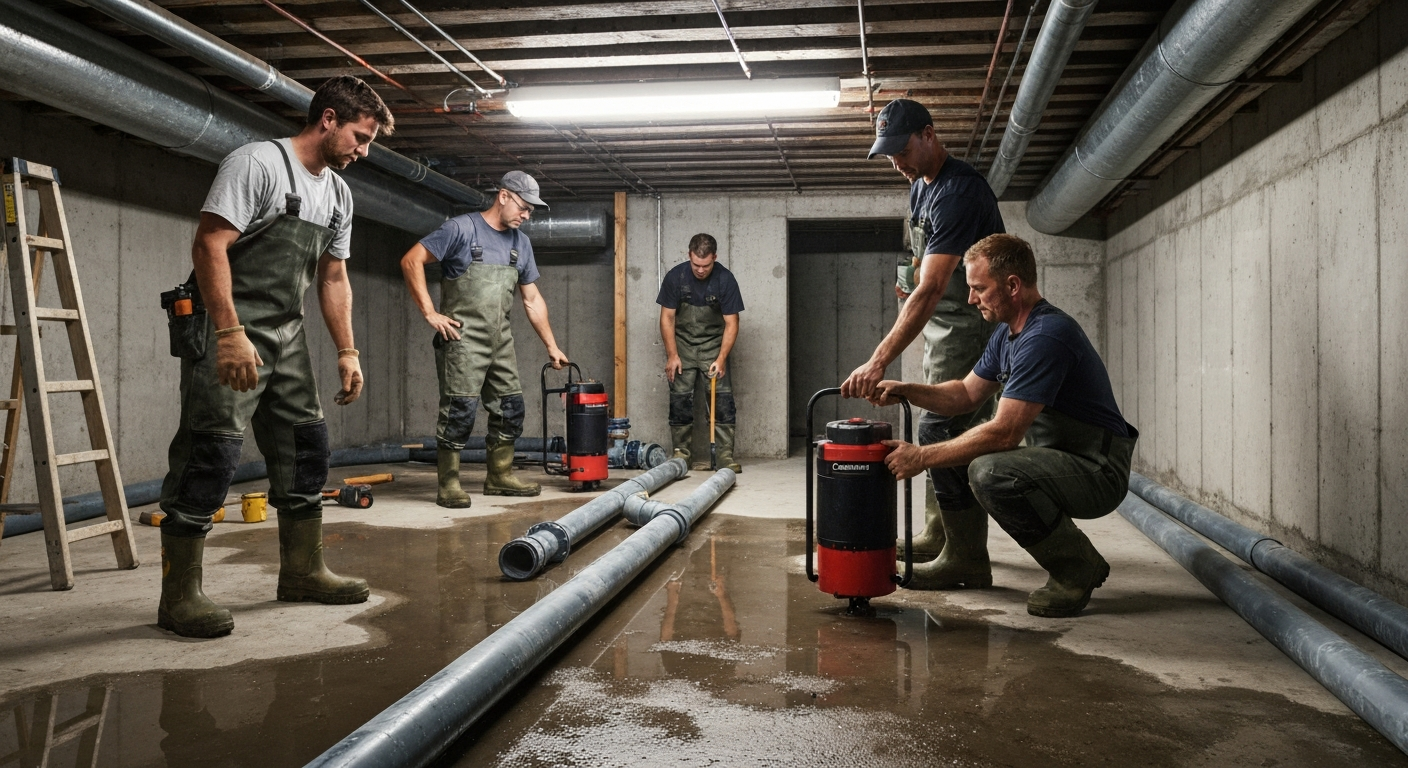
Basement waterproofing options and costs in Bow Island
In Bow Island, basement waterproofing is less about a single “magic coating” and more about stopping water at the right point—whether it’s water that’s migrating through foundation walls, hydrostatic pressure building behind them, or cracks that grow during freeze-thaw. With local housing conditions—83.0% of dwellings being single-detached homes and 58.2% of homes built before 1981—many basements were originally protected with older, less reliable waterproofing systems, and the weeping tile/drainage approach often ages out. (Statistics Canada, 2021 Census.)
Cost and contractor availability in the Lethbridge–Medicine Hat region are shaped by soil and water behaviour. Soils ranging from silt loam to clay loam can swell when wet and shrink when dry, which stresses foundation walls and footings. Even though this part of Alberta is generally drier, intense rain events and snowmelt can still overload drainage, and clay-rich backfill can trap water against walls. Freeze-thaw cycles also widen existing cracks, so small defects can become recurring leak points.
In Bow Island, service demand is especially common in older residential pockets near downtown where lots are more compact and excavation access is tighter. That’s also where downspouts and grading are frequently modified over the years, sometimes directing more water toward the foundation.
Use the table below to compare the most common methods—then match the approach to your foundation type and how the water is entering, not just how it looks inside.
| Method |
What It Addresses |
Disruption Level |
Durability |
Price Range |
| Exterior excavation + new membrane + drainage tile |
Stops water at the source by replacing failed waterproofing and re-establishing perimeter drainage |
High (excavation, backfill, landscaping reinstatement) |
Long-term (typically many years with proper drainage) |
$14,000 – $28,000 |
| Interior perimeter drain channel + sump pit |
Collects water after it enters and relieves hydrostatic pressure |
Medium (floor/grade cutting, pump installation, tidy-up) |
Long-term (depends on sump reliability and maintenance) |
$9,000 – $18,000 |
| Foundation crack injection (epoxy or polyurethane) |
Seals cracks; epoxy suits non-moving cracks, polyurethane targets active moisture pathways |
Low to medium (minor interior access) |
Good when crack type matches product and surface prep is solid |
$600 – $2,500 |
| Sump pump installation (primary + battery backup) |
Keeps water levels down during saturated soil periods and power interruptions |
Low to medium (pit, discharge piping, electrical tie-in) |
Very good when paired with backup and correct discharge |
$1,800 – $3,500 |
| Window well drain installation |
Prevents seepage and pooling around basement egress openings |
Medium (local excavation and grading changes) |
Good (site drainage dependent) |
$1,200 – $3,000 |
| Lot re-grading / downspout extension |
Reduces run-off toward foundation and improves surface shedding |
Low to medium (minor excavation, landscaping adjustments) |
Moderate (ongoing grading maintenance may be needed) |
$2,000 – $6,000 |
Prices are estimates only and vary by project scope, site access and material selection.
What affects the price of waterproofing in Bow Island
In the Lethbridge–Medicine Hat region, two homeowners can receive quotes that differ by 30–50% for the “same” leak because waterproofing is driven by how water behaves in your specific soils, not by the symptom you see in the basement. In Bow Island and across southern Alberta, the biggest separators from national averages are soil type, water-table behaviour, and freeze-thaw. These factors change excavation depth, drainage design, and how often cracks or joints will react after the job is done—so contractors plan differently and price accordingly.
Clay-heavy soils common in parts of the Prairies expand during freeze-thaw and exert lateral pressure on foundation walls, making sealing measures more demanding over time. When saturated periods increase, sump run times rise and discharge piping/backup design can become necessary. While southern Alberta isn’t like coastal BC, intense rain events and snowmelt can still saturate backfill that’s trapped against walls—especially when original weeping tile has failed. Older housing stock (58.2% built before 1981) also tends to correlate with failing drainage and more frequent service calls. (Statistics Canada, 2021 Census.)
Concrete examples from Bow Island: if the foundation has deteriorated weeping tile along most of the perimeter, an interior-only solution might still require significant drain excavation indoors, pushing work toward the upper end of interior waterproofing pricing (for example, nearing the $9,000–$18,000 band). Conversely, if the issue is localized window well seepage, a drainage improvement may stay closer to smaller line-item budgets. If the job needs exterior excavation because water is actively pressing the wall during saturated seasons, costs usually move toward the $14,000–$28,000 exterior band—particularly where disposal and reinstatement are unavoidable.
| Price Factor |
Why It Matters |
Cost Impact |
| Interior vs. exterior approach — interior is less disruptive but addresses symptoms |
Exterior addresses the source; interior relieves pressure after entry |
Can swing budgets by thousands (interior often 9k–18k; exterior often 14k–28k) |
| Foundation type — poured concrete vs. block vs. stone vs. ICF |
Different wall structures react differently and need different sealing strategies |
Crack injection success varies; interior drains may be more necessary on block |
| Soil type — clay expands more than sand, adding pressure |
Clay can swell when wet and shrink when dry, stressing joints and cracks |
Higher likelihood of repeat sealing work; may require stronger drainage design |
| Crack type and length — hairline vs. structural horizontal cracks |
Structural movement can defeat “one-time” sealing |
Structural cracks may require engineering review and more involved remediation |
| Sump pump backup system — battery or water-powered backup needed |
Power reliability matters during spring wet periods and outages |
Backup can add cost; often justified for active seepage |
| Access — landscaping, decks, or driveways must be removed for exterior |
Excavation and reinstatement time varies widely |
Can materially increase labour and disposal costs |
| Weeping tile age — original tile (60+ years) may be completely failed |
Old drainage frequently collapses or clogs |
May require replacement (bigger scope, higher cost) |
| Mould or efflorescence remediation required before sealing |
Sealers don’t perform well over unresolved moisture/contamination |
Additional prep and treatment before membranes/injections |
Permits & regulations in Alberta
In Alberta, some foundation and drainage work will require permits, while other tasks usually don’t. In general terms for Bow Island homeowners: foundation excavation, structural crack repair, and changes to how lot drainage directs water typically require a permit because you’re altering building-related systems and sometimes structural performance. If you’re adding or modifying a sump pump system, and especially if it ties into municipal storm or sanitary services, you’ll need municipal approval before connecting or altering connections.
For structural crack repair—particularly horizontal cracks in block walls or major step cracks—a structural engineer’s assessment is commonly needed to determine whether underpinning or other structural work is required. A reputable contractor should explain whether your crack is being treated as a moisture pathway versus a movement issue, and be comfortable coordinating engineering if structural capacity is in question.
To verify your contractor in Alberta, start by confirming the correct business licensing for construction-related work (use the relevant provincial listings, and ensure the company matches the legal name on the quote). Next, request a certificate of liability insurance showing coverage limits appropriate for excavation and foundation work, and check the WSIB/WCB clearance or coverage status from the insurer’s paperwork or the relevant coverage certificate. For structural jobs, ask whether they carry engineering support and whether they’ll provide documentation for your records and the permit/inspection process.
Finally, don’t assume “permit-ready” means “permit included”—ask who pulls the permit, what’s in the scope, and whether inspections are scheduled into the timeline.
Interior vs exterior waterproofing — what does Bow Island need?
Exterior waterproofing is the “source control” option: full excavation, new membrane, new drainage tile, and proper backfill are designed to stop water from reaching the foundation in the first place. It’s typically the most durable approach because it addresses the water entry pathway and reduces hydrostatic pressure at the wall. The trade-off is higher cost and greater landscape disruption—there’s excavation, disposal, and reinstatement.
Interior waterproofing manages what gets past the wall. It usually includes a perimeter drain channel, a sump pit, and sump pump discharge—sometimes paired with wall crack injection or targeted sealing. This approach can be less disruptive and is often the right practical choice when exterior access is difficult (tight lots, mature landscaping, fencing, or an existing finished yard). However, interior systems do not eliminate hydrostatic pressure on the foundation itself; they reduce the impact by capturing and diverting water after entry.
In Bow Island, soil conditions (silt loam to clay loam) and freeze-thaw mean cracks can grow and reopen over time if water pressure isn’t controlled. For poured concrete walls, crack injection can be a strong complement because properly prepared, non-moving cracks can be sealed effectively. For block foundations—where joints and mortar can wick water—interior drainage is frequently necessary as a practical line of defence, even when crack injection is used.
Sump pump backup systems matter in Alberta because spring saturation and storm conditions increase the chance of pump runtime, and power disruptions can be a real risk. If you’re already in the $9,000–$18,000 interior band, adding a backup may be a cost-effective safeguard rather than waiting for damage.
Dollar perspective: if your leak is widespread along most of the perimeter and weeping tile is likely failed, exterior waterproofing at about $14,000–$28,000 is often justified. If the seepage is limited and driven by a single interior symptom (for example, recurring water at the sump area), interior work around $9,000–$18,000 may solve the problem without the disruption of excavation.
| Method |
Best For |
Addresses Source? |
Disruption |
Lifespan |
Price Band |
| Full exterior excavation + membrane |
Widespread seepage, repeated interior water, and confirmed drainage/tile failure |
Yes |
High |
Long-term when drainage is designed correctly |
$14,000 – $28,000 |
| Interior French drain + sump system |
Basements with damp floors/walls where exterior access is limited |
No (relieves after entry) |
Medium |
Long-term with reliable pump/backup and maintained discharge |
$9,000 – $18,000 |
| Crack injection — epoxy (structural) |
Non-moving cracks where moisture is present but the wall isn’t actively shifting |
Partially (seals the pathway) |
Low to medium |
Good when the crack type is correctly identified |
$600 – $2,500 |
| Crack injection — polyurethane (active leak) |
Active seepage through cracks or joints with ongoing water pressure |
Partially (seals the pathway) |
Low to medium |
Good when used on active leak routes with proper prep |
$600 – $2,500 |
| Interior drain channel only (no sump) |
Minor dampness where water can be managed without active pumping |
No |
Low to medium |
Moderate; depends on how much water arrives |
$4,500 – $9,000 |
| Re-grading + downspout extensions |
Surface run-off contributing to foundation wetting |
Yes for surface water sources |
Low to medium |
Moderate (grade maintenance needed) |
$2,000 – $6,000 |
How to choose a waterproofing contractor in Bow Island
Choosing a waterproofing contractor in Bow Island is about verifying the basics—then confirming the scope details match your foundation reality. First, require documentation for Alberta licensing/registration relevant to the work being performed, plus liability insurance. Ask for a current certificate of insurance and confirm the coverage includes excavation, foundation work, and jobsite operations. For work requiring worker coverage, request proof of WSIB/WCB coverage (or clearance documentation where applicable). Don’t accept “we’re insured” as a verbal statement—ask to see the paperwork before any work begins.
Next, get 2–3 itemised written quotes. You want a breakdown that separates labour and materials (membrane/drain tile, pump, discharge piping, disposal, reinstatement), not a vague lump sum. Read the exclusions carefully: is demolition included? Is disposal of excavated soil included? Does the price include permit pull and inspections if required? If the quote covers crack injection, is the crack type (epoxy versus polyurethane) specified and based on their assessment?
Warranty matters too. Confirm the workmanship warranty length and what it covers (for example, seams/membrane system performance, not just “leaks at the time of completion”). Also ask about product/manufacturer warranties and whether they are transferable to you as the homeowner. Payment schedule should be conservative: never pay more than about 10–15% upfront, and request holdback until key milestones are complete. Finally, insist on a written start date and completion estimate, including weather-related contingencies typical of Alberta winters and spring saturation periods.
- Confirm the contractor’s legal business name matches the quote and invoices.
- Provide proof of liability insurance (certificate of insurance) before signing.
- Provide WSIB/WCB coverage documentation or clearance where applicable.
- Ask which permits are required and who is responsible for pulling them.
- Get an itemised quote: labour, materials, disposal, reinstatement, and pump specs.
- Ensure the scope lists how discharge will be routed safely (not just “to grade”).
- Verify whether exterior work includes backfill type and compaction plan.
- Check whether they diagnose soil/water behaviour (not just seal visible damp spots).
- For crack injection, confirm the crack assessment method and product selection.
- Ask for warranty details in writing: length, coverage, exclusions, and transferability.
- Confirm pump backup is included if you’re targeting a high-risk season (spring saturation).
- Set milestone-based payments with holdback until successful pressure/water testing is done.
Red flags I see in Bow Island when customers get burned: (1) quotes that promise “one-coat” interior sealing without addressing drainage or sump requirements, (2) no discussion of whether your crack is moving versus non-moving (epoxy versus polyurethane), (3) missing insurance/WSIB/WCB documentation, (4) vague scope language like “waterproofing system” with no materials or discharge plan, and (5) pushing large upfront payments or refusing to put start dates and warranty terms in writing.
Frequently asked questions — waterproofing in Bow Island
Do I need a permit for foundation work in Alberta?
In Bow Island and across Alberta, permits are commonly required when you’re doing foundation excavation, structural crack repairs, or making changes that affect how lot drainage directs water. If your waterproofing includes altering drainage routes, tie-ins, or major changes near service connections, municipal approval may be needed—especially for sump systems that connect to storm or sanitary infrastructure. For structural crack repairs (such as major step cracks or horizontal cracking in block walls), a structural engineer’s assessment is often required to confirm whether underpinning or other structural work is needed.
How long does waterproofing last?
Basement waterproofing longevity depends on whether the job addresses the source of water entry or only manages water after it enters. Exterior waterproofing with new membrane and drainage tile—when installed over properly prepared surfaces with correct drainage design—typically provides long-term performance, often many years. Interior systems (French drain + sump) can also last a long time, but their lifespan is strongly linked to pump reliability, backup readiness, and whether the drainage system can keep up during saturated soil periods. For context, older housing stock in Bow Island (58.2% built before 1981) means some systems were never designed for modern drainage expectations, so performance can fail earlier if drainage is overlooked.
Can I waterproof my basement from the inside only?
Yes, you can waterproof from the inside only in many Bow Island homes, especially if exterior access is limited. Interior approaches—like a perimeter drain channel, sump pit, and sump pump—are effective at collecting water after it enters and relieving hydrostatic pressure. However, inside-only work doesn’t stop water pressure against the wall itself, so it’s best when the leak pathways can be managed and the sump system is properly sized and maintained. Where exterior weeping tile has failed or clay-rich backfill is trapping water, inside-only waterproofing often works best as a complement rather than the only measure. If you’re seeing active leakage through cracks, injection (epoxy for non-moving cracks or polyurethane for active leaks) can help alongside an interior drainage system.
What causes foundation cracks in Bow Island?
In Bow Island, foundation cracks often come from the soil mechanics and freeze-thaw cycle. Clay loam and other clay-rich soils can expand when wet and shrink when dry, putting lateral stress on walls and footings. Seasonal freeze-thaw can widen existing cracks and joints over time, turning hairline defects into active leak pathways. Poor drainage or trapped water behind the foundation can intensify the problem by increasing hydrostatic pressure during spring snowmelt and heavy rain events. Older homes (many built before 1981) are also more likely to have aging drainage around the perimeter, so cracks and seepage become more common call-backs.
How do I compare waterproofing quotes?
To compare quotes, start by making sure every contractor is quoting the same problem and the same scope. Look for itemised labour and materials rather than lump sums, and confirm whether they’re recommending interior-only versus exterior excavation. In the Lethbridge–Medicine Hat region, typical exterior waterproofing (excavation, membrane and drainage tile) commonly falls in the $14,000–$28,000 range, while interior waterproofing and weeping tile solutions often land in the $9,000–$18,000 range. Compare what’s included: disposal of excavated soil (for exterior), sump pump specifications, discharge routing, and whether permit work is included. Finally, check the warranty language and whether the crack injection method is matched to the crack type (epoxy versus polyurethane).
How long does basement waterproofing take in Bow Island?
Timing depends on whether you’re doing interior-only work or full exterior excavation. Interior systems typically take days to complete active drainage and install the sump and discharge components, then allow time for curing and finishing. Exterior projects take longer because excavation, drainage tile replacement, membrane application, backfill/compaction, and reinstatement require more staging and materials handling—especially when crews must manage disposal and landscaping restoration in a compact lot. Seasonal factors in Alberta matter too: spring saturation and winter conditions can limit excavation depth and backfill work. If your project includes structural assessment for cracking, that adds scheduling time before work begins. Get a written start date and completion estimate tied to weather contingencies.