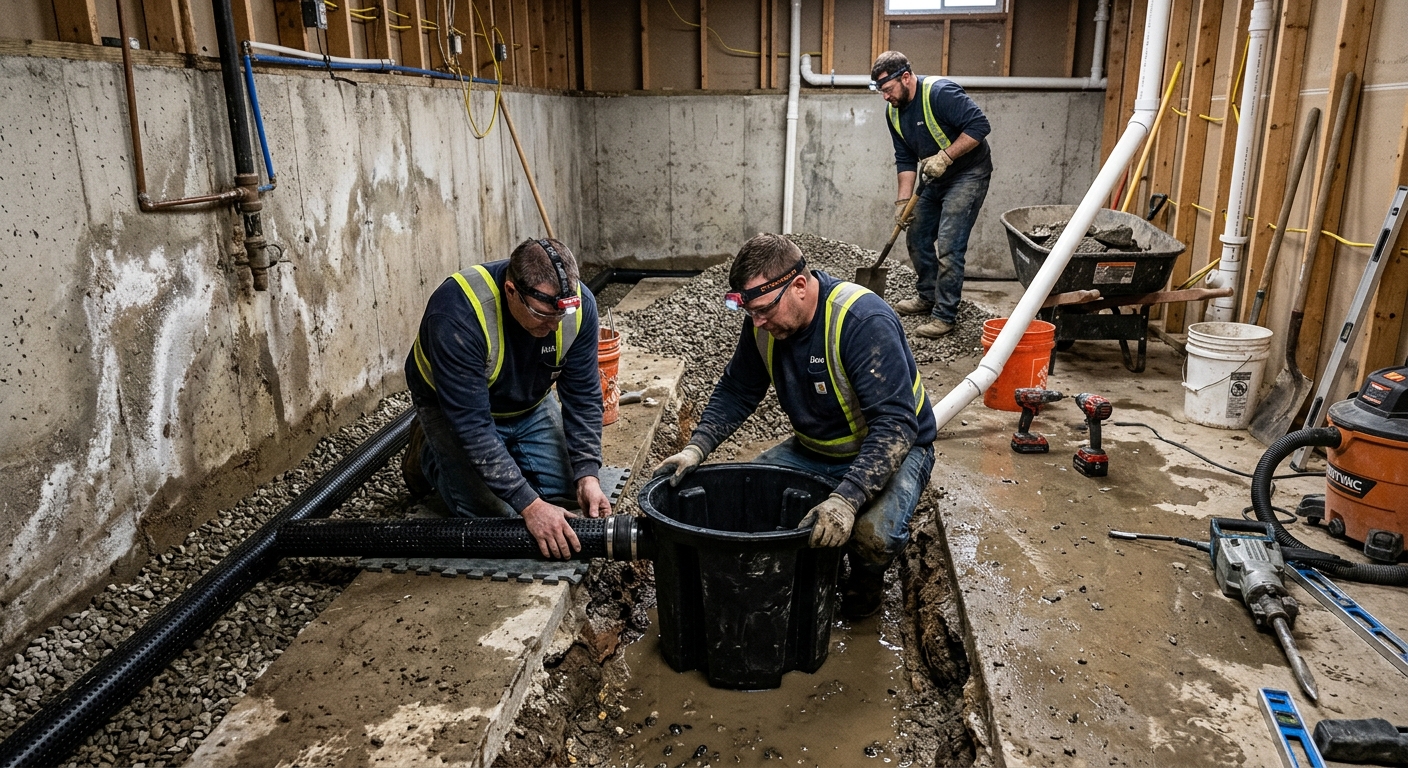
Basement waterproofing options and costs in North Glenora
North Glenora homeowners typically need waterproofing that matches both the water that gets in and the soil that keeps pushing it back. In this community, local housing stock includes a good share of older homes—exactly the kind of build that can start with tar-and-paper style systems and later develop corroded or failing drainage performance. With North Glenora’s population at 2,023 residents (Statistics Canada, 2021 Census), the area tends to see a steady—but not overwhelming—flow of basement leak callouts, so scheduling often lines up with spring and fall access windows rather than immediate, week-of starts.
Calgary-area waterproofing costs are shaped by predominantly clay and clay-till soils that hold water and expand during freeze–thaw. That movement increases lateral pressure and can widen existing cracks and joints, making exterior excavation and drainage corrections more expensive when full perimeter access is required. On top of that, contractors often charge a premium where yards are tight or where patios, decks, and landscaping block excavation depth—common in established pockets near the river valleys where hydrostatic pressure can be higher.
In North Glenora, neighbourhood demand is especially strong for repeatable service on homes around the established residential blocks close to shopping corridors and school routes, where landscaping access is tight and older basements frequently show seepage, efflorescence, or wet corners. The result: many homeowners start by comparing interior solutions, then move to exterior only when recurring pressure and drainage failures keep returning.
Use the comparison below to anchor your expectations on method, disruption, durability, and typical price ranges before you request itemised quotes.
| Method |
What It Addresses |
Disruption Level |
Durability |
Price Range |
| Exterior excavation + new membrane + drainage tile |
Hydrostatic pressure at the wall + bulk water management with a continuous perimeter system |
High (excavation, removal and re-landscaping) |
High (best source control when detailed correctly) |
$9,000–$25,000 |
| Interior perimeter drain channel + sump pit |
Water that enters through cracks/joints and directs it to a sump for removal |
Medium (floor cut and interior drainage installation) |
Medium to high (depends on wall condition and power reliability) |
$5,000–$15,000 |
| Foundation crack injection (epoxy or polyurethane) |
Stops non-moving cracks (epoxy) or active seepage (polyurethane) depending on crack behaviour |
Low to medium (minor drilling/patching) |
Medium (needs correct crack type diagnosis) |
$500–$1,800 |
| Sump pump installation (primary + battery backup) |
Reduces basement flooding risk by maintaining discharge during outages and high-run periods |
Low to medium (pit + discharge routing) |
Medium to high (backup improves resilience) |
$900–$3,000 |
| Window well drain installation |
Controls surface water entering egress/window areas and reduces wet sills |
Medium (excavation near window wells) |
Medium (often highly effective for targeted leaks) |
$1,200–$4,200 |
| Lot re-grading / downspout extension |
Keeps roof and surface water away from the foundation and reduces saturation around the perimeter |
Low to medium (soil reshaping and minor drainage changes) |
Low to medium (best paired with membrane/drainage repairs) |
$900–$3,600 |
Prices are estimates only and vary by project scope, site access and material selection.
What affects the price of waterproofing in North Glenora
In North Glenora and the wider Calgary region, you can see the same basement waterproofing request come back with quotes that differ by 30–50%. That gap usually isn’t “guesswork”—it’s what each contractor assumes about access, water pressure, soil conditions, and how much of the drainage system must be rebuilt rather than patched. Two crews can both say “we’ll waterproof the basement,” but one may be building a true continuous perimeter drainage plan while the other is only managing a wet spot inside.
The biggest drivers that separate local (Calgary-area) costs from a national average are soil type, water table conditions, and freeze–thaw behaviour. Clay-heavy soils common across the Prairies expand when saturated and then shift again through winter, increasing lateral pressure on foundation walls and pushing cracks/joints open. When water has more places to move during thaw, existing failures—like clogged weeping tile or undersized interior drainage—tend to show up repeatedly. In pockets where seasonal groundwater and heavy storm runoff raise pressure, a system that includes a functioning perimeter drain and reliable sump becomes more than a “nice-to-have.” Freeze–thaw widens the problem over time, so small sealing-only work can become more expensive later.
Concrete examples in North Glenora: (1) If you’re excavating along a tight side yard with buried utilities and thick clay spoil, exterior pricing often climbs toward the $9,000–$25,000 range. (2) If the leak is isolated and the wall is otherwise sound, crack injection and targeted interior drainage may keep you closer to the $500–$1,800 or $5,000–$15,000 bands. (3) If the sump pit location must be changed due to existing slab reinforcement or low headroom, labour and pump/discharge materials add cost fast.
| Price Factor |
Why It Matters |
Cost Impact |
| Interior vs. exterior approach — interior is less disruptive but addresses symptoms |
Interior systems manage water after it enters; exterior reduces the water source and pressure |
Interior often lower upfront; exterior can be 2–4× but more complete for recurring leaks |
| Foundation type — poured concrete vs. block vs. stone vs. ICF |
Different wall materials and joints respond differently to sealing and drainage |
Poured walls may accept crack injection better; block often needs interior drainage complement |
| Soil type — clay expands more than sand, adding pressure |
Saturated clay expands during freeze–thaw, increasing lateral force on walls |
Clay sites push costs upward via more detailed drainage and more robust membrane work |
| Crack type and length — hairline vs. structural horizontal cracks |
Hairline cracks may be manageable; horizontal/structural cracks can indicate movement |
Structural cracks can require engineer assessment and more costly repair scope |
| Sump pump backup system — battery or water-powered backup needed |
Prevents flooding during outages when pumps can’t run during high-run events |
Backup adds materials and install time, often increasing sump installs within the local band |
| Access — landscaping, decks, or driveways must be removed for exterior |
Excavation depth and material removal drive labour and disposal |
Restricted access can add significant cost even if the membrane footprint is small |
| Weeping tile age — original tile (60+ years) may be completely failed |
Old tile systems clog and lose flow, leaving walls to take the full pressure load |
Rebuilding drainage shifts the job toward the higher exterior excavation pricing |
| Mould or efflorescence remediation required before sealing |
Moisture damage and salts must be addressed to avoid recurring failure after coating |
Remediation adds time and materials; skipping it leads to faster re-leaks |
Permits & regulations in Alberta
In Alberta, foundation excavation, structural crack repair, and changes to lot drainage typically require a building permit. If your project involves modifying how water is managed outside—especially where it affects surface flow around the home—don’t assume it’s “just landscaping.” For sump pump installations that connect to the storm or sanitary sewer, municipal approval is commonly required, and your contractor should spell out the routing and compliance steps in the scope.
For structural crack repair (for example, horizontal cracks in block walls or major step cracking), an assessment by a structural engineer is often required to determine whether underpinning, wall stabilization, or other structural work is needed. A good waterproofing contractor will have engineering support for the structural portion and won’t just “inject and hope” when movement is suspected.
For your North Glenora checklist, here’s a practical way to verify contractors in Alberta:
- Confirm the contractor is registered/licensed as required for the work they’re performing (ask for their licence number and trade details).
- Request a current certificate of insurance showing liability coverage for your project address.
- Ask for WSIB/WCB clearance documentation (or evidence of coverage) before work starts.
- For any structural scope, confirm they can provide engineering involvement in writing.
- Ensure permit responsibilities are clear: who pulls the permit, timelines, and inspection dates.
Also ask whether disposal fees, backfill compaction requirements, and downspout/grade restoration are included—these details affect both the permit plan and the final waterproofing performance.
Interior vs exterior waterproofing — what does North Glenora need?
For North Glenora basements, the fundamental difference is that exterior waterproofing targets the water entry source, while interior waterproofing manages water after it has entered. Exterior excavation (full perimeter where feasible) lets contractors install a continuous membrane system and new drainage tile, then backfill and restore the grade so meltwater and storm water can’t keep saturating the perimeter. It’s more disruptive and usually higher cost, but in clay and freeze–thaw conditions it often gives the most complete, long-term source control.
Interior waterproofing—like a perimeter drain channel, sump pit, and sump pump—collects water at the basement floor/wall junction and discharges it away. This approach is typically less invasive, which matters in established North Glenora yards with patios, retaining edges, or limited access. However, it does not stop hydrostatic pressure from acting on the wall itself; it reduces the risk of pooling and flooding once water passes through cracks or joints.
Given Calgary-area soils and the typical older housing patterns in the region, poured-concrete foundations often respond well to properly assessed crack injection as a complementary step, but block foundations frequently need an interior drainage strategy in addition to crack sealing. Alberta spring conditions can also bring power interruptions; that’s why sump pump jobs often include primary plus backup, especially where meltwater spikes are common.
Example: an interior system that brings you into the $5,000–$15,000 band can be justified if leaks are confined and the exterior access is poor. But when clay saturation and recurring seepage show the perimeter drainage is essentially failing, budgeting toward the $9,000–$25,000 exterior band is often the better value—because you’re fixing the root drainage path, not only the symptom.
| Method |
Best For |
Addresses Source? |
Disruption |
Lifespan |
Price Band |
| Full exterior excavation + membrane |
Recurring leaks, strong signs of hydrostatic pressure, and homes where perimeter drainage is failing |
Yes |
High |
High (when membrane details and backfill compaction are done correctly) |
$9,000–$25,000 |
| Interior French drain + sump system |
Basements with wet corners/wet walls where exterior excavation is impractical or too costly |
Partially (manages water entry consequences) |
Medium |
Medium to high (depends on sump reliability and wall condition) |
$5,000–$15,000 |
| Crack injection — epoxy (structural) |
Non-moving cracks in sound poured concrete where the crack is stable |
No (it seals a crack pathway rather than rebuilding drainage) |
Low |
Medium (effective when crack behaviour is correctly identified) |
$500–$1,800 |
| Crack injection — polyurethane (active leak) |
Cracks with active seepage where flexible sealing is needed to accommodate minor movement |
No (seals flow path; doesn’t stop external pressure) |
Low to medium |
Medium (best when paired with proper drainage plan) |
$800–$2,300 |
| Interior drain channel only (no sump) |
Light seepage where water can drain by gravity to a manageable outlet |
No |
Medium to high (still requires floor work) |
Low to medium (less resilient during power outages or high water conditions) |
$4,000–$10,000 |
| Re-grading + downspout extensions |
Surface water problems (roof runoff directing toward the foundation), early moisture issues |
Yes (for surface water sources) |
Low to medium |
Low to medium (needs maintenance and works best with other repairs) |
$900–$3,600 |
How to choose a waterproofing contractor in North Glenora
Choosing the right waterproofing contractor in North Glenora comes down to proof, clarity, and realistic scope. First, verify Alberta compliance. Ask for the contractor’s documentation before you sign: (1) Alberta registration/licence details for the trades performing the work, (2) liability insurance certificate naming you as applicable under the policy terms, and (3) WSIB/WCB coverage evidence. In practice, you should be able to see certificates and clearance letters on request—if they “can’t find them,” that’s a warning sign.
Next, get 2–3 itemised written quotes—not lump sums. You want a labour + materials breakdown and line items that match the real problem: excavation depth and disposal, membrane and drainage tile type, pipe diameter and slope, sump pump model (including backup if proposed), crack injection material and method, and prep work like cleaning and efflorescence removal. Confirm exclusions in writing: what’s not included, what triggers change orders, and whether permit pulling is included.
Warranty matters. Ask for the workmanship warranty length and what it covers (labour, rework labour, diagnostic visits). Also ask about the product/manufacturer warranties and whether you can transfer them if you sell the home. For payment, avoid large upfront deposits—commonly keep it to 10–15%—and use a holdback until the job is complete and deficiencies (like discharge routing and grade restoration) are addressed. Finally, require a start date and completion estimate in writing, with a reasonableness check for curing times and inspection scheduling.
- Request licence/registration details and confirm they match the scope (exterior excavation vs structural crack repair).
- Collect the certificate of liability insurance and verify project/address coverage.
- Verify WSIB/WCB coverage with clearance documentation before work starts.
- Ask for 2–3 itemised quotes with labour and materials line items.
- Confirm whether permit pulling is included, and list the permit type(s) expected.
- Make disposal fees and backfill/compaction testing part of the written scope for exterior jobs.
- Ensure drainage tile layout includes proper slope, daylighting/connection plan, and discharge routing.
- For interior jobs, confirm sump pit size, pump capacity, discharge line routing, and backup plan.
- Require a clear plan for crack diagnosis (hairline vs structural/horizontal) before injection.
- Ask what prep work is included for mould/efflorescence remediation before sealing.
- Confirm warranty terms: workmanship duration, product warranty duration, and transferability.
- Use a payment schedule with ≤10–15% upfront and hold back until close-out and cleanup.
Red flags in North Glenora: crews promising “one-size-fits-all” waterproofing without inspecting weeping tile/ground conditions; quotes that include no disposal or re-grading details for exterior work; injection-only proposals for suspected active pressure or horizontal movement without an engineer assessment; warranties that cover only materials (not labour); and contractors asking for most of the payment upfront before any material is on site.
Frequently asked questions — waterproofing in North Glenora
How do I compare waterproofing quotes?
Start by comparing scope, not just the total price, because quotes in Alberta can swing 30–50% for the same “wet basement” wording. For North Glenora, insist on itemised lines for excavation (if exterior), disposal/backfill/compaction, membrane/drainage tile type and layout, sump pit and pump specifications (including any backup), and whether crack injection includes the correct material for crack behaviour. A good quote will state what it excludes (for example, permit pulling, existing weeping tile removal, or interior finishes). Use local price bands as a sanity check: exterior systems commonly fall near $9,000–$25,000, while interior drainage is often within $5,000–$15,000. Finally, confirm warranty length and whether it’s workmanship-only or includes rework labour.
How long does basement waterproofing take in North Glenora?
Timing depends on whether you’re doing interior work, exterior excavation, or a hybrid. In North Glenora, interior perimeter drains and sump installs often take less calendar time than full excavation because there’s less outdoor disruption and no lengthy regrading/landscape restoration. Typical interior projects can range from several days to a couple of weeks when you include drying/curing and any required remediation. Exterior jobs can take longer because you must excavate, install membrane and drainage tile, allow for inspection and compaction, and then restore grades, patios, or access paths. Alberta freeze–thaw also affects scheduling: work that requires exposed soil and membrane detailing is usually planned to avoid deep cold snaps. Your contractor should provide a written start date, completion estimate, and explicit curing/inspection milestones.
What is a weeping tile and does my North Glenora home have one?
Weeping tile is the older perimeter drainage system installed around (or at) the foundation designed to collect groundwater and direct it away from the basement walls—often to a weeping tile outlet and sometimes toward a sump or daylight connection. Many older Calgary-area homes have some form of weeping tile, but in established areas it’s common for those systems to be clogged, disconnected, or undersized, especially in clay and during freeze–thaw years. In North Glenora, you can’t confirm presence or condition without checking access points (like a sump pit, cleanouts, or at the excavation stage). If your basement shows efflorescence (white salts) or recurring wet corners, that’s often consistent with failing perimeter drainage. During quoting, ask how they’ll verify weeping tile condition—visual inspection, locating lines, or excavation exposure.
Can I waterproof my basement in winter in North Glenora?
Winter waterproofing is possible in Alberta, but it’s more limited—especially for exterior excavation. In North Glenora, frozen ground reduces excavation efficiency and can make it harder to dig to proper depths, install drainage tile, and achieve clean backfill and compaction. Interior work can be done in winter more readily since the foundation interior is accessible, but curing times and moisture control still matter. If you have an urgent leak, interior perimeter drains and sump installation are often the practical route because they don’t require open excavation of the entire perimeter. For crack injection, it may also be feasible depending on product requirements and wall dryness. A reputable contractor will propose the safest approach for freeze conditions and clarify whether parts of your scope must wait for thaw to complete properly.
What is the difference between waterproofing and damp-proofing?
Waterproofing is intended to resist hydrostatic pressure and active water entry through foundations. Damp-proofing generally means managing minor moisture—such as condensation or light seepage—without the same level of pressure resistance. In North Glenora and across Calgary’s clay-based soils with freeze–thaw cycles, “damp-proofing only” often doesn’t address recurring seepage when the perimeter drainage is failing. For example, if you see wet walls during spring melt, efflorescence, or water pooling near floor-wall joints, that’s closer to a waterproofing problem requiring drainage and/or a sump, not just coatings. That’s why interior perimeter drain + sump systems are commonly proposed when excavation isn’t feasible, while full exterior excavation + membrane + drainage tile tends to be the correct source-control solution for persistent hydrostatic pressure.
Will basement waterproofing affect my property value in North Glenora?
Yes—when it’s done correctly and documented. In North Glenora, basement leaks and moisture damage can reduce perceived value and increase renovation costs for future buyers, particularly if mould remediation or repeated seepage is suspected. Buyers tend to value a system that includes evidence of root cause correction: drainage tile functionality, sump reliability (including backup where appropriate), and clear warranty terms. Even if you choose interior waterproofing due to access limitations, having detailed records and a workmanship warranty helps reassure buyers that the problem is controlled. The specific impact varies, but generally, preventing recurring moisture is a selling advantage. Use the same price-banding logic when planning: source-control exterior work often sits around $9,000–$25,000, while interior drainage solutions are frequently in the $5,000–$15,000 range, and either can support stronger resale confidence when properly documented.