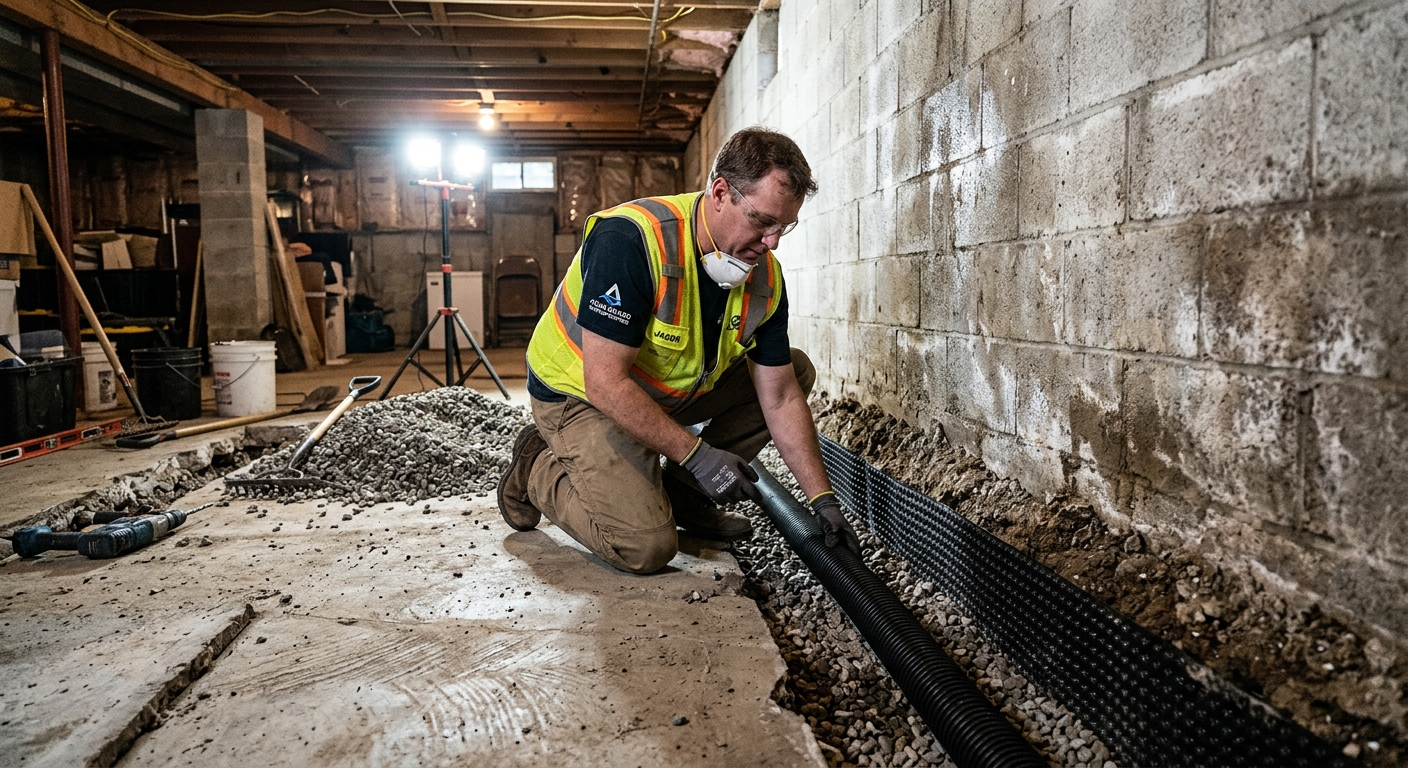
Basement waterproofing options and costs in Armstrong
Basement waterproofing in Armstrong usually starts with a site assessment, because the Thompson–Okanagan’s semi-arid valleys can still produce sudden, damaging water events. Even when rainfall isn’t constant, spring snowmelt and heavy storms can push water sideways against foundation walls—then freeze-thaw cycles widen cracks and turn “seepage” into active leakage. For homeowners, that matters because Armstrong’s housing profile skews older: 42.7% of homes were built before 1981 (Statistics Canada, 2021 Census). In practice, those homes are more likely to have aging exterior drainage details and older weeping tile that no longer performs, plus jointing and mortar that don’t forgive freeze-thaw as well as newer assemblies.
Costs are also shaped by regional soil and contractor access. In many parts of the Thompson–Okanagan, glacial and alluvial deposits can create mixed profiles of sand, silt, and pockets of clay. Clay pockets hold water longer and increase lateral pressure, which often forces more extensive drainage corrections. On top of that, 83.5% of households in Armstrong are homeowners (Statistics Canada, 2021 Census), so demand is steady, but excavation scheduling can vary when multiple trades need the same access (and when decks, landscaping, or older drains must be carefully removed). If you’re seeing slab-edge dampness or cold-joint moisture, for example along older residential strips near the Armstrong downtown / heritage core and surrounding older neighbourhoods, interior perimeter drainage may help—but it may only be a partial fix if the exterior water path is still active.
The comparison below shows common approaches, what they target, and the typical price ranges used in Armstrong for budgeting.
| Method |
What It Addresses |
Disruption Level |
Durability |
Price Range |
| Exterior excavation + new membrane + drainage tile |
Stops bulk water at the source by rebuilding the outer waterproofing system and improving drainage to daylight or an approved discharge point |
High (excavation, removal/reinstatement of landscaping, concrete/asphalt where present) |
Highest (long-term exterior system with proper backfill and drainage) |
$18,000–$40,000 |
| Interior perimeter drain channel + sump pit |
Collects and removes water after it enters the foundation; reduces hydrostatic pressure at the interior surface |
Medium (demo at slab perimeter/walls, sump installation, cleaning and sealing) |
High (depends on sump reliability and how well water is captured) |
$9,000–$22,000 |
| Foundation crack injection (epoxy or polyurethane) |
Seals cracks; epoxy for non-moving structural cracks and polyurethane for active leaks |
Low to Medium (access to crack line; interior or localized exterior may be needed) |
Medium to High (best when paired with correct drainage and crack movement assessment) |
$800–$3,500 |
| Sump pump installation (primary + battery backup) |
Prevents water accumulation during peak seepage; battery backup helps during power disruptions in spring storm periods |
Low to Medium (pit and discharge routing; minor concrete/surface patching) |
High (when sized correctly and maintained) |
$2,500–$5,500 |
| Window well drain installation |
Controls localized water pooling near egress window areas, reducing seepage and freeze-thaw damage |
Low to Medium (window well access; backfill and surface reinstatement) |
Medium to High (depends on outlet/discharge and grading) |
$1,200–$3,200 |
| Lot re-grading / downspout extension |
Moves roof and surface water away from the foundation to reduce the amount reaching the wall line |
Low to Medium (soil reshaping; sometimes minor deck/step adjustments) |
Medium (effective when drainage is the main cause and existing pipes aren’t failing) |
$2,000–$7,000 |
Prices are estimates only and vary by project scope, site access and material selection.
What affects the price of waterproofing in Armstrong
In Armstrong and across the Thompson–Okanagan, you can see the same “waterproof the basement” request land 30–50% apart between quotes. The big reason isn’t brand—it’s site conditions and how far a contractor must go to remove the water path. In different parts of British Columbia, the soil profile, local water table pockets, and freeze-thaw intensity change what it takes to keep water from pushing through. National averages can’t fully capture this, because local crews must design around whether water is freely draining or held in clay/silt pockets.
Three local drivers separate Thompson–Okanagan costs from the national average. First is soil type: clay expands more during freeze-thaw and can exert higher lateral pressure. Second is water table / seepage behaviour: even if Armstrong isn’t “high water table everywhere,” localized pockets can raise sump run times and increase required drainage capacity. Third is freeze-thaw: repeated cycles widen existing joints, especially where older foundations have minor offsets, turning slow dampness into active leaks after a couple of seasons.
Here are concrete Armstrong examples that change price quickly. A home with older weeping tile (often 60+ years in pre-1981 builds) may require exterior excavation—pushing you toward the $18,000–$40,000 exterior band—because interior-only work can’t replace a failed exterior drainage outlet. In contrast, a poured-concrete wall with a limited number of non-moving hairline cracks might be resolved with crack injection and perimeter sealing, often within the $800–$3,500 crack repair band (if active inflow isn’t coming from a higher water path). Finally, tight landscaping, decks, and driveways in older neighbourhood blocks can add disposal and reinstatement time to exterior scopes, while homes with easier access can come closer to the lower end of the range.
| Price Factor |
Why It Matters |
Cost Impact |
| Interior vs. exterior approach — interior is less disruptive but addresses symptoms |
Interior systems manage water after entry; exterior addresses the source by changing how water contacts and drains from the foundation |
Interior often saves upfront money, but can cost more long-term if exterior drainage is the root cause |
| Foundation type — poured concrete vs. block vs. stone vs. ICF |
Different materials crack and leak differently; block and stone typically need more attention to joints and interior capture |
Poured concrete may seal with targeted injection; block/stone frequently needs interior drainage add-ons |
| Soil type — clay expands more than sand, adding pressure |
Clay pockets can hold water and increase lateral pressure against walls during freeze-thaw |
Clay-heavy sites tend to require more drainage correction and larger sump capacity |
| Crack type and length — hairline vs. structural horizontal cracks |
Hairline cracks often respond to sealing; structural or horizontal cracks can indicate movement and need engineering direction |
Complex crack patterns usually increase labour time, materials, and testing |
| Sump pump backup system — battery or water-powered backup needed |
Backup reduces risk during outages when spring storms spike seepage |
Adding backup can increase total cost but often prevents repeat emergency calls |
| Access — landscaping, decks, or driveways must be removed for exterior |
Exterior excavation requires room for equipment and safe trenching, plus reinstatement |
Hardscape removal/replacement can swing a project price substantially |
| Weeping tile age — original tile (60+ years) may be completely failed |
Original tile may be crushed, clogged, or disconnected, causing water to back up at the foundation |
If replacement is needed, scopes commonly move toward the exterior excavation band |
| Mould or efflorescence remediation required before sealing |
Sealers and membranes won’t perform well over contaminated or unstable surfaces |
Pre-treatment adds time and materials and may require additional containment |
Permits & regulations in British Columbia
In British Columbia, foundation excavation, structural crack repair, and changes to lot drainage typically require a building permit. That often includes work that alters how water is directed from the property (for example, modifying discharge routing for drainage tile or changing grades around the foundation). Sump pump installations also commonly require municipal approval when the discharge connects to storm or sanitary systems, or when the discharge path must be altered to meet local requirements. For structural crack repair—particularly horizontal cracks in block walls or major step cracks—an assessment by a structural engineer is often required to determine whether underpinning, partial structural repair, or other measures are needed before sealing.
From a homeowner standpoint in Armstrong, the practical step is to verify the contractor can support these requirements. Ask whether they will pull the permit (if applicable) and whether their permit process includes any required engineering sign-offs. Also confirm they carry liability insurance and WSIB/WCB coverage (or the appropriate coverage for the contractor’s work type). For structural repairs, ask if they provide engineering support on their team or coordinate directly with an engineer you can review.
To verify, check three items: (1) their business and contractor licensing details through the appropriate BC registry online, (2) a current certificate of insurance for liability and proof of workers’ coverage, and (3) any permit/engineering clearance letter they provide for structural scope items. If they can’t show current paperwork before starting, that’s a red flag—waterproofing is not a “guess and patch” trade, especially where cracks suggest possible movement.
Interior vs exterior waterproofing — what does Armstrong need?
Exterior waterproofing and interior waterproofing solve different problems. Exterior waterproofing involves full excavation, surface preparation, new membrane, and new drainage tile/backfill. It’s the most complete way to address the source of water entry, but it’s disruptive and more expensive because excavation and reinstatement are unavoidable. Interior waterproofing typically uses a perimeter drain channel, sump pit, and sump pump to collect water after it enters the foundation. It generally costs less and causes less landscape disruption, but it does not stop hydrostatic pressure from acting on the foundation wall; it manages it.
In Armstrong’s Thompson–Okanagan conditions, the right choice often depends on how water is getting in. Where homes have older drainage details, mixed sand/silt with clay pockets, and visible seepage along slab edges or cold joints, the water path may be coming from outside the foundation line. In that scenario, exterior work is more likely to be justified—especially when older weeping tile is compromised—often aligning with the $18,000–$40,000 exterior excavation band. If your basement is only showing localized dampness, efflorescence, or a limited number of active cracks—and the rest of the exterior system is functioning—an interior perimeter drain and sump approach can be a good fit, typically within the $9,000–$22,000 interior band.
Foundation material matters too. Poured concrete walls often respond better to targeted crack injection, particularly when cracks are non-moving or can be stabilized. Block foundations frequently benefit from interior drainage because water can travel through block voids and mortar joints, making interior capture a practical complement to crack sealing. Also consider sump pump backup: spring storms can trigger power interruptions just when seepage peaks, so backup systems can prevent repeat flooding and odours.
Example: if you have a short crack run and no exterior drainage signs, paying for crack injection plus interior sealing may cost a few thousand and avoid a large excavation. But if you’re replacing failing weeping tile or correcting a long exterior water path, the extra investment is usually justified because it reduces the chances you’ll re-open interior work after one or two wet seasons.
| Method |
Best For |
Addresses Source? |
Disruption |
Lifespan |
Price Band |
| Full exterior excavation + membrane |
Widespread seepage, failing weeping tile, active external water path, or repeated interior flooding |
Yes (builds the outer waterproofing/drainage system) |
High |
Long-term when backfill and drainage are done properly |
$18,000–$40,000 |
| Interior French drain + sump system |
Interior dampness/seepage, slab-edge moisture, and homes where exterior access is limited |
No (captures water after entry) |
Medium |
Long-term with correct pump sizing and maintenance |
$9,000–$22,000 |
| Crack injection — epoxy (structural) |
Non-moving cracks in poured concrete or stable cracks needing sealing |
No (seals the opening, but relies on drainage to reduce pressure) |
Low |
Medium to long-term if cracks are stable |
$800–$3,500 |
| Crack injection — polyurethane (active leak) |
Active seepage where cracks are allowing water through |
No (treats the leak path through the crack) |
Low to Medium |
Medium to long-term when paired with drainage controls |
$1,000–$4,200 |
| Interior drain channel only (no sump) |
Light seepage with reliable gravity discharge opportunities |
No |
Medium |
Moderate (performance depends on slope/discharge and rainfall peaks) |
$6,000–$14,000 |
| Re-grading + downspout extensions |
Surface water and roof runoff issues when drainage around the foundation is the main cause |
Partially (reduces water reaching the foundation line) |
Low to Medium |
Moderate (can’t fix failed weeping tile or blocked drains) |
$2,000–$7,000 |
How to choose a waterproofing contractor in Armstrong
Start by confirming your waterproofing contractor’s credentials in British Columbia, then verify the insurance that protects you during demolition. Licensing requirements can vary by scope, but you should still be able to provide proof of business registration/licence and current insurance. For liability insurance, ask for a certificate that lists you/your property as additionally insured where possible, and confirm coverage limits are appropriate for excavation and concrete work. For WSIB/WCB coverage, ask for proof of workers’ compensation coverage for the workers who will be on site—don’t accept “we have someone insured” as an answer. If a contractor can’t produce these documents before starting, walk away.
Next, get 2–3 itemised written quotes, not a single lump sum. You want a labour + materials breakdown showing: excavation/disposal (if exterior), membrane/drainage components, sump pit and discharge details (if applicable), crack injection type and crack footage/linear metres, and surface reinstatement. Read exclusions: is permit pulling included, is engineering required included (if cracks suggest movement), and is hauling/disposal included for removed concrete/asphalt and unsuitable backfill? Make sure the quote states who provides the product data sheets and whether the warranty is workmanship-only or product + workmanship.
On warranty, ask for the workmanship warranty length and confirm whether it transfers if you sell the home. For payment schedule, never pay more than 10–15% upfront; hold back a portion until key milestones are complete (for example, before backfill and after final discharge checks). Finally, insist on a written timeline with a start date and completion estimate—waterproofing schedules can slip, but vague promises lead to stalled basements and open excavations in our freeze-thaw seasons.
- Ask for itemised scope: what’s included for excavation, disposal, membrane, drainage tile, and reinstatement
- Confirm crack injection type (epoxy vs polyurethane) is chosen based on active vs stable crack behaviour
- Require photos of foundation prep and inspection points before backfill or sealing
- Verify liability insurance certificate and adequate coverage limits
- Verify WSIB/WCB coverage for workers on site
- Ask who pulls any required BC permits and whether timelines include permit approval
- Confirm sump pump sizing assumptions and whether backup power is included if requested
- Request warranty details in writing (workmanship length, product coverage, transferability)
- Check discharge plan: where water goes, and whether discharge routing is to an approved location
- Confirm disposal is included for any concrete/asphalt removal and unsuitable soil
- Review payment schedule: keep upfront to 10–15%, use holdback tied to milestones
- Get start date and completion estimate in writing, plus weather/freeze contingency language
Red flags we see around Armstrong: contractors who won’t walk you through a site moisture/entry-path assessment; quotes that skip whether weeping tile is functioning or only offer “interior sealing” without addressing exterior drainage; no proof of insurance/WSIB/WCB before mobilization; product-only warranties with no workmanship coverage; and payment terms that demand large upfront deposits or refuse milestone-based holdback.
Frequently asked questions — waterproofing in Armstrong
How does Armstrong's soil affect my foundation?
In Armstrong, soil conditions in the Thompson–Okanagan can be mixed—often sand/silt with localized clay pockets—thanks to glacial and alluvial deposits. Clay pockets are the big issue because they can hold water longer and push back against foundations during spring melt and heavy rain events. Then freeze-thaw cycles can widen existing joints and cracks, increasing seepage over a few seasons. If your foundation is older (and 42.7% of homes in Armstrong were built before 1981 per Statistics Canada, 2021 Census), it’s also common to see older drainage details and weeping tile that may be partially failed. That combination is why two homes on the same street can have very different waterproofing needs and budgets.
Do I need a permit for foundation work in British Columbia?
Often, yes. In British Columbia, foundation excavation, structural crack repair, and changes that alter lot drainage typically require a building permit. Sump pump work may also require municipal approval if discharge connects to municipal storm or sanitary systems or if discharge routing changes from what’s currently approved. For structural crack situations (such as major horizontal cracks in block walls), an engineer’s assessment is frequently needed before sealing or any underpinning-type work. For a homeowner in Armstrong, the simplest check is to ask the contractor to state which permits they will pull (or confirm they are not required for the specific scope) and to show you their process in writing before starting. This is one reason “cheap” quotes can end up costing more.
How long does waterproofing last?
Longevity depends on whether you solved the water entry path or only managed water after it enters. Exterior waterproofing systems—when done with proper membrane, correct drainage tile installation, and good backfill—are designed for long service life, but they still require periodic maintenance of discharge outlets (like ensuring downspouts and surface drainage stay clear). Interior systems typically last well when the sump is correctly sized and maintained, and when backup power is available for peak wet periods. Crack injection can last many years when the crack is stable, but if the crack is actively moving due to pressure from clay-heavy soils or poor drainage, you can see recurring leaks. In Armstrong, with freeze-thaw cycles, it’s common for short-term “sealing only” to be less durable than source-focused repairs.
Can I waterproof my basement from the inside only?
Often you can manage seepage from the inside, especially when the leak is localized and you don’t have easy exterior access. Interior perimeter drains, a sump pit, and sealing can reduce water accumulation and improve basement comfort. But interior-only solutions don’t stop hydrostatic pressure from acting on the foundation wall. In Armstrong’s Thompson–Okanagan context—where clay pockets can hold water longer and older weeping tile may be failed—interior-only work can sometimes become a “repeat maintenance” scenario if the exterior water path remains active. If your quotes are only discussing an interior drain and sump, ask whether they assessed exterior drainage/weep tile function and whether mould or efflorescence remediation is needed before sealing.
What causes foundation cracks in Armstrong?
Common causes in Armstrong include freeze-thaw movement (widening small gaps over time), soil expansion in clay pockets, and long-term settlement effects—especially in older homes. If 42.7% of Armstrong homes were built before 1981 (Statistics Canada, 2021 Census), older foundation details may be more susceptible to joint deterioration and drainage failure. Poor lot grading, clogged downspouts, or failing exterior weeping tile can also increase moisture around the foundation, which accelerates cracking. The key question isn’t only “why is there a crack,” but “is it moving?” That affects whether an epoxy (for stable cracks) or polyurethane (for active leaks) approach is appropriate, and whether you should involve a structural engineer.
How do I compare waterproofing quotes?
Compare quotes line-by-line. Make sure each quote describes the same scope: exterior excavation vs interior drain and sump, the chosen crack injection product (epoxy vs polyurethane), sump discharge route, and whether backup power is included. Also compare disruption and reinstatement: excavation often pushes you into the $18,000–$40,000 exterior range, while interior perimeter drainage and sump work commonly falls within the $9,000–$22,000 band. Crack repair-only can look small (often around the $800–$3,500 range), but only if the crack is stable and the water entry path is addressed. Finally, verify permit responsibility, disposal, and warranty transferability in writing. The best quote is usually the one that matches the actual failure mechanism—not the lowest number.