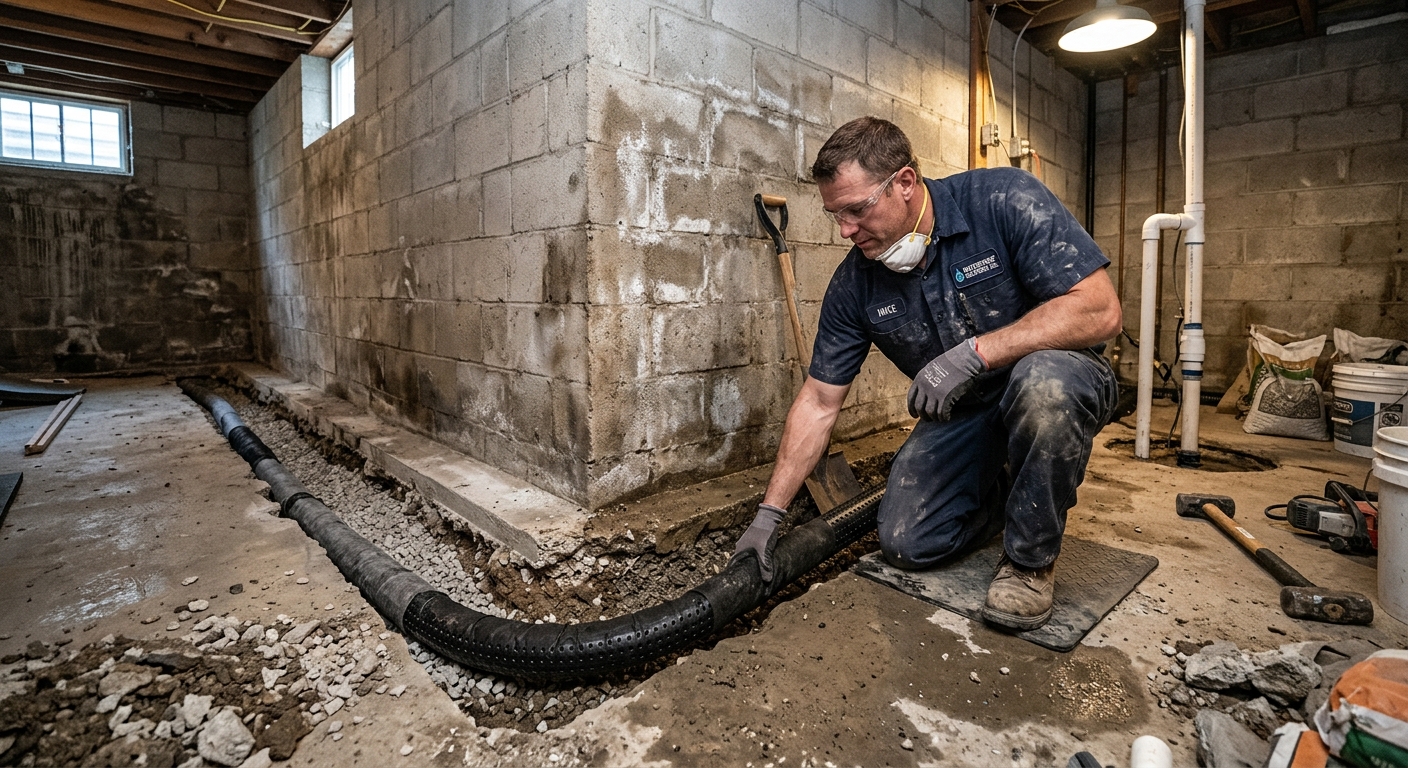
Basement waterproofing options and costs in Dufferin
Dufferin homeowners typically choose between exterior waterproofing and interior drainage based on where the water is entering and how long the moisture has been building up. Dufferin has a small population (2,783 residents, Statistics Canada, 2021 Census), but the Lower Mainland–Southwest market still sees steady demand because foundation drainage failures are common as homes age. In older neighbourhood pockets around the Town of Dufferin area (and nearby rural lots), original tar-and-paper type approaches and early generations of weeping tile often fall out of service, while modern fixes must contend with saturated backfill and hydrostatic pressure. That matters because in coastal BC, groundwater and prolonged rainfall can keep pressure on basement walls and slab edges even when the visible seepage looks “manageable.”
Pricing is also shaped by access constraints—tight lots, landscaping, and driveways—and by excavation conditions where contractors may need mechanical breaking. Freeze-thaw in British Columbia can widen existing joints and cracks, making some “minor” leaks turn into persistent seepage. For many properties, especially where perimeter drainage is undersized or missing, interior retrofits alone can become a recurring maintenance cycle rather than a long-term solution.
Below is a practical cost comparison for common waterproofing scopes you’ll see quoted in Dufferin. Use it as a starting point, then match the method to your foundation type and active water path before comparing contractor proposals.
| Method |
What It Addresses |
Disruption Level |
Durability |
Price Range |
| Exterior excavation + new membrane + drainage tile |
Source water entry by rebuilding the perimeter waterproofing system and drainage |
High (excavation, backfill, landscaping restoration) |
Long-term (typically best-performing when installed to full perimeter) |
$15,000–$30,000 |
| Interior perimeter drain channel + sump pit |
Captures seepage after it enters; reduces hydrostatic pressure inside the basement |
Medium (interior floor/footing access, sump discharge routing) |
Good (depends on crack condition and discharge reliability) |
$8,000–$18,000 |
| Foundation crack injection (epoxy or polyurethane) |
Seals non-moving cracks (epoxy) or active leaks (polyurethane) |
Low (localized drilling and sealing) |
Moderate to long-term when the water path is correctly identified |
$500–$2,000 |
| Sump pump installation (primary + battery backup) |
Manages collected water and protects during outages or pump failures |
Low to medium (pit, piping, electrical work) |
High when paired with an interior drain and backup |
$1,000–$5,000 |
| Window well drain installation |
Controls water pooling around egress/well areas and prevents seepage into the basement |
Medium (well excavation, grating/drain tie-in) |
Good (site grading and discharge routing are critical) |
$2,000–$6,500 |
| Lot re-grading / downspout extension |
Reduces surface water infiltration at the foundation |
Low to medium (minor excavation and drainage work) |
Variable (best as a complement to drainage and sealing) |
$1,500–$5,000 |
Prices are estimates only and vary by project scope, site access and material selection.
What affects the price of waterproofing in Dufferin
In Dufferin and throughout the Lower Mainland–Southwest, two quotes for the “same” basement leak can differ by 30–50% because the underlying cause is often not the crack you can see—it’s the water pressure, drainage capacity, and how complete the drainage system is. Labour rates and excavation complexity are higher here than in many parts of Canada, and contractors often have to work around landscaping, decks, and tight setbacks. That’s why your region’s costs can sit above the national average even when the materials look similar on paper.
The three biggest drivers that separate Lower Mainland–Southwest pricing from the national average are soil/water conditions, water table, and freeze-thaw. First, soil type influences how much lateral movement pressure develops at the foundation. Clay-heavy soils in other regions can expand dramatically with freeze-thaw, but in the Lower Mainland the cost penalty more often comes from persistent saturation of soils and backfill. Second, higher groundwater tables increase sump run times and require stronger drainage design—pumping and discharge details matter. Third, wet, mild winters with freeze-thaw cycles widen joints and accelerate crack growth, so repairs that rely on sealing without drainage can fail sooner.
Concrete examples in Dufferin: if your perimeter drain (weeping tile) is 60+ years old and partially collapsed, replacing exterior excavation and the drainage line pushes you toward the $15,000–$30,000 range. If the water is mostly entering at a few interior corners and the slab is otherwise sound, an interior perimeter drain plus sump system can often stay in the $8,000–$18,000 band. Where you add backup pumping, the sump portion can jump further, especially when electrical routing is constrained.
| Price Factor |
Why It Matters |
Cost Impact |
| Interior vs. exterior approach — interior is less disruptive but addresses symptoms |
Exterior targets the water entry point; interior manages water after entry |
Exterior often costs ~2x or more of interior for comparable leakage |
| Foundation type — poured concrete vs. block vs. stone vs. ICF |
Different materials behave differently with crack movement and sealing methods |
Block/stone frequently needs interior drainage emphasis; poured walls may suit injection |
| Soil type — clay expands more than sand, adding pressure |
Movement during freeze-thaw can stress repaired joints and seals |
Higher risk of repeat cracks increases labour and monitoring |
| Crack type and length — hairline vs. structural horizontal cracks |
Structural or horizontal cracks may indicate movement that needs engineering |
Complex repairs can add assessment and potentially underpinning coordination |
| Sump pump backup system — battery or water-powered backup needed |
Protects against prolonged outages during spring storms and power interruptions |
Often adds several thousand dollars depending on backup approach |
| Access — landscaping, decks, or driveways must be removed for exterior |
Restoration requirements expand scope and crew time |
Can swing exterior jobs upward when demolition/rebuild is required |
| Weeping tile age — original tile (60+ years) may be completely failed |
Complete failure typically requires full replacement, not patching |
Drives you toward higher exterior excavation pricing |
| Mould or efflorescence remediation required before sealing |
Sealers need clean, dry surfaces; active moisture and contamination can spread |
Adds prep time and sometimes separate remediation scope |
Permits & regulations in British Columbia
In British Columbia, certain foundation and drainage changes can require a building permit, especially when work affects structural components or alters how water is managed on the lot. Typically, foundation excavation near the footing, structural crack repairs, underpinning, and any changes to lot drainage that could impact drainage pathways or discharge plans often require municipal review through the building permit process. If you’re adding or modifying a sump system that connects into a storm or sanitary service, you should expect municipal approval before discharge is made.
For structural crack repair—such as horizontal cracks in block walls, major step cracks, or cracks accompanied by bulging—an engineer’s assessment is often required. That assessment determines whether the crack is “active movement” versus a passing leak, which then dictates whether you can simply seal it or whether structural work is needed.
To verify a contractor’s compliance in Dufferin (and across BC), ask for three items and check them before signing: (1) proof of the contractor’s licence or registration as applicable to the trade they perform; (2) a certificate of liability insurance showing adequate coverage; and (3) evidence of WSIB/WCB coverage for workers. If the work needs engineered sign-off, ask whether they carry engineering support or a direct relationship with an engineer, and request that the engineer’s involvement is included in the scope. If they won’t provide documentation, request it in writing or move on.
Interior vs exterior waterproofing — what does Dufferin need?
The fundamental difference is straightforward: exterior waterproofing, which involves full excavation, new membrane, new drainage tile, and backfill, addresses the source of water entry. It’s the most complete approach, but it costs more and causes landscape disruption. Interior waterproofing—typically a perimeter drain channel, sump pit, and sump pump—manages water after it enters and reduces internal hydrostatic pressure. It’s less invasive, but it doesn’t stop water from reaching the wall in the first place.
In Dufferin, the Lower Mainland–Southwest climate pushes many basements toward comprehensive water management. Mild, wet winters keep soils saturated, and freeze-thaw can keep expanding existing cracks and joints. If your foundation walls are poured concrete and the crack pattern is stable, crack injection (especially for non-moving cracks) paired with interior drainage may be cost-effective. If you have a block foundation or repeated seepage at mortar joints, interior perimeter drainage becomes a practical complement—often because water pathways don’t always stop with injection alone.
Power reliability is also part of planning. During spring flooding periods in BC, sump pumps can run continuously and occasional outages happen—so backup systems can be worth the incremental cost. For a real example: if exterior work is quoted around $15,000–$30,000 because full perimeter excavation is needed, but your leak is localized and the slab edge is accessible, an interior system in the $8,000–$18,000 band may be justified as a first step. However, if the exterior drainage is fully failed or discharge is incorrect, interior-only solutions may become a short-to-medium-term fix rather than a permanent one.
| Method |
Best For |
Addresses Source? |
Disruption |
Lifespan |
Price Band |
| Full exterior excavation + membrane |
Widespread seepage, failing perimeter drains, or chronic hydrostatic pressure |
Yes |
High |
Long-term (when full system is rebuilt correctly) |
$15,000–$30,000 |
| Interior French drain + sump system |
Active seepage, saturated backfill effects, or limited exterior access |
No (manages water after entry) |
Medium |
Good to long-term with properly sized discharge and backup |
$8,000–$18,000 |
| Crack injection — epoxy (structural) |
Non-moving cracks in poured concrete where leakage is controlled |
Partially (seals crack path) |
Low |
Moderate to long-term when crack is truly stable |
$500–$2,000 |
| Crack injection — polyurethane (active leak) |
Active leaks or water flow through cracks (hydrophobic sealing) |
Partially (stops leak path) |
Low |
Moderate (best when combined with drainage plans) |
$500–$2,000 |
| Interior drain channel only (no sump) |
Light seepage where gravity drainage/discharge is reliable |
No (captures water after entry) |
Medium |
Shorter if hydrostatic pressure overwhelms capacity |
$6,000–$12,000 |
| Re-grading + downspout extensions |
Surface-water related dampness, clogged downspouts, or minor seepage |
Helps (reduces water reaching the foundation) |
Low to medium |
Variable; works best with sealing and drainage |
$1,500–$5,000 |
How to choose a waterproofing contractor in Dufferin
Choosing the right contractor matters as much as the method. Start by verifying BC compliance: request proof of liability insurance (certificate of insurance naming the project owner or showing adequate limits), and evidence of WSIB/WCB coverage for their workers. If the contractor is using subcontractors, ask whether they manage coverage for everyone on site. Next, verify their licensing/registration for the trade scope they are performing—especially when structural repairs, excavation, or electrical tie-ins are involved.
Get 2–3 itemised written quotes. You want line items for labour and materials (membrane type, drainage tile size, sump pump model, piping route, disposal, and labour hours), not a single lump sum. Read exclusions: confirm whether permits are included, whether excavation includes mechanical breaking when needed, and whether landscaping restoration is included or only “topsoil and seed.” Ask whether they will dry out and address mould or efflorescence before sealing, because sealing over moisture often leads to failure.
Warranty is non-negotiable. Ask for a workmanship warranty length, product/manufacturer warranties (and what triggers them), and whether coverage is transferable if you sell the home. For payment, use a schedule that keeps upfront payments around 10–15% and includes a holdback until the job is complete and inspected. Finally, confirm a written timeline with a start date and estimated completion—waterproofing materials and drying conditions depend on weather, so unclear scheduling can impact performance.
- Request BC documentation: licence/registration, liability insurance certificate, and WSIB/WCB coverage proof before work starts.
- Confirm who is responsible for permits (and whether permit fees are included).
- Ask for an itemised quote: materials, labour, excavation scope, discharge routing, and restoration.
- Verify disposal/haul-away is included for excavated soil and old drainage materials.
- Insist on a site plan showing where drainage lines, sump pit, and discharge go.
- Ask how they handle active leaks and whether they test crack stability before injection.
- Confirm sump pump details: primary model, discharge pipe size, and backup option.
- Require specific warranty terms in writing (workmanship and product coverage).
- Check references for nearby Lower Mainland–Southwest basements, not just distant projects.
- Ask what they do about mould/efflorescence before applying any sealants or membranes.
- Understand restoration: what landscaping is included and what is excluded (patios, decks, driveways).
- Use milestone-based payment: small deposit, then payments tied to completion steps with a holdback.
Concrete red flags in Dufferin include: quotes that avoid mentioning discharge routing or sump pump specifications, refusing to provide insurance/WSIB/WCB documentation, proposing interior-only drainage for a basement with failed perimeter drainage without explaining why, “one-size-fits-all” crack injection with no crack assessment, and skipping written scopes for permits, disposal, and restoration.
Frequently asked questions — waterproofing in Dufferin
How do I know if a foundation crack is serious?
In Dufferin and across BC’s Lower Mainland–Southwest, a crack can be “active” even if it looks similar year to year, especially when freeze-thaw and wet seasons keep joints stressed. Watch for signs like horizontal or stair-step cracking, widening after heavy rain, dampness that returns quickly after patching, or visible mortar separation in block walls. If you see any bulging, listen for popping sounds, or notice water tracking along the wall, treat it as potentially structural. A credible contractor will assess crack orientation, measurement over time, and whether injection is appropriate. If the crack suggests movement, they should recommend an engineer review before sealing—otherwise you may pay for repeat repairs.
How much does foundation crack repair cost in Dufferin?
Foundation crack repair in Dufferin usually falls into the $500–$2,000 band for localized injection work, assuming the crack length and accessibility are straightforward and the wall condition is otherwise stable. The cost can rise when there are multiple cracks, difficult access, or when prep work is required due to mould, efflorescence, or heavy water flow. In Lower Mainland–Southwest conditions, active leaks often call for polyurethane injection, and if water pressure is high you may also need an interior perimeter drain and sump to prevent recurring moisture. If the crack is structural or horizontal, expect additional assessment costs because engineering may be required.
Do I need a sump pump in Dufferin?
Many Dufferin basements do benefit from a sump pump, especially where groundwater and prolonged rainfall keep soils saturated. If you’re installing an interior perimeter drain channel, a sump pit is commonly used because it gives the system a reliable place to collect and remove water. Whether you need backup depends on your risk tolerance and basement usage; in British Columbia, wet spring periods can lead to long runtimes, and temporary power interruptions can turn a manageable leak into damage. Some homeowners choose primary plus battery backup if they have finished basements, valuable storage, or a history of outages during storm events. If the discharge route and grade are limited, a properly designed sump setup becomes even more important.
How does Dufferin's soil affect my foundation?
In Dufferin’s Lower Mainland–Southwest setting, soil issues often show up as persistent saturation rather than extreme seasonal swelling. That means water can stay in contact with foundation walls and slab edges longer, increasing hydrostatic pressure even during mild winter stretches. If original perimeter drainage (weeping tile) is failing or undersized, saturated backfill can overwhelm interior repairs that only “patch” cracks. Freeze-thaw cycles still matter: they widen joints and can accelerate deterioration of mortar lines and concrete surfaces. Soil and drainage conditions are why exterior systems (excavation, membrane, and new drainage tile) can land in the $15,000–$30,000 range when a complete perimeter rebuild is needed, while targeted interior retrofits often sit in the $8,000–$18,000 range when the source is limited or access is constrained.
Do I need a permit for foundation work in British Columbia?
In British Columbia, you often need a building permit for foundation excavation, structural crack repairs, and drainage changes that alter how water is handled on the property. If you’re modifying discharge, connecting sump discharge to services, or doing work near footings, it’s especially likely the municipality will require review. Structural cracks (for example, major step or horizontal cracking in block walls) may require an engineer’s assessment to determine whether underpinning or structural interventions are needed before permits can be issued. Before you hire a contractor in Dufferin, ask who will pull the permit and confirm the contractor’s documentation. A reputable firm should clearly list permit responsibilities in the written scope.
How long does waterproofing last?
“How long” depends on the method and the cause of the water. Exterior waterproofing rebuilt as a full perimeter system—membrane plus properly sized and routed drainage tile—typically delivers the most durable outcome when installed correctly and connected to an appropriate discharge path. Interior systems generally last well too, but performance depends on sump capacity, backup planning, and whether water entry pathways keep overwhelming the setup. For example, localized crack injection in the $500–$2,000 band can perform for many years when the crack is stable and prep is done right, but active leaks under ongoing hydrostatic pressure may require an interior drainage plan. In BC’s wet, mild winters with freeze-thaw cycles, expect a longer lifespan when waterproofing is paired with correct lot grading and functional downspouts.